
Kanji you already know, meanings you don't
The shared script makes you fast, but it also makes you confident in the wrong places. When a kanji word looks familiar, your brain fills in the Chinese meaning before you have checked. Most of the time that is correct. Sometimes it is quietly wrong, and the error only shows when a Japanese friend looks puzzled.
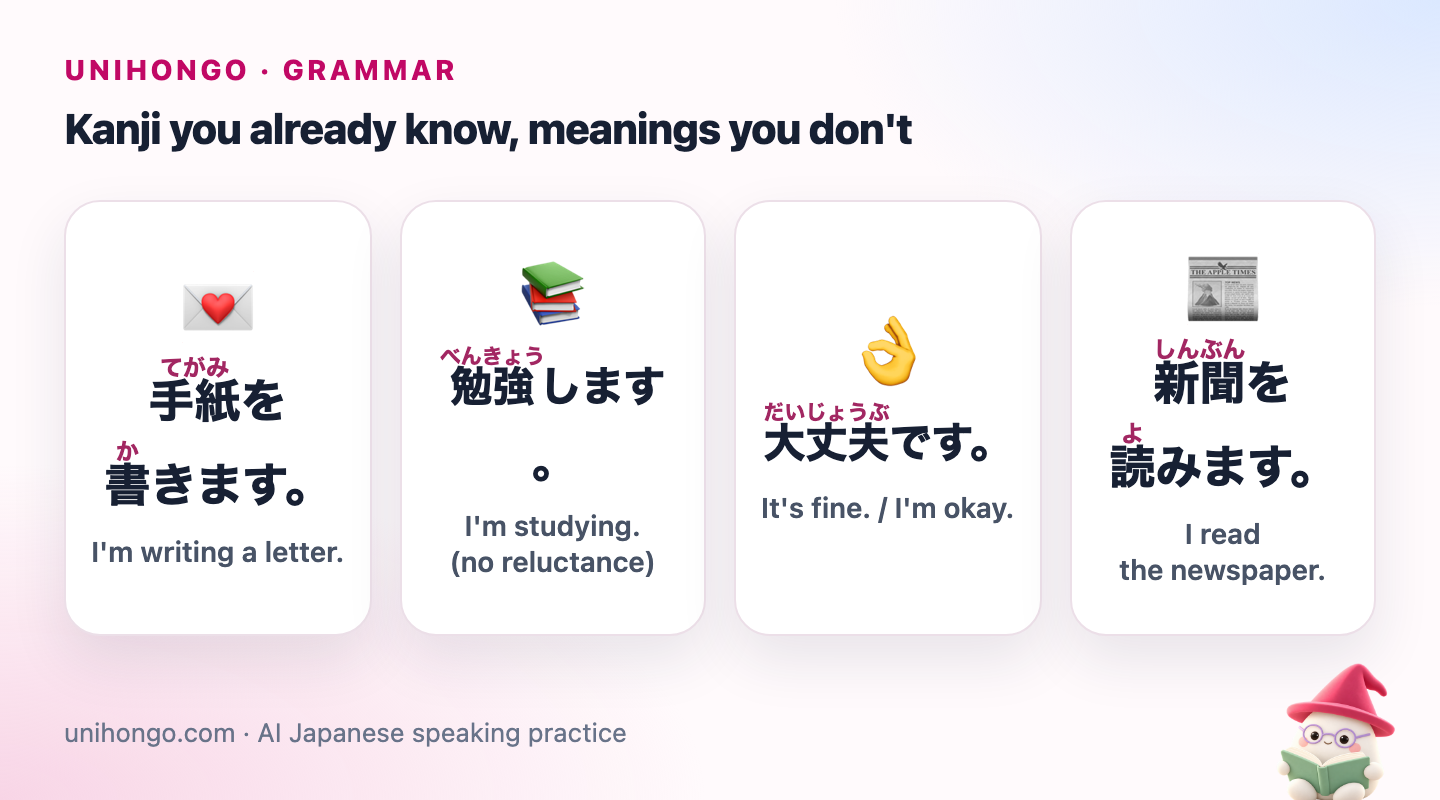
These four words are the famous ones. Each card gives the Japanese meaning; the trap is the meaning your Chinese suggests.
| Japanese | Romaji | Meaning |
|---|---|---|
| 手紙を書きます。 | Tegami o kakimasu. | I'm writing a letter. |
| 勉強します。 | Benkyō shimasu. | I'm studying. (no reluctance) |
| 大丈夫です。 | Daijōbu desu. | It's fine. / I'm okay. |
| 新聞を読みます。 | Shinbun o yomimasu. | I read the newspaper. |
False friends worth a second look
Here is a longer list. The middle column gives the meaning most Mandarin speakers would expect from the characters; meanings can differ in other varieties of Chinese and between regions. The last column is what a Japanese speaker means.
| Japanese | Romaji | Meaning |
|---|---|---|
| このかばんは丈夫です。 | Kono kaban wa jōbu desu. | This bag is sturdy. |
| 駅まで走りました。 | Eki made hashirimashita. | I ran to the station. |
| 娘は高校生です。 | Musume wa kōkōsei desu. | My daughter is a high school student. |
| 今朝のニュースを見ましたか。 | Kesa no nyūsu o mimashita ka. | Did you see this morning's news? |
| Japanese word | Chinese reader may expect | Japanese meaning |
|---|---|---|
| 手紙 tegami | Toilet paper | A letter |
| 勉強 benkyō | Reluctantly, barely | Study |
| 大丈夫 daijōbu | A real man | Fine, okay, all right |
| 新聞 shinbun | News | A newspaper (news is nyūsu) |
| 汽車 kisha | A car | A steam train (car is kuruma) |
| 丈夫 jōbu | Husband | Sturdy, healthy |
| 走る hashiru | To walk | To run (walk is aruku) |
| 娘 musume | Mother | Daughter |
| 高校 kōkō | University | Senior high school |
| 先生 sensei | Mr, sir | Teacher, doctor |
Same idea, different kanji shape
Japanese simplified many characters after the Second World War, but not always in the same way as mainland Chinese. Learners who write in simplified Chinese often produce a Chinese form inside a Japanese sentence, and learners from Taiwan or Hong Kong may write the traditional one. In handwriting tests and on forms, this counts as a mistake.
The pairs to watch are common ones: Japanese 気 (air, spirit), not 气 or 氣; 図 (diagram), not 图; 発 (depart, emit), not 发; 広 (wide), not 广; 単 (single), not 单. Also note words that use different kanji altogether, such as 駅 for a station instead of 站, and 電車 for an electric train.
| Japanese | Romaji | Meaning |
|---|---|---|
| 天気がいいですね。 | Tenki ga ii desu ne. | Nice weather, isn't it? |
| 地図を見せてください。 | Chizu o misete kudasai. | Please show me the map. |
| 駅は広いです。 | Eki wa hiroi desu. | The station is big. |
The particle no is not Chinese de
Chinese de joins many kinds of descriptions to a noun: big de house, beautiful de room, my de book. Japanese no looks like the same word, so many Chinese speakers use it everywhere. But Japanese no only joins a noun to another noun: watashi no hon, Nihon no kuruma.
I-adjectives go directly before the noun with nothing in between: ōkii ie, atarashii hon. Na-adjectives take na: kirei na heya, yūmei na mise. Verbs in plain form also go directly before the noun: kinō katta hon. Adding no between them is one of the clearest signals of Chinese transfer.
| Japanese | Romaji | Meaning |
|---|---|---|
| 新しい本 | atarashii hon | Right: a new book |
| きれいな部屋 | kirei na heya | Right: a clean room |
| 有名な店 | yūmei na mise | Right: a famous shop |
| 日本の車 | Nihon no kuruma | Right: a Japanese car (noun + no) |
| 昨日買った本 | kinō katta hon | Right: the book I bought yesterday |
Wa and ga: Chinese has no direct match
Chinese does not mark the topic and the subject with separate particles, so wa and ga are new territory. A common strategy is to learn wa first and use it for every subject. That works in many simple sentences, which is why the habit survives, but it fails in three places.
First, question words such as dare, nani and doko cannot take wa as a subject; they take ga, and so does the answer. Second, inside a description before a noun, the subject takes ga: watashi ga tsukutta kēki, the cake I made. Third, when you report something new that just happened or that you see, such as rain starting, ga is natural: ame ga futte imasu.
| Japanese | Romaji | Meaning |
|---|---|---|
| 誰が来ましたか。 | Dare ga kimashita ka. | Who came? |
| 田中さんが来ました。 | Tanaka san ga kimashita. | Mr Tanaka came. |
| 私が作ったケーキです。 | Watashi ga tsukutta kēki desu. | It's the cake I made. |
| あ、雨が降ってきました。 | A, ame ga futte kimashita. | Oh, it's started raining. |
Wrong vs right: three quick checks
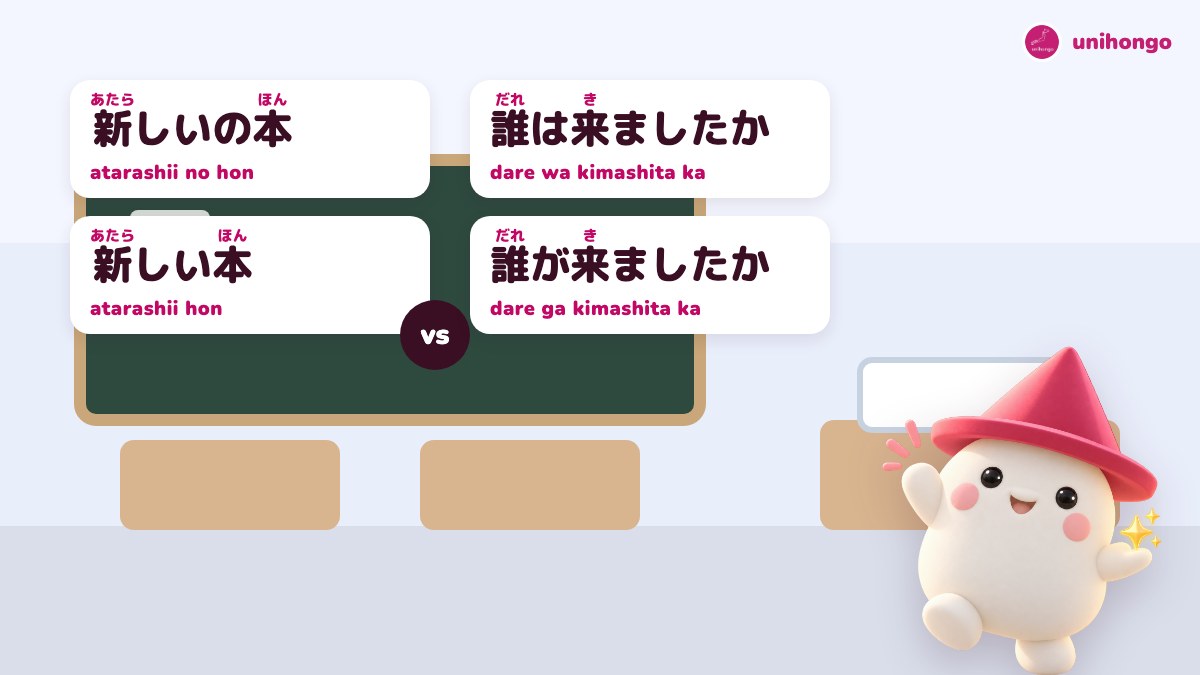
Before you send a message or hand in homework, run three checks: is there a no between an adjective and a noun, is there a wa after a question word, and is every kanji in its Japanese form? These three catch a large share of Chinese-influenced errors in writing.
| Japanese | Romaji | Meaning |
|---|---|---|
| 新しいの本 | atarashii no hon | Wrong: no after an i-adjective |
| 新しい本 | atarashii hon | Right: the adjective goes straight on |
| 誰は来ましたか | dare wa kimashita ka | Wrong: wa after a question word |
| 誰が来ましたか | dare ga kimashita ka | Right: question words take ga |
Tones, pitch and voiced sounds
Mandarin gives every syllable a tone. Japanese pitch accent only marks where the voice drops, and each beat stays level. When a falling fourth tone lands on Japanese syllables, the speaker can sound emphatic or annoyed. Try reading a sentence in a deliberately flat voice first, then add only one drop per word.
The other sound pattern is voicing. Mandarin separates sounds like b and p by a puff of air, aspiration, not by voicing. Japanese separates them by voicing: the vocal cords buzz on d, g and b, not on t, k and p. So many Mandarin speakers hear and say tenki, weather, and denki, electricity, as the same word. Put your fingers on your throat: you should feel a buzz on the d of denki. Some speakers from parts of southern and south-western China also mix n and l-like sounds, which affects Japanese n and r, as in nani and nari; if that is you, practise such pairs slowly.
| Japanese | Romaji | Meaning |
|---|---|---|
| 天気 | tenki | weather (t: no buzz) |
| 電気 | denki | electricity, a light (d: buzz) |
| 柿 | kaki | persimmon |
| 鍵 | kagi | key |
| 電気をつけてください。 | Denki o tsukete kudasai. | Please turn on the light. |
Mini dialogue: telling a friend about your weekend
A short chat with the fixes in place. Watch for adjective-noun pairs without no, ga after a question word, and the false friends used with their Japanese meaning.
| Japanese | Romaji | Meaning |
|---|---|---|
| 週末、何をしたの? | Shūmatsu, nani o shita no? | Friend: What did you do at the weekend? (casual) |
| 新しいカフェで勉強したよ。 | Atarashii kafe de benkyō shita yo. | You: I studied at a new café. |
| 誰が一緒だったの? | Dare ga issho datta no? | Friend: Who was with you? |
| 妹が来たよ。夜は母に手紙を書いた。 | Imōto ga kita yo. Yoru wa haha ni tegami o kaita. | You: My sister came. In the evening I wrote my mum a letter. |
| 手紙?すてきだね。 | Tegami? Suteki da ne. | Friend: A letter? That's lovely. |
Make the Japanese meaning win
- Type /create-flashcards in Mocchi's chat and list your false friends with their Japanese meanings. Pick a photo for each card, such as an envelope for tegami, so the picture replaces the Chinese meaning in your memory.
- Run /review-flashcards every day. The spaced repetition brings each card back just before you would forget it.
- Ask Mocchi to /explain any sentence where you are not sure whether to use no, na or nothing at all.
- Once a week, play Flashcard Flip on unihongo.com/games with your own flashcard deck, for quick recall under a little time pressure.