
The four orders you make at every meal
A meal out in Japan follows a script. You say how many you are, you order drinks, you order food, and you often order a little more. Each of those moments has its counter, and if you learn just these four lines you can already get through most visits to a casual restaurant or an izakaya.
Notice where the number goes. In Japanese the counted number usually comes after the thing and its particle: nama bīru o nihai, two draught beers, literally draught beer, two glasses. You can drop the o in fast speech, and many people do.
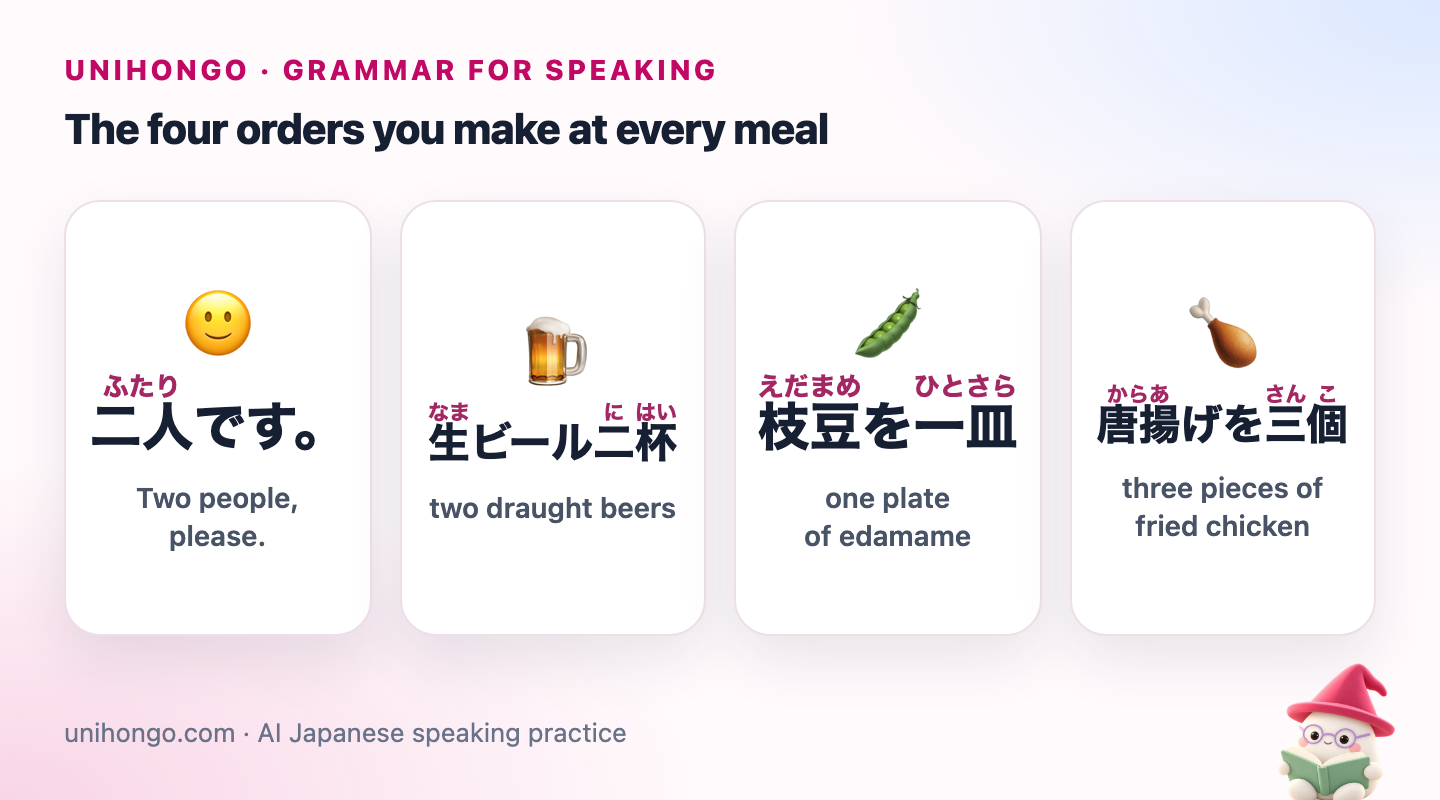
| Japanese | Romaji | Meaning |
|---|---|---|
| 二人です。 | Futari desu. | Two people, please. |
| 生ビール二杯 | nama bīru nihai | two draught beers |
| 枝豆を一皿 | edamame o hitosara | one plate of edamame |
| 唐揚げを三個 | karaage o sanko | three pieces of fried chicken |
At the door: 人 for you, 名 for the staff
The first question is always the size of your group. Staff speak to customers in polite service Japanese, so they use the formal counter 名 (mei) with the respectful suffix sama: nanmeisama desu ka, how many guests? You answer in plain polite Japanese with 人 (nin). The first two numbers are irregular, and four is yonin, never shinin, because shi sounds like the word for death.
Do not answer with nimei or nimeisama. Nimei is understandable on a reservation form or a phone booking, but sama would be honouring yourself, which sounds odd. Showing fingers while you speak is completely normal, and staff will often repeat the number back to confirm it.
| Japanese | Romaji | Meaning |
|---|---|---|
| いらっしゃいませ。何名様ですか。 | Irasshaimase. Nanmeisama desu ka. | Staff: Welcome. How many in your party? |
| 三人です。 | Sannin desu. | You: Three people. |
| あとから一人来ます。 | Ato kara hitori kimasu. | One more person is coming later. |
| 四人ですが、大丈夫ですか。 | Yonin desu ga, daijōbu desu ka. | We're four. Is that all right? |
| Number | 人 (what you say) | 名 (what staff say) |
|---|---|---|
| 1 | hitori | ichimei |
| 2 | futari | nimei |
| 3 | sannin | sanmei |
| 4 | yonin | yonmei |
| 5 | gonin | gomei |
| 6 | rokunin | rokumei |
| How many? | nannin | nanmei |
Drinks: 杯 for glasses, 本 for bottles
杯 (hai) counts anything served in a glass, cup, mug or bowl: beer, sake in a small cup, coffee, and also bowls of rice or soup. Its sound changes are worth practising aloud, because the h turns into p or b. 本 (hon) counts long, thin things, which in a restaurant means bottles, and it follows the same pattern of changes.
| Japanese | Romaji | Meaning |
|---|---|---|
| 生ビールを二杯ください。 | Nama bīru o nihai kudasai. | Two draught beers, please. |
| ウーロン茶を一杯お願いします。 | Ūron cha o ippai onegai shimasu. | One oolong tea, please. |
| 瓶ビールを一本ください。 | Bin bīru o ippon kudasai. | One bottle of beer, please. |
| ご飯をもう一杯いいですか。 | Gohan o mō ippai ii desu ka. | Could I have another bowl of rice? |
| もう一杯ください。 | Mō ippai kudasai. | Another one, please. |
| Number | 杯 (glasses, bowls) | 本 (bottles) |
|---|---|---|
| 1 | ippai | ippon |
| 2 | nihai | nihon |
| 3 | sanbai | sanbon |
| 4 | yonhai | yonhon |
| 6 | roppai | roppon |
| 8 | happai | happon |
| 10 | juppai | juppon |
| How many? | nanbai | nanbon |
Ippai has a second life as a word: it also means full or a lot, and Ippai nomō is a casual invitation, let's have a drink. Context makes it clear which you mean.
Food: 皿, 個 and the serving counter 人前
皿 (sara) counts plates, and you hear it most at conveyor-belt sushi, where the bill is based on the number of plates. The everyday forms are hitosara, futasara and then sansara or mi-sara; both are heard for three. 個 (ko) counts single small objects: pieces of fried chicken, gyoza, takoyaki balls or scoops of ice cream. Its forms are ikko, niko, sanko, yonko, goko, rokko, nanako, hakko and jukko.
Menus often use a third counter you should recognise: 人前 (ninmae), a serving for one person. Gyōza nininmae means two portions of gyoza, not two dumplings. Hot pot, sushi platters and noodle dishes are often sold this way, and the menu will show it next to the price.
| Japanese | Romaji | Meaning |
|---|---|---|
| サーモンを一皿お願いします。 | Sāmon o hitosara onegai shimasu. | One plate of salmon, please. |
| 全部で何皿ですか。 | Zenbu de nansara desu ka. | How many plates altogether? |
| たこ焼きは何個入りですか。 | Takoyaki wa nanko iri desu ka. | How many takoyaki come in one order? |
| 餃子を二人前ください。 | Gyōza o nininmae kudasai. | Two portions of gyoza, please. |
| 鍋は三人前からです。 | Nabe wa sanninmae kara desu. | Staff: Hot pot is a minimum of three servings. |
A full izakaya order, door to bill
Here is a realistic visit for three friends at a casual izakaya. The staff use polite service Japanese and you use ordinary polite speech. Notice how often the counters appear, and how naturally the native series slips in for food.
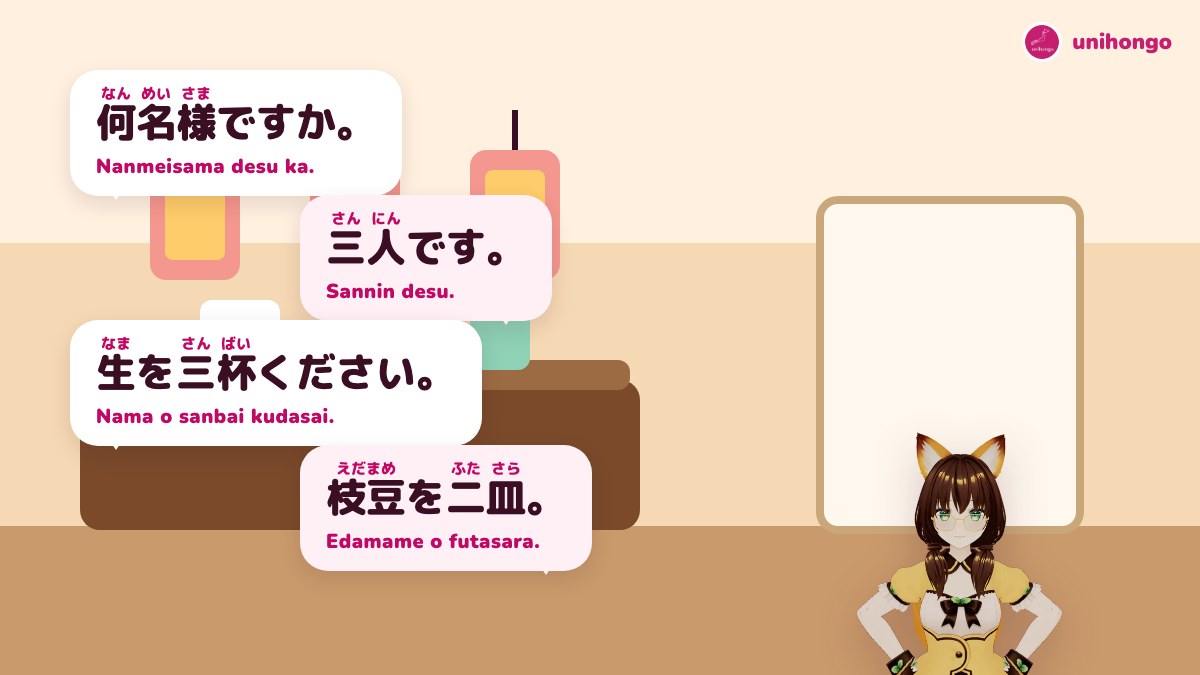
| Japanese | Romaji | Meaning |
|---|---|---|
| いらっしゃいませ!何名様ですか。 | Irasshaimase! Nanmeisama desu ka. | Staff: Welcome! How many? |
| 三人です。 | Sannin desu. | You: Three. |
| こちらへどうぞ。お飲み物は? | Kochira e dōzo. Onomimono wa? | Staff: This way, please. Anything to drink? |
| 生を二杯と、ウーロン茶を一杯。 | Nama o nihai to, ūron cha o ippai. | You: Two draught beers and one oolong tea. |
| かしこまりました。 | Kashikomarimashita. | Staff: Certainly. |
| あと、枝豆を二皿と唐揚げを一つ。 | Ato, edamame o futasara to karaage o hitotsu. | You: Also two plates of edamame and one fried chicken. |
| 唐揚げは五個入りですが、よろしいですか。 | Karaage wa goko iri desu ga, yoroshii desu ka. | Staff: The fried chicken comes as five pieces. Is that OK? |
| はい、大丈夫です。 | Hai, daijōbu desu. | You: Yes, that's fine. |
| すみません、生をもう一杯ください。 | Sumimasen, nama o mō ippai kudasai. | You: Excuse me, one more draught beer, please. |
| お会計お願いします。 | Okaikei onegai shimasu. | You: The bill, please. |
Nama is short for nama bīru, draught beer, and is completely normal when ordering. The staff will often repeat your order back with the counters; listening for the number in their repetition is a good way to catch mistakes.
The lazy fallback: hitotsu, futatsu, mittsu
If the right counter does not come to you, use the native Japanese series with つ. It is not a beginner's crutch: Japanese speakers use it all the time for menu items, and Kōhī futatsu is exactly what most people say for two coffees. It works up to nine, and tō is ten, though for ten items you would usually switch to a number and a counter.
The fallback has two limits. It never counts people: futatsu desu at the door means two things, not two people. And it sounds slightly vague with large numbers, so above ten use jū ikko, jū nihon and so on.
| Japanese | Romaji | Meaning |
|---|---|---|
| コーヒーを二つください。 | Kōhī o futatsu kudasai. | Two coffees, please. |
| これを一つと、これを三つ。 | Kore o hitotsu to, kore o mittsu. | One of these and three of these. (pointing at the menu) |
| 同じものを四つお願いします。 | Onaji mono o yottsu onegai shimasu. | Four of the same, please. |
Common mistakes at the table
- Saying ichinin or ninin instead of hitori and futari. They are the two irregular forms you will use most often, so drill them first.
- Answering nimeisama desu. Sama is respect for the guest; leave it to the staff and say futari desu.
- Saying sanhai or rokuhai. Glasses become sanbai and roppai; say them aloud until the sound changes feel automatic.
- Using 本 for a glass of beer. 本 is for the bottle; a glass or mug is 杯.
- Confusing 二人前 and 二つ. Nininmae is two servings; futatsu of gyoza could mean two dumplings, and staff may check which you mean.
Rehearse a whole night out
Start with Mocchi. Type something like: quiz me on restaurant counters, give me an order in English and let me answer in Japanese. Mocchi, Unihongo's study assistant, checks each answer, explains the sound change when you slip from sanbai to sanhai, and remembers the counters you miss for your next review.
Then say it out loud. In AI Sensei, choose the First Round at an Izakaya mission or ask Ibuki-sensei to play a busy izakaya server who asks how many you are, takes your drinks order and tries to sell you a second round. Ask the Sensei to speak at normal speed once you are comfortable, and check the session report for any counters it corrected.