
What you hold at the till decides the counter
Japanese counters follow the shape of the object, and a konbini is full of different shapes. Round or chunky snacks are small objects, so they take 個. Bottles and cans are long and cylindrical, so they take 本. Flat things take 枚. A bag of something takes 袋. Once you look at what is in your basket this way, the choice becomes almost visual.
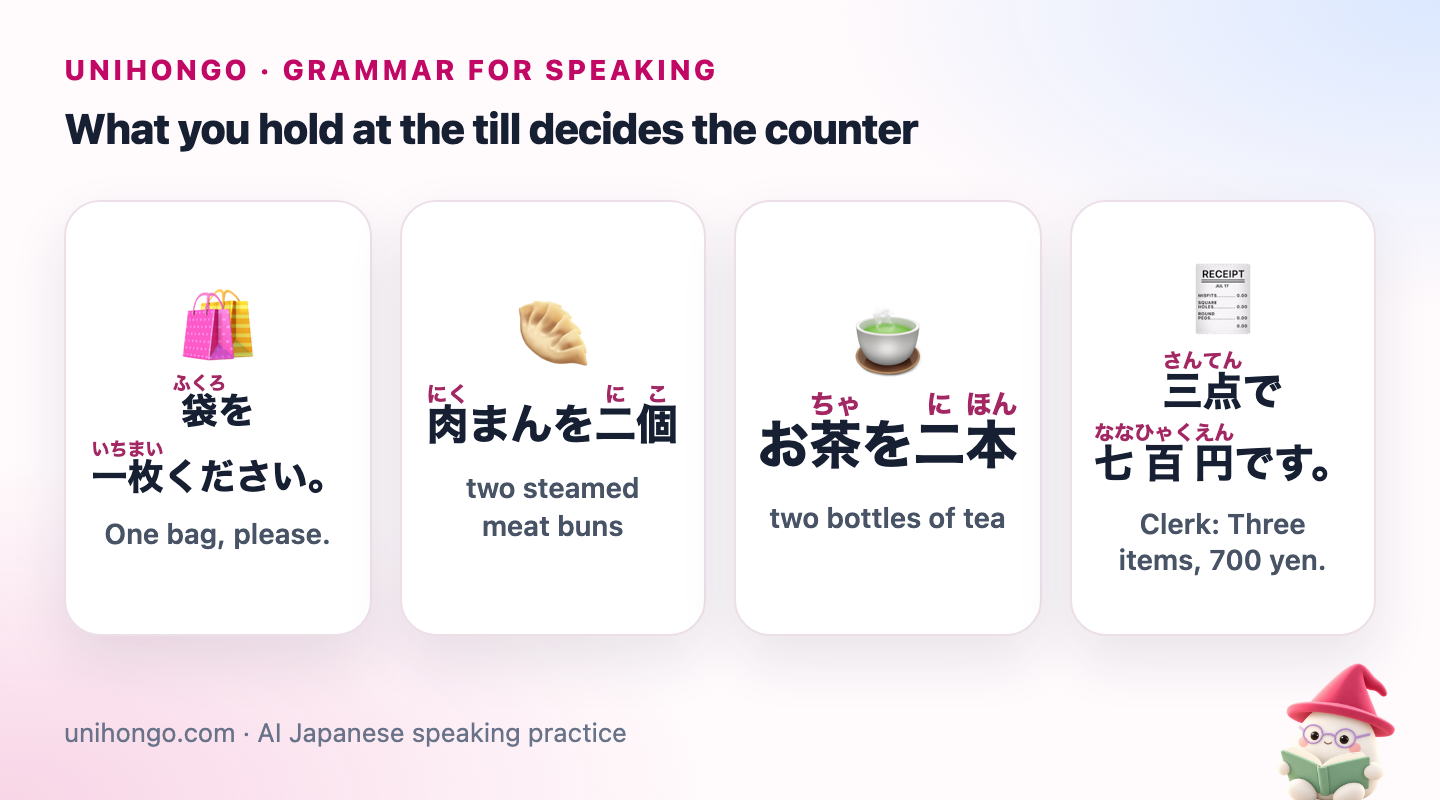
| Japanese | Romaji | Meaning |
|---|---|---|
| 袋を一枚ください。 | Fukuro o ichimai kudasai. | One bag, please. |
| 肉まんを二個 | nikuman o niko | two steamed meat buns |
| お茶を二本 | ocha o nihon | two bottles of tea |
| 三点で七百円です。 | Santen de nanahyaku en desu. | Clerk: Three items, 700 yen. |
個 and 本: snacks and drinks
個 (ko) is the general counter for small, separate objects. At a konbini it covers onigiri, meat buns, fried chicken from the hot case, eggs and sweets. 本 (hon) covers bottles, cans and anything long, such as a stick of fried chicken on a skewer or a bar of ice cream. Both have small sound changes on 1, 6, 8 and 10, and 本 also changes on 3.
| Japanese | Romaji | Meaning |
|---|---|---|
| おにぎりを三個買いました。 | Onigiri o sanko kaimashita. | I bought three rice balls. |
| からあげを一個追加でお願いします。 | Karaage o ikko tsuika de onegai shimasu. | One more piece of fried chicken, please. |
| 水を六本買います。 | Mizu o roppon kaimasu. | I'll buy six bottles of water. |
| 缶コーヒーを一本ください。 | Kan kōhī o ippon kudasai. | One can of coffee, please. |
| Number | 個 (small items) | 本 (bottles, cans) |
|---|---|---|
| 1 | ikko | ippon |
| 2 | niko | nihon |
| 3 | sanko | sanbon |
| 4 | yonko | yonhon |
| 6 | rokko | roppon |
| 8 | hakko or hachiko | happon |
| 10 | jukko | juppon |
| How many? | nanko | nanbon |
袋 and 枚: the bag trap
Since 2020, plastic shopping bags in Japan are generally charged for, so the clerk asks whether you need one. If you buy hot and cold food together, you may want two bags. The bag itself is a thin, flat object, so it takes 枚: ichimai, nimai. 枚 also counts receipts, tickets, stamps, postcards and slices of bread, and it has no sound changes at all.
袋 (fukuro) works the other way round: it counts goods sold in a bag. Poteto chippusu o hitofukuro is one bag of crisps. The forms are hitofukuro, futafukuro, and for three either mifukuro or sanfukuro; both are heard. In daily speech, many people just say hitotsu for a bag of crisps.
| Japanese | Romaji | Meaning |
|---|---|---|
| 袋は分けてもらえますか。 | Fukuro wa wakete moraemasu ka. | Could you put them in separate bags? |
| 袋、二枚お願いします。 | Fukuro, nimai onegai shimasu. | Two bags, please. |
| 袋はいりません。 | Fukuro wa irimasen. | I don't need a bag. |
| ポテトチップスを一袋。 | Poteto chippusu o hitofukuro. | One bag of crisps. |
| 切手を三枚ください。 | Kitte o sanmai kudasai. | Three stamps, please. |
Many konbini sell stamps and postcards at the counter, and 枚 is the counter for both. If you pay a bill or print something at the multi-copy machine, the slip and the printed pages are counted with 枚 too.
点: the counter you mostly hear
点 (ten) counts items in a purchase or in a list of goods, and it belongs to shop and office language. A clerk may read the total as niten de yonhyaku gojū en desu, or a receipt may print the item count next to the total. You rarely need to say it yourself, but hearing santen and thinking three items saves a moment of confusion.
Its sound changes match 本 for 1, 8 and 10: itten, hatten, jutten. Listen for them, because 1 and 10 sound alike to many learners.
| Japanese | Romaji | Meaning |
|---|---|---|
| 二点で四百五十円です。 | Niten de yonhyaku gojū en desu. | Clerk: Two items, 450 yen. |
| お会計、五点で千二百円になります。 | Okaikei, goten de sen nihyaku en ni narimasu. | Clerk: Five items, that comes to 1,200 yen. |
| 一点だけですか。 | Itten dake desu ka. | Clerk: Just the one item? |
A konbini checkout with every counter
Here is a realistic checkout. The clerk speaks polite service Japanese at speed, and you answer with short, polite phrases. The counters carry the important information, so practise hearing them.
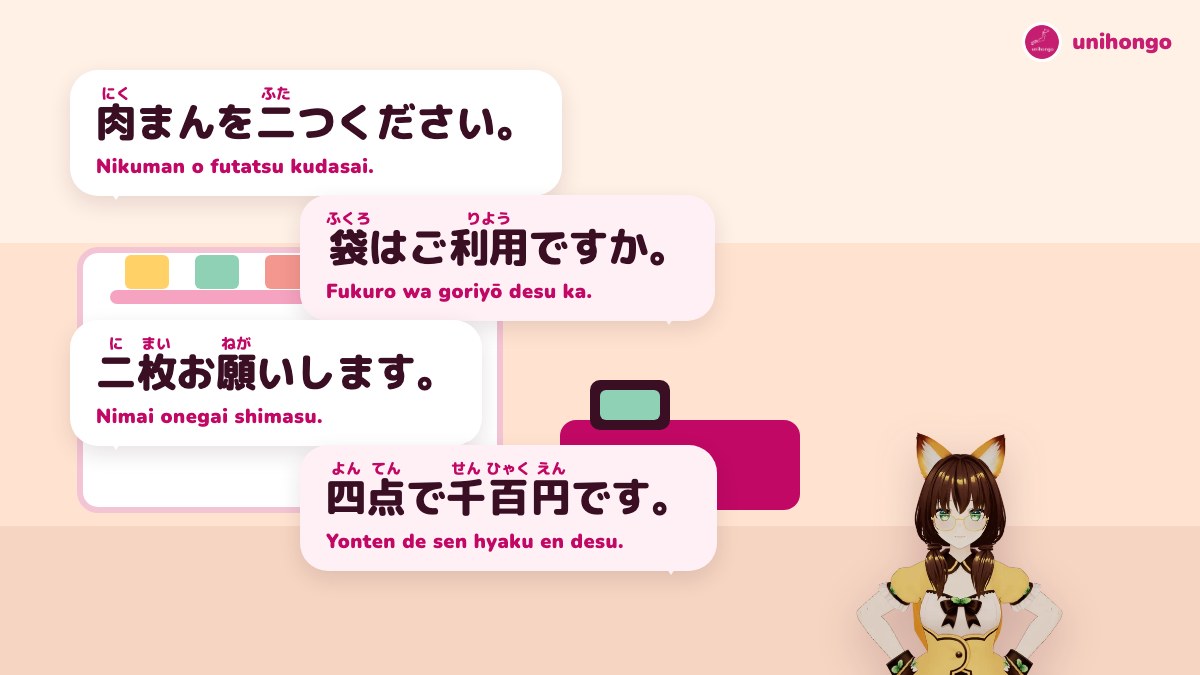
| Japanese | Romaji | Meaning |
|---|---|---|
| いらっしゃいませ。 | Irasshaimase. | Clerk: Welcome. |
| すみません、肉まんを二つください。 | Sumimasen, nikuman o futatsu kudasai. | You: Excuse me, two meat buns, please. |
| 肉まんお二つですね。 | Nikuman ofutatsu desu ne. | Clerk: Two meat buns, right? |
| お弁当、温めますか。 | Obentō, atatamemasu ka. | Clerk: Shall I heat the bento? |
| はい、お願いします。 | Hai, onegai shimasu. | You: Yes, please. |
| 袋はご利用ですか。 | Fukuro wa goriyō desu ka. | Clerk: Will you need a bag? |
| はい、二枚お願いします。分けてください。 | Hai, nimai onegai shimasu. Wakete kudasai. | You: Yes, two please. Separate them, please. |
| お箸は何膳おつけしますか。 | Ohashi wa nanzen otsuke shimasu ka. | Clerk: How many pairs of chopsticks? |
| 一膳でいいです。 | Ichizen de ii desu. | You: One pair is fine. |
| 四点で千百円です。 | Yonten de sen hyaku en desu. | Clerk: Four items, 1,100 yen. |
膳 (zen) counts pairs of chopsticks and is another counter you will hear rather than say. If it catches you off guard, hitotsu de ii desu or simply ichizen with a finger works. Many clerks just ask ohashi wa otsuke shimasu ka, do you need chopsticks, so the counter does not always appear.
When to skip the counter
Konbini Japanese is about speed, and the native series hitotsu, futatsu, mittsu is the fastest way to ask for anything behind the counter. Kore hitotsu with a finger pointing at the hot case is perfectly natural, and so is karaage futatsu. You can also skip numbers completely for self-service items: just put them on the counter.
Keep the counter when the shape matters to the meaning. Fukuro nimai is clearer than fukuro futatsu, and stamps or tickets almost always take 枚.
| Japanese | Romaji | Meaning |
|---|---|---|
| これ、一つください。 | Kore, hitotsu kudasai. | One of these, please. |
| からあげ、二つお願いします。 | Karaage, futatsu onegai shimasu. | Two fried chicken, please. |
| あと一つ追加で。 | Ato hitotsu tsuika de. | One more, please. |
Spoons, straws and tickets
A konbini sells more than food, and a few extra counters come with the extras. Spoons, forks and straws are long and thin, so they take 本: supūn o nihon, two spoons. Clerks usually add one of each automatically for a dessert or a drink, so you only need the counter when you want more than one, for example when sharing.
Concert and event tickets printed at the multi-copy machine or handed over at the till are counted with 枚, like any paper. Wet towels, oshibori, are usually asked for with the native series. If you are buying for a group, these small requests make the difference between a smooth checkout and a second trip to the counter.
| Japanese | Romaji | Meaning |
|---|---|---|
| スプーンを二本ください。 | Supūn o nihon kudasai. | Two spoons, please. |
| ストロー、一本もらえますか。 | Sutorō, ippon moraemasu ka. | Could I have a straw? |
| チケットを二枚発券したいです。 | Chiketto o nimai hakken shitai desu. | I'd like to print two tickets. |
| おしぼりを三つお願いします。 | Oshibori o mittsu onegai shimasu. | Three wet towels, please. |
Common konbini mistakes
- Asking for fukuro o hitotsu when you mean an empty bag. It is understood, but fukuro ichimai is what people say.
- Saying sanhon or rokuhon for bottles. Three and six become sanbon and roppon.
- Missing the total because of 点. When you hear a number and ten before the price, it is the item count, not a points balance.
- Answering a yes-or-no question with a counter. When the clerk asks atatamemasu ka, a simple hai, onegai shimasu or daijōbu desu is enough.
- Using nimai for two onigiri because they look flat in the wrapper. Onigiri are niko or futatsu.
Rehearse the checkout until it is automatic
- Ask Mocchi: give me ten konbini items one at a time and let me count them with the right counter. Mocchi checks each answer and keeps track of the shapes you mix up.
- Use /create-flashcards with a photo of each item, such as a bottle, a bag of crisps and a meat bun, so the counter is tied to a picture rather than an English word.
- Play the Convenience Store Checkout mission in AI Sensei, where Sakura-sensei plays the clerk and asks the bag, heating and chopsticks questions at a natural speed.