
Four counters for one shopping bag
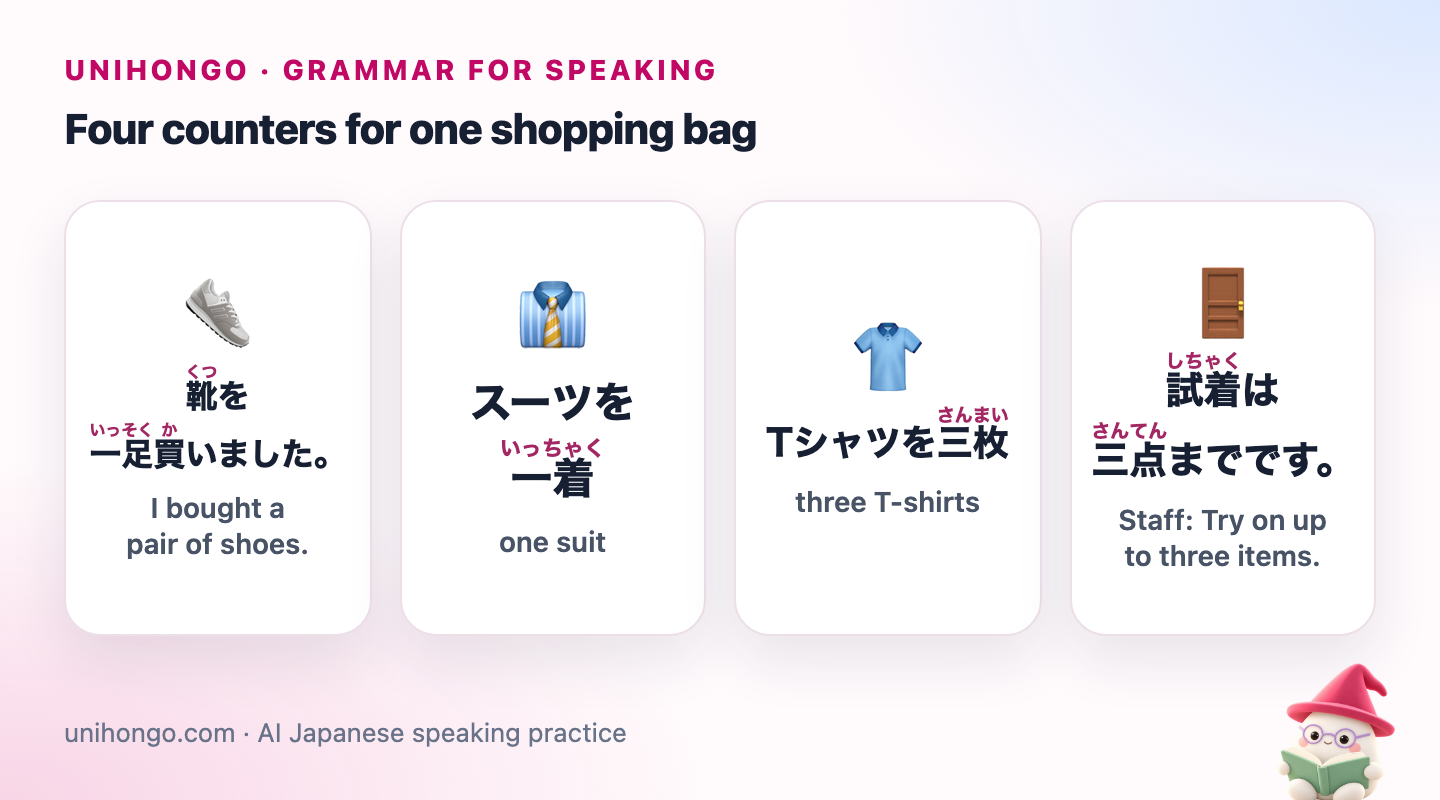
A single shopping trip can need four counters. Think about shape and use: things that come in pairs, complete outfits, flat folded tops, and items as the shop counts them. These four lines cover each one.
| Japanese | Romaji | Meaning |
|---|---|---|
| 靴を一足買いました。 | Kutsu o issoku kaimashita. | I bought a pair of shoes. |
| スーツを一着 | sūtsu o itchaku | one suit |
| Tシャツを三枚 | tīshatsu o sanmai | three T-shirts |
| 試着は三点までです。 | Shichaku wa santen made desu. | Staff: Try on up to three items. |
着: suits, dresses and coats
着 (chaku) comes from the verb kiru, to wear, and counts complete garments: suits, dresses, coats, jackets, kimono, uniforms and swimsuits. Its sound changes are on 1, 8 and 10: itchaku, hatchaku, jutchaku. The question is nanchaku.
You will hear it in shops that sell formal wear and in conversations about job hunting, when students buy their first suit, and about weddings, when people choose a dress or a kimono.
| Japanese | Romaji | Meaning |
|---|---|---|
| 就活用のスーツを一着買いました。 | Shūkatsu yō no sūtsu o itchaku kaimashita. | I bought one suit for job hunting. |
| ワンピースを二着試着してもいいですか。 | Wanpīsu o nichaku shichaku shite mo ii desu ka. | May I try on two dresses? |
| 冬のコートは一着しか持っていません。 | Fuyu no kōto wa itchaku shika motte imasen. | I only have one winter coat. |
| 制服は二着あります。 | Seifuku wa nichaku arimasu. | I have two uniforms. |
| Number | 着 (outfits) | 足 (pairs) |
|---|---|---|
| 1 | itchaku | issoku |
| 2 | nichaku | nisoku |
| 3 | sanchaku | sanzoku |
| 4 | yonchaku | yonsoku |
| 6 | rokuchaku | rokusoku |
| 8 | hatchaku | hassoku |
| 10 | jutchaku | jussoku |
| How many? | nanchaku | nanzoku |
足: shoes, socks and anything in pairs for your feet
足 (soku) is the kanji for foot and leg, and as a counter it counts pairs of footwear: shoes, boots, sandals, slippers, socks and stockings. One pair is issoku, and three is sanzoku, with the s turning into z, just as the question nanzoku does. Eight and ten are hassoku and jussoku.
Japanese homes and some restaurants ask you to take off your shoes, so you may also hear 足 for slippers at the entrance: surippa o nisoku dashimashō ka, shall I put out two pairs of slippers?
| Japanese | Romaji | Meaning |
|---|---|---|
| 靴下を三足ください。 | Kutsushita o sanzoku kudasai. | Three pairs of socks, please. |
| 靴は何足持っていますか。 | Kutsu wa nanzoku motte imasu ka. | How many pairs of shoes do you have? |
| 靴下、三足で千円です。 | Kutsushita, sanzoku de sen en desu. | Staff: Socks, three pairs for 1,000 yen. |
| この靴の二十六センチはありますか。 | Kono kutsu no nijūroku senchi wa arimasu ka. | Do you have these shoes in 26 centimetres? |
Shoe sizes in Japan are given in centimetres, so you ask for nijūroku senchi rather than a European or American size. Sizes such as nijūroku ten go, 26.5, are common.
枚 for tops, and when 着 is also fine
枚 (mai) counts thin, flat things, and folded clothes count as flat: T-shirts, shirts, blouses, sweaters, scarves and handkerchiefs. It has no sound changes, so it is the easiest counter in this guide. Ties and belts are long and thin, so they take 本: nekutai o ippon.
For tops, both 枚 and 着 are heard, and Japanese speakers do not always agree. As a rule of thumb, use 枚 for simple tops and underwear, and 着 for jackets, suits, dresses and coats. Nobody will misunderstand either choice for a sweater.
| Japanese | Romaji | Meaning |
|---|---|---|
| 白いシャツを二枚ください。 | Shiroi shatsu o nimai kudasai. | Two white shirts, please. |
| Tシャツを五枚持って行きます。 | Tīshatsu o gomai motte ikimasu. | I'm taking five T-shirts. |
| セーターを一枚買いました。 | Sētā o ichimai kaimashita. | I bought a sweater. |
| ネクタイを一本選びました。 | Nekutai o ippon erabimashita. | I picked out one tie. |
点: what the shop counts
Shop staff count everything you bring as items, regardless of shape, with 点 (ten): itten, niten, santen, yonten, goten, rokuten, nanaten, hatten, kyūten, jutten. You hear it at the fitting room, where many shops limit the number of items, and at the till, where the total is read with the number of items.
You will rarely need to say it, but you must understand it. Nanten desu ka at the fitting room means how many items do you have?
| Japanese | Romaji | Meaning |
|---|---|---|
| 何点お持ちですか。 | Nanten omochi desu ka. | Staff: How many items do you have? |
| 三点です。 | Santen desu. | You: Three. |
| お会計、四点で八千円です。 | Okaikei, yonten de hassen en desu. | Staff: Four items, that's 8,000 yen. |
Mini dialogue: at the fitting room
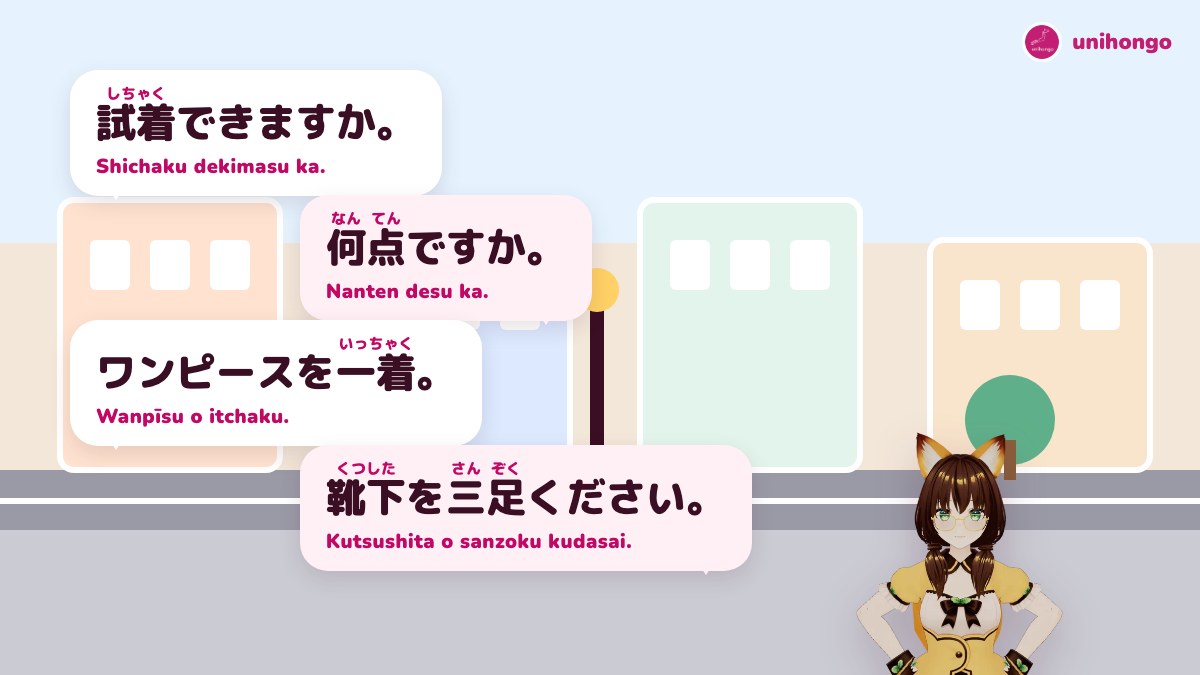
You want to try on a dress and a jacket, and buy socks. The staff speak polite service Japanese, and the counters change with every item.
| Japanese | Romaji | Meaning |
|---|---|---|
| すみません、試着できますか。 | Sumimasen, shichaku dekimasu ka. | You: Excuse me, can I try these on? |
| はい、何点ですか。 | Hai, nanten desu ka. | Staff: Of course. How many items? |
| ワンピースが一着とジャケットが一着です。 | Wanpīsu ga itchaku to jaketto ga itchaku desu. | You: One dress and one jacket. |
| 二点ですね。試着は三点までです。 | Niten desu ne. Shichaku wa santen made desu. | Staff: Two items, then. You can try on up to three. |
| このジャケット、もう一つ大きいサイズはありますか。 | Kono jaketto, mō hitotsu ōkii saizu wa arimasu ka. | You: Do you have this jacket one size up? |
| お持ちします。少々お待ちください。 | Omochi shimasu. Shōshō omachi kudasai. | Staff: I'll bring it. One moment, please. |
| あと、この靴下を三足お願いします。 | Ato, kono kutsushita o sanzoku onegai shimasu. | You: And three pairs of these socks, please. |
Mō hitotsu ōkii saizu, one size bigger, uses the native series for a step on the scale. Mō hitotsu chiisai saizu is one size smaller. These phrases are worth memorising as they are.
Bags, hats and the lazy fallback
Not every accessory has a neat counter. Bags, hats, watches and rings are usually counted with the native series, hitotsu, futatsu, or with 個 in shops. Belts and ties are long, so they take 本. Handkerchiefs and scarves are flat, so they take 枚. When you are not sure, hitotsu works for almost any accessory, and shop staff will often switch to 点 anyway when they count your items.
The fallback is not natural for shoes or socks, where people expect 足, or for suits, where 着 is standard. For tops, 枚 is so easy that you rarely need the fallback at all.
| Japanese | Romaji | Meaning |
|---|---|---|
| 帽子を一つ買いました。 | Bōshi o hitotsu kaimashita. | I bought a hat. |
| かばんを二つ持っています。 | Kaban o futatsu motte imasu. | I have two bags. |
| ベルトを一本ください。 | Beruto o ippon kudasai. | One belt, please. |
| ハンカチを三枚買いました。 | Hankachi o sanmai kaimashita. | I bought three handkerchiefs. |
Common mistakes when shopping for clothes
- Saying sansoku for three pairs. It is sanzoku, and the question is nanzoku.
- Saying ichichaku or ichisoku. One suit is itchaku and one pair is issoku.
- Counting one shoe as issoku. 足 counts pairs; for a single shoe, say katahō, one of the pair.
- Using 枚 for a suit or a coat. These are complete garments and take 着.
- Answering nanten desu ka with a list of garments. The staff want one number of items: santen desu.
Practise a full shopping trip
Ask Mocchi: give me ten clothes and shoe items one at a time and let me say them with the right counter. Mocchi checks each answer, explains the sanzoku and itchaku changes and keeps a note of the counters you mix up, so a later review can bring them back.
Then go to the shop. In AI Sensei, choose the shopping topic and ask Hana-sensei to play a clothes shop assistant who counts your items at the fitting room and suggests other sizes. Ask the Sensei to use full polite service Japanese, so you hear what real shop staff say.