
Particles that do not match Korean
Korean speakers often map particles one to one: eul and reul become o, i and ga become ga, eun and neun become wa. That map is right most of the time, which is why the exceptions stick. A handful of very common verbs take a different particle in Japanese, and they appear in almost every conversation.
Learn these four as fixed chunks. Do not think about why; just say them until the Japanese particle sounds right.
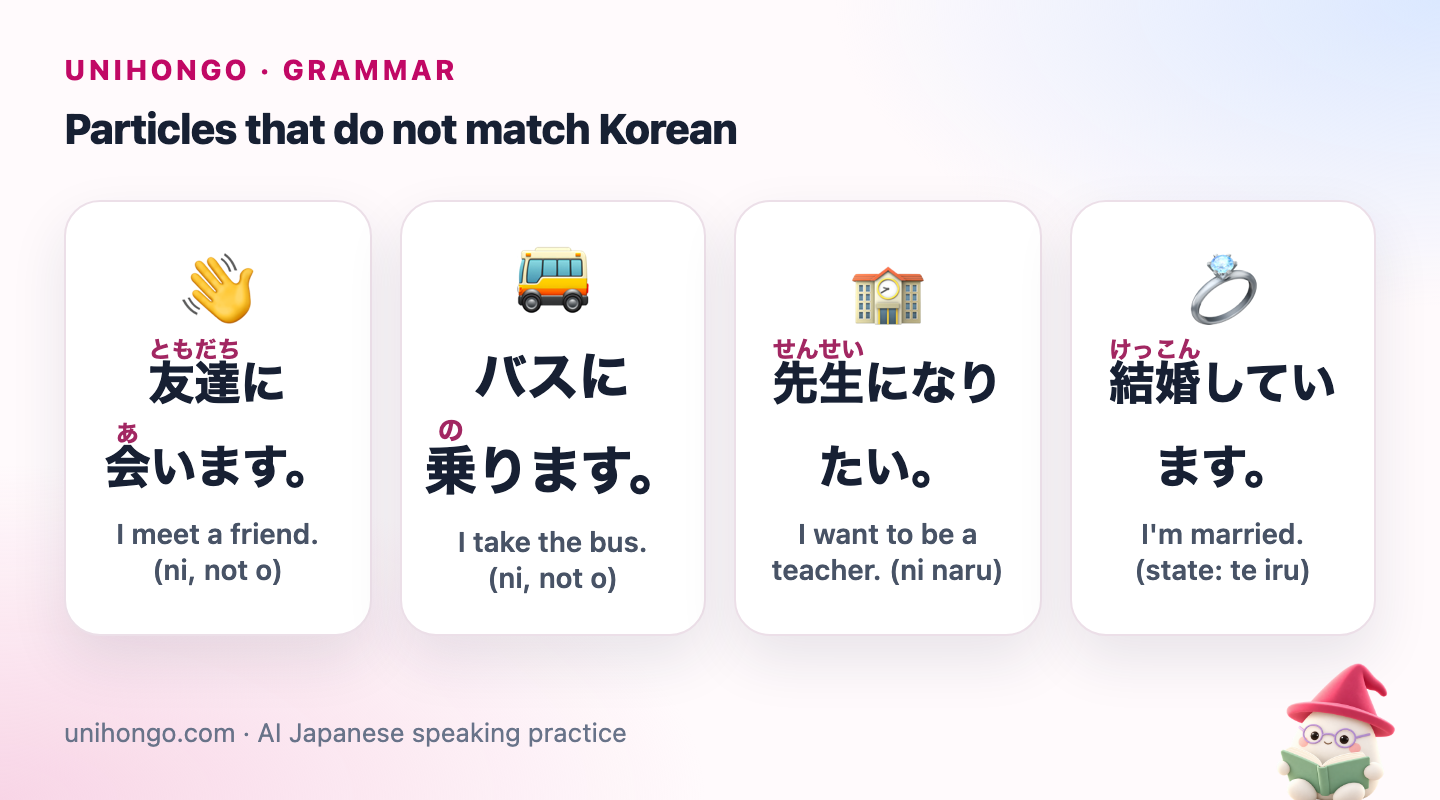
| Japanese | Romaji | Meaning |
|---|---|---|
| 友達に会います。 | Tomodachi ni aimasu. | I meet a friend. (ni, not o) |
| バスに乗ります。 | Basu ni norimasu. | I take the bus. (ni, not o) |
| 先生になりたい。 | Sensei ni naritai. | I want to be a teacher. (ni naru) |
| 結婚しています。 | Kekkon shite imasu. | I'm married. (state: te iru) |
More particle pairs to check
The same pattern appears with a few more verbs and adjectives. Suki and kirai are adjectives in Japanese, so the thing you like takes ga: neko ga suki desu. In Korean, joahada takes reul, so neko o suki desu is a frequent slip. You will hear o suki in some songs and casual speech, but ga is the standard form. Wakaru, understand, and dekiru, can do, also take ga.
Another is the verb for asking: here Korean uses ege or kke, and Japanese uses ni as well, sensei ni kiku, so do not switch to o just because the verb looks transitive. And to resemble someone is chichi ni nite iru, with ni.
| Japanese | Romaji | Meaning |
|---|---|---|
| 猫が好きです。 | Neko ga suki desu. | I like cats. |
| 日本語が少しわかります。 | Nihongo ga sukoshi wakarimasu. | I understand a little Japanese. |
| 先生に聞いてみます。 | Sensei ni kiite mimasu. | I'll ask the teacher. |
| 父に似ています。 | Chichi ni nite imasu. | I look like my father. |
| Meaning | Korean pattern | Japanese pattern |
|---|---|---|
| Meet someone | Object particle | ni au |
| Ride a bus, train | Object particle | ni noru |
| Become a teacher | Subject particle | ni naru |
| Like cats | Object particle with joahada | ga suki |
| Understand Japanese | Object particle with alda | ga wakaru |
| Ask a teacher | ege or kke | ni kiku (not o) |
Te iru for states: married, living, knowing
Korean often uses the past tense for a state that started in the past and is still true: I married means I am married. Japanese uses te iru for these ongoing states. If someone asks whether you are married and you answer kekkon shimashita, it sounds as if you are announcing that you just got married, or describing an event in your past.
The same applies to know, live and wear. Shirimasu is almost never the answer to do you know?; say shitte imasu, or shirimasen for no. Live is sunde imasu. Wearing glasses is megane o kakete imasu. Korean -go itta and -a itta both map onto Japanese te iru, which is why this ending deserves extra practice.
Linking is easier: the Japanese te form covers both Korean -go and -aseo in most sequences, as in asagohan o tabete, dekakemashita, I ate breakfast and went out.
| Japanese | Romaji | Meaning |
|---|---|---|
| 結婚していますか。 | Kekkon shite imasu ka. | Are you married? |
| はい、結婚しています。 | Hai, kekkon shite imasu. | Yes, I'm married. |
| その店、知っていますか。 | Sono mise, shitte imasu ka. | Do you know that shop? |
| いいえ、知りません。 | Iie, shirimasen. | No, I don't. |
| 横浜に住んでいます。 | Yokohama ni sunde imasu. | I live in Yokohama. |
Your boss on the phone: relative honorifics
Korean honorifics mostly follow the person being talked about: your father or your manager is honoured wherever you are, although in Korean business speech this is also changing. Japanese uses relative honorifics. The question is not who Tanaka is, but who you are talking to. With a client or anyone outside your company, your own manager belongs to your side, so you drop the title from the name, use humble verbs and never use honorific verbs about them.
Family works the same way. Talking to a teacher or a neighbour, your mother is haha, not okāsan, and your father is chichi. Many Korean speakers find this uncomfortable at first because it feels disrespectful. In Japanese, it is the respectful choice towards the listener.
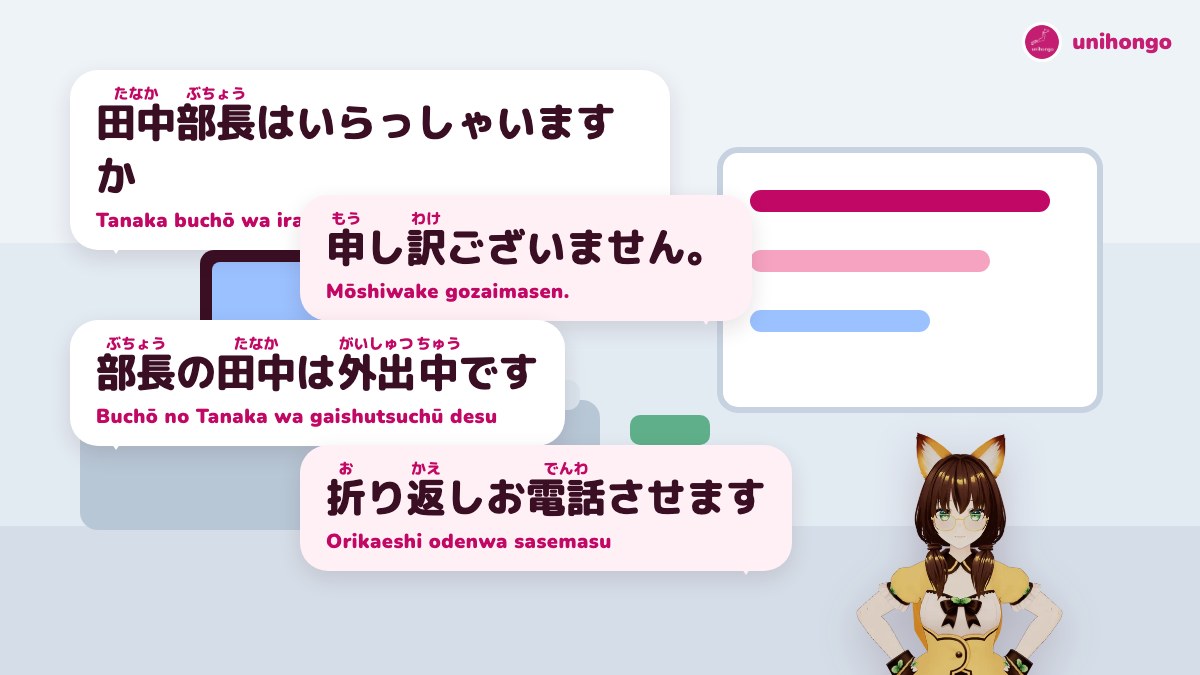
| Japanese | Romaji | Meaning |
|---|---|---|
| 田中部長はいらっしゃいますか。 | Tanaka buchō wa irasshaimasu ka. | Client: Is Manager Tanaka in? |
| 申し訳ございません。 | Mōshiwake gozaimasen. | You: I'm very sorry. |
| 部長の田中は外出中です。 | Buchō no Tanaka wa gaishutsuchū desu. | You: Our manager Tanaka is out. |
| 折り返しお電話させます。 | Orikaeshi odenwa sasemasu. | You: I'll have Tanaka call you back. |
| 母は元気です。 | Haha wa genki desu. | My mother is well. (to a teacher) |
Desu and masu: when to let go
Korean -yo speech and Japanese desu and masu feel like the same level, and in most first meetings they are. Some teachers notice that Korean-speaking learners keep desu and masu with Japanese friends long after the friends have switched to plain speech, perhaps because Korean -yo is a comfortable default with people of a similar age. Japanese friends of the same age often switch to casual speech quickly, and staying polite can feel like keeping your distance.
This is not a rule for everyone, and with someone older or senior, keep desu and masu until they invite you to relax. With classmates and friends, follow their lead: when they say ikō yo, you can answer un, ikō.
| Japanese | Romaji | Meaning |
|---|---|---|
| タメ口でいいよ。 | Tameguchi de ii yo. | Friend: You can talk casually with me. |
| じゃあ、そうするね。 | Jā, sō suru ne. | You: Okay, I will. (casual) |
| 明日、行く? | Ashita, iku? | Friend: Are you going tomorrow? |
| うん、行くよ。 | Un, iku yo. | You: Yeah, I'm going. |
Zu, tsu and voiced sounds at the start
Korean has no z sound and no ts sound. Many Korean speakers replace zu with ju, za with ja and tsu with chu, so mizu, water, comes out as miju and tsukue, desk, as chukue. Japanese listeners will usually understand, but it is one of the most recognisable features of a Korean accent.
For zu, keep the tip of the tongue close to the back of the top teeth without pressing, and let a buzzing air stream through. For tsu, start with a t and release it into an s, as in the end of English cats. A second pattern is voicing at the start of a word: Korean g, d and b at the start of a word are often weak or unvoiced, so gakusei can sound like kakusei. Start voiced words with a clear buzz.
| Japanese | Romaji | Meaning |
|---|---|---|
| 水 | mizu | water (zu, not ju) |
| 全然 | zenzen | not at all (ze, not je) |
| 机 | tsukue | desk (tsu, not chu) |
| 学生 | gakusei | student (voiced g) |
| 地図がありますか。 | Chizu ga arimasu ka. | Do you have a map? |
The small tsu and long vowels
Korean final consonants make the small tsu feel familiar, and many Korean speakers produce it well. The usual issue is timing. The pause before the consonant must last a full beat. Kite, come, has two beats; kitte, stamp, has three. Long vowels work the same way: obasan, aunt, has four beats and obāsan, grandmother, has five.
The other trap is adding a small tsu where there is none. Korean tense consonants, written with doubled letters, can make Japanese ka or ta at the start of a word sound stronger, and some learners then write or say a pause before them. When unsure, check the word in kana and count the beats.
| Japanese | Romaji | Meaning |
|---|---|---|
| 切手 | kitte | postage stamp (ki-t-te) |
| 来て | kite | come (ki-te) |
| おばあさん | obāsan | grandmother (long a) |
| おばさん | obasan | aunt |
Mini dialogue: catching up with a friend
A casual chat that uses the particle pairs, te iru for states and the zu sound. Say it once slowly, once at natural speed.
| Japanese | Romaji | Meaning |
|---|---|---|
| 昨日、誰に会ったの? | Kinō, dare ni atta no? | Friend: Who did you meet yesterday? |
| 高校の友達に会ったよ。 | Kōkō no tomodachi ni atta yo. | You: A friend from high school. |
| その人、まだ大阪に住んでるの? | Sono hito, mada Ōsaka ni sunderu no? | Friend: Does she still live in Osaka? |
| うん。来年、先生になるんだって。 | Un. Rainen, sensei ni naru n da tte. | You: Yes. She says she'll become a teacher next year. |
| ずっと先生になりたがってたもんね。 | Zutto sensei ni naritagatteta mon ne. | Friend: She always wanted to, didn't she. |
Practise the phone call and the particles
Particles first. Paste a few sentences after /correct in Mocchi's chat and ask: tell me if any particle looks translated from Korean. Mocchi explains why au takes ni or why suki takes ga, and brings those points back in later quizzes until they stop appearing.
Then the spoken part. In AI Sensei, ask Yamada-sensei to play a client who calls your office and asks for your manager. Answer with the humble forms from this guide, and ask Yamada-sensei to repeat the call with a different request. The session report lists every honorific slip, so you can see whether the Korean habit is fading.