
Four counters for what you read, hear and watch
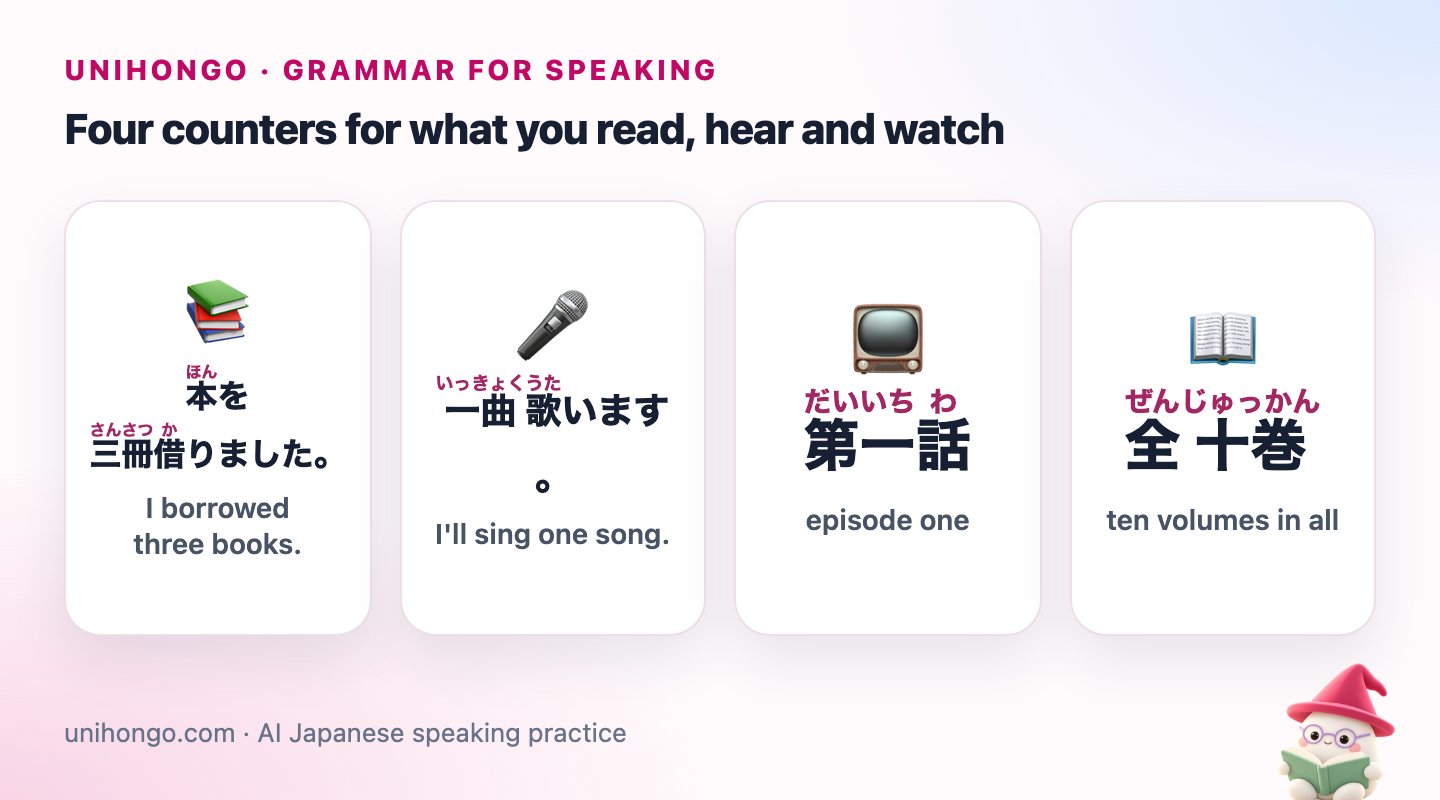
Each kind of media has its own unit: a book, a song, an episode, a volume. Japanese gives each one a counter, and fans use them constantly. These four lines are the core of most conversations about books, music and series.
| Japanese | Romaji | Meaning |
|---|---|---|
| 本を三冊借りました。 | Hon o sansatsu karimashita. | I borrowed three books. |
| 一曲歌います。 | Ikkyoku utaimasu. | I'll sing one song. |
| 第一話 | dai ichiwa | episode one |
| 全十巻 | zen jukkan | ten volumes in all |
At the library and the bookshop: 冊 and ページ
冊 (satsu) counts bound things: books, magazines, notebooks, comics as physical objects and textbooks. Its sound changes are on 1, 8 and 10: issatsu, hassatsu, jussatsu. ページ (pēji) counts pages, and you will hear it in classrooms, meetings and when someone tells you where to look. Pēji changes on 1, 6, 8 and 10 for many speakers: ippēji or ichipēji, roppēji, happēji, juppēji.
Libraries in Japan often have a limit on how many books you can borrow at once, and the staff will tell you with 冊.
| Japanese | Romaji | Meaning |
|---|---|---|
| 何冊まで借りられますか。 | Nansatsu made kariraremasu ka. | How many books can I borrow? |
| 一度に十冊までです。 | Ichido ni jussatsu made desu. | Staff: Up to ten at a time. |
| ノートを二冊ください。 | Nōto o nisatsu kudasai. | Two notebooks, please. |
| 三十ページ読みました。 | Sanjuppēji yomimashita. | I read thirty pages. |
| 教科書の五ページを開いてください。 | Kyōkasho no gopēji o hiraite kudasai. | Please open your textbook to page five. |
| Number | 冊 (books) | ページ (pages) |
|---|---|---|
| 1 | issatsu | ippēji or ichipēji |
| 2 | nisatsu | nipēji |
| 3 | sansatsu | sanpēji |
| 6 | rokusatsu | roppēji |
| 8 | hassatsu | happēji |
| 10 | jussatsu | juppēji |
| How many? | nansatsu | nanpēji |
At karaoke: 曲
曲 (kyoku) counts songs and pieces of music. Its forms are ikkyoku, nikyoku, sankyoku, yonkyoku, gokyoku, rokkyoku, nanakyoku, hakkyoku, kyūkyoku and jukkyoku. At karaoke, people take turns to put songs into the machine, ireru, and the counter comes up all evening.
Kyoku also means a tune or composition in general, so you can use it for classical pieces, game music and songs on an album: kono arubamu wa jūnikyoku iri, this album has twelve tracks.
| Japanese | Romaji | Meaning |
|---|---|---|
| 次、何曲入れる? | Tsugi, nankyoku ireru? | How many songs shall we put in next? (casual) |
| 一人二曲ずつ歌おう。 | Hitori nikyoku zutsu utaō. | Let's each sing two songs. (casual) |
| もう一曲だけ! | Mō ikkyoku dake! | Just one more song! |
| この曲、好きです。 | Kono kyoku, suki desu. | I like this song. |
Streaming and anime: 話 and 本
話 (wa) counts episodes and chapters: ichiwa, niwa, sanwa, regular all the way. Dai ichiwa is episode one, and the question nanwa made mita, how far have you watched, is how fans compare progress. 話 also counts stories, as in a collection of short stories.
Whole films take 本 (hon), the counter for long things, perhaps from the old film reels: eiga o ippon mita, I watched a film. A season of a series is often called ikki, niki, the first or second season, from the counter 期, period.
| Japanese | Romaji | Meaning |
|---|---|---|
| 今、何話まで見た? | Ima, nanwa made mita? | How far have you watched? (casual) |
| 第五話がいちばん好き。 | Dai gowa ga ichiban suki. | Episode five is my favourite. (casual) |
| 週末に映画を二本見ました。 | Shūmatsu ni eiga o nihon mimashita. | I watched two films at the weekend. |
| 二期はいつからですか。 | Niki wa itsu kara desu ka. | When does the second season start? |
On the manga shelf: 巻
巻 (kan) counts and names volumes in a series: ikkan, nikan, sankan, yonkan, gokan, rokkan, nanakan, hakkan or hachikan, kyūkan, jukkan. Ikkan is both one volume and volume one, and the ordinal suffix me makes the order clear: sankanme, the third volume. Zen jukkan means ten volumes in all, and saishinkan is the latest volume.
Use 冊 when you think of the books as objects and 巻 when you think of their place in the series. A friend who bought three volumes might say sansatsu katta or sankan made katta, I bought up to volume three.
| Japanese | Romaji | Meaning |
|---|---|---|
| この漫画は何巻まで出ていますか。 | Kono manga wa nankan made dete imasu ka. | How many volumes of this manga are out? |
| 今、三巻目を読んでいます。 | Ima, sankanme o yonde imasu. | I'm reading the third volume now. |
| 最新刊は来月出ます。 | Saishinkan wa raigetsu demasu. | The latest volume comes out next month. |
| 全二十巻を一気に読みました。 | Zen nijukkan o ikki ni yomimashita. | I read all twenty volumes in one go. |
Mini dialogue: two friends comparing a series
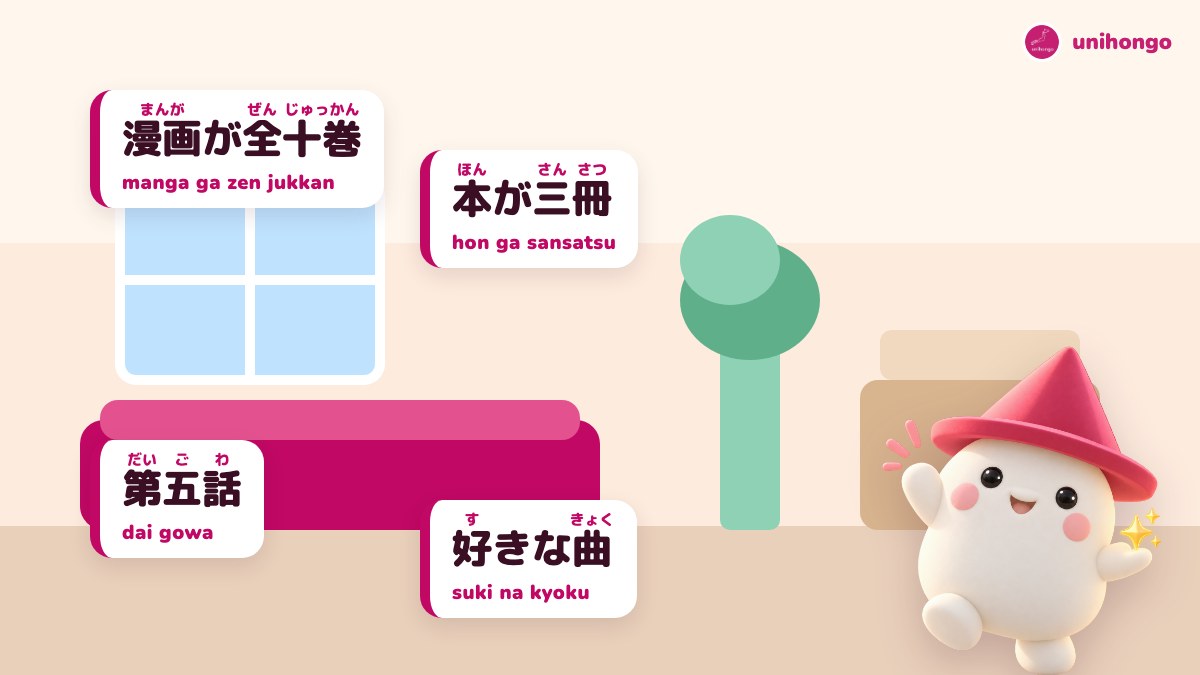
Two friends chat casually about a manga that has just become an anime. Notice how the counters let them compare progress quickly.
| Japanese | Romaji | Meaning |
|---|---|---|
| アニメ、何話まで見た? | Anime, nanwa made mita? | Friend: How far have you got in the anime? |
| まだ三話。原作は全部読んだよ。 | Mada sanwa. Gensaku wa zenbu yonda yo. | You: Only episode three. But I've read the whole original. |
| え、何巻まであるの? | E, nankan made aru no? | Friend: What, how many volumes are there? |
| 十二巻。三冊だけ図書館で借りた。 | Jūnikan. Sansatsu dake toshokan de karita. | You: Twelve. I borrowed three of them from the library. |
| オープニングの曲もいいよね。 | Ōpuningu no kyoku mo ii yo ne. | Friend: The opening song is great too, isn't it? |
| うん、カラオケで一曲目に歌いたい。 | Un, karaoke de ikkyokume ni utaitai. | You: Yeah, I want to sing it as my first song at karaoke. |
Gensaku means the original work, usually the manga or novel an anime is based on. Ikkyokume, the first song, uses the same me suffix as sankanme.
Discs, videos, consoles and photos
A few more counters complete the media picture. Discs such as CDs and DVDs are thin and flat, so they take 枚. Online videos are counted with 本, like films, which is how video creators talk about their uploads. Game consoles and devices are machines, so they take 台. Photos are flat, so a photo is ichimai, and shashin o ichimai is how people ask for one picture.
Many people now count streaming content with the general 本 or simply use the native series, so do not worry if you hear variation. The counters in this section are the ones most people agree on.
| Japanese | Romaji | Meaning |
|---|---|---|
| CDを二枚買いました。 | Shīdī o nimai kaimashita. | I bought two CDs. |
| 動画を三本アップしました。 | Dōga o sanbon appu shimashita. | I uploaded three videos. |
| ゲーム機を一台持っています。 | Gēmuki o ichidai motte imasu. | I have one games console. |
| 写真を一枚撮ってもいいですか。 | Shashin o ichimai totte mo ii desu ka. | May I take a photo? |
Common mistakes with media counters
- Using 冊 for episodes or songs. 冊 is only for bound things; episodes take 話 and songs take 曲.
- Saying ichisatsu or hachisatsu. One and eight books are issatsu and hassatsu.
- Saying sankan when you mean the third volume and the listener hears three volumes. Add me, sankanme, when order matters.
- Counting films with 話. A film is ippon; 話 is for episodes in a series.
- Forgetting that ikkan can mean volume one. On a shop shelf, ikkan usually means the first volume.
Talk about your favourite series
Tell Mocchi about something you are reading or watching, in Japanese, and add: correct my counters and ask me follow-up questions. Mocchi checks your 冊, 巻 and 話, asks a question or two to keep you talking, and remembers the series you like, so later chats and quizzes can use it.
When you want to say it aloud, choose the anime topic in AI Sensei and ask Sakura-sensei to play a fellow fan who wants to know how far you have got. The session report lists any counters the Sensei corrected.