
Four sentences for the first weeks
Early pregnancy is when you most need simple, clear sentences, often at places that have nothing to do with maternity care: a dentist, a pharmacy, a company health check. Say that you are pregnant first, because it changes which medicines and tests are suitable.
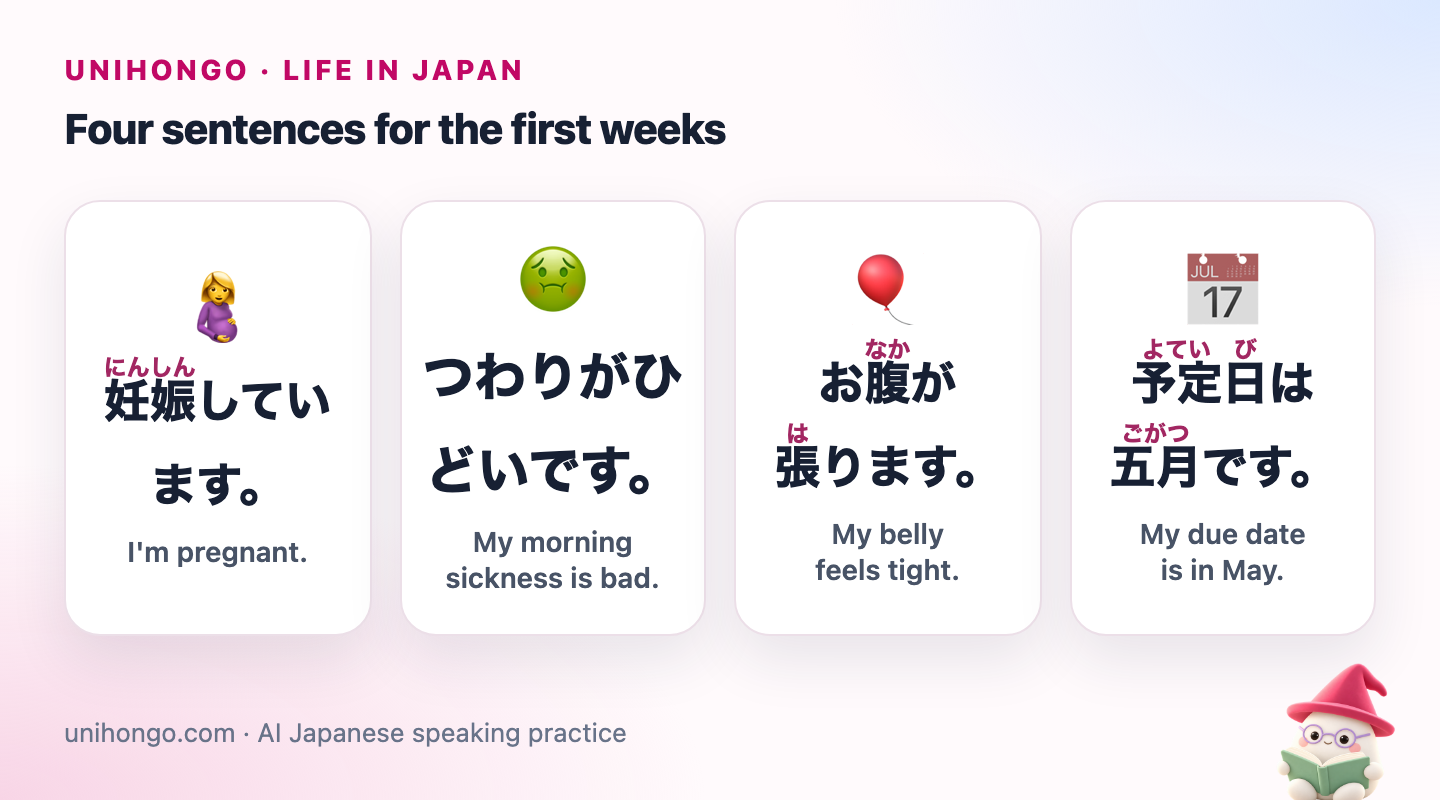
Tsuwari is the everyday word for morning sickness, even though it is not limited to mornings. Onaka ga haru describes the belly tightening or feeling hard, a sensation doctors often ask about.
| Japanese | Romaji | Meaning |
|---|---|---|
| 妊娠しています。 | Ninshin shite imasu. | I'm pregnant. |
| つわりがひどいです。 | Tsuwari ga hidoi desu. | My morning sickness is bad. |
| お腹が張ります。 | Onaka ga harimasu. | My belly feels tight. |
| 予定日は五月です。 | Yoteibi wa gogatsu desu. | My due date is in May. |
| 今、十二週目です。 | Ima, jūnishūme desu. | I'm in week twelve now. |
Registering the pregnancy and the handbook
After a doctor confirms the pregnancy, you usually submit a pregnancy notification (妊娠届, ninshin todoke) at your city or ward office, or a health centre the city designates. You then receive the boshi techō and, in many cities, a set of checkup vouchers and information about local support, sometimes with an interview with a public health nurse. The exact papers, the vouchers' number and value, and any additional support all vary by municipality, so ask at the counter what you are entitled to.
| Japanese | Romaji | Meaning |
|---|---|---|
| 妊娠届を出したいです。 | Ninshin todoke o dashitai desu. | I'd like to submit a pregnancy notification. |
| 外国語の母子手帳はありますか。 | Gaikokugo no boshi techō wa arimasu ka. | Do you have the handbook in other languages? |
| 受診票はいつから使えますか。 | Jushinhyō wa itsu kara tsukaemasu ka. | From when can I use the checkup vouchers? |
| ほかにどんな支援がありますか。 | Hoka ni donna shien ga arimasu ka. | What other support is available? |
Remember the word shien (support). City offices use it for many programmes for families, and asking what shien exists is often the quickest way to learn about services you would not otherwise find.
At the checkup: what usually happens
A typical prenatal checkup includes a urine test, weight and blood pressure, a look at swelling, and often an ultrasound, called ekō in everyday speech. As the weeks go on, you may also have blood tests, a check of the baby's heartbeat and position, and later, monitoring of contractions. Staff often give instructions in short forms, and the doctor talks while watching the screen.
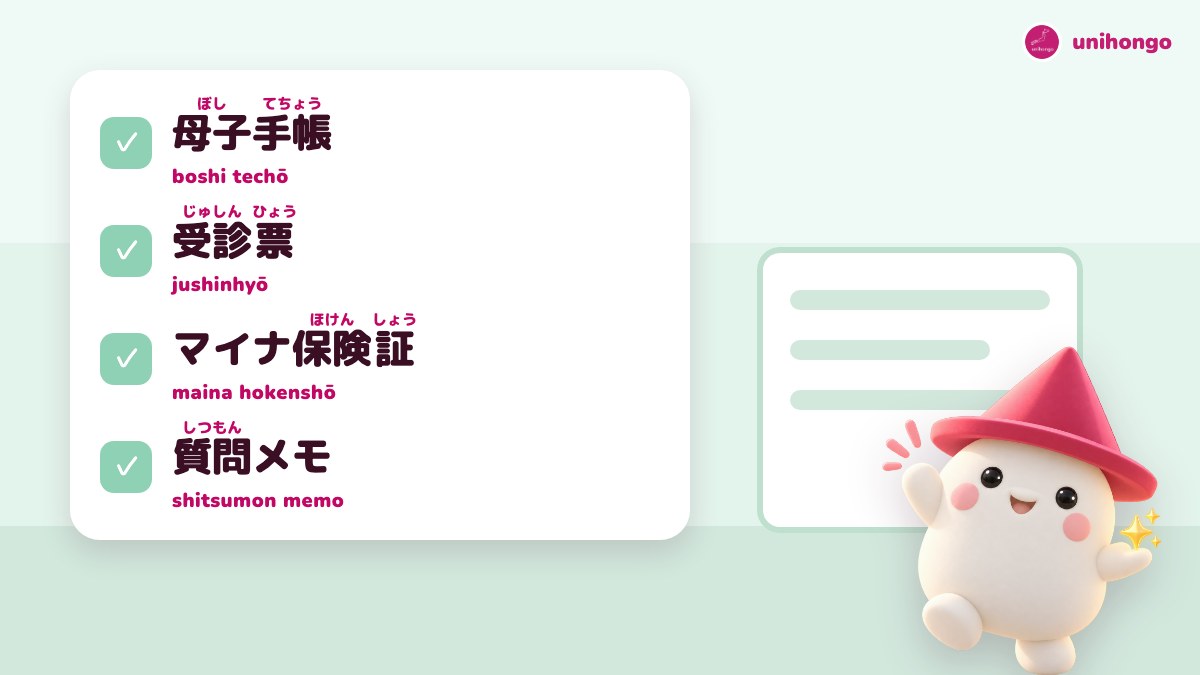
The checklist below shows what many clinics expect you to bring; your clinic may add its own items.
| Japanese | Romaji | Meaning |
|---|---|---|
| 尿検査をお願いします。 | Nyō kensa o onegai shimasu. | Staff: Please do a urine test. |
| 体重と血圧を測ってください。 | Taijū to ketsuatsu o hakatte kudasai. | Staff: Please check your weight and blood pressure. |
| エコーで見てみましょう。 | Ekō de mite mimashō. | Doctor: Let's take a look on the ultrasound. |
| 心臓の音、聞こえますね。 | Shinzō no oto, kikoemasu ne. | Doctor: You can hear the heartbeat. |
| 順調ですね。 | Junchō desu ne. | Doctor: Everything is going well. |
| 写真をもらえますか。 | Shashin o moraemasu ka. | Could I have a printout? |
Describing symptoms and asking questions
Doctors and midwives ask about specific signs, and some of them are hard to describe in a second language. Learn the words below and prepare your questions in advance. Write them in your boshi techō or on a note; asking from a written list is normal.
| Japanese | Romaji | Meaning |
|---|---|---|
| 胎動を感じます。 | Taidō o kanjimasu. | I can feel the baby moving. |
| 胎動が少ない気がします。 | Taidō ga sukunai ki ga shimasu. | I feel the baby is moving less. |
| 少し出血がありました。 | Sukoshi shukketsu ga arimashita. | There was a little bleeding. |
| 足がむくんでいます。 | Ashi ga mukunde imasu. | My legs are swollen. |
| この薬は飲んでも大丈夫ですか。 | Kono kusuri wa nonde mo daijōbu desu ka. | Is it safe to take this medicine? |
| 食べてはいけない物はありますか。 | Tabete wa ikenai mono wa arimasu ka. | Are there foods I should avoid? |
Clinics usually tell you which signs mean you should call straight away, such as bleeding, strong regular pain or fewer movements. Ask for the phone number for nights and holidays and save it in your phone: Yoru ya kyūjitsu wa doko ni denwa sureba ii desu ka.
Planning the birth
Around the middle of pregnancy you decide or confirm where to give birth. Some clinics handle checkups only, and you move to a hospital later; others handle everything. Birth centres run by midwives (助産院, josan'in) are another option for low-risk pregnancies. Options such as pain relief during labour, called mutsū bunben, and partner attendance, tachiai shussan, differ a lot between hospitals, so ask early.
| Japanese | Romaji | Meaning |
|---|---|---|
| ここで出産できますか。 | Koko de shussan dekimasu ka. | Can I give birth here? |
| 無痛分娩はできますか。 | Mutsū bunben wa dekimasu ka. | Do you offer pain relief during labour? |
| 夫も立ち会えますか。 | Otto mo tachiaemasu ka. | Can my husband be present? |
| Topic | Word | What to ask |
|---|---|---|
| Where to give birth | 分娩予約 (bunben yoyaku) | When do I need to book the birth? |
| Pain relief | 無痛分娩 (mutsū bunben) | Is it available, and is it planned or on request? |
| Partner present | 立ち会い出産 (tachiai shussan) | Can my partner be there? |
| Going home to give birth | 里帰り出産 (satogaeri shussan) | By which week must I transfer? |
| Classes | 両親学級 (ryōshin gakkyū) | Are there classes for parents, and in which language? |
Japanese for the partner
Partners often handle phone calls, paperwork and the drive to the hospital. A few lines make that easier. Use the polite form on the phone, and remember that when labour starts, the hospital usually asks you to call before coming in.
| Japanese | Romaji | Meaning |
|---|---|---|
| 妻の陣痛が始まったようです。 | Tsuma no jintsū ga hajimatta yō desu. | Partner: I think my wife's contractions have started. |
| 間隔は十分ぐらいです。 | Kankaku wa juppun gurai desu. | Partner: They're about ten minutes apart. |
| 破水したかもしれません。 | Hasui shita kamo shiremasen. | Partner: Her waters may have broken. |
| 今から向かってもいいですか。 | Ima kara mukatte mo ii desu ka. | Partner: May we come in now? |
Common learner mistakes
- Not mentioning the pregnancy at other clinics. Dentists, pharmacists and radiographers all need to know.
- Mixing up ninshin (pregnancy) and ninshiki (recognition). Practise ninshin shite imasu until it is automatic.
- Leaving the boshi techō at home. Many clinics will not record the checkup without it.
- Assuming a friend's city gives the same vouchers. Support differs by municipality; ask your own office.
- Waiting until late to book the birth. In some areas popular hospitals fill up early, so ask at the first visits.
Keep the new words close between visits
Ask Mocchi: Make flashcards for prenatal checkup words such as tsuwari, taidō, yoteibi and junchō. Mocchi creates the cards with /create-flashcards, and /review-flashcards brings them back at spaced intervals, focusing on the ones you miss.
For quick review on the train, play Flashcard Flip on the games page using those same cards. Matching onaka no hari or taidō in a few seconds is exactly the kind of instant recognition you need in a busy consulting room.