
The four lines to know by heart
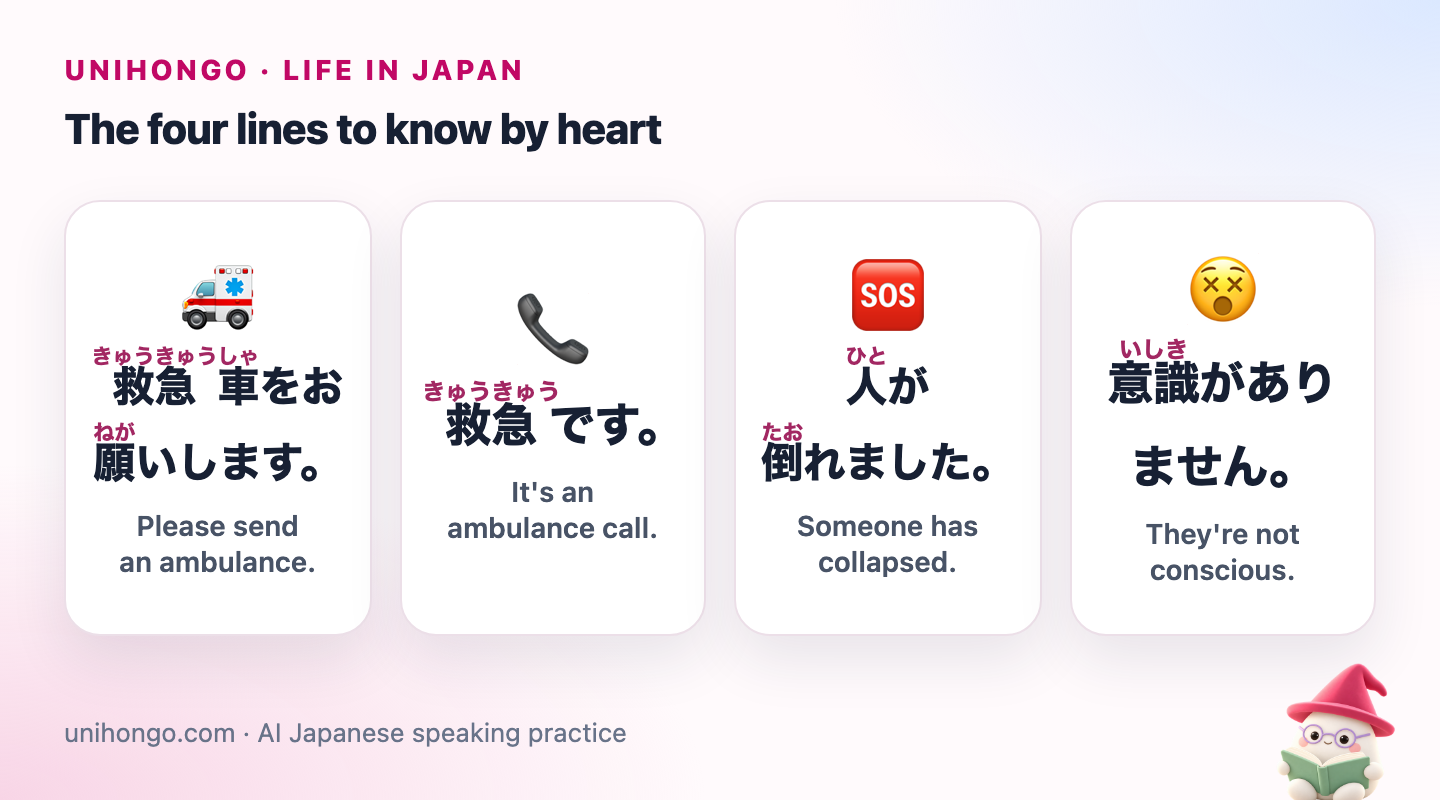
If you remember nothing else, remember these. The first is a request anyone will understand. The second is the answer to the operator's very first question. The last two describe the two situations that most need speed: someone has collapsed, and they are not responding.
| Japanese | Romaji | Meaning |
|---|---|---|
| 救急車をお願いします。 | Kyūkyūsha o onegai shimasu. | Please send an ambulance. |
| 救急です。 | Kyūkyū desu. | It's an ambulance call. |
| 人が倒れました。 | Hito ga taoremashita. | Someone has collapsed. |
| 意識がありません。 | Ishiki ga arimasen. | They're not conscious. |
The operator's questions, in order
Operators follow a fixed sequence, and knowing it lets you predict each question. They speak calmly and quite fast, using polite but simple forms. The table shows the usual order; the exact words vary.
| Japanese | Romaji | Meaning |
|---|---|---|
| 火事ですか、救急ですか。 | Kaji desu ka, kyūkyū desu ka. | Operator: Fire or ambulance? |
| 住所を教えてください。 | Jūsho o oshiete kudasai. | Operator: Please tell me the address. |
| どうしましたか。 | Dō shimashita ka. | Operator: What happened? |
| 意識はありますか。 | Ishiki wa arimasu ka. | Operator: Are they conscious? |
| 息はしていますか。 | Iki wa shite imasu ka. | Operator: Are they breathing? |
| 何歳ぐらいの方ですか。 | Nansai gurai no kata desu ka. | Operator: About how old are they? |
| お名前と電話番号をお願いします。 | Onamae to denwa bangō o onegai shimasu. | Operator: Your name and phone number, please. |
| Order | What the operator asks | What you give |
|---|---|---|
| 1 | Fire or ambulance? | Kyūkyū desu |
| 2 | The address or location | City, district, block numbers, building, room |
| 3 | What happened | One short sentence: collapsed, fell, can't breathe |
| 4 | Conscious? Breathing? | Hai or iie, or arimasu / arimasen |
| 5 | Age and sex | An approximate age is fine |
| 6 | Your name and phone number | Your name and the number you are calling from |
Saying where you are
The location is the most important answer, so prepare it in advance. Japanese addresses go from large to small: prefecture or city, ward, district, then block numbers, often written as 3-5-2 and read as san chōme go ban ni gō or simply san no go no ni. Add the building name and room number. If you are outside, give a landmark: a station exit, a convenience store, a school or a large intersection.
If you really do not know the address, describe what you can see, and say so plainly. Operators can sometimes locate mobile callers, but never rely on it.
| Japanese | Romaji | Meaning |
|---|---|---|
| 住所は、みどり町三丁目五番二号です。 | Jūsho wa, Midori chō san chōme go ban ni gō desu. | The address is 3-5-2 Midori-chō. |
| さくらマンションの二〇三号室です。 | Sakura Manshon no ni maru san gōshitsu desu. | It's room 203 in the Sakura Mansion building. |
| 駅の北口の前です。 | Eki no kitaguchi no mae desu. | In front of the north exit of the station. |
| 近くにコンビニがあります。 | Chikaku ni konbini ga arimasu. | There's a convenience store nearby. |
| 住所が分かりません。 | Jūsho ga wakarimasen. | I don't know the address. |
Describing what happened and the person's state
One short sentence is better than a long story. Start with the main event, then answer the operator's yes-or-no questions. If you are not sure, say wakarimasen; operators prefer an honest unknown to a guess.
| Japanese | Romaji | Meaning |
|---|---|---|
| 急に倒れました。 | Kyū ni taoremashita. | They suddenly collapsed. |
| 階段から落ちました。 | Kaidan kara ochimashita. | They fell down the stairs. |
| 胸が痛いと言っています。 | Mune ga itai to itte imasu. | They say their chest hurts. |
| 息が苦しそうです。 | Iki ga kurushisō desu. | They seem to be struggling to breathe. |
| 呼びかけても反応しません。 | Yobikakete mo hannō shimasen. | They don't respond when I call them. |
| 血がたくさん出ています。 | Chi ga takusan dete imasu. | There's a lot of bleeding. |
| 三十代の男性です。 | Sanjūdai no dansei desu. | A man in his thirties. |
| 日本語があまり話せません。 | Nihongo ga amari hanasemasen. | I can't speak much Japanese. |
If the operator gives instructions, such as how to check breathing or start chest compressions, follow them and say hai after each step so they know you are with them. Do not hang up until the operator says you can.
A complete call, start to finish
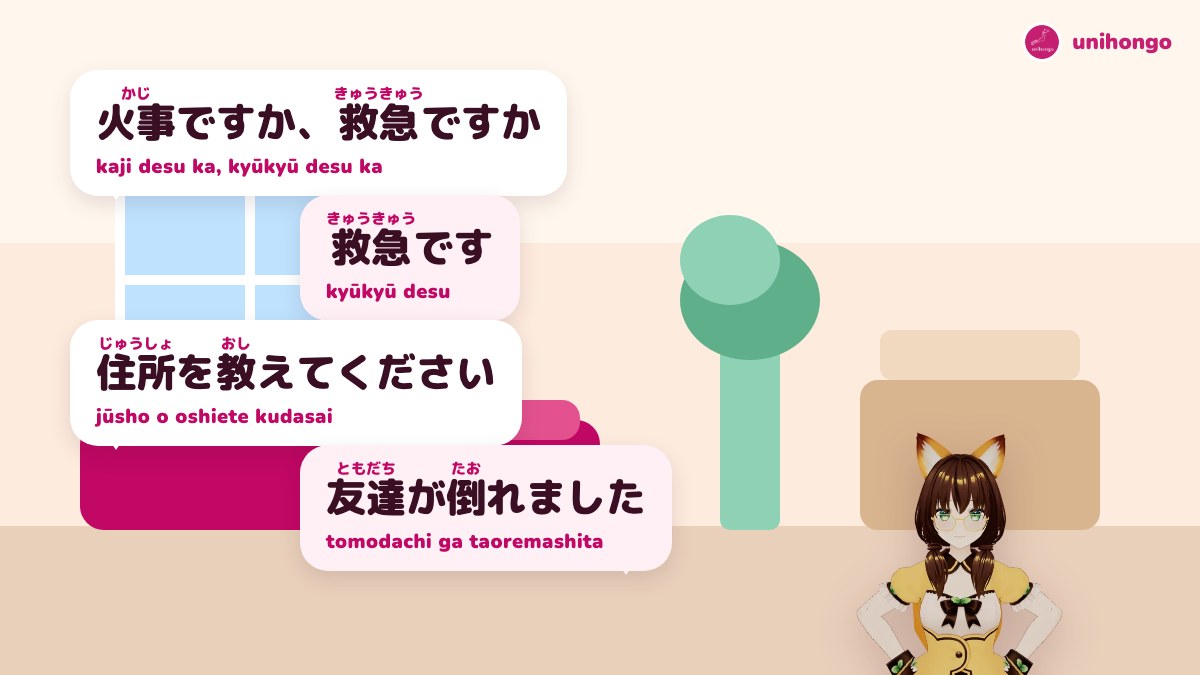
Here is a typical call from someone at home, with short, clear answers. Real calls are often faster and the operator may combine questions, but the shape is the same.
| Japanese | Romaji | Meaning |
|---|---|---|
| はい、119番です。火事ですか、救急ですか。 | Hai, hyakujūkyū ban desu. Kaji desu ka, kyūkyū desu ka. | Operator: 119. Fire or ambulance? |
| 救急です。 | Kyūkyū desu. | You: Ambulance. |
| 住所を教えてください。 | Jūsho o oshiete kudasai. | Operator: Please tell me the address. |
| みどり町三丁目五番二号、二〇三号室です。 | Midori chō san chōme go ban ni gō, ni maru san gōshitsu desu. | You: 3-5-2 Midori-chō, room 203. |
| どうしましたか。 | Dō shimashita ka. | Operator: What happened? |
| 友達が急に倒れました。 | Tomodachi ga kyū ni taoremashita. | You: My friend suddenly collapsed. |
| 意識はありますか。 | Ishiki wa arimasu ka. | Operator: Is your friend conscious? |
| 目は開けていますが、話せません。 | Me wa akete imasu ga, hanasemasen. | You: Their eyes are open, but they can't speak. |
| 救急車が向かっています。そのまま電話を切らないでください。 | Kyūkyūsha ga mukatte imasu. Sono mama denwa o kiranaide kudasai. | Operator: An ambulance is on its way. Stay on the line. |
While you wait, and what to bring
If someone else is with you, one person can go outside to guide the ambulance, especially in apartment buildings or narrow streets. Unlock the door, turn on lights, and secure pets. Gather what the hospital will want: the person's insurance card or My Number card used as one, their medicine notebook (okusuri techō) or a list of medicines, shoes, money and a phone. When the crew arrives, they will ask some of the same questions again; answer them the same way.
| Japanese | Romaji | Meaning |
|---|---|---|
| 外で待っています。 | Soto de matte imasu. | I'll wait outside. |
| こちらです! | Kochira desu! | Over here! |
| 持病があります。 | Jibyō ga arimasu. | They have a chronic condition. |
| この薬を飲んでいます。 | Kono kusuri o nonde imasu. | They take this medicine. |
| 一緒に行ってもいいですか。 | Issho ni itte mo ii desu ka. | May I come with them? |
When it is not clearly an emergency
If you are unsure whether to call an ambulance, many areas run #7119, a phone line where medical staff help you decide, and some cities and prefectures offer a web or app version with the same purpose. Coverage is not nationwide, and opening hours and languages differ, so check what your area offers before you need it. Your city office or international association usually lists night and holiday clinics as well.
- Clear emergency, such as collapse, no breathing, severe bleeding or chest pain: call 119.
- Unsure, and the person is stable: call #7119 if your area has it.
- Minor illness at night: look up the local night or holiday clinic.
Make the call automatic
Rehearsal is what turns this page into something you can actually say. Ask Mocchi: Play a 119 operator and ask me the questions one at a time, then correct my answers. Mocchi checks each reply, points out where a word was unclear and remembers your address practice, so you can pick up from there next week.
Then say it out loud with a voice on the other end. In AI Sensei, choose Ibuki-sensei and the travel emergency topic, and ask Ibuki-sensei to act as the 119 operator, speaking at natural speed. Practise giving your real address until it comes out in one breath.