
The four lines that carry the whole morning
A checkup is a chain of short stations, and at almost every one you hear some version of the same few instructions. If you recognise them instantly, you can relax and follow along even when the rest of the sentence goes past too quickly.
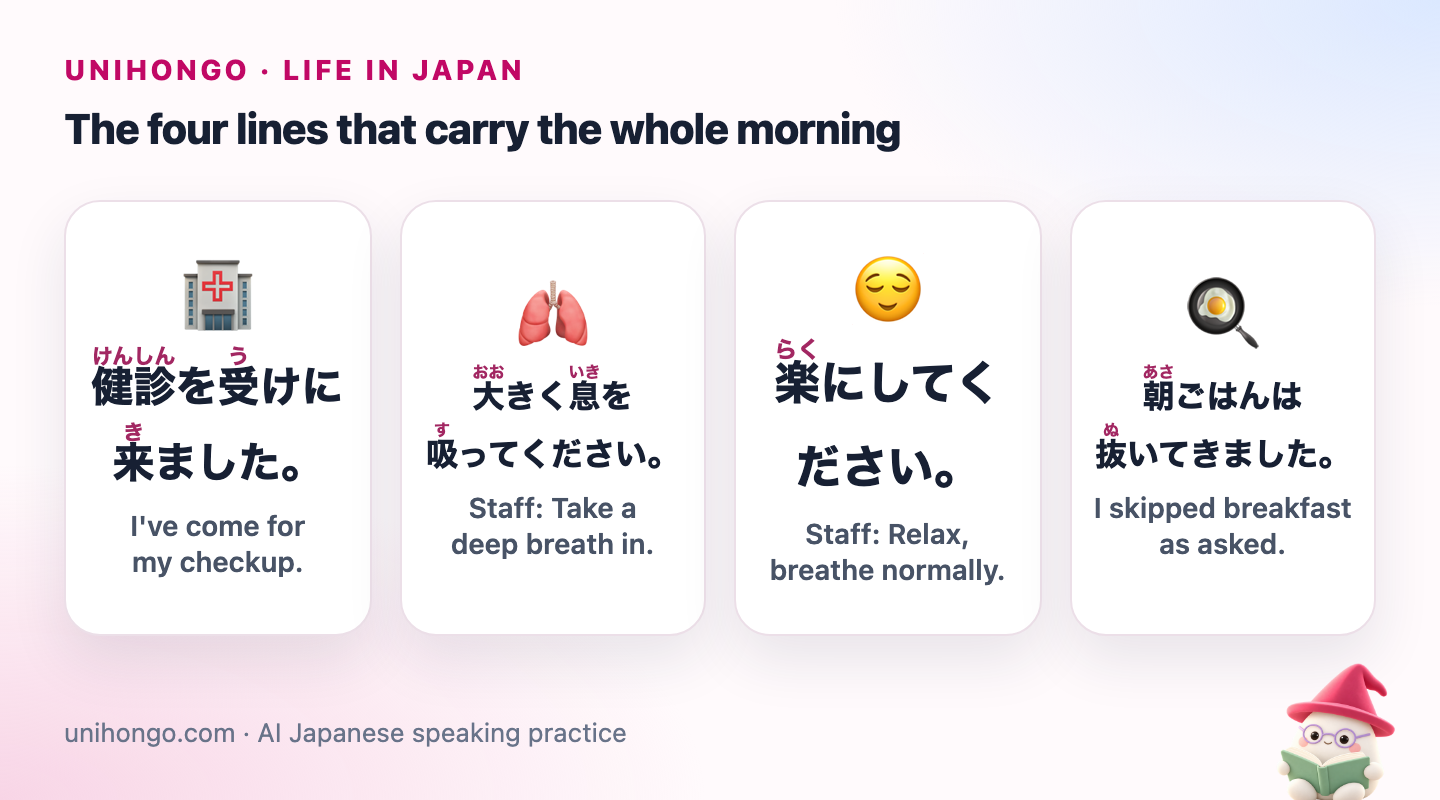
The first line below is yours, for the reception desk. The other three are what staff say to you again and again: breathe in deeply, relax, and the question about breakfast that confirms you have followed the fasting rule.
| Japanese | Romaji | Meaning |
|---|---|---|
| 健診を受けに来ました。 | Kenshin o uke ni kimashita. | I've come for my checkup. |
| 大きく息を吸ってください。 | Ōkiku iki o sutte kudasai. | Staff: Take a deep breath in. |
| 楽にしてください。 | Raku ni shite kudasai. | Staff: Relax, breathe normally. |
| 朝ごはんは抜いてきました。 | Asagohan wa nuite kimashita. | I skipped breakfast as asked. |
| はい、分かりました。 | Hai, wakarimashita. | Yes, understood. |
Before the day: the envelope, the kit and the rules
Your checkup usually begins with an envelope or an email. It may contain a questionnaire (問診票, monshinhyō), a sheet with your appointment time, and sometimes small containers for samples. A common one is a stool test kit (検便, kenben), often collected on two different days before the checkup, and a urine cup that you may use at home or at the clinic. Whether you collect samples at home, and when, depends on your programme.
The other rule to look for is fasting. Many programmes ask you not to eat from a set time the evening before; some allow water, and some ask you to skip medicine until after the blood test. Do not guess: read the sheet, and if anything is unclear, phone the clinic. The phrases below are what you might say on that call.
| Japanese | Romaji | Meaning |
|---|---|---|
| 前の日の夜は何時まで食べられますか。 | Mae no hi no yoru wa nanji made taberaremasu ka. | Until what time can I eat the night before? |
| 水は飲んでもいいですか。 | Mizu wa nonde mo ii desu ka. | May I drink water? |
| いつもの薬は飲んでもいいですか。 | Itsumo no kusuri wa nonde mo ii desu ka. | May I take my usual medicine? |
| 検便の容器を忘れました。 | Kenben no yōki o wasuremashita. | I forgot my stool sample container. |
| 当日に持っていけばいいですか。 | Tōjitsu ni motte ikeba ii desu ka. | Should I just bring it on the day? |
Notice the pattern 〜てもいいですか, may I…? It is the safest way to ask about any rule, and staff answer with dōzo (go ahead), daijōbu desu (that's fine) or chotto… (that's a problem), which usually means no.
At reception: forms, the gown and your number
At reception you hand over your forms and samples and confirm your identity. Depending on the programme, you may be asked for your insurance card or the My Number card used as one, a voucher from your city, or nothing but your name. You often receive a file or a card that travels with you from station to station, and in larger centres a number that is called instead of your name.
Many clinics ask you to change into a simple gown or top and leave your bag in a locker. Staff will tell you what to remove, typically jewellery, a watch and anything metal before the chest X-ray.
| Japanese | Romaji | Meaning |
|---|---|---|
| お名前と生年月日をお願いします。 | Onamae to seinengappi o onegai shimasu. | Staff: Your name and date of birth, please. |
| 問診票はご記入いただけましたか。 | Monshinhyō wa gokinyū itadakemashita ka. | Staff: Did you fill in the questionnaire? |
| 一か所、分からないところがあります。 | Ikkasho, wakaranai tokoro ga arimasu. | There's one part I didn't understand. |
| こちらに着替えてください。 | Kochira ni kigaete kudasai. | Staff: Please change into this. |
| アクセサリーは外してください。 | Akusesarī wa hazushite kudasai. | Staff: Please take off any jewellery. |
| 番号でお呼びします。 | Bangō de oyobi shimasu. | Staff: We'll call you by your number. |
Instructions you will hear, station by station
The order changes between clinics, and not every programme includes every test, but the instructions at each station are very similar everywhere. The table gives the gist so you know what is coming; the phrases after it are the exact lines to train your ear on.
| Japanese | Romaji | Meaning |
|---|---|---|
| 靴を脱いで、まっすぐ立ってください。 | Kutsu o nuide, massugu tatte kudasai. | Staff: Shoes off, and stand up straight. |
| 袖をまくってください。 | Sode o makutte kudasai. | Staff: Please roll up your sleeve. |
| 片目を隠してください。 | Katame o kakushite kudasai. | Staff: Please cover one eye. |
| 音が聞こえたらボタンを押してください。 | Oto ga kikoetara botan o oshite kudasai. | Staff: Press the button when you hear a sound. |
| 手をぎゅっと握ってください。 | Te o gyutto nigitte kudasai. | Staff: Make a tight fist. |
| ここを押さえていてください。 | Koko o osaete ite kudasai. | Staff: Keep pressing here. |
| 胸を板につけてください。 | Mune o ita ni tsukete kudasai. | Staff: Put your chest against the panel. |
| はい、吸って、止めて。 | Hai, sutte, tomete. | Staff: OK, breathe in, and hold it. |
| 横になってください。 | Yoko ni natte kudasai. | Staff: Please lie down. |
| Station | What staff typically ask | What you do |
|---|---|---|
| Height and weight | Shoes off, stand straight, look ahead | Step on, stand still until they say it's done |
| Blood pressure | Roll up your sleeve, rest your arm | Sit still and do not talk while the cuff tightens |
| Eyesight | Cover one eye, say where the gap is | Answer up, down, right or left |
| Hearing | Press the button when you hear a sound | Press for each beep, even a faint one |
| Blood test | Make a fist, relax your hand, press here | Hold the cotton on the spot for a while |
| Chest X-ray | Chest to the panel, breathe in, hold it | Hold still until you hear raku ni |
| ECG | Lie down, open your top, relax | Lie still while small clips are attached |
Hai, sutte, tomete is the clipped form you will really hear in the X-ray room. Staff drop kudasai to keep the rhythm short, and the hai at the start just means OK, here we go. It is not rude; it is simply efficient.
Why staff keep saying 〜ますね
A large part of the checkup is announced rather than requested. Instead of asking may I take your blood pressure, a nurse says ketsuatsu o hakarimasu ne, I'll take your blood pressure now. The ne softens the sentence and invites agreement, a bit like OK? in English. You are not expected to give permission; a short hai or onegai shimasu is the natural reply.
Learners sometimes freeze, thinking that they missed a question. Listen for the ending: 〜ますか with a rising tone is a question that needs an answer, while 〜ますね is a friendly announcement.
| Japanese | Romaji | Meaning |
|---|---|---|
| 血圧を測りますね。 | Ketsuatsu o hakarimasu ne. | Staff: I'll take your blood pressure, OK? |
| ちょっとチクッとしますね。 | Chotto chikutto shimasu ne. | Staff: You'll feel a little prick. |
| 少し冷たいですよ。 | Sukoshi tsumetai desu yo. | Staff: This will feel a bit cold. |
| はい、お願いします。 | Hai, onegai shimasu. | You: Yes, go ahead. |
| お疲れさまでした。 | Otsukaresama deshita. | Staff: All done, thank you. |
Mini dialogue: the blood test
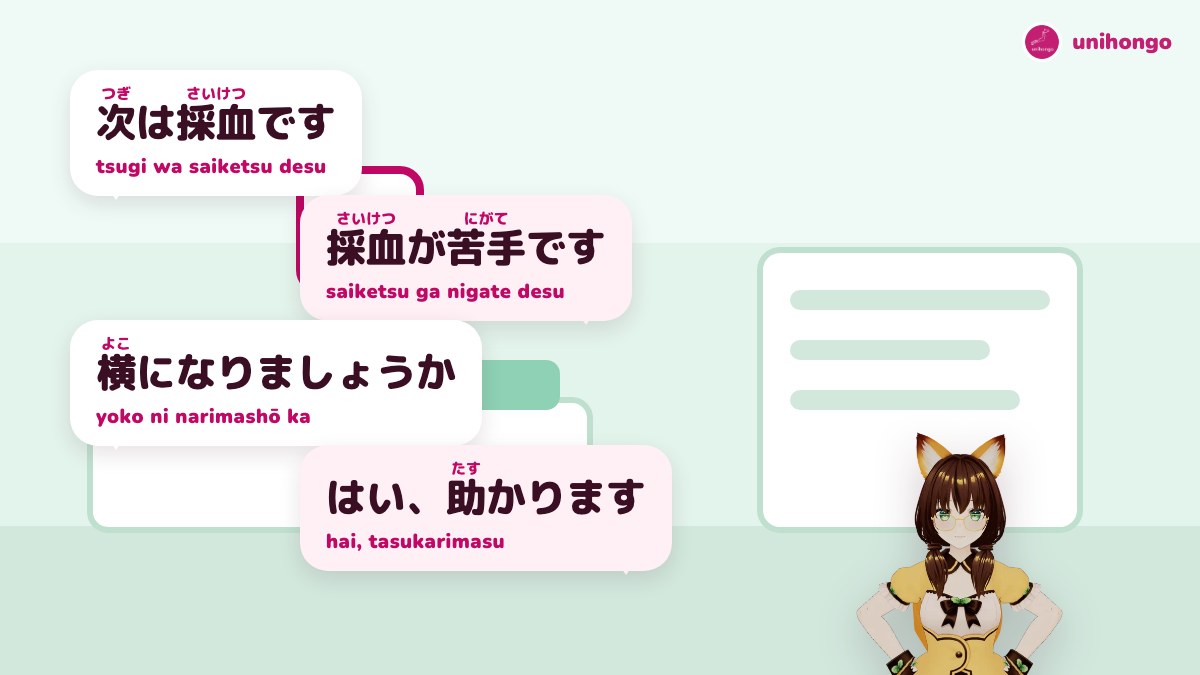
The blood test is the station where a little Japanese helps most, because you can mention a fear of needles, a fainting history or the arm that usually works best. Here is a typical exchange at a busy checkup centre.
| Japanese | Romaji | Meaning |
|---|---|---|
| 次は採血です。どうぞおかけください。 | Tsugi wa saiketsu desu. Dōzo okake kudasai. | Nurse: Next is the blood test. Please take a seat. |
| すみません、採血が苦手です。 | Sumimasen, saiketsu ga nigate desu. | You: Sorry, I'm not good with blood tests. |
| 気分が悪くなったことはありますか。 | Kibun ga waruku natta koto wa arimasu ka. | Nurse: Have you ever felt unwell during one? |
| はい、前に一度ありました。 | Hai, mae ni ichido arimashita. | You: Yes, once before. |
| では、横になってやりましょうか。 | Dewa, yoko ni natte yarimashō ka. | Nurse: Then shall we do it lying down? |
| はい、助かります。 | Hai, tasukarimasu. | You: Yes, that would really help. |
| 左腕のほうが採りやすいです。 | Hidari ude no hō ga toriyasui desu. | You: My left arm is usually easier. |
| はい、終わりました。五分押さえてください。 | Hai, owarimashita. Gofun osaete kudasai. | Nurse: Done. Press on it for five minutes. |
Replies that keep things moving
You do not need much. The lines below cover not understanding, asking where to go next, and saying that something is wrong. Keep them polite but short; at a busy checkup, a quick clear reply is more helpful than a long careful one.
| Japanese | Romaji | Meaning |
|---|---|---|
| すみません、もう一度お願いします。 | Sumimasen, mō ichido onegai shimasu. | Sorry, once more, please. |
| ゆっくり言ってもらえますか。 | Yukkuri itte moraemasu ka. | Could you say it slowly? |
| 次はどこに行けばいいですか。 | Tsugi wa doko ni ikeba ii desu ka. | Where should I go next? |
| 気分が悪いです。 | Kibun ga warui desu. | I feel unwell. |
| これで全部終わりですか。 | Kore de zenbu owari desu ka. | Is that everything? |
| 結果はいつ届きますか。 | Kekka wa itsu todokimasu ka. | When will the results arrive? |
Common learner mistakes
- Answering every 〜ますね as if it were a question. A simple hai is enough; save longer answers for sentences ending in 〜ますか.
- Eating breakfast out of habit. If your sheet says no food, even coffee with milk can mean the blood test has to be repeated. Ask beforehand rather than on the day.
- Saying daijōbu desu to mean no thanks and yes, I'm fine at the same time. If you feel dizzy, say kibun ga warui desu clearly instead of politely insisting you are fine.
- Talking during the blood pressure reading. Staff may say ohanashi wa chotto, which is a gentle please don't talk.
- Leaving without the small final step. Some clinics ask you to return the file to reception or to answer a few questions before you go; listen for kochira de saigo desu, this is the last one.
Rehearse the checkup before the day
Ask Mocchi to turn this page into practice: type Quiz me on the instructions Japanese staff give at a health checkup, one at a time. Mocchi gives you a line such as sode o makutte kudasai, asks what you should do, and explains anything you miss. If one form question puzzled you, paste it after /explain and Mocchi breaks the sentence down word by word.
Then take the listening into a spoken scene. In AI Sensei, choose Haru-sensei and the clinic reception topic, and ask Haru-sensei to play a checkup nurse who gives quick instructions in natural speed. Reply out loud, ask for a repeat at least once, and read the corrections in the session report afterwards.