
Four sentences to start a conversation
You do not need complex vocabulary to ask for support. These four lines are neutral and polite, and staff at clinics, consultation desks and workplaces will understand them immediately. The first is a general opening; the next three describe the most common reasons people seek help.
Notice the endings. Masen and nai forms describe what you cannot do, while 〜ています shows something that is continuing, which is often exactly what a doctor needs to know.
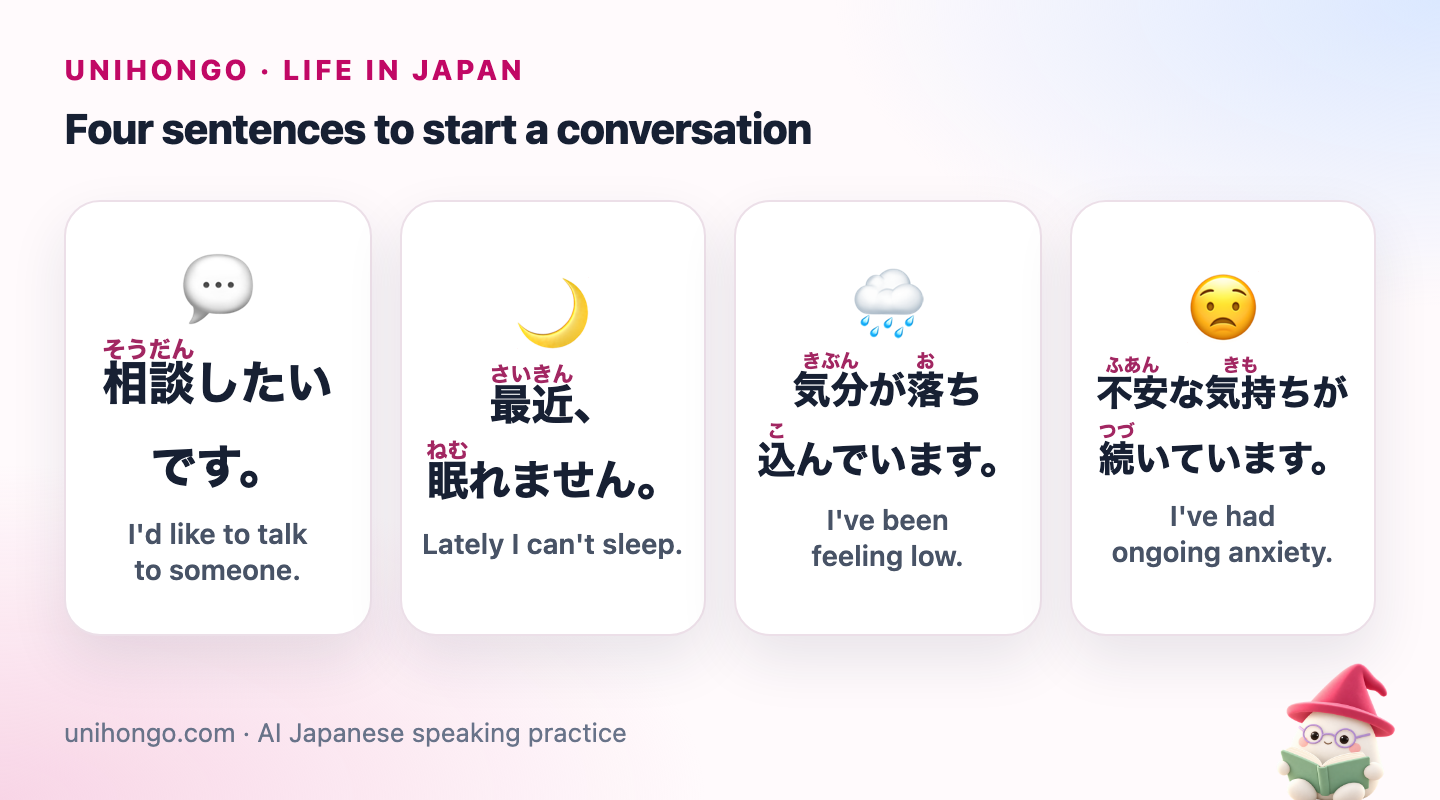
| Japanese | Romaji | Meaning |
|---|---|---|
| 相談したいです。 | Sōdan shitai desu. | I'd like to talk to someone. |
| 最近、眠れません。 | Saikin, nemuremasen. | Lately I can't sleep. |
| 気分が落ち込んでいます。 | Kibun ga ochikonde imasu. | I've been feeling low. |
| 不安な気持ちが続いています。 | Fuan na kimochi ga tsuzuite imasu. | I've had ongoing anxiety. |
Describing how you feel and how long it has lasted
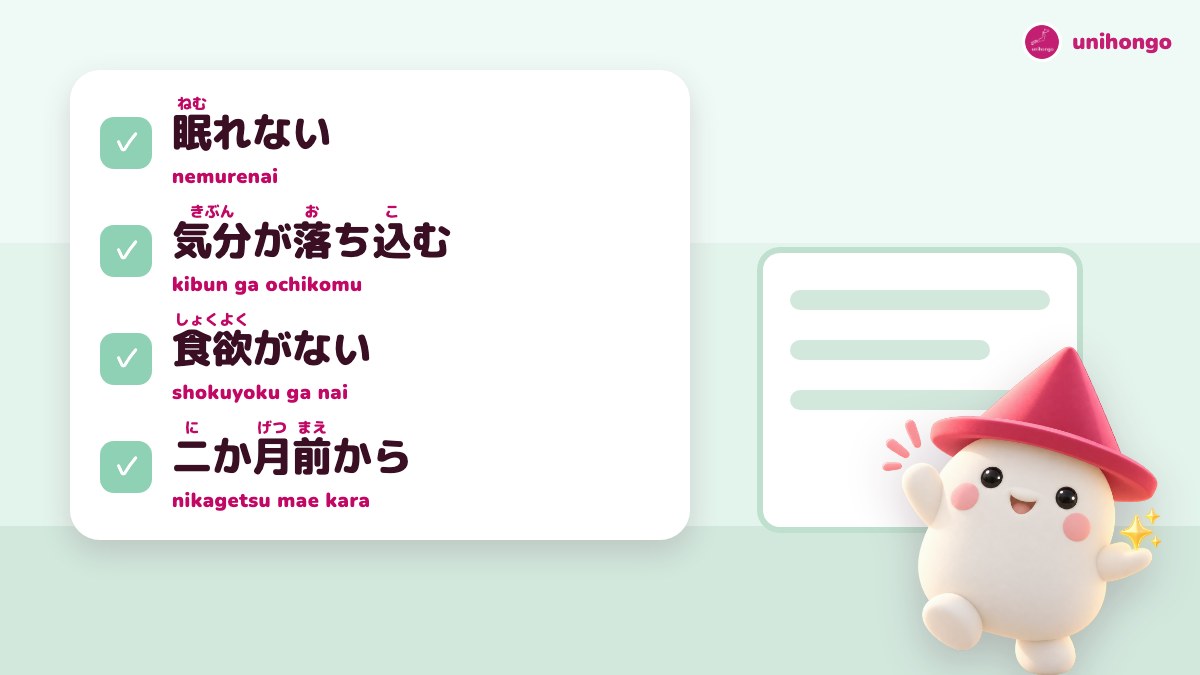
Doctors and counsellors usually ask three things first: what you have noticed, since when, and how it affects your daily life, such as work, study, eating or sleep. Short answers are fine. If you cannot find a word, describe what you can no longer do; that is often clearer than an abstract adjective.
| Japanese | Romaji | Meaning |
|---|---|---|
| 二か月ぐらい前からです。 | Nikagetsu gurai mae kara desu. | Since about two months ago. |
| 夜中に何度も目が覚めます。 | Yonaka ni nando mo me ga samemasu. | I wake up many times in the night. |
| 食欲がありません。 | Shokuyoku ga arimasen. | I have no appetite. |
| 何をしても楽しくないです。 | Nani o shite mo tanoshiku nai desu. | Nothing feels enjoyable. |
| 仕事に集中できません。 | Shigoto ni shūchū dekimasen. | I can't concentrate at work. |
| 朝、体が動きません。 | Asa, karada ga ugokimasen. | In the morning I can't get going. |
| 人と話すのがつらいです。 | Hito to hanasu no ga tsurai desu. | Talking to people is hard for me. |
| 日本語でうまく説明できません。 | Nihongo de umaku setsumei dekimasen. | I can't explain it well in Japanese. |
Tsurai is a key word. It means painful or hard to bear, emotionally or physically, and it is how many Japanese speakers describe struggling without sounding dramatic. Shigoto ga tsurai (work is really hard for me) is a sentence a doctor will take seriously.
Where people go: signs you will see
Several kinds of places offer support, and their names can be confusing. The table describes typical roles; individual clinics vary, and many accept first-time patients without a referral. Popular clinics can have waiting lists for a first visit, so booking early and asking about cancellations is common.
| Name on the sign | Typical role | Good to know |
|---|---|---|
| 心療内科 (shinryōnaika) | Stress-related physical and mental symptoms | Often a comfortable first stop |
| 精神科 (seishinka) | Psychiatry | Many clinics combine it with shinryōnaika |
| メンタルクリニック | A clinic for mental health care | A common modern name for the two above |
| カウンセリングルーム | Talking therapy with a counsellor | Often not covered by public insurance |
| 保健所, 精神保健福祉センター | Public consultation services | Run by local governments; services differ |
| 産業医 (sangyōi) | A company doctor at larger workplaces | Confidentiality rules apply; ask about them |
If you are employed, your company may also offer an employee assistance programme or a consultation desk, sometimes in English. Your city's international exchange association can often point you to local services in several languages.
Booking a first appointment
Many mental health clinics in Japan work by appointment only and ask new patients to phone or use an online form. The receptionist usually asks whether this is your first visit, what is troubling you in a few words, your insurance and when you are free. You can keep your answer short; the details are for the doctor.
| Japanese | Romaji | Meaning |
|---|---|---|
| 初診の予約をしたいのですが。 | Shoshin no yoyaku o shitai no desu ga. | I'd like to book a first appointment. |
| どのようなことでお困りですか。 | Dono yō na koto de okomari desu ka. | Receptionist: What seems to be troubling you? |
| 眠れなくて、気分も落ち込んでいます。 | Nemurenakute, kibun mo ochikonde imasu. | I can't sleep and I feel low. |
| 英語が話せる先生はいますか。 | Eigo ga hanaseru sensei wa imasu ka. | Is there a doctor who speaks English? |
| 保険は使えますか。 | Hoken wa tsukaemasu ka. | Can I use my health insurance? |
| キャンセルが出たら連絡をもらえますか。 | Kyanseru ga detara renraku o moraemasu ka. | Could you contact me if there's a cancellation? |
Words you may hear from the doctor or your workplace
After a consultation, a doctor may suggest rest, medicine, counselling or a follow-up visit. If work is part of the problem, you may hear words about certificates and leave. Ask the doctor to write down anything important; it is a normal request.
| Japanese | Romaji | Meaning |
|---|---|---|
| 診断書 | shindansho | medical certificate |
| 休職 | kyūshoku | leave of absence from work |
| 通院 | tsūin | regular outpatient visits |
| しばらく様子を見ましょう。 | Shibaraku yōsu o mimashō. | Doctor: Let's watch how it goes for a while. |
| 紙に書いてもらえますか。 | Kami ni kaite moraemasu ka. | Could you write that down for me? |
| 次はいつ来ればいいですか。 | Tsugi wa itsu kureba ii desu ka. | When should I come next? |
For ongoing outpatient care, many cities run a public support scheme that can reduce costs; clinics or the city office can explain whether it applies to you. Details differ, so ask rather than assume.
Talking to a friend or colleague
Not every conversation needs a clinic. Sometimes you want to tell a friend or a manager that you are struggling, or check on someone else. Keep it simple and honest. These lines are in polite or casual register as marked.
| Japanese | Romaji | Meaning |
|---|---|---|
| 最近ちょっと疲れてて。 | Saikin chotto tsukaretete. | Lately I've been kind of worn out. (casual) |
| 少し話を聞いてもらえますか。 | Sukoshi hanashi o kiite moraemasu ka. | Could you listen to me for a bit? (polite) |
| 大丈夫?無理しないでね。 | Daijōbu? Muri shinaide ne. | Are you OK? Don't push yourself. (casual) |
| 何かできることがあったら言ってね。 | Nanika dekiru koto ga attara itte ne. | Tell me if there's anything I can do. (casual) |
Common learner mistakes
- Using byōki (illness) for everything. Many people say chōshi ga yokunai (I'm not in good shape) or tsurai, which is gentler and accurate.
- Using the slang yamu (病む) at a clinic. It appears in casual online talk, but it is too loose for a doctor; describe the actual symptoms instead.
- Waiting to find perfect Japanese. A written note in simple sentences, or a mix of Japanese and English, is completely acceptable.
- Assuming counselling and a clinic are the same thing. Ask which professional you will see and whether insurance applies.
- Forgetting to ask about confidentiality at work. Kaisha ni wa tsutawarimasu ka (will the company be told?) is a fair question.
Prepare the words calmly, at your own pace
If writing helps, draft a short note in English and ask Mocchi to Help me turn this into simple polite Japanese I can hand to a clinic receptionist. Mocchi rewrites it, explains any word you do not know, and keeps track of the vocabulary you asked about so a later /review can bring it back.
If you would rather practise the phone call, open AI Sensei, choose Hana-sensei and the clinic reception topic, and ask Hana-sensei to play a receptionist taking a first booking. You decide how much to say; rehearsing only the booking lines is a useful step on its own.