
The words on the envelope
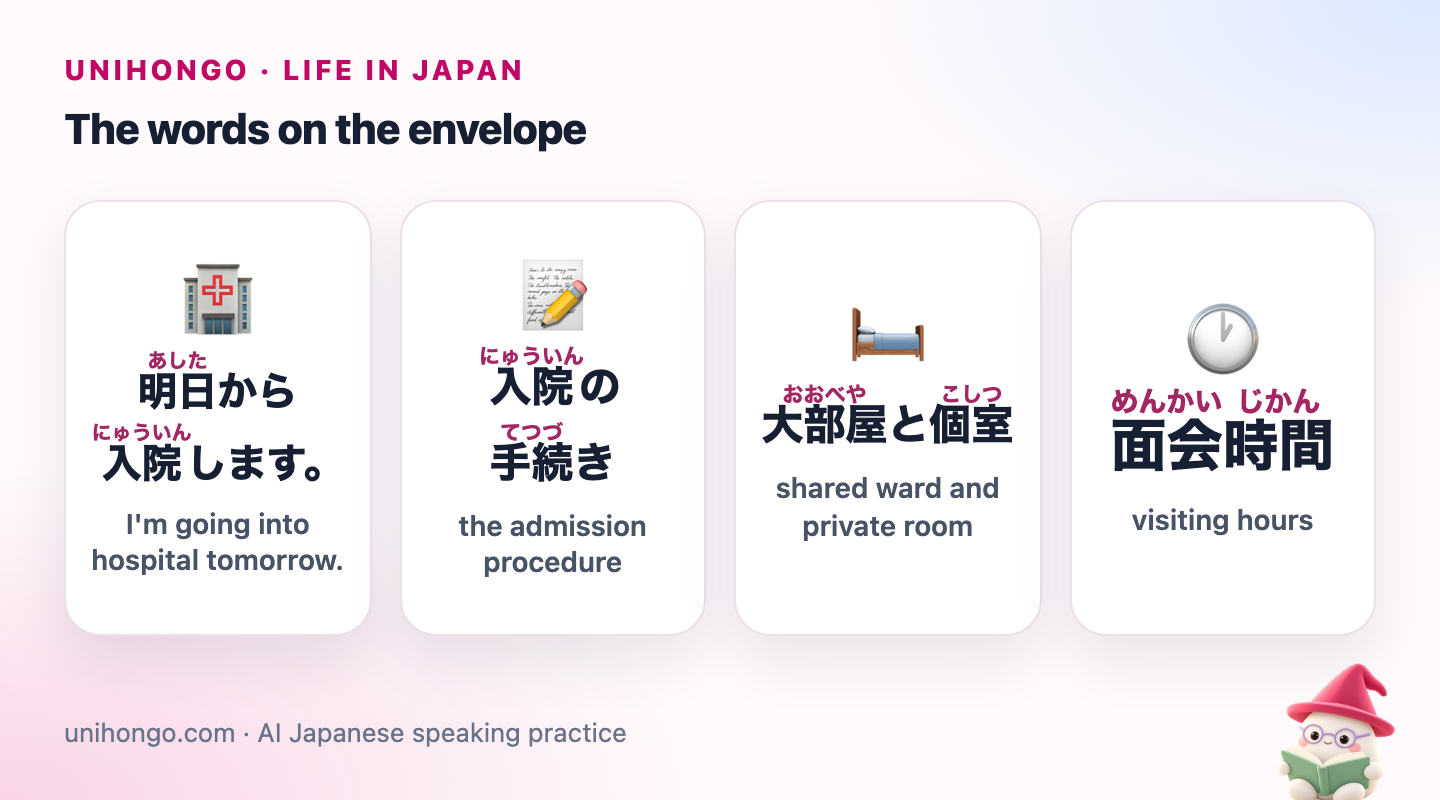
Your first contact with an admission is usually a phrase and a handful of nouns. Ashita kara nyūin shimasu is what you tell your workplace or school. The other words below appear on the envelope, the booklet and the signs at the admissions desk, called the nyūin uketsuke or nyūin sentā in larger hospitals.
| Japanese | Romaji | Meaning |
|---|---|---|
| 明日から入院します。 | Ashita kara nyūin shimasu. | I'm going into hospital tomorrow. |
| 入院の手続き | nyūin no tetsuzuki | the admission procedure |
| 大部屋と個室 | ōbeya to koshitsu | shared ward and private room |
| 面会時間 | menkai jikan | visiting hours |
| 入院のしおり | nyūin no shiori | the admission guide booklet |
Before the day: forms and money questions
Admission forms vary, but many hospitals ask for an application form (入院申込書, nyūin mōshikomisho), consent forms for treatment, an emergency contact and, in some cases, a guarantor. Some ask for a deposit (入院保証金, nyūin hoshōkin) that is returned or deducted at discharge. You also show your insurance, usually the My Number card used as an insurance card or the paper document that replaces it.
Japan's public health insurance has a monthly cap on how much a patient pays for medical care, called the high-cost medical expense system. Depending on your insurance and how you show it, the hospital may apply the cap at the cashier, or you may claim the difference later. Ask the admissions desk how it works for you; it is a routine question.
| Japanese | Romaji | Meaning |
|---|---|---|
| 保証人は必要ですか。 | Hoshōnin wa hitsuyō desu ka. | Do I need a guarantor? |
| 保証人がいない場合はどうすればいいですか。 | Hoshōnin ga inai baai wa dō sureba ii desu ka. | What should I do if I don't have a guarantor? |
| 入院保証金はいくらですか。 | Nyūin hoshōkin wa ikura desu ka. | How much is the deposit? |
| 高額療養費の制度は使えますか。 | Kōgaku ryōyōhi no seido wa tsukaemasu ka. | Can I use the high-cost medical expense system? |
| 支払いはカードでもできますか。 | Shiharai wa kādo demo dekimasu ka. | Can I pay by card? |
Choosing a room and what to bring
Shared wards, often four beds with curtains, usually have no extra charge. Private and two-bed rooms often cost extra per day, and that charge is not covered by insurance. You normally sign to agree to it, so ask the price before you sign.
Many hospitals offer a rental set of pyjamas, towels and toiletries for a daily fee, sometimes called nyūin setto. Others ask you to bring your own. Check your guide; it also lists items you should not bring, such as valuables.
| Japanese | Romaji | Meaning |
|---|---|---|
| 大部屋を希望します。 | Ōbeya o kibō shimasu. | I'd like a shared ward. |
| 個室は一日いくらですか。 | Koshitsu wa ichinichi ikura desu ka. | How much is a private room per day? |
| 入院セットは申し込めますか。 | Nyūin setto wa mōshikomemasu ka. | Can I sign up for the rental set? |
| Item | Japanese | Often provided? |
|---|---|---|
| Pyjamas and towels | パジャマ, タオル (pajama, taoru) | Often as a paid rental set |
| Slip-resistant shoes | かかとのある靴 (kakato no aru kutsu) | Usually bring your own |
| Medicine and notebook | お薬, お薬手帳 (okusuri, okusuri techō) | Bring all current medicine |
| Earphones | イヤホン (iyahon) | Bring your own for the TV |
| Prepaid TV card | テレビカード (terebi kādo) | Bought from a machine on the ward |
A day on the ward
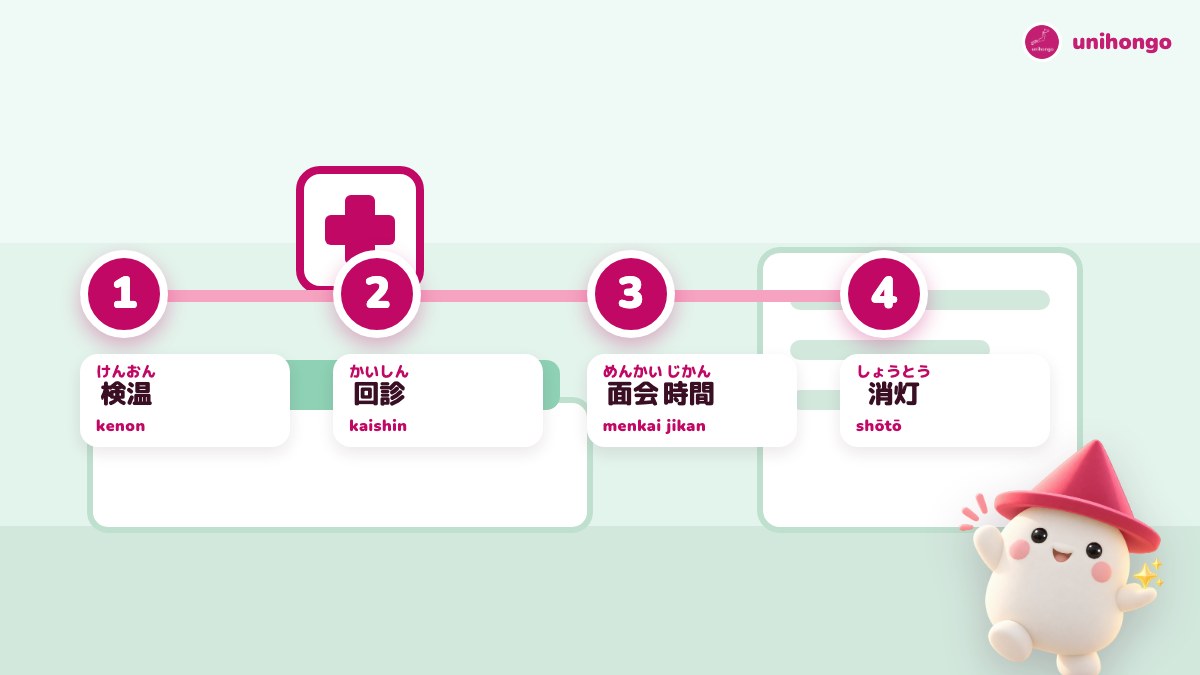
Hospital days in Japan follow a clear routine, and nurses announce each step. Mornings usually begin with a temperature and blood pressure check (検温, kenon). Doctors make rounds (回診, kaishin), meals arrive at set times, and lights out (消灯, shōtō) is early, often around nine. Times differ by hospital, but the words are the same.
If you are told not to eat or drink before a test or operation, the word is zesshoku (絶食, no food) or inshoku kinshi. A drip is tenteki (点滴).
| Japanese | Romaji | Meaning |
|---|---|---|
| 検温の時間です。 | Kenon no jikan desu. | Nurse: Time for your temperature check. |
| 夜はよく眠れましたか。 | Yoru wa yoku nemuremashita ka. | Nurse: Did you sleep well last night? |
| もうすぐ先生の回診です。 | Mō sugu sensei no kaishin desu. | Nurse: The doctor's rounds are soon. |
| 明日の朝から絶食です。 | Ashita no asa kara zesshoku desu. | Nurse: No food from tomorrow morning. |
| 点滴が終わりました。 | Tenteki ga owarimashita. | The drip has finished. |
| 消灯は九時です。 | Shōtō wa kuji desu. | Lights out is at nine. |
Calling the nurse and asking for help
The nurse call button (ナースコール, nāsu kōru) is for any need, not only emergencies. Nurses often prefer that you call rather than try to walk alone after an operation. When someone answers over the speaker, say what you need in one sentence; they will come or reply.
| Japanese | Romaji | Meaning |
|---|---|---|
| すみません、痛みが強くなりました。 | Sumimasen, itami ga tsuyoku narimashita. | Excuse me, the pain has got worse. |
| 痛み止めをお願いできますか。 | Itamidome o onegai dekimasu ka. | Could I have some pain relief? |
| 気持ちが悪いです。 | Kimochi ga warui desu. | I feel sick. |
| トイレに行きたいです。 | Toire ni ikitai desu. | I need to go to the toilet. |
| 毛布をもう一枚もらえますか。 | Mōfu o mō ichimai moraemasu ka. | Could I have one more blanket? |
| 先生とお話しできますか。 | Sensei to ohanashi dekimasu ka. | Could I speak to the doctor? |
Visitors, going out and discharge
Visiting rules differ between hospitals and can change quickly, for example during infection seasons. Some hospitals limit the number of visitors or the length of a visit, and many require visitors to sign in at a desk. Short trips outside or a night at home during a long stay need permission, called gaishutsu kyoka or gaihaku kyoka.
On discharge day you settle the bill at the cashier (会計, kaikei), collect any medicine to take home, and receive a date for a follow-up visit. Ask for a receipt and any certificate your employer or private insurance may need.
| Japanese | Romaji | Meaning |
|---|---|---|
| 面会は何時から何時までですか。 | Menkai wa nanji kara nanji made desu ka. | What are the visiting hours? |
| 外出してもいいですか。 | Gaishutsu shite mo ii desu ka. | May I go out for a while? |
| 退院はいつごろになりますか。 | Taiin wa itsugoro ni narimasu ka. | Around when will I be discharged? |
| 診断書をお願いしたいです。 | Shindansho o onegai shitai desu. | I'd like a medical certificate. |
| お世話になりました。 | Osewa ni narimashita. | Thank you for taking care of me. |
Osewa ni narimashita is what patients say to nurses and staff when they leave. It thanks people for everything they did, and you will hear it at every discharge.
Common learner mistakes
- Confusing nyūin (admission) with nyūgaku (school entrance) or tsūin (outpatient visits). Practise all three.
- Signing for a private room without asking the daily charge. The agreement is usually on paper; ask first.
- Saying daijōbu desu out of politeness when you are in pain. Nurses rely on your words; say itai desu.
- Bringing every medicine except the notebook. Staff check the okusuri techō to avoid duplicates.
- Leaving without the follow-up appointment. Ask Tsugi no gairai wa itsu desu ka, when is my next outpatient visit?
Get ready for the ward before you go
Photograph a page of your admission guide and type the hard sentences to Mocchi after /explain. Mocchi breaks each sentence into its parts, explains words like hoshōkin and sagaku beddo dai, and can then quiz you with /quiz on the ward vocabulary until it sticks.
For the spoken side, choose Sakura-sensei in AI Sensei and the doctor topic, and ask Sakura-sensei to play a ward nurse on your first evening. Practise the nurse call lines, ask about lights out and explain that the pain has changed. The session report shows which requests came out clearly.