
Four eye complaints in plain Japanese
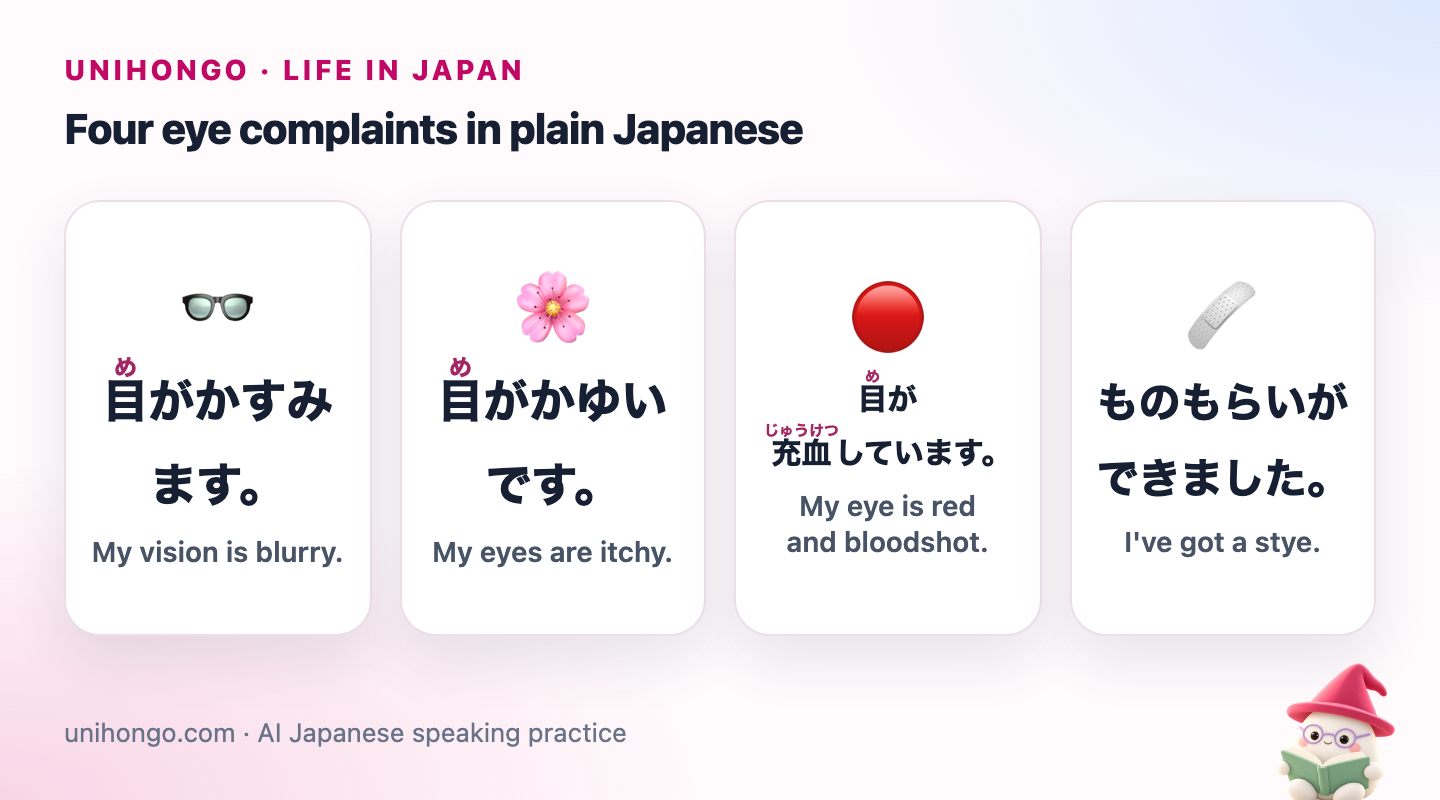
Most visits to a ganka start with one of a few complaints. The word me (目, eye) comes first, then the particle ga, then what is wrong. Add which eye with migi me (right eye), hidari me (left eye) or ryōme (both eyes).
Kasumu describes vision that is hazy or blurry, as if through mist. Jūketsu is the medical word for a red, bloodshot eye, and monomorai is the common word for a stye.
| Japanese | Romaji | Meaning |
|---|---|---|
| 目がかすみます。 | Me ga kasumimasu. | My vision is blurry. |
| 目がかゆいです。 | Me ga kayui desu. | My eyes are itchy. |
| 目が充血しています。 | Me ga jūketsu shite imasu. | My eye is red and bloodshot. |
| ものもらいができました。 | Monomorai ga dekimashita. | I've got a stye. |
| 右目だけです。 | Migi me dake desu. | Only my right eye. |
| 三日前からです。 | Mikka mae kara desu. | Since three days ago. |
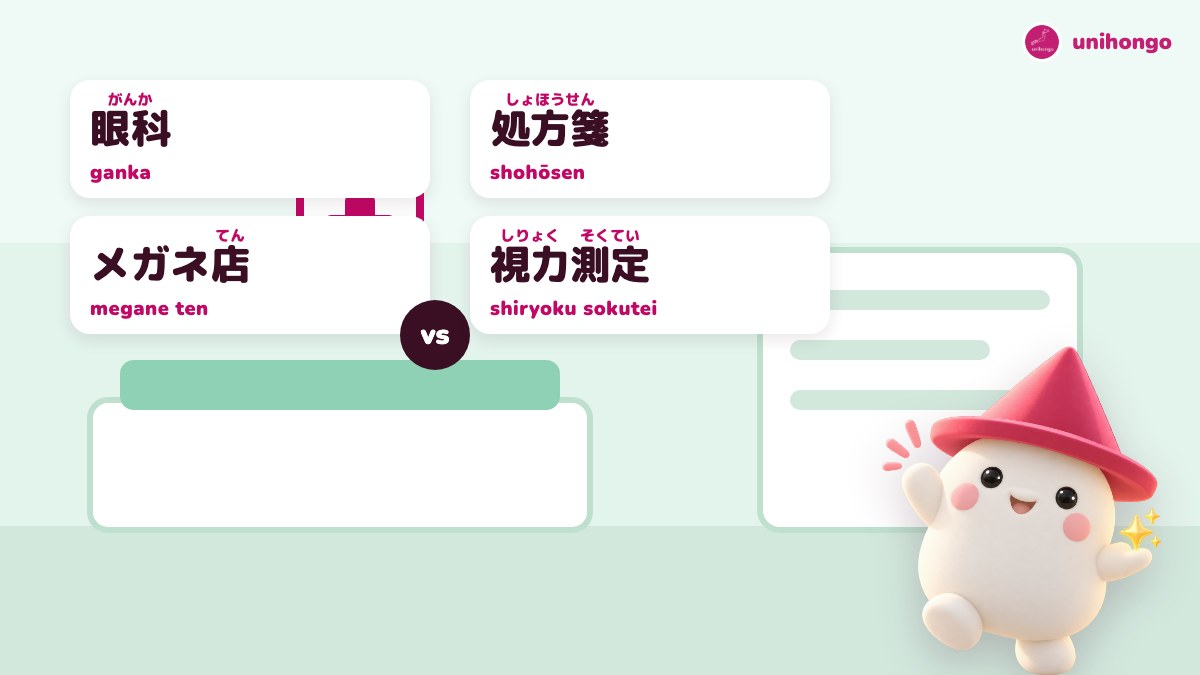
Ganka or glasses shop: where to go first
Choose by your need. Pain, redness, sudden changes, a scratch or something in the eye, flashes of light, or worsening blurriness belong at a ganka. If your eyes feel fine and you simply want new glasses with the same or a slightly stronger prescription, a glasses shop is often enough. If you are unsure, the ganka is the safer first stop, and the shop will happily work from its prescription.
| Japanese | Romaji | Meaning |
|---|---|---|
| 初めてです。予約は必要ですか。 | Hajimete desu. Yoyaku wa hitsuyō desu ka. | It's my first visit. Do I need an appointment? |
| メガネの処方箋をお願いしたいです。 | Megane no shohōsen o onegai shitai desu. | I'd like a prescription for glasses. |
| コンタクトの検査もできますか。 | Kontakuto no kensa mo dekimasu ka. | Can you also do a contact lens exam? |
| Point | Ganka (eye clinic) | Glasses shop |
|---|---|---|
| Who you see | An ophthalmologist and clinic staff | Shop staff trained in eyesight measurement |
| What they do | Examine, diagnose, treat, prescribe drops | Measure eyesight, sell and fit glasses |
| Insurance | Usually covered by public health insurance | A retail purchase, not insurance |
| Prescription | Can write one for glasses or contacts | Can make glasses from its own measurement |
| Typical wait | Often long at popular clinics | Often short, but glasses take days |
The eye chart and the tests you will meet
Japanese clinics and shops often use rings with a small gap, called Landolt rings, instead of letters. Staff point at a ring and you say where the gap is. When the rings get too small, simply say that you cannot tell. Guessing is fine if you say so: tabun migi, probably right.
Two other tests surprise visitors. The eye pressure test is often done with a machine that blows a short puff of air into each eye; staff warn you with kaze ga demasu, air is coming. The other is dilation, which is explained in the next section.
| Japanese | Romaji | Meaning |
|---|---|---|
| 片目を隠して、穴の向きを教えてください。 | Katame o kakushite, ana no muki o oshiete kudasai. | Staff: Cover one eye and tell me where the gap is. |
| 上です。 | Ue desu. | It's up. |
| 右です。 | Migi desu. | It's right. |
| たぶん左です。 | Tabun hidari desu. | Probably left. |
| 分かりません。 | Wakarimasen. | I can't tell. |
| あごをここに乗せてください。 | Ago o koko ni nosete kudasai. | Staff: Rest your chin here. |
| 風が出ます。まばたきしないでください。 | Kaze ga demasu. Mabataki shinaide kudasai. | Staff: A puff of air is coming. Try not to blink. |
| ぼやけて見えます。 | Boyakete miemasu. | It looks blurry. |
Eye drops, dilation and the doctor's questions
If the doctor needs to look at the back of your eye, a nurse puts in drops that open your pupils. This is called sandō. The drops take a while to work, so you wait, and for several hours afterwards bright light dazzles and close reading is hard. Many people bring sunglasses and avoid driving or cycling; the clinic will tell you its own advice.
The doctor's questions are short and practical. Listen for itsu kara (since when), itai (painful), mieru (can see) and kontakuto (contact lenses), which is a common cause of eye trouble.
| Japanese | Romaji | Meaning |
|---|---|---|
| 瞳孔を開く目薬をさします。 | Dōkō o hiraku megusuri o sashimasu. | Nurse: I'll put in drops to widen your pupils. |
| 数時間、まぶしく感じます。 | Sūjikan, mabushiku kanjimasu. | Nurse: Light will feel too bright for a few hours. |
| 車の運転は大丈夫ですか。 | Kuruma no unten wa daijōbu desu ka. | Is it all right to drive? |
| コンタクトは使っていますか。 | Kontakuto wa tsukatte imasu ka. | Doctor: Do you wear contact lenses? |
| 花粉症もあります。 | Kafunshō mo arimasu. | I also have hay fever. |
| この目薬は一日何回ですか。 | Kono megusuri wa ichinichi nankai desu ka. | How many times a day for these drops? |
Megusuri o sasu is the verb for putting in eye drops; sasu is used for drops, not ireru. On a prescription bag you may see 1日4回 (four times a day) and 両眼 (ryōgan, both eyes), the written form of ryōme.
At the glasses counter
At a glasses shop, staff usually ask whether you have a prescription, measure your eyesight if you do not, and then talk about frames and lenses. Lens options are where the vocabulary gets dense: thinner lenses for strong prescriptions, blue-light filtering coatings, and lenses for both distance and close-up.
Staff will usually ask how you use your glasses: for driving, computer work or reading. Be specific, because it changes their recommendation.
| Japanese | Romaji | Meaning |
|---|---|---|
| 処方箋を持ってきました。 | Shohōsen o motte kimashita. | I've brought a prescription. |
| 今のメガネが合わなくなりました。 | Ima no megane ga awanaku narimashita. | My current glasses don't suit my eyes any more. |
| パソコンの作業が多いです。 | Pasokon no sagyō ga ōi desu. | I do a lot of computer work. |
| 薄いレンズにしたいです。 | Usui renzu ni shitai desu. | I'd like thinner lenses. |
| 遠近両用はありますか。 | Enkin ryōyō wa arimasu ka. | Do you have lenses for far and near? |
| いつ仕上がりますか。 | Itsu shiagarimasu ka. | When will they be ready? |
Pickup and adjustment
When you collect your glasses, staff check how they sit and adjust the arms and nose pads. If something feels wrong, say so then; many shops also adjust glasses later at no charge, especially ones bought there. Ask about the shop's policy if the lenses still feel strange after a few days.
| Japanese | Romaji | Meaning |
|---|---|---|
| 少しきついです。 | Sukoshi kitsui desu. | They're a little tight. |
| ずり落ちてきます。 | Zuriochite kimasu. | They keep slipping down. |
| 左右で見え方が違います。 | Sayū de miekata ga chigaimasu. | The left and right look different. |
| 調整してもらえますか。 | Chōsei shite moraemasu ka. | Could you adjust them? |
Common learner mistakes
- Saying me ga itai for every problem. Itai means pain; for itchiness say kayui, for blur kasumu or boyakeru, and for dryness me ga kawaku.
- Using ireru for eye drops. The natural verb is sasu: megusuri o sasu.
- Going to a glasses shop with a painful red eye. Shops do not diagnose or treat; go to a ganka.
- Forgetting to mention contact lenses. Doctors need to know, and it often changes the treatment.
- Confusing ganka with geka (外科, surgery). The two words sound close; say ganka clearly, or point to 眼科 on your phone.
Practise the clinic and the counter
Start with Mocchi. Type /kanji 眼 and Mocchi explains the kanji behind ganka and ryōgan with example words; then ask Write three sentences describing an eye problem and check mine, and type your own attempts for Mocchi to correct.
For the spoken half, choose Hana-sensei in AI Sensei with the eyeglasses shop topic. Ask Hana-sensei to play a shop assistant, explain how you use your glasses, choose lenses and arrange pickup. The session report afterwards lists the words you hesitated on.