
San in four everyday uses
San attaches to much more than surnames. These four uses show how flexible it is.
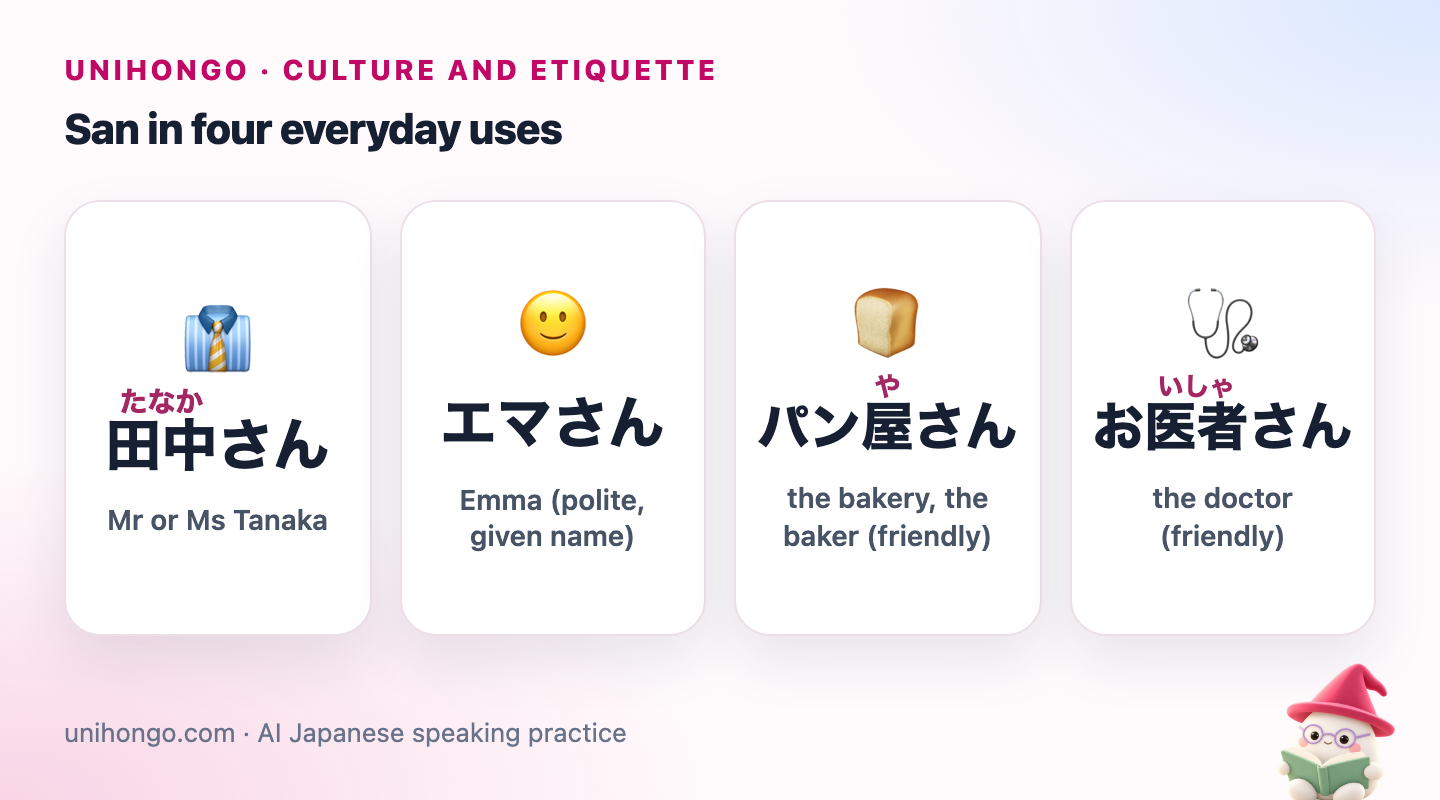
| Japanese | Romaji | Meaning |
|---|---|---|
| 田中さん | Tanaka-san | Mr or Ms Tanaka |
| エマさん | Ema-san | Emma (polite, given name) |
| パン屋さん | pan'ya-san | the bakery, the baker (friendly) |
| お医者さん | oisha-san | the doctor (friendly) |
Adding san to shops and jobs, as in pan'ya-san or oisha-san, softens the word and sounds friendly. Children use these forms a lot, and so do adults in conversation. In formal writing, people use the plain words, such as ishi for doctor.
Why the suffix exists: Japanese avoids you
In English you can say you to anyone. Japanese has words for you, such as anata, but in daily life they are used much less than learners expect. Calling a colleague, a teacher or a neighbour anata can sound distant, slightly cold or, in some tones, even confrontational. Instead, people use the name, a title or nothing at all, because the subject is often left out in Japanese.
Once names replace you, they need a way to carry politeness, and that is what suffixes do. A bare name is close, sometimes intimate; a name with san is polite but friendly; a name with sama is very respectful. The suffix tells everyone listening how the speaker sees the relationship.
| Japanese | Romaji | Meaning |
|---|---|---|
| 田中さんはどう思いますか。 | Tanaka-san wa dō omoimasu ka. | What do you think, Ms Tanaka? |
| 先生、質問があります。 | Sensei, shitsumon ga arimasu. | Teacher, I have a question. |
| 部長、お疲れさまです。 | Buchō, otsukaresama desu. | Thanks for your work. (to a department head) |
The other suffixes, briefly
San sits in the middle of a small family of suffixes. You can use san safely in almost every situation, but you will hear the others, so it helps to know roughly what they signal. Usage varies by family, school, region and workplace.
| Japanese | Romaji | Meaning |
|---|---|---|
| お客様 | okyakusama | the customer (very polite) |
| 山田くん | Yamada-kun | Yamada (to a junior, often a boy) |
| ゆきちゃん | Yuki-chan | little Yuki, dear Yuki |
| Suffix | Feeling | Typical use |
|---|---|---|
| sama | Very respectful | Customers, letters and emails, formal speech |
| san | Polite, neutral | Almost anyone: colleagues, neighbours, acquaintances |
| kun | Friendly, often for boys or juniors | Boys, male juniors; some offices use it for all juniors |
| chan | Affectionate, cute | Children, close friends, family, pets |
| sensei | Respect for expertise | Teachers, doctors, lawyers, authors |
| senpai | Respect for seniority | Seniors at school, clubs and sometimes work |
Never for yourself, and not for your own team
The most important rule is simple: suffixes are for other people. You never add san to your own name. Some small children call themselves by their own name with chan, but adults do not.
The second rule surprises many learners. In business, when you talk about a colleague to someone outside your company, you drop san, even for your boss. Your company counts as your side, uchi, and the client is on the outside, soto. Raising your own people with san in front of a client sounds as if you are praising your own side. Inside the company, you go back to Tanaka-san.
| Japanese | Romaji | Meaning |
|---|---|---|
| エマです。よろしくお願いします。 | Ema desu. Yoroshiku onegai shimasu. | I'm Emma. Nice to meet you. |
| 田中はただいま席を外しております。 | Tanaka wa tadaima seki o hazushite orimasu. | Tanaka is away from her desk. (to a client) |
| 鈴木部長 | Suzuki buchō | Mr Suzuki, department head (inside the company) |
What should I call you? A short exchange
When you meet someone new, it is completely normal to ask how they would like to be addressed, and to tell them what to call you. Many Japanese people will say that first names are fine with you, especially if you are a visitor, but they may still use san with your first name.
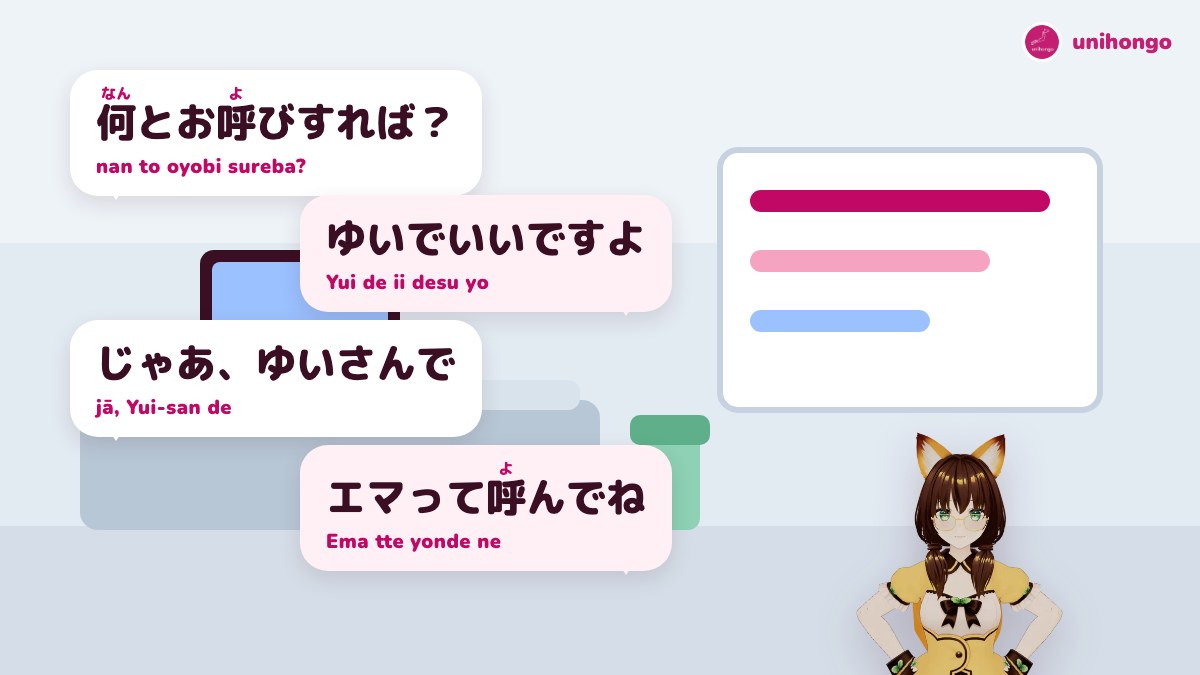
| Japanese | Romaji | Meaning |
|---|---|---|
| 何とお呼びすればいいですか。 | Nan to oyobi sureba ii desu ka. | You: What should I call you? (polite) |
| ゆいでいいですよ。 | Yui de ii desu yo. | Coworker: Just Yui is fine. |
| じゃあ、ゆいさんって呼びますね。 | Jā, Yui-san tte yobimasu ne. | You: Then I'll call you Yui-san. |
| エマって呼んでください。 | Ema tte yonde kudasai. | You: Please call me Emma. |
| 何て呼べばいい? | Nan te yobeba ii? | Friend: What should I call you? (casual) |
Notice the polite compromise in the third line. When someone says you can drop the suffix, many people still use the given name with san for a while, which feels friendly but respectful. Moving to no suffix at all, yobisute, usually happens later and often at the other person's suggestion.
When san disappears
Dropping the suffix is called yobisute. Between close friends, family and classmates it signals closeness. From a senior to a junior it can signal hierarchy, and in some sports clubs and workplaces it is normal. From a junior to a senior, or between new acquaintances, it sounds rude or overly familiar. Nicknames, adana, often come with their own rules and sometimes with chan or kun.
| Japanese | Romaji | Meaning |
|---|---|---|
| 呼び捨てでいいよ。 | Yobisute de ii yo. | You can drop the san. (casual) |
| さん付けで呼ぶ | sanzuke de yobu | to call someone with san |
| あだ名は何? | Adana wa nani? | What's your nickname? (casual) |
San, sama and onchū in emails and letters
Written Japanese has its own rules. In emails to clients and in letters, names usually take sama rather than san: Tanaka-sama. For a company or department rather than a person, the word onchū, to, is written after the name instead. Inside a company, many people use san in emails to colleagues, which feels friendlier, and some companies have even adopted a rule of using san for everyone, including senior managers, to make communication flatter.
Customers are addressed as okyakusama, and in shops staff talk about you with sama. You never write sama with your own name either, even on an envelope addressed to yourself; Japanese people sometimes cross out the printed sama on a reply card and write in its place.
| Japanese | Romaji | Meaning |
|---|---|---|
| 田中様 | Tanaka-sama | Mr or Ms Tanaka (email, letter) |
| 営業部御中 | eigyōbu onchū | To the Sales Department (letter) |
| 田中さん、お疲れさまです。 | Tanaka-san, otsukaresama desu. | Hi Tanaka-san. (internal email opening) |
Mistakes learners make
- Introducing yourself as Emma-san. Use your name alone.
- Using anata to a teacher, colleague or senior. Use their name with san, their title, or leave the subject out.
- Saying Tanaka-san-sensei. Titles like sensei and buchō replace san; they are not added on top.
- Adding san to your own boss when speaking to a client. Use the family name alone or the title after the name.
- Dropping san too early with a new Japanese friend. Wait until they suggest it.
Make names feel natural in your Japanese
The best practice is with real names. Tell Mocchi about the people in your life, such as a teacher, a coworker and a friend, and ask which suffix you would use for each one and why. Mocchi keeps notes on your situation, so when you later ask for a /quiz on suffixes, the questions can use the same people and the same contexts you care about.
For extra practice, play Sentence Builder on the games page with your own flashcards of the lines above, building sentences such as Tanaka wa tadaima seki o hazushite orimasu until the word order feels automatic.