
Four voices you will recognise
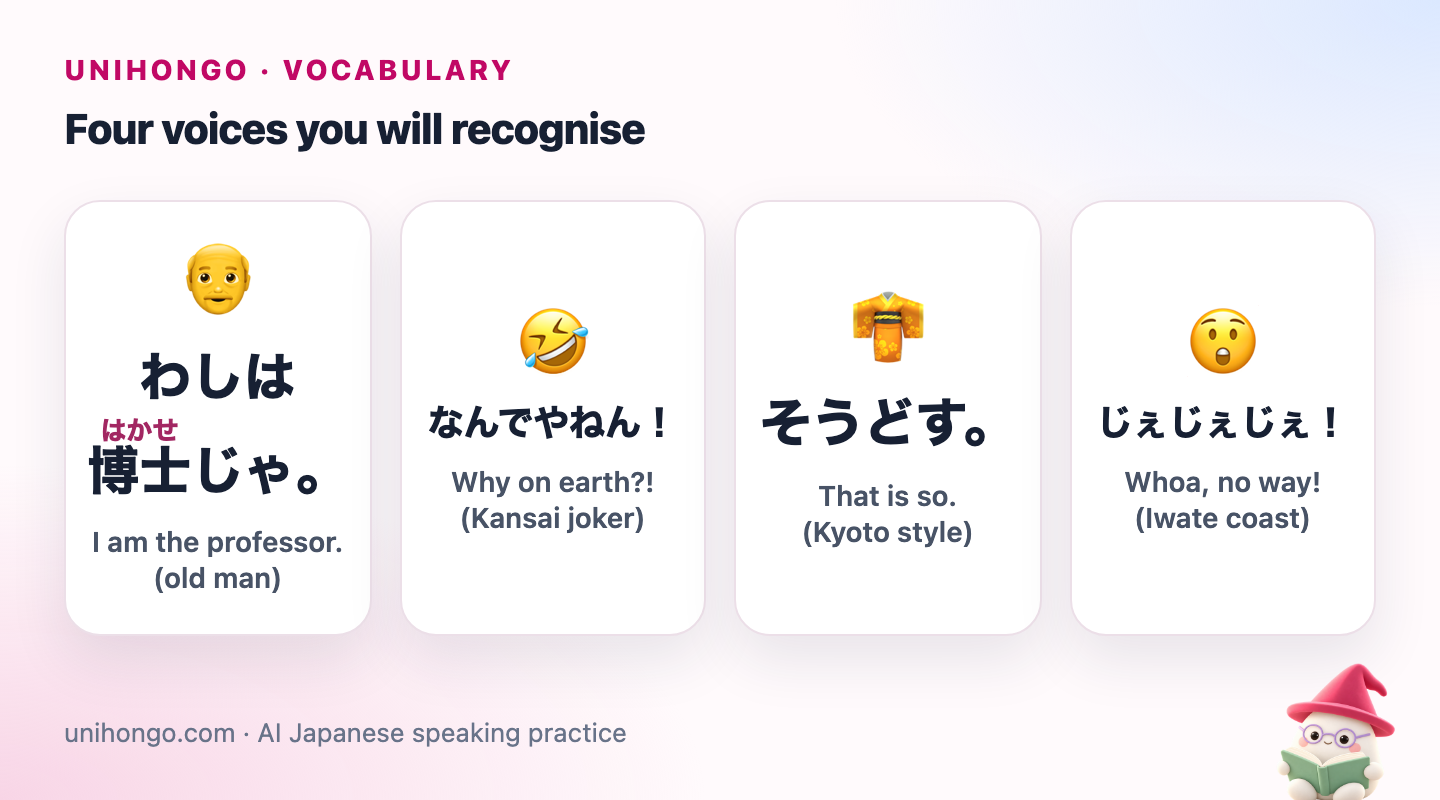
These four lines could each introduce a different character before you see their face. Washi wa hakase ja is the classic elderly professor. Nande ya nen is the Kansai joker's retort. Sō dosu is the Kyoto-style beauty or the maiko. Jejeje is a surprise from the coast of Iwate made famous by an NHK morning drama.
| Japanese | Romaji | Meaning |
|---|---|---|
| わしは博士じゃ。 | Washi wa hakase ja. | I am the professor. (old man) |
| なんでやねん! | Nande ya nen! | Why on earth?! (Kansai joker) |
| そうどす。 | Sō dosu. | That is so. (Kyoto style) |
| じぇじぇじぇ! | Jejeje! | Whoa, no way! (Iwate coast) |
| On screen | Standard | What it signals |
|---|---|---|
| washi wa hakase ja (わしは博士じゃ) | watashi wa hakase da (私は博士だ) | Old man, professor, wise elder |
| nande ya nen (なんでやねん) | nande da yo (なんでだよ) | Comic, frank, quick-witted |
| sō dosu (そうどす) | sō desu (そうです) | Kyoto elegance, tradition |
| jejeje (じぇじぇじぇ) | ē! / bikkuri (えっ! / びっくり) | Surprise, local colour |
Role language: the idea behind it
The linguist Satoshi Kinsui popularised the term yakuwarigo, role language, for speech that tells you who a character is. Some role language is regional dialect. Some is not tied to any real place at all. The elderly professor's washi and ja, for example, resemble western Japanese speech of the past and are still used by some older people in western regions, but in fiction they simply mean old and wise, whoever the character is and wherever they live.
Knowing this helps in two ways. You stop worrying that you have missed a grammar point when a robot, a samurai and a grandfather all speak differently. And you learn to hear what a line signals: when a character switches into dialect at an emotional moment, the writer is often telling you they have stopped performing and are speaking from the heart.
| Japanese | Romaji | Meaning |
|---|---|---|
| 拙者は旅の者でござる。 | Sessha wa tabi no mono de gozaru. | I am but a traveller. (samurai style; standard: watashi wa ryokōsha desu) |
| よろしくってよ。 | Yoroshikutte yo. | Very well, I don't mind. (refined-young-lady style; standard: ii desu yo) |
| おら、腹減ったぞ。 | Ora, hara hetta zo. | I'm starving! (rustic style; standard: ore, onaka suita yo) |
Kansai: the joker, the merchant and the honest friend
Kansai speech is the most common dialect on screen, partly because of the strong Osaka comedy industry. It often marks a character who is funny, quick-witted, money-minded or refreshingly direct. A well-known example is Heiji Hattori in Detective Conan, a teenage detective from Osaka whose Kansai speech sets him apart from the Tokyo hero. Kansai characters are not only comic: many are loyal, warm friends who say what others will not.
| Japanese | Romaji | Meaning |
|---|---|---|
| ほんまかいな。 | Honma ka ina. | You don't say? Really? (standard: hontō ka na) |
| あかん、もう無理や。 | Akan, mō muri ya. | No good, I can't take any more. (standard: dame da, mō muri da) |
| 任しとき! | Makashitoki! | Leave it to me! (standard: makasete oite!) |
| そんなん、知らんわ。 | Sonnan, shiran wa. | How should I know? (standard: sonna no, shiranai yo) |
Kyoto, Hiroshima, Tosa and Kyushu
Kyoto speech, with dosu, haru and okoshi yasu, usually signals grace, tradition or a refined person who may be sharper than they seem. Hiroshima speech has a tough image in Japan largely because of yakuza films, especially the 1973 film Battles Without Honor and Humanity, set in Hiroshima and Kure. Tosa speech from Kōchi, with its zeyo ending, is tied to the historical figure Sakamoto Ryōma, who is often shown speaking it in dramas. Kyushu speech often marks a bold, hot-blooded character.
These images say more about storytelling than about real people. Most people from Hiroshima are not gangsters, and most people from Kyoto are not secretly insulting you.
| Japanese | Romaji | Meaning |
|---|---|---|
| よろしゅうおたのもうします。 | Yoroshū otanomō shimasu. | I humbly ask for your kindness. (traditional Kyoto, maiko style; standard: yoroshiku onegai shimasu) |
| わしゃ、知らんけえのう。 | Washa, shiran kee nō. | I don't know anything, see. (film-style Hiroshima; standard: ore wa shiranai kara na) |
| 日本を今一度せんたくいたし申し候。 | Nippon o ima ichido sentaku itashi mōshi sōrō. | I will wash Japan clean once more. (a famous line from Ryōma's letters, old written style; standard: Nihon o mō ichido sentaku shimasu) |
| やるぜよ! | Yaru zeyo! | I'll do it! (Tosa style; standard: yaru zo!) |
The sentaku line comes from a real letter by Sakamoto Ryōma and is often quoted in dramas. It is written in old epistolary style, not in Tosa dialect, which is a good reminder that screen speech mixes periods and styles freely.
Northern voices: Tohoku warmth and Iwate surprise
Tohoku speech on screen usually signals a country background: honest, hard-working, sometimes naive, often deeply kind. Writers have sometimes used it for comedy at the expense of rural characters, which many viewers now find dated. Newer works tend to treat northern speech with more affection.
Two famous examples are easy to look up. Lum in Urusei Yatsura ends her sentences with datcha, an ending often linked to the Sendai area. And the 2013 NHK morning drama Amachan, set on the coast of Iwate, made jejeje, a local cry of surprise, into one of the most talked-about words in Japan that year.
| Japanese | Romaji | Meaning |
|---|---|---|
| 好きだっちゃ。 | Suki datcha. | I like you, you know. (Lum's style, linked to Sendai; standard: suki da yo) |
| じぇじぇ! | Jeje! | Huh?! (Iwate coast surprise; standard: ē!) |
| んだんだ。 | Nda nda. | Yes, that's right. (Tohoku; standard: sō da sō da) |
Where screen dialects come from
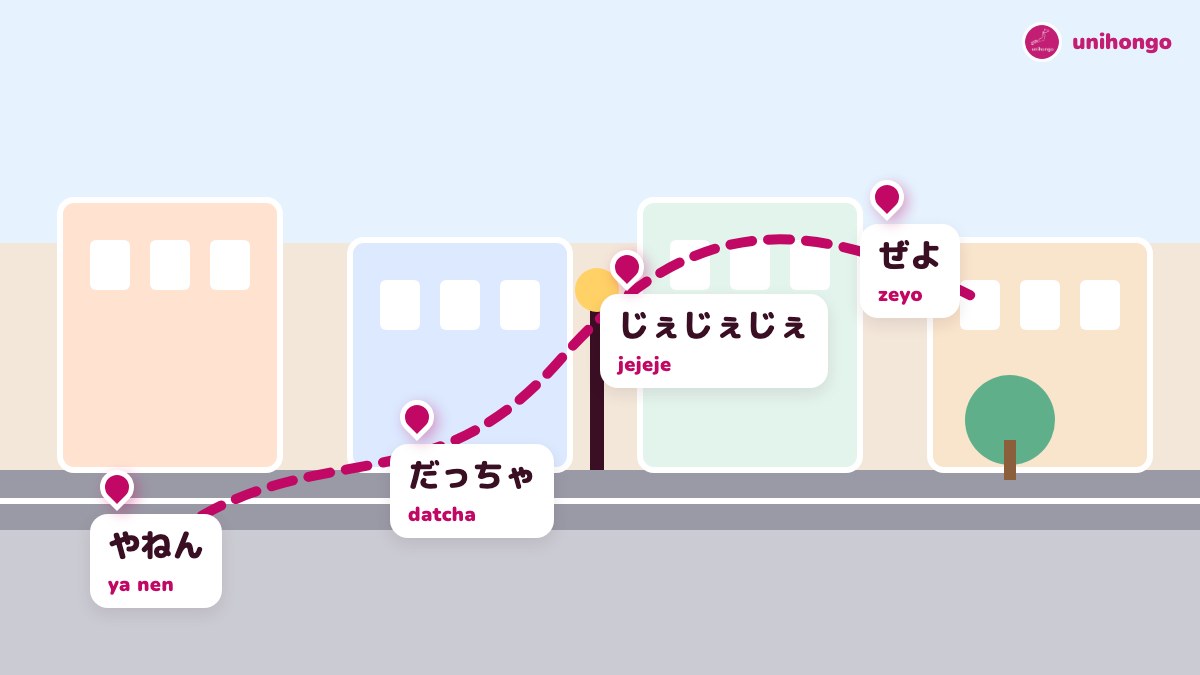
If you picture Japan as a map, screen dialects cluster in a few places. Osaka supplies jokers and merchants, Kyoto elegance, Kōchi bold heroes, Hiroshima tough guys and the north warm country people. Knowing the map helps you guess a character's background in the first few lines.
| Region | Ending or word | Typical screen image |
|---|---|---|
| Osaka | ya nen, akan, honma | Funny, frank, streetwise |
| Kyoto | dosu, haru, okoshi yasu | Elegant, traditional, subtly sharp |
| Hiroshima | ja kee, nō | Tough, blunt, loyal |
| Kōchi (Tosa) | zeyo, ya ki | Bold, idealistic hero |
| Sendai area | datcha | Lively, distinctive |
| Iwate coast | jejeje | Surprise, local charm |
Common learner mistakes
- Learning Japanese from one character and speaking like them. A learner who talks like a Kansai comedian or an elderly professor will surprise people, and not always pleasantly.
- Thinking role language is real dialect. Washi wa ... ja and de gozaru are mostly stage conventions today.
- Assuming screen dialect is accurate. Writers simplify, and native speakers sometimes find screen versions odd.
- Missing the switch. When a character drops into dialect at an emotional peak, that switch is often the point of the scene.
- Reading regional stereotypes as facts about real people. Enjoy the convention and leave it on the screen.
Watch, decode, then talk about it
Next time a dialect line catches your ear, paste it into the chat with Mocchi and type /explain. Mocchi separates the dialect or role-language parts from the standard grammar, gives you the plain version and keeps a note of the endings you have met, so it can quiz you on them later.
To use what you watch in conversation, open AI Sensei, choose the anime topic and talk with Ibuki-sensei about a favourite character and the way they speak. Describe the character in standard Japanese, quote one line, and explain what the dialect tells the viewer; the session report shows which of your sentences were natural and which need a fix.