
Hiroshima in four phrases
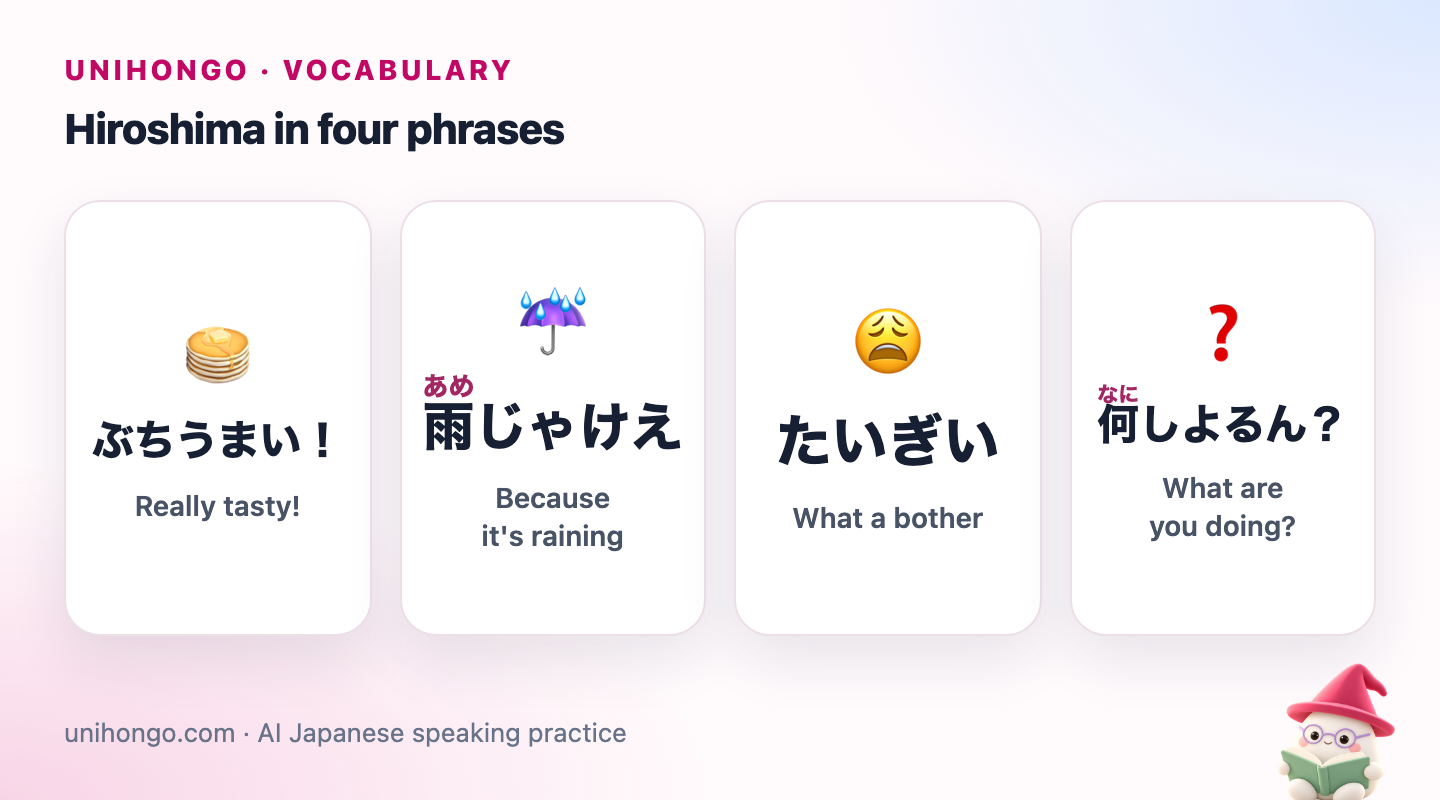
These four phrases capture the sound of Hiroshima. Buchi umai shows the favourite intensifier. Ame ja kee shows ja for da and kee for because. Taigii is the everyday sigh about a chore. Nani shiyoru n? is how a friend asks what you are doing.
| Japanese | Romaji | Meaning |
|---|---|---|
| ぶちうまい! | Buchi umai! | Really tasty! |
| 雨じゃけえ | ame ja kee | Because it's raining |
| たいぎい | taigii | What a bother |
| 何しよるん? | Nani shiyoru n? | What are you doing? |
| Hiroshima | Standard | Meaning |
|---|---|---|
| buchi umai (ぶちうまい) | sugoku oishii (すごくおいしい) | Really tasty |
| ame ja kee (雨じゃけえ) | ame da kara (雨だから) | Because it's raining |
| taigii (たいぎい) | mendōkusai (面倒くさい) | What a bother |
| nani shiyoru n? (何しよるん?) | nani shite iru no? (何しているの?) | What are you doing? |
Ja, kee and ken: the grammar you hear in every sentence
Hiroshima uses ja as the plain copula, where Tokyo uses da and Osaka uses ya. Because is kee or ken; which one a person prefers depends on area, age and habit, and many people use both. Questions often end in n or no, softer than a bare verb. Put these together and you can follow most casual Hiroshima talk.
| Japanese | Romaji | Meaning |
|---|---|---|
| そうじゃ。 | Sō ja. | That's right. (standard: sō da) |
| そうじゃろ? | Sō jaro? | Right? Isn't it? (standard: sō darō?) |
| 明日は休みじゃけん、遊びに行こうや。 | Ashita wa yasumi ja ken, asobi ni ikō ya. | Tomorrow's a day off, so let's go out. (standard: ashita wa yasumi da kara, asobi ni ikō yo) |
| どこ行くん? | Doko iku n? | Where are you going? (standard: doko iku no?) |
| ほうじゃね。 | Hō ja ne. | Yeah, true. (standard: sō da ne) |
Buchi, taigii and other everyday words
A handful of words make Hiroshima speech instantly recognisable. Buchi is the best known; younger people may also say bari. Taigii describes anything that feels like too much effort. Habuteru means to sulk, and it is a word many Hiroshima people are surprised to learn is not standard Japanese.
| Japanese | Romaji | Meaning |
|---|---|---|
| 今日はぶち寒いね。 | Kyō wa buchi samui ne. | It's really cold today. (standard: kyō wa sugoku samui ne) |
| 掃除、たいぎいわ。 | Sōji, taigii wa. | Cleaning is such a pain. (standard: sōji, mendōkusai na) |
| なんではぶてとるん? | Nande habutetoru n? | Why are you sulking? (standard: nande sunete iru no?) |
| ばりうまいじゃん! | Bari umai jan! | That's seriously tasty! (younger speakers; standard: sugoku oishii ja nai) |
Words that surprise learners
Some Hiroshima words look like standard Japanese but mean something else. They are good listening traps to know, especially if you visit a family home. Several of them sound older to younger speakers, but you will still hear them from parents and grandparents.
| Japanese | Romaji | Meaning |
|---|---|---|
| えっとあるよ。 | Etto aru yo. | There's loads. (older; standard: takusan aru yo) |
| 醤油がみてた。 | Shōyu ga miteta. | We've run out of soy sauce. (standard: shōyu ga nakunatta) |
| いなげなこと言うね。 | Inage na koto iu ne. | What a strange thing to say. (older; standard: hen na koto iu ne) |
| 来てつかあさい。 | Kite tsukāsai. | Please do come. (old-fashioned polite; standard: kite kudasai) |
Etto is the trap most learners fall into, because in standard Japanese ētto is a filler like um. In older Hiroshima speech, etto means a lot. Miteru, meaning to run out, has nothing to do with miru, to see. Tsukāsai is the old Hiroshima form of kudasai; you will see it on posters and in local slogans more than hear it in conversation.
Shiyoru and shitoru: now versus done
Like many dialects in western Japan, Hiroshima often splits the standard -te iru form in two. Shiyoru describes an action happening right now. Shitoru describes a state after an action. Standard Japanese uses shite iru for both, so the context has to tell you which is meant. Not every speaker keeps the split strictly, but it is a useful listening clue.
| Japanese | Romaji | Meaning |
|---|---|---|
| いま宿題しよる。 | Ima shukudai shiyoru. | I'm doing my homework right now. (standard: ima shukudai o shite iru) |
| 宿題はもうしとる。 | Shukudai wa mō shitoru. | I've already done my homework. (standard: shukudai wa mō shita) |
| 花が散りよる。 | Hana ga chiriyoru. | The blossoms are falling. (standard: hana ga chitte iru) |
| 花が散っとる。 | Hana ga chittoru. | The blossoms have fallen. (standard: hana ga chitte iru) |
At an okonomiyaki counter
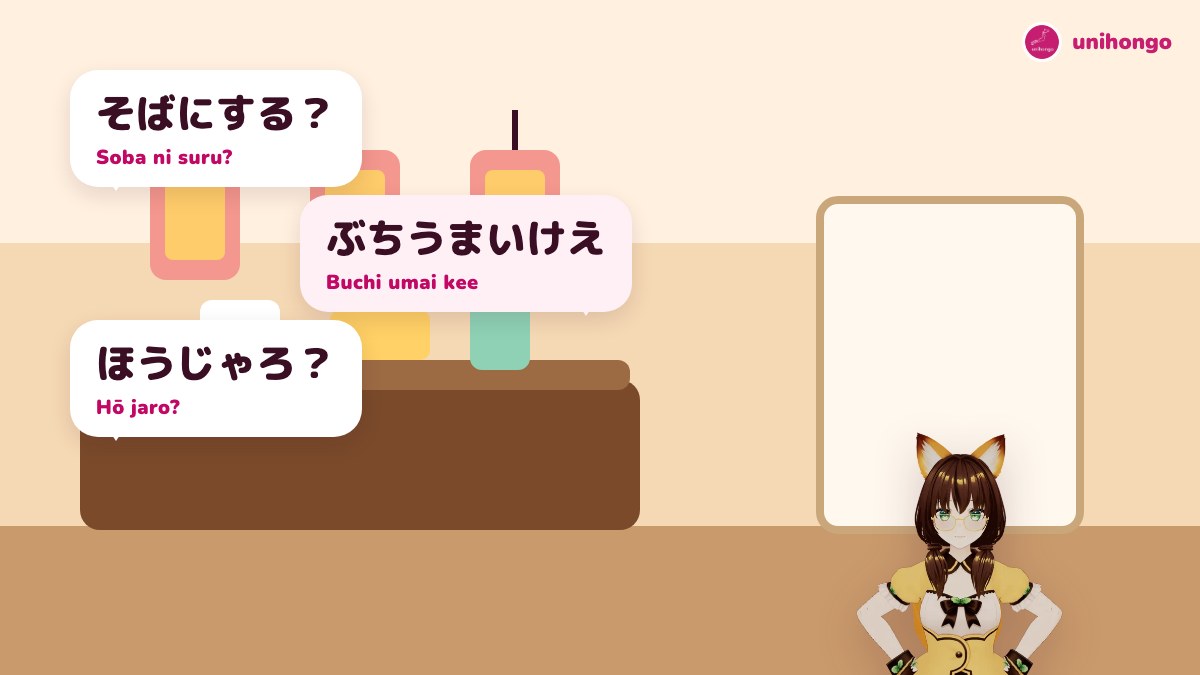
Hiroshima okonomiyaki is layered on the griddle in front of you, and the counter is the classic place to chat with the cook. Here the cook speaks Hiroshima-ben and you answer in friendly polite Japanese. The standard Japanese for each Hiroshima line is in brackets.
| Japanese | Romaji | Meaning |
|---|---|---|
| いらっしゃい。そばにする?うどんにする? | Irasshai. Soba ni suru? Udon ni suru? | Cook: Welcome. Soba noodles or udon? (standard) |
| そばでお願いします。 | Soba de onegai shimasu. | You: Soba, please. |
| 卵、ダブルにもできるけえね。 | Tamago, daburu ni mo dekiru kee ne. | Cook: I can do a double egg too, you know. (standard: tamago, daburu ni mo dekiru kara ne) |
| じゃあ、ダブルで! | Jā, daburu de! | You: Then double, please! |
| はい、お待ち。ぶちうまいけえ、熱いうちに食べんさい。 | Hai, omachi. Buchi umai kee, atsui uchi ni tabensai. | Cook: Here you go. It's really good, so eat it while it's hot. (standard: sugoku oishii kara, atsui uchi ni tabete) |
| 本当だ、ぶちうまいです! | Hontō da, buchi umai desu! | You: You're right, it's really tasty! |
| ほうじゃろ? | Hō jaro? | Cook: Told you, didn't I? (standard: sō darō?) |
Use it, or just understand it?
- Understand: ja, kee and ken, buchi, taigii, shiyoru and shitoru. These carry most daily conversation.
- Try with friends: buchi umai, hō ja ne. They are short, cheerful and hard to get wrong.
- Leave for listening: etto, inage na, tsukāsai and anything you have heard in gangster films, which exaggerate a rough style.
- Stay in standard keigo with staff, older people and at work, even in Hiroshima.
- Do not copy the film voice. Real Hiroshima speech is ordinary and friendly; a tough-guy imitation is likely to sound like mockery.
Common learner mistakes
- Hearing etto as a hesitation. When an older Hiroshima speaker says etto aru, they mean there is plenty, not um, there is.
- Reading shiyoru as the volitional let's do. Nani shiyoru n? asks what you are doing now, not what we should do.
- Using buchi in polite speech. Buchi umai desu to a cook who is chatting with you is charming; in a formal thank-you letter or at work, use totemo.
- Assuming ja always sounds like an old man. In anime, ja often marks an elderly character, but in Hiroshima it is simply the normal copula for people of every age.
- Treating ken and kee as different meanings. They are two forms of the same because; listen to which one your friends use and follow them if you want to try it.
Make the Hiroshima words stick
Ask Mocchi to explain a full line with /explain, for example /explain ぶちうまいけえ、熱いうちに食べんさい. Mocchi splits it into buchi, umai, kee and the -nsai command, gives the standard Japanese and can follow up with three similar lines for you to translate. It remembers the words that tripped you up, so etto and miteru come back in later reviews.
Then turn the Hiroshima words into flashcards with /create-flashcards and play Kotoba Stack on the games page with your own cards. Seeing buchi next to sugoku and taigii next to mendōkusai in a fast game builds the quick recognition you need when a cook is talking to you over a hot griddle.