
Okinawa's best-known words
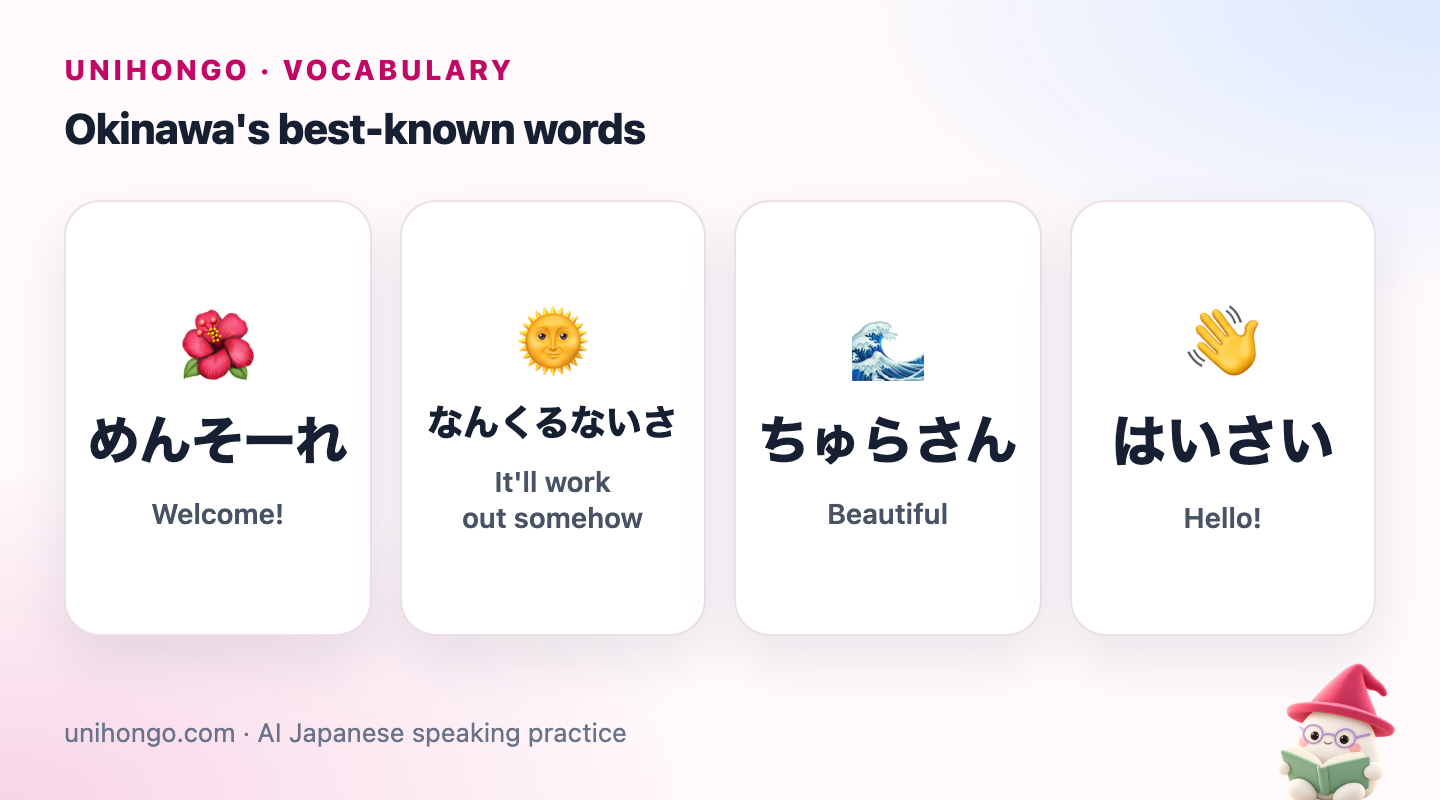
These four words appear on airport banners, shop signs, T-shirts and in greetings. Mensōre welcomes you to the islands. Nankuru nai sa is the phrase everyone associates with Okinawa's easy-going image. Churasan means beautiful. Haisai is a cheerful hello.
| Japanese | Romaji | Meaning |
|---|---|---|
| めんそーれ | mensōre | Welcome! |
| なんくるないさ | nankuru nai sa | It'll work out somehow |
| ちゅらさん | churasan | Beautiful |
| はいさい | haisai | Hello! |
| Okinawan | Standard | Meaning |
|---|---|---|
| mensōre (めんそーれ) | irasshaimase / yōkoso (いらっしゃいませ / ようこそ) | Welcome |
| nankuru nai sa (なんくるないさ) | nantoka naru sa (なんとかなるさ) | It'll work out somehow |
| churasan (ちゅらさん) | utsukushii (美しい) | Beautiful |
| haisai (はいさい) | konnichiwa (こんにちは) | Hello |
Okinawan, and the Japanese spoken in Okinawa
It helps to separate two things. Uchinaaguchi, Okinawan, is the traditional language of the main island of Okinawa, one of several Ryukyuan varieties spoken from Amami to Yonaguni. It developed alongside Japanese for many centuries, and a speaker of standard Japanese cannot follow it without study. Many linguists treat it as a separate language, and fluent speakers today are mostly older people, though there are revival classes, radio programmes and local events.
What you hear in shops and on buses is mostly Japanese, often with Okinawan intonation, words and endings. People sometimes call this Uchinaa Yamatoguchi, Okinawan-style Japanese. One well-known sound pattern between the two systems is that Japanese e and o often correspond to Okinawan i and u: kokoro, heart, is kukuru in Okinawan.
| Japanese | Romaji | Meaning |
|---|---|---|
| うちなーぐち | Uchināguchi | The Okinawan language (standard: Okinawa no kotoba) |
| うちなーんちゅ | uchinānchu | An Okinawan person (standard: Okinawa no hito) |
| ないちゃー | naichā | Someone from mainland Japan (can sound distancing; standard: hondo no hito) |
| くくる | kukuru | Heart, mind (Okinawan; standard: kokoro) |
Greetings and thanks in Okinawan
Traditional Okinawan greetings mark the speaker. Haisai is the hello used traditionally by men, and haitai by women; in practice many people use haisai casually regardless, especially in a playful or tourist context. Nifēdēbiru, thank you, is a polite form. You will see it on receipts, shop signs and souvenirs.
| Japanese | Romaji | Meaning |
|---|---|---|
| はいさい! | Haisai! | Hello! (traditionally male speaker; standard: konnichiwa) |
| はいたい! | Haitai! | Hello! (traditionally female speaker; standard: konnichiwa) |
| にふぇーでーびる。 | Nifēdēbiru. | Thank you. (polite Okinawan; standard: arigatō gozaimasu) |
| ちばりよー! | Chibariyō! | Go for it! Do your best! (standard: ganbare!) |
| あきさみよー! | Akisamiyō! | Oh my goodness! (surprise or dismay; standard: ara mā!) |
Nankuru nai sa: more than don't worry
Nankuru nai sa is easily the most famous Okinawan phrase in mainland Japan. It is usually translated as it'll work out somehow, like standard nantoka naru sa. Okinawans and writers about Okinawa often point out that the longer saying it comes from includes the idea of doing what is right and doing your best first: if you live honestly and keep trying, things will work out. Used alone, it can sound like don't bother, and some locals dislike that reading.
People use it to comfort someone after a setback, or to describe a relaxed attitude to plans. As a visitor, it is a lovely phrase to hear and a gentle one to say back when a friend is worried, but it is not an excuse for being late.
| Japanese | Romaji | Meaning |
|---|---|---|
| 大丈夫、なんくるないさ。 | Daijōbu, nankuru nai sa. | It's fine, it'll work out. (standard: daijōbu, nantoka naru yo) |
| 一生懸命やったから、なんくるないさ。 | Isshōkenmei yatta kara, nankuru nai sa. | You gave it your all, so it'll work out. (standard: isshōkenmei yatta kara, nantoka naru yo) |
Everyday Okinawan Japanese
These words are part of the Japanese spoken in Okinawa today, used by many people of all ages in casual talk. They are a good set to recognise in shops, taxis and among friends.
| Japanese | Romaji | Meaning |
|---|---|---|
| でーじおいしい! | Dēji oishii! | Really delicious! (standard: totemo oishii) |
| てーげーでいいさ。 | Tēgē de ii sa. | Roughly is fine, don't sweat it. (standard: daitai de ii yo) |
| ゆいまーる | yuimāru | Mutual help in a community (standard: tasukeai) |
| ちゅら海 | Churaumi | The beautiful sea (standard: utsukushii umi) |
| 島んちゅ | shimanchu | Island people, locals (standard: shima no hito) |
Tēgē is a word many Okinawans use with affection to describe their own relaxed, roughly-is-fine attitude, and also with mild criticism when something is done carelessly. Yuimāru, mutual help, is a value people often mention when describing community life in Okinawa, from farm work to raising money for a neighbour.
Okinawan words around the island
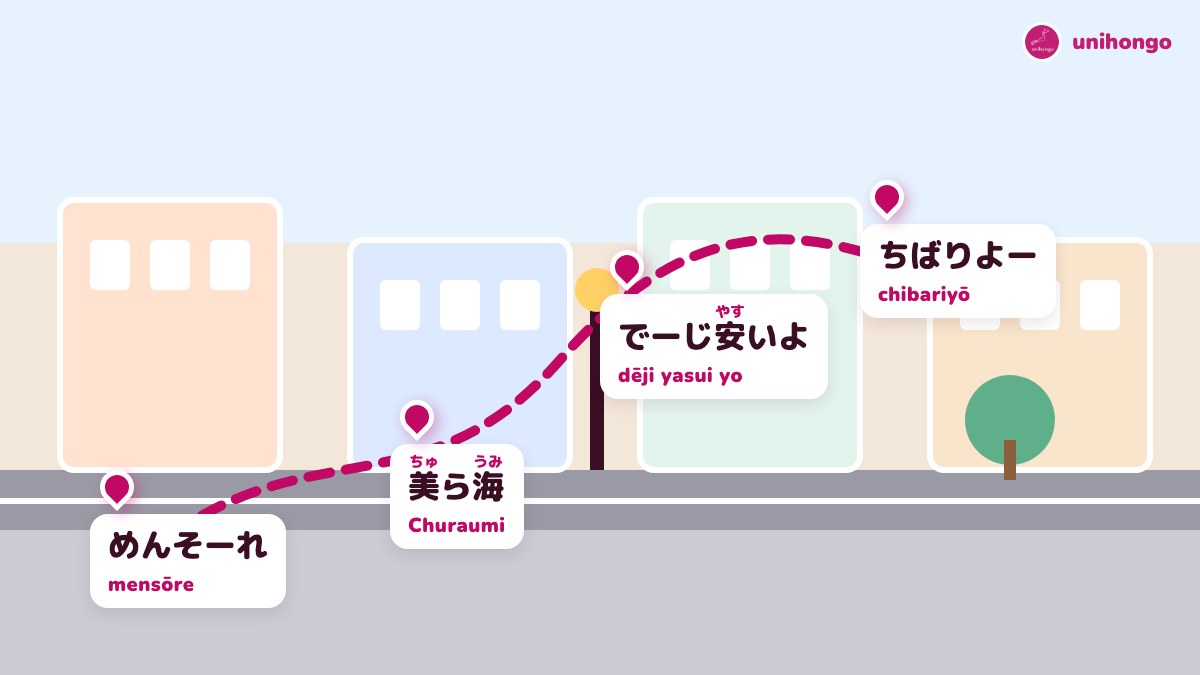
Many visitors meet Okinawan words in a set order: at the airport, at the aquarium, in a market or on a street of shops, and at an event such as a sports race or an eisa dance. Here is a typical route, with what you might see or hear at each stop.
| Japanese | Romaji | Meaning |
|---|---|---|
| めんそーれ沖縄へ | Mensōre Okinawa e | Welcome to Okinawa (airport banner; standard: Okinawa e yōkoso) |
| 美ら海水族館 | Churaumi Suizokukan | Churaumi Aquarium |
| でーじ安いよ! | Dēji yasui yo! | Seller: Really cheap! (standard: totemo yasui yo) |
| ちばりよー! | Chibariyō! | Spectators: Go for it! (standard: ganbare!) |
Using Okinawan words as a guest
- Do use: nifēdēbiru when leaving a shop where staff greeted you in Okinawan, or dēji oishii about the food. People generally receive this warmly.
- Do learn: mensōre, haisai and chura, so you understand signs and greetings.
- Be careful with: naichā, and jokes about island time. These touch on history and identity.
- Do not assume Okinawan is just a dialect or a cute accent. For many families it is a heritage language that older relatives spoke and younger ones are relearning.
- Use standard Japanese for everything practical: bookings, directions, problems at the hotel.
Before the flight to Naha
Ask Mocchi to explain the kanji on the sign you will see first, with /kanji 美, and why 美ら海 is read chura. Mocchi explains the usual readings, the special Okinawan one, and can turn the words from this post into a short quiz that comes back in later reviews.
Then practise the tourist side of the trip aloud. In AI Sensei, choose the sightseeing topic, pick Haru-sensei and ask the Sensei to play a tour guide in Okinawa. Ask about the aquarium, a market and the best beach in polite Japanese, and finish with nifēdēbiru; the session report afterwards lists any corrections and the new words you used.