
The words for the debate
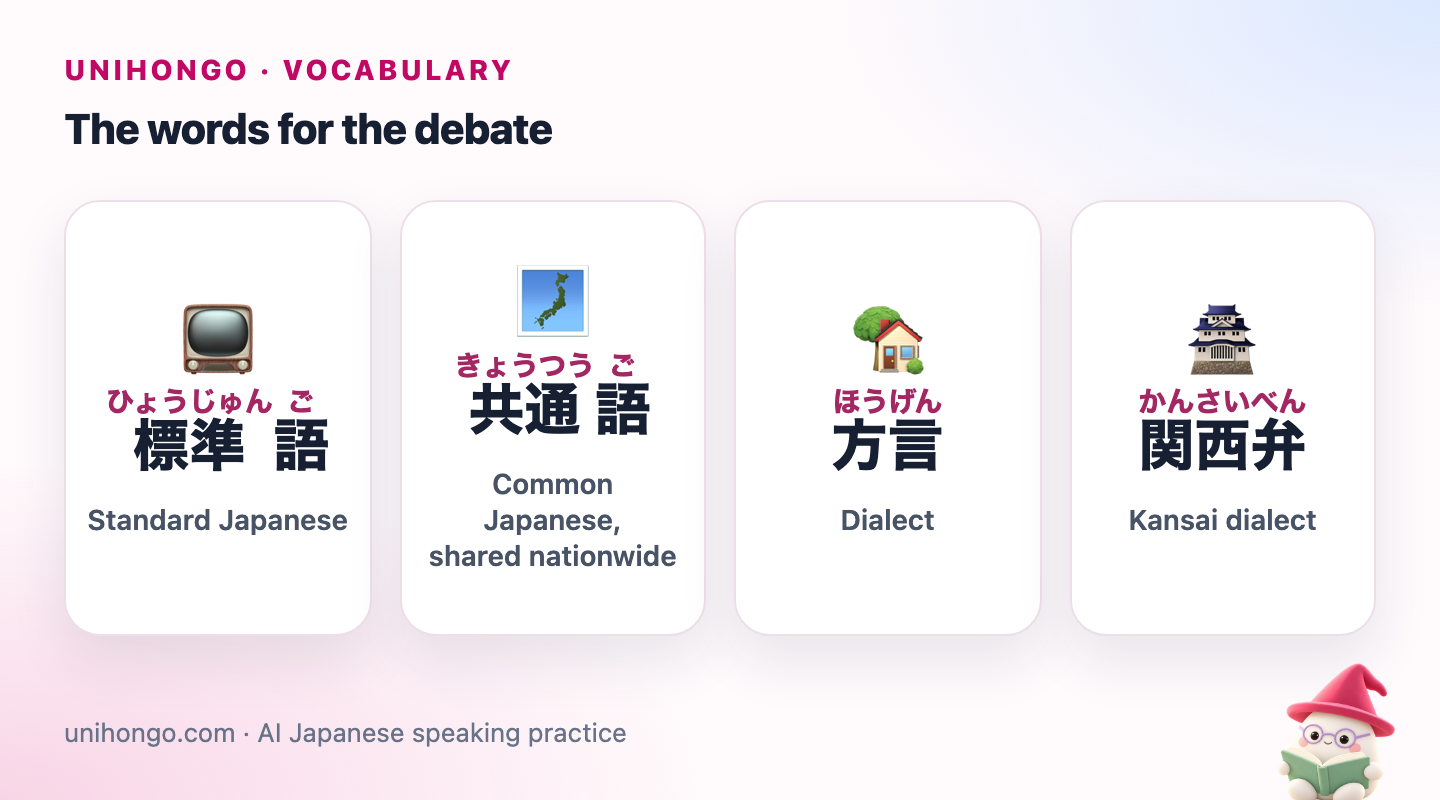
Four words come up whenever Japanese people talk about how they speak. Hyōjungo is standard Japanese. Kyōtsūgo, common language, is the term many linguists prefer for the Japanese everyone shares. Hōgen means dialect in general. Kansai-ben, and every other -ben, names a particular regional variety.
| Japanese | Romaji | Meaning |
|---|---|---|
| 標準語 | hyōjungo | Standard Japanese |
| 共通語 | kyōtsūgo | Common Japanese, shared nationwide |
| 方言 | hōgen | Dialect |
| 関西弁 | Kansai ben | Kansai dialect |
What standard Japanese really is
Standard Japanese grew out of efforts from the late nineteenth century to give a modernising country one shared language for schools, the army, government and newspapers. It was based mainly on the educated speech of Tokyo's Yamanote area. Radio, then television, spread it into every home. Today it is the Japanese of textbooks, NHK news, official documents and most business.
Two points surprise learners. First, standard Japanese is not the same as Tokyo street speech: young Tokyo people use plenty of casual forms that are not standard. Second, many linguists prefer the term kyōtsūgo, common language, because hyōjungo can suggest that other speech is substandard. In daily conversation you will hear both words, and hyōjungo is the one most people use.
| Japanese | Romaji | Meaning |
|---|---|---|
| 標準語で話してもいいですか。 | Hyōjungo de hanashite mo ii desu ka. | Is it all right if I speak standard Japanese? |
| 地元の言葉は何弁ですか。 | Jimoto no kotoba wa nani ben desu ka. | What dialect do they speak where you're from? |
| 職場では標準語を使います。 | Shokuba de wa hyōjungo o tsukaimasu. | At work I use standard Japanese. |
Why almost everyone should start with standard Japanese
| Reason | What it means for you |
|---|---|
| Understood everywhere | From Hokkaido to Okinawa, everyone understands it |
| Used in tests | The JLPT and other exams use standard Japanese |
| Used at work and in admin | Keigo, emails, forms and meetings are almost always standard |
| Most materials | Textbooks, apps, graded readers and news use it |
| Neutral image | It carries no regional stereotype in the listener's ear |
| A base for dialects | Dialects are easiest to learn as changes from the standard |
The last point matters most. Every dialect post in this series describes local speech as swaps from the standard: ya for da, hen for nai, bai for yo. Without the standard, those swaps have nothing to attach to.
When a dialect really helps
There are real situations where dialect skills pay off. Most of them are about listening, and only a few are about speaking.
| Japanese | Romaji | Meaning |
|---|---|---|
| すみません、今のはどういう意味ですか。 | Sumimasen, ima no wa dō iu imi desu ka. | Sorry, what did that just mean? |
| それは方言ですか。 | Sore wa hōgen desu ka. | Is that a dialect word? |
| 標準語だと何と言いますか。 | Hyōjungo da to nan to iimasu ka. | How would you say that in standard Japanese? |
| 関西弁、ちょっとだけわかります。 | Kansai ben, chotto dake wakarimasu. | I understand a little Kansai dialect. |
- You live in a region: understanding neighbours, shop staff, doctors and colleagues when they speak naturally.
- Your partner's family is from a region: following conversation at family gatherings, especially with grandparents.
- You work in a local business: many workplaces outside Tokyo use dialect in the break room and standard in meetings.
- You love media from a region: comedy, local dramas or music.
- You want to build rapport: one local word used warmly can show you care about the place.
Politeness inside dialects
Dialect does not mean casual. Every region has its own ways to be respectful, and older forms of polite dialect are still heard in shops and among older people. In Kansai, the honorific haru is used every day for respect towards others. In Kyoto, traditional shops may welcome you with okoshi yasu. Older Hiroshima speakers may say tsukāsai for kudasai.
At the same time, the most formal Japanese, the keigo of business emails, ceremonies and customer service, is nearly always standard. A Kansai salesperson who chats in dialect with colleagues will usually switch to standard keigo with a client. For a learner, the rule is simple: when in doubt, polite standard Japanese.
| Japanese | Romaji | Meaning |
|---|---|---|
| 社長が言うてはった。 | Shachō ga yūte hatta. | The president was saying so. (Kansai, respectful to the president; standard: shachō ga osshatte ita) |
| またおこしやす。 | Mata okoshi yasu. | Please come again. (traditional Kyoto shop; standard: mata okoshi kudasai) |
| ゆっくりしてつかあさい。 | Yukkuri shite tsukāsai. | Please make yourself at home. (older Hiroshima; standard: yukkuri shite kudasai) |
| 本日はありがとうございました。 | Honjitsu wa arigatō gozaimashita. | Thank you for today. (standard business keigo, used everywhere) |
The same words, standard and dialect
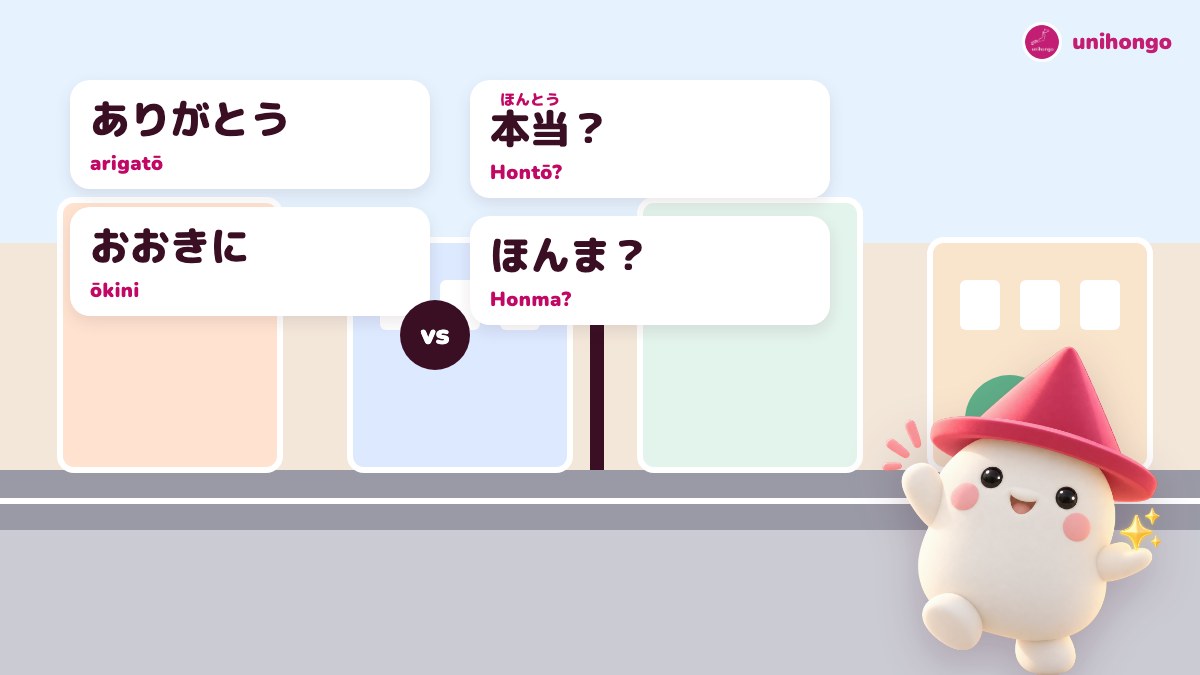
Local people constantly switch between the two systems, often within one conversation. The comparison below shows how small the switch can be: one word, sometimes one sound. Learning to hear these pairs is the first and most useful dialect skill.
| Standard | Kansai | Hakata | Hiroshima |
|---|---|---|---|
| sō da (そうだ) | sō ya (そうや) | sō tai (そうたい) | sō ja (そうじゃ) |
| dakara (だから) | ya kara (やから) | ya ken (やけん) | ja kee (じゃけえ) |
| totemo (とても) | meccha (めっちゃ) | bari (ばり) | buchi (ぶち) |
| nani shite iru no? (何しているの?) | nani shiteru n? (何してるん?) | nan shiyō to? (なんしようと?) | nani shiyoru n? (何しよるん?) |
A sensible order of study
- Stage 1: build standard Japanese, both casual and polite, to a comfortable conversational level.
- Stage 2: add listening for the dialect you meet most, starting with its five or six most common swaps.
- Stage 3: learn local words for food, weather and feelings, the topics where dialect is strongest.
- Stage 4: use one or two local words with friends who welcome it, and keep polite standard Japanese for everyone else.
- Throughout: keep asking what words mean. Curiosity is the best dialect teacher.
Common learner mistakes
- Learning a dialect before the standard. You will be understood, but you will struggle with tests, work and polite speech.
- Mixing dialect into keigo, such as sō ya gozaimasu. In polite speech, stay with standard forms.
- Imitating the accent. Pitch and intonation are the hardest parts of a dialect, and an imperfect imitation can sound like teasing.
- Assuming standard Japanese sounds cold. It sounds neutral, and warmth comes from how you speak.
- Treating a dialect as wrong Japanese. Dialects are full, rule-governed systems, and many people are proud of theirs.
Build the base, then add the flavour
Ask Mocchi to build your plan with /plan, telling it your level, your goal and the region you care about. Mocchi builds a personal path around your study time; if you later want a weekly dialect listening task, ask with /adjust-plan and the plan changes without losing the work you have done.
For the standard base itself, the pronunciation coach is a good partner: its pitch accent and sentence intonation drills use standard Japanese, so you build the neutral sound first and can recognise regional melodies against it later.