
Four words heard across Tohoku
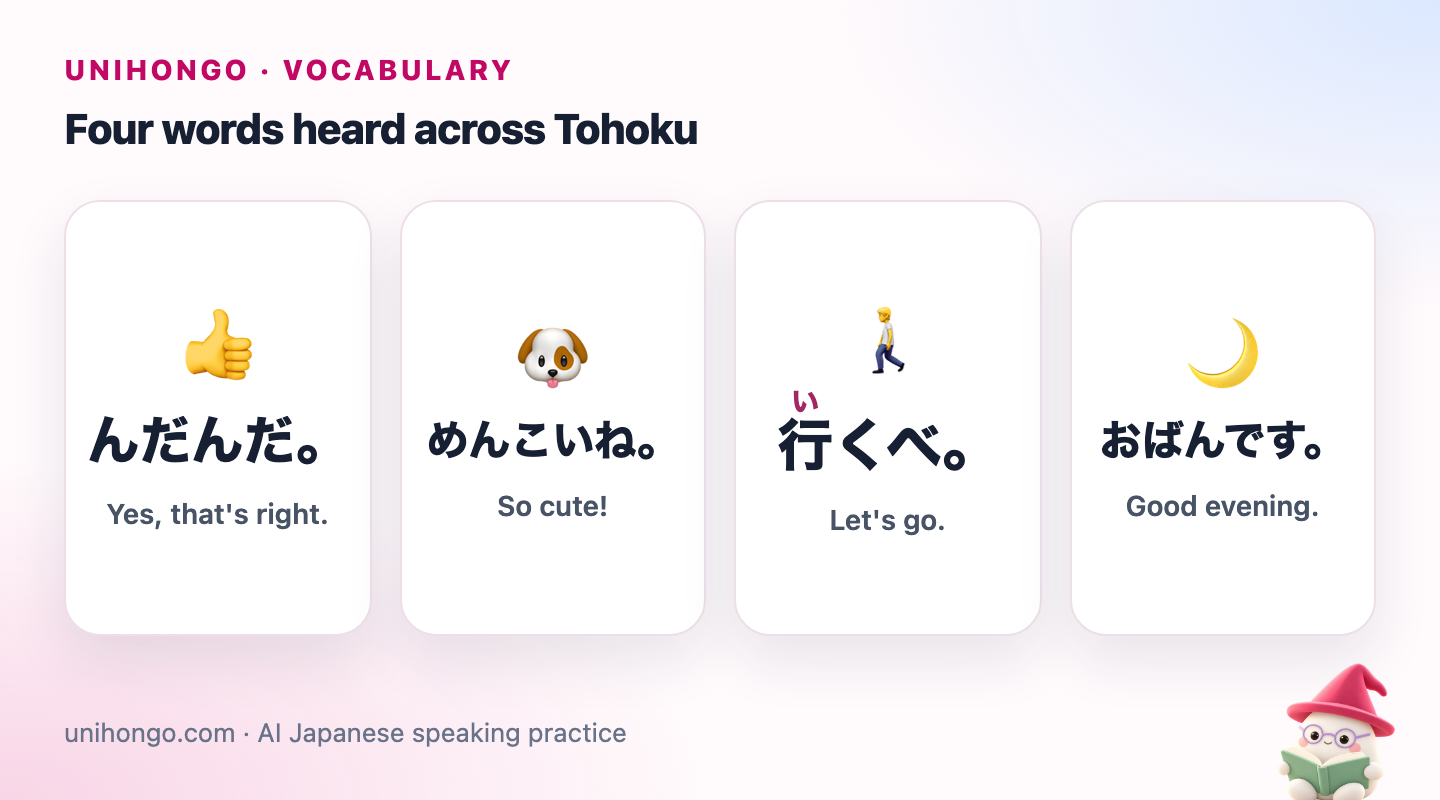
These four turn up in much of the region, though not everywhere and not in the same way. Nda nda is a friendly agreement. Menkoi is the warm word for cute. Iku be means let's go, with the regional ending be. Oban desu is a good-evening greeting heard in Tohoku and Hokkaido, especially among older people.
| Japanese | Romaji | Meaning |
|---|---|---|
| んだんだ。 | Nda nda. | Yes, that's right. |
| めんこいね。 | Menkoi ne. | So cute! |
| 行くべ。 | Iku be. | Let's go. |
| おばんです。 | Oban desu. | Good evening. |
| Tohoku | Standard | Meaning |
|---|---|---|
| nda nda (んだんだ) | sō da sō da (そうだそうだ) | Yes, that's right |
| menkoi ne (めんこいね) | kawaii ne (かわいいね) | So cute |
| iku be (行くべ) | ikō (行こう) | Let's go |
| oban desu (おばんです) | konbanwa (こんばんは) | Good evening |
Be, dabe and dappe: the endings
The ending be, from the old auxiliary beshi, is the most famous feature of eastern and northern Japanese. After a verb it often means let's or shall we; after da it becomes dabe, probably or isn't it. In parts of Fukushima and the northern Kanto area you also hear dappe, with a similar meaning. Be is also used in Hokkaido and, among some speakers, in rural parts of the Kanto region.
| Japanese | Romaji | Meaning |
|---|---|---|
| そろそろ帰るべ。 | Sorosoro kaeru be. | Let's head home soon. (standard: sorosoro kaerō) |
| 明日は雨だべ。 | Ashita wa ame dabe. | It'll probably rain tomorrow. (standard: ashita wa ame darō) |
| そうだべ? | Sō dabe? | Right? Isn't it? (standard: sō darō?) |
| そうだっぺ。 | Sō dappe. | That's how it is, isn't it. (Fukushima, northern Kanto; standard: sō darō) |
The sounds that make Tohoku speech soft
Much of what makes Tohoku speech hard for learners is sound, not vocabulary. Linguists describe several common features, though how strong they are depends on place and speaker. In many areas, shi and su, and chi and tsu, sound very close, which is why Tohoku speech is sometimes jokingly called zūzū-ben. Between vowels, k and t often become voiced, so kara sounds like gara and mato like mado. Vowels i and e can also merge. Once you know this, many mysterious words turn out to be standard ones in disguise.
| Japanese | Romaji | Meaning |
|---|---|---|
| 寒いがら、早ぐ入れ。 | Samui gara, hayagu haire. | It's cold, so come in quickly. (standard: samui kara, hayaku haire) |
| どさ行ぐの? | Dosa igu no? | Where are you going? (standard: doko e iku no?) |
| You may hear | Standard | Sound change |
|---|---|---|
| samui gara (寒いがら) | samui kara (寒いから) | k becomes g between sounds |
| sushi ≈ susu | sushi (すし) | shi and su sound close |
| kagi (柿) | kaki (柿) | k becomes g between vowels |
| hato ≈ hado | hato (鳩) | t becomes d between vowels |
Local favourites by prefecture
Every part of Tohoku has its own famous words. A few are known nationwide through television and local tourism. Treat the labels as rough guides: many words cross prefecture lines, and usage differs between generations.
| Japanese | Romaji | Meaning |
|---|---|---|
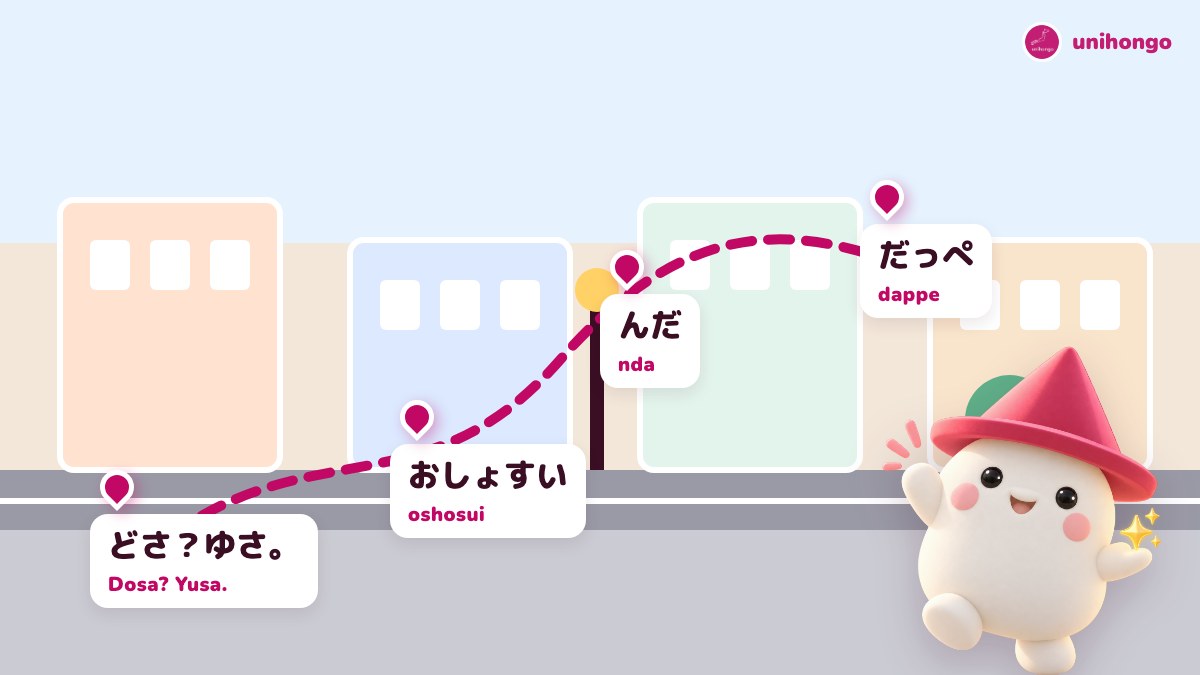
| どさ? ゆさ。 | Dosa? Yusa. | Where to? To the bath. (Tsugaru, Aomori; standard: doko e? Ofuro e.) |
| おしょすい。 | Oshosui. | How embarrassing. (Miyagi and nearby; standard: hazukashii) |
| いずい。 | Izui. | It feels uncomfortable, it doesn't sit right. (Miyagi, Hokkaido; standard: igokochi ga warui) |
| 水がしゃっこい。 | Mizu ga shakkoi. | The water is ice-cold. (Tohoku, Hokkaido; standard: mizu ga tsumetai) |
| そうだっちゃ。 | Sō datcha. | That's right. (Sendai area; standard: sō da yo) |
Izui is a lovely example of a word with no exact standard equivalent. It describes the nagging discomfort of something not quite right: an eyelash in your eye, a shirt label that scratches, new shoes that do not fit. Many people from Miyagi say they were surprised to discover it is not standard Japanese.
A short talk at a country inn
A traveller arrives at a small family-run inn in the evening. The owner, an older local, speaks gently in dialect; the traveller answers in polite standard Japanese and asks when something is unclear. Asking is not rude: most people are happy to explain their words.
| Japanese | Romaji | Meaning |
|---|---|---|
| おばんです。よぐ来たね。 | Oban desu. Yogu kita ne. | Owner: Good evening. Welcome, so glad you came. (standard: konbanwa. Yoku kita ne.) |
| こんばんは。今日からお世話になります。 | Konbanwa. Kyō kara osewa ni narimasu. | You: Good evening. Thank you for having me from today. |
| 寒がったべ? 風呂さ入って温まれ。 | Samugatta be? Furo sa haitte atatamare. | Owner: You must have been cold. Get in the bath and warm up. (standard: samukatta darō? Ofuro ni haitte atatamari nasai.) |
| すみません、「さ」はどういう意味ですか。 | Sumimasen, sa wa dō iu imi desu ka. | You: Sorry, what does sa mean? |
| 「に」とおんなじだ。風呂に、だ。 | Ni to onnaji da. Furo ni, da. | Owner: It's the same as ni. Into the bath. (standard: ni to onaji da) |
| なるほど。ありがとうございます。 | Naruhodo. Arigatō gozaimasu. | You: I see. Thank you. |
When you do not catch a word
With strong Tohoku speech, even advanced learners and Japanese visitors from other regions sometimes miss whole sentences. That is normal, and nobody expects you to understand everything. The key is to ask early and kindly, and to show that you are interested rather than lost. Most older speakers will slow down or switch towards standard Japanese as soon as they notice you are a visitor, and many enjoy explaining a word.
It also helps to repeat back the part you did understand. If someone says samugatta be?, a simple samukatta desu, yes, it was cold, shows you followed and keeps the conversation going.
| Japanese | Romaji | Meaning |
|---|---|---|
| すみません、もう一度お願いします。 | Sumimasen, mō ichido onegai shimasu. | Sorry, could you say that once more? |
| もう少しゆっくり話していただけますか。 | Mō sukoshi yukkuri hanashite itadakemasu ka. | Could you speak a little more slowly, please? |
| それはこの辺りの言葉ですか。 | Sore wa kono atari no kotoba desu ka. | Is that a local word around here? |
| 面白い言葉ですね。 | Omoshiroi kotoba desu ne. | What an interesting word. |
Respect, not imitation
- Tohoku dialects have sometimes been mocked on television as country speech. Many speakers are proud of them now, but imitation from outsiders can still sting. Recognise the words; do not perform them.
- Use standard Japanese when you speak. Menkoi ne about a grandchild or a dog is about as far as most visitors should go.
- Ask politely when you are lost: sumimasen, mō ichido onegai shimasu or dō iu imi desu ka. People usually explain kindly.
- Do not assume one Tohoku dialect fits all six prefectures. Aomori, Akita and Fukushima speech can be very different.
- Older speakers keep more dialect. Younger people in Sendai or Morioka often sound close to standard, with a few local words.
Ten minutes of Tohoku listening practice
Tell Mocchi you are heading to Tohoku and ask it to quiz you with /vocab on regional words such as nda, menkoi, oshosui and izui, with the standard Japanese for each. Because Mocchi keeps notes on what you miss, the next session starts with the words that slipped away rather than the ones you already know.
For the ear, open the pronunciation coach and work through a long-vowel or small tsu drill, listening at the slowed-down speed first. It practises standard Japanese, not dialect, but training yourself to hear small differences in sound is exactly the skill that later helps you decode samui gara as samui kara.