
Hokkaido in four phrases
Namara umai is what you might hear over a bowl of miso ramen or a plate of crab. Shibareru ne is a winter morning greeting. Ii ssho? asks for agreement. Gomi nagetoite is a household request that surprises almost every visitor.
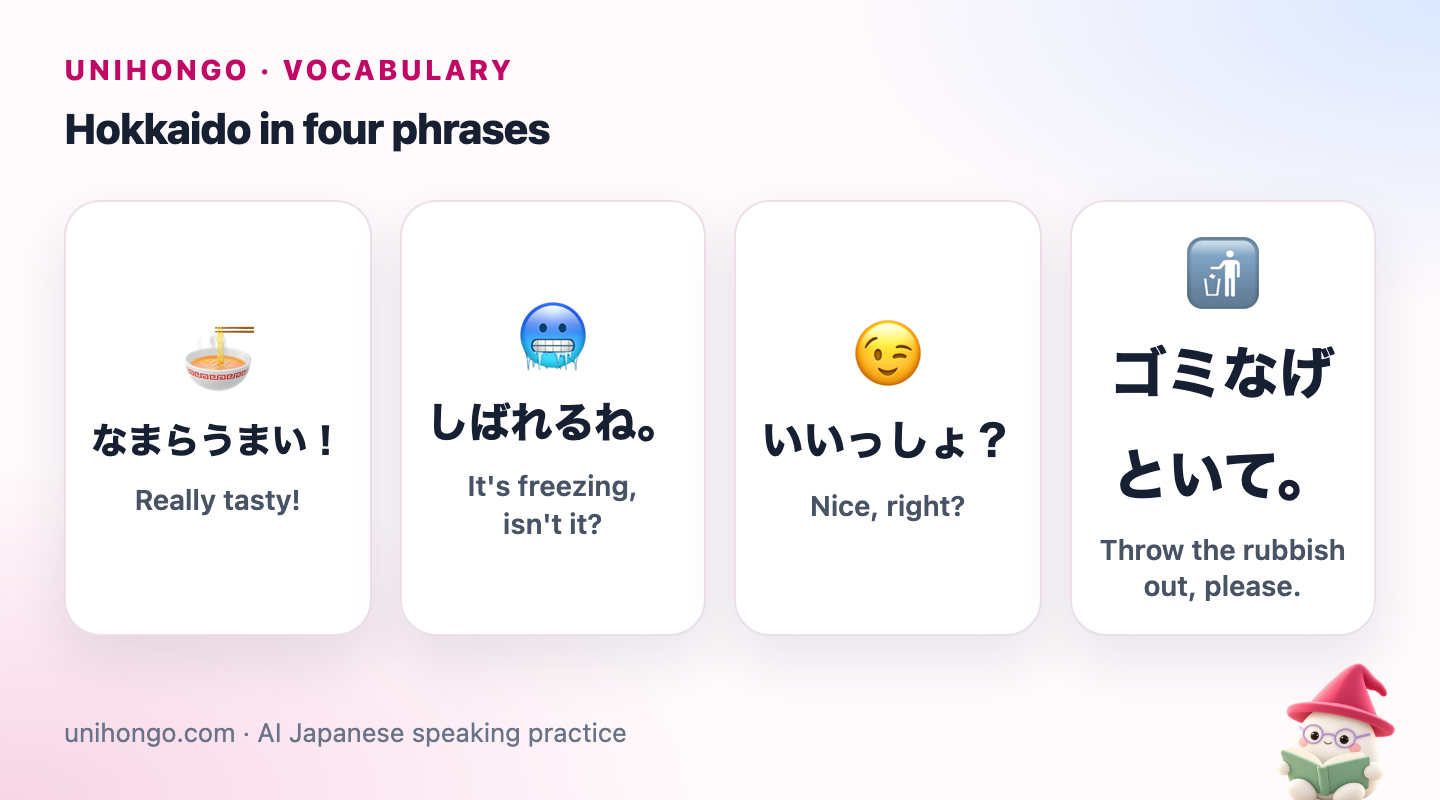
| Japanese | Romaji | Meaning |
|---|---|---|
| なまらうまい! | Namara umai! | Really tasty! |
| しばれるね。 | Shibareru ne. | It's freezing, isn't it? |
| いいっしょ? | Ii ssho? | Nice, right? |
| ゴミなげといて。 | Gomi nagetoite. | Throw the rubbish out, please. |
| Hokkaido | Standard | Meaning |
|---|---|---|
| namara umai (なまらうまい) | sugoku oishii (すごくおいしい) | Really tasty |
| shibareru ne (しばれるね) | kogoeru hodo samui ne (凍えるほど寒いね) | It's freezing |
| ii ssho? (いいっしょ?) | ii deshō? (いいでしょう?) | Nice, right? |
| gomi nagetoite (ゴミなげといて) | gomi o sutete oite (ゴミを捨てておいて) | Throw the rubbish out |
Why Hokkaido sounds close to standard
Before the late nineteenth century, Hokkaido was home mainly to the Ainu people, with Japanese settlements concentrated in the south. When large-scale settlement began after 1869, people arrived from many parts of Japan, and their children needed a shared way to talk. Many historians of the language describe Hokkaido Japanese as a mix that levelled out towards the common standard, with words carried from Tohoku and Hokuriku in particular. That is why so many Hokkaido words, such as shibareru, shakkoi, menkoi and be, are also heard in Tohoku.
Hokkaido place names tell another part of the story. Many come from the Ainu language, such as Sapporo and Otaru, and are written with kanji chosen mainly for sound. A few everyday Hokkaido words are also thought to come from Ainu, but the clearest Ainu legacy is on the map rather than in casual speech.
Winter words: shibareru, shakkoi and more
Hokkaido's winter shaped its vocabulary. Shibareru is a step beyond samui: the cold that freezes pipes and makes the snow squeak underfoot. Shakkoi, ice-cold to the touch, is shared with Tohoku. Many people also use the verb haku, normally used for shoes and trousers, for putting on gloves, where standard Japanese uses hameru or suru.
| Japanese | Romaji | Meaning |
|---|---|---|
| 今朝はなまらしばれる。 | Kesa wa namara shibareru. | It's bitterly cold this morning. (standard: kesa wa hontō ni samui) |
| 水がしゃっこい。 | Mizu ga shakkoi. | The water is freezing to the touch. (standard: mizu ga tsumetai) |
| 手袋はいてってね。 | Tebukuro haitette ne. | Put your gloves on before you go. (standard: tebukuro o shite itte ne) |
| 道、つるつるだから気をつけて。 | Michi, tsurutsuru da kara ki o tsukete. | The road's icy, so be careful. (standard) |
-ssho, -be and other endings
The ending -ssho is a shortened deshō, used to ask for agreement or to say something is obvious. It is so common in Hokkaido that many people use it without noticing, and it has spread into casual speech elsewhere. You will also hear be and dabe, shared with Tohoku, though many younger people use them less.
| Japanese | Romaji | Meaning |
|---|---|---|
| そうっしょ? | Sō ssho? | Right? That's how it is, isn't it? (standard: sō deshō?) |
| 寒いっしょ。上着着な。 | Samui ssho. Uwagi kina. | It's cold, obviously. Put a jacket on. (standard: samui deshō. Uwagi o kinasai.) |
| 明日、札幌行くべ。 | Ashita, Sapporo iku be. | Let's go to Sapporo tomorrow. (standard: ashita, Sapporo ni ikō) |
| したっけ、またね。 | Shitakke, mata ne. | Well then, see you. (standard: jā, mata ne) |
Shitakke is a useful listening word. It can mean then or so at the start of a story, and, said at the door, well then, bye. Context makes the meaning clear.
False friends: nageru, kowai and yurukunai
These are the Hokkaido words most likely to confuse a learner who knows standard Japanese well, because the words exist in the standard language with a different meaning. Kowai meaning tired is mostly heard from older speakers, but it is good to know when a grandparent sighs ā, kowai after a walk.
| Japanese | Romaji | Meaning |
|---|---|---|
| この空き缶、なげていい? | Kono akikan, nagete ii? | Can I throw this can away? (standard: kono akikan, sutete ii?) |
| ああ、こわい。 | Ā, kowai. | Oh, I'm worn out. (older; standard: ā, tsukareta) |
| 雪かき、ゆるくないわ。 | Yukikaki, yurukunai wa. | Shovelling snow is tough. (standard: yukikaki wa taihen da) |
| Word | Standard meaning | Hokkaido meaning |
|---|---|---|
| nageru (投げる) | to throw | to throw away, dispose of |
| kowai (こわい) | scary | tired, worn out (mostly older speakers) |
| yurukunai (ゆるくない) | not loose | hard, tough, a struggle |
| haku (はく) | to put on shoes or trousers | also to put on gloves |
The -saru form: when things happen by themselves
Hokkaido and parts of Tohoku have a verb form that standard Japanese lacks: -saru, which says that something happened without the speaker meaning it, almost as if the object did it. Osasatta means the button got pressed, it wasn't me! Kakasaru describes a pen that writes nicely, almost by itself. It is handy and expressive, and Hokkaido people often say they miss it when they move away.
| Japanese | Romaji | Meaning |
|---|---|---|
| ボタンが押ささった。 | Botan ga osasatta. | The button got pressed, I didn't mean to. (standard: ukkari botan o oshite shimatta) |
| このペン、よく書かさる。 | Kono pen, yoku kakasaru. | This pen writes really smoothly. (standard: kono pen wa kakiyasui) |
| つい食べらさる。 | Tsui taberasaru. | I just can't stop eating it. (standard: tsui tabete shimau) |
A frosty morning at a guesthouse
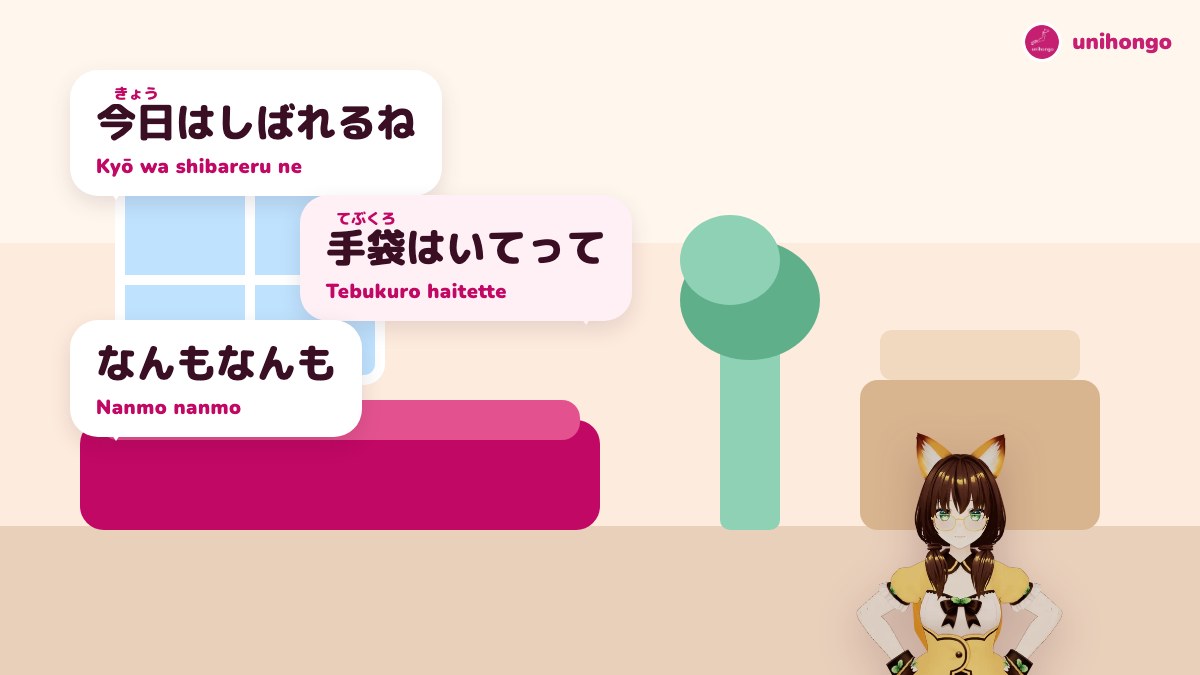
A visitor comes down to breakfast at a small guesthouse in winter. The host uses some Hokkaido words; the visitor answers in polite standard Japanese. The standard Japanese for each Hokkaido line is in brackets.
| Japanese | Romaji | Meaning |
|---|---|---|
| おはよう。今日はしばれるねえ。 | Ohayō. Kyō wa shibareru nē. | Host: Morning. It's freezing today. (standard: kyō wa hontō ni samui ne) |
| おはようございます。本当に寒いですね。 | Ohayō gozaimasu. Hontō ni samui desu ne. | You: Good morning. It really is cold. |
| 外、つるつるだから、手袋はいてって。 | Soto, tsurutsuru da kara, tebukuro haitette. | Host: It's icy outside, so wear your gloves. (standard: tebukuro o shite itte) |
| はい。朝ご飯、とてもおいしかったです。 | Hai. Asagohan, totemo oishikatta desu. | You: I will. Breakfast was delicious. |
| なんもなんも。 | Nanmo nanmo. | Host: Oh, it was nothing. (standard: iie iie, tondemo nai) |
| したっけ、気をつけて行ってらっしゃい。 | Shitakke, ki o tsukete itterasshai. | Host: Well then, take care out there. (standard: jā, ki o tsukete itterasshai) |
Common learner mistakes
- Taking nageru literally and looking alarmed when someone asks you to nageru the rubbish.
- Answering kowai with is something scary? when an older person simply means they are tired.
- Overusing namara. Said once with real feeling, it sounds natural; in every sentence it sounds like an impression.
- Thinking -ssho is rude. It is casual, not rude, but keep deshō or desu yo in polite speech.
- Expecting strong dialect everywhere. In Sapporo most people sound close to standard; stronger forms are more common in rural and coastal areas.
Practise the words before the snow
Type a few lines of your own with Hokkaido words to Mocchi and use /correct, for example 今朝はなまらしばれるっしょ. Mocchi checks the Japanese, tells you whether the dialect is used naturally and gives the standard version beside it. Ask for a short review a few days later; Mocchi picks up with the words you were unsure of.
Then talk it through out loud. In AI Sensei, choose the weather topic, pick Yamada-sensei and ask the Sensei to play the owner of a guesthouse in Hokkaido on a snowy morning. Talk about the cold, the icy roads and breakfast in polite Japanese, and end with a namara oishikatta desu if you feel brave.