
Nagoya in four phrases
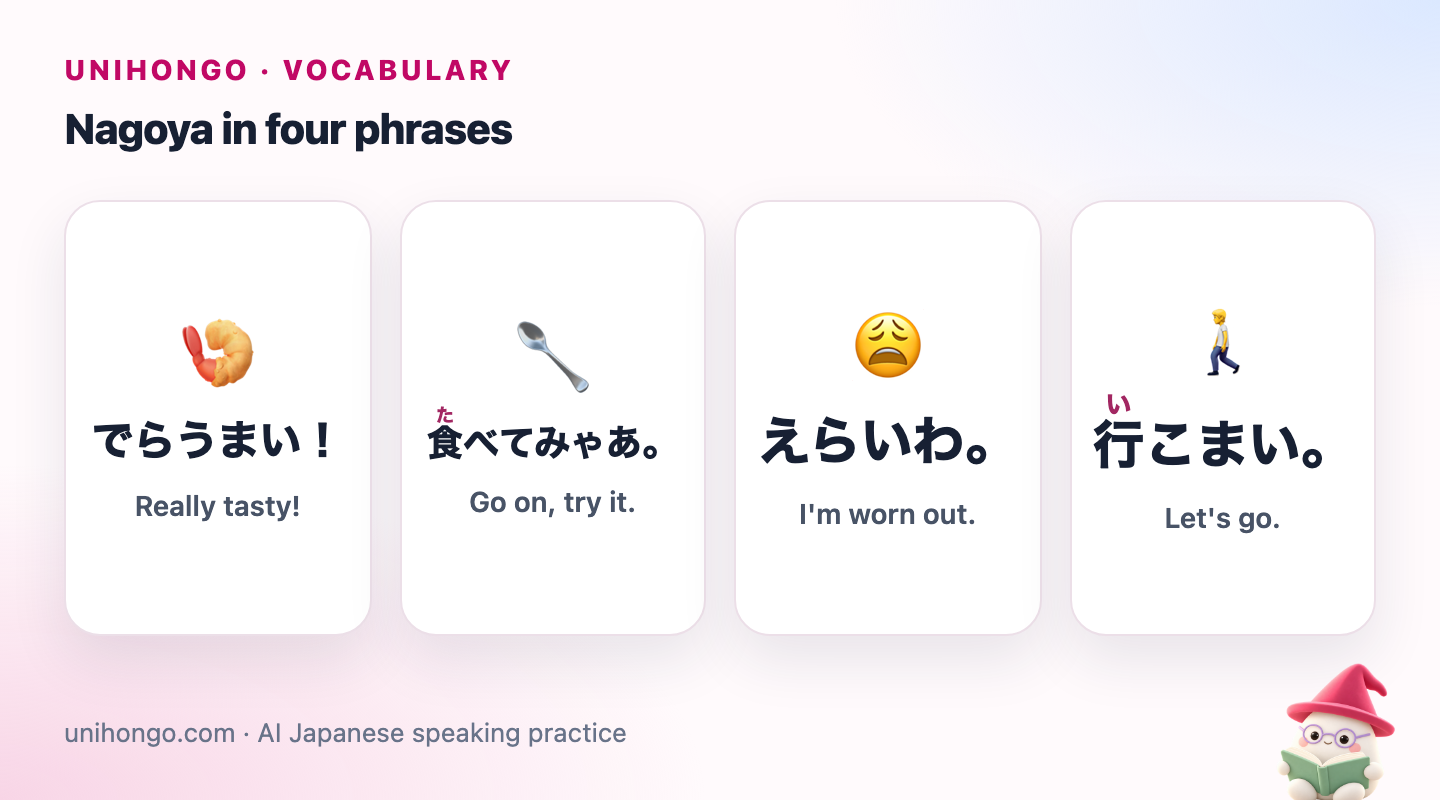
These four lines sum up Nagoya speech as people actually use it. Dera umai is the favourite verdict on miso katsu or hitsumabushi. Tabete myā is a warm push to try something. Erai wa is a sigh of tiredness. Ikomai is an invitation to go somewhere together.
| Japanese | Romaji | Meaning |
|---|---|---|
| でらうまい! | Dera umai! | Really tasty! |
| 食べてみゃあ。 | Tabete myā. | Go on, try it. |
| えらいわ。 | Erai wa. | I'm worn out. |
| 行こまい。 | Ikomai. | Let's go. |
| Nagoya | Standard | Meaning |
|---|---|---|
| dera umai (でらうまい) | sugoku oishii (すごくおいしい) | Really tasty |
| tabete myā (食べてみゃあ) | tabete mite (食べてみて) | Go on, try it |
| erai wa (えらいわ) | tsukareta (疲れた) | I'm worn out |
| ikomai (行こまい) | ikō (行こう) | Let's go |
Where myā really comes from
Traditional Nagoya speech changes some vowel combinations. The ai in words like akai, red, or daikon, radish, can come out as a single sound somewhere between a and e, or as ya after some consonants. That is why older forms such as akyā for akai or dyākon for daikon are quoted. Add the soft command miyā, try, from miru, which easily contracts to myā, and you have the sound that comedians love: tabete myā, go on, try it. Older speakers in Nagoya still use these sounds to varying degrees; many younger people use them much less.
The comedy version, in which every sentence ends with myā and fried shrimp becomes ebi furyā, is an exaggeration made popular on national television. Many Nagoya people find it funny; some find it tiresome. As a learner, recognise the real sound change, enjoy the joke, and do not use ebi furyā as if it were real Nagoya speech.
| Japanese | Romaji | Meaning |
|---|---|---|
| 赤い | akai | Red (standard; older Nagoya speech may sound like akyā) |
| 大根 | daikon | Japanese radish (standard; older Nagoya speech may sound like dyākon) |
| えびふりゃー | ebi furyā | Fried shrimp (comedy parody; standard: ebi furai) |
Endings and grammar: -mai, -yā and da gaya
A few endings do most of the work. The volitional -mai means let's: ikomai, tabeyomai. The soft command -yā or -te yā is a friendly please do: hayo shiyā, hurry up. Da gaya and da gane add emphasis, like ja nai ka or da yo; da gaya sounds stronger and older, da gane softer. Kan, from ikan, means must not: yattara kan, you mustn't do that.
| Japanese | Romaji | Meaning |
|---|---|---|
| はよしやあ。 | Hayo shiyā. | Hurry up, come on. (standard: hayaku shinasai) |
| そうだがや。 | Sō da gaya. | That's what I'm saying! (older, strong; standard: sō ja nai ka) |
| そうだがね。 | Sō da gane. | That's right, you know. (softer; standard: sō da yo) |
| それ、やったらかんよ。 | Sore, yattara kan yo. | You mustn't do that. (standard: sore wa yatte wa ikenai yo) |
| 一緒に食べよまい。 | Issho ni tabeyomai. | Let's eat together. (standard: issho ni tabeyō) |
False friends that catch learners out
Several Nagoya words exist in standard Japanese but mean something different, or are so ordinary in Aichi that people are surprised to learn they are dialect. School words are the classic examples, because everyone grew up using them.
| Japanese | Romaji | Meaning |
|---|---|---|
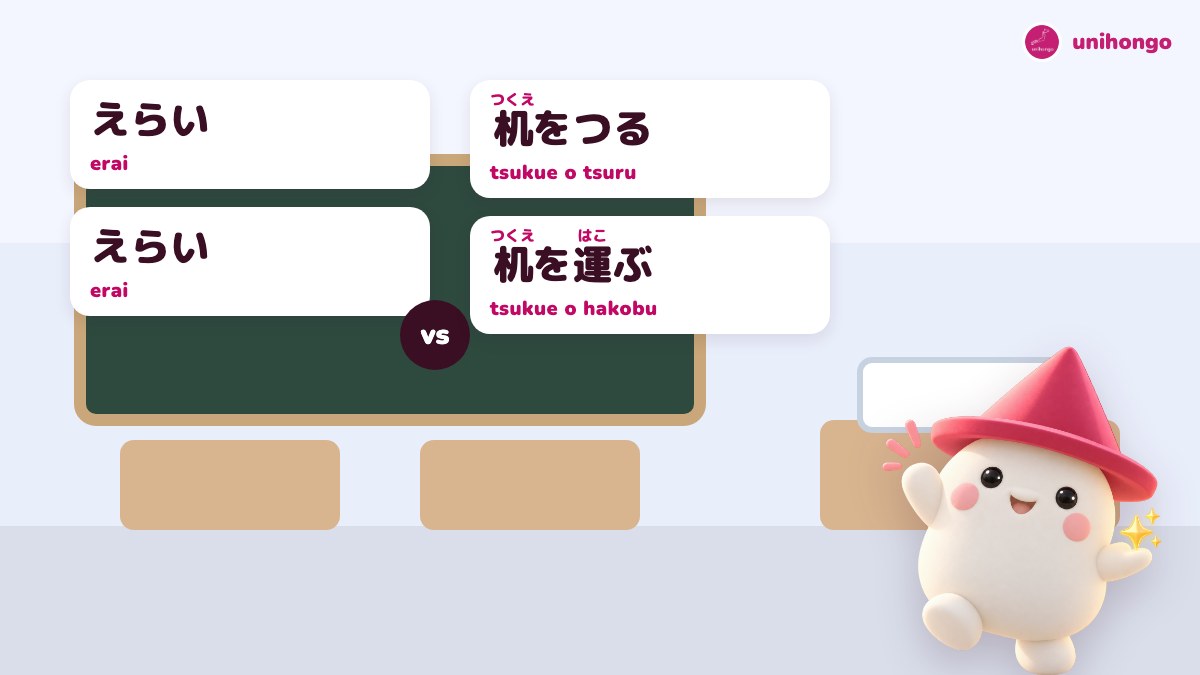
| 机、つって。 | Tsukue, tsutte. | Carry the desk, please. (standard: tsukue o hakonde) |
| 次の放課に行こう。 | Tsugi no hōka ni ikō. | Let's go at the next break. (standard: tsugi no yasumi jikan ni ikō) |
| 鉛筆がときんときんだ。 | Enpitsu ga tokintokin da. | The pencil is really sharp. (standard: enpitsu ga togatte iru) |
| Nagoya word | Nagoya meaning | Standard word or meaning |
|---|---|---|
| erai (えらい) | tired, tough | erai means great, admirable |
| tsuru (つる) | to carry (desks, together) | hakobu (運ぶ) |
| hōka (放課) | break between lessons | yasumi jikan (休み時間) |
| B-shi (B紙) | large sheet of poster paper | mozōshi (模造紙) |
| kettā (ケッタ) | bicycle (casual, a bit dated) | jitensha (自転車) |
If a Nagoya friend says erai after work, the kind reply is otsukare-sama or taihen datta ne, not a compliment. If a teacher asks students to tsuru the desks, they mean pick them up and carry them, often in pairs, when the classroom is cleaned. Hōka, the break between lessons, is used across Aichi and nearby Gifu and Mie, and many people only learn it is dialect when a classmate from Tokyo looks confused.
Words like these show something important about dialect: much of it is not about accent or exotic endings, but ordinary daily words that people grew up with and never thought to question.
A morning set at a Nagoya café
Nagoya is famous for its kissaten morning culture: order a coffee before late morning and many cafés add toast, a boiled egg or other extras at no extra charge. Here a regular who speaks Nagoya-ben chats with a visitor, who answers in polite standard Japanese.
| Japanese | Romaji | Meaning |
|---|---|---|
| ここのモーニング、でらええよ。 | Koko no mōningu, dera ee yo. | Regular: The morning set here is really good. (standard: koko no mōningu, sugoku ii yo) |
| そうなんですか。何が付きますか。 | Sō nan desu ka. Nani ga tsukimasu ka. | You: Really? What comes with it? |
| トーストとゆで卵だがね。小倉トーストも食べてみやあ。 | Tōsuto to yudetamago da gane. Ogura tōsuto mo tabete miyā. | Regular: Toast and a boiled egg. Try the red-bean toast too. (standard: tōsuto to yudetamago da yo. Ogura tōsuto mo tabete mite) |
| 小倉トースト、初めてです。 | Ogura tōsuto, hajimete desu. | You: I've never had red-bean toast. |
| どう? | Dō? | Regular: Well? |
| 甘くて、おいしいです! | Amakute, oishii desu! | You: It's sweet and delicious! |
| ほうだがね。また来やあね。 | Hō da gane. Mata kiyā ne. | Regular: Told you. Come again. (standard: sō deshō. Mata kite ne) |
Common learner mistakes
- Telling a Nagoya friend erai ne! as praise after they say they are erai. They meant they are exhausted; a sympathetic otsukare is the right reply.
- Saying ebi furyā in a restaurant as if it were real dialect. Some people will laugh, but you are quoting a parody, not Nagoya speech.
- Adding myā to everything. It is a sound change in certain words, not a magic ending.
- Using da gaya with strangers. It sounds strong and a little rough; keep standard polite forms with people you do not know.
- Assuming all of Aichi speaks alike. The Mikawa area in the east has its own forms, such as -rin for gentle commands.
Make the Nagoya false friends stick
Ask Mocchi to make flashcards with /create-flashcards for erai, tsuru, hōka and dera, each with the Nagoya meaning and the standard one, and pick a photo for each card. Then use /review-flashcards over the following days; the spaced repetition brings the tricky ones back just before you would forget them.
When the cards feel easy, load them into Kotoba Tank on the games page. A fast game with your own cards is a good test: if you still pause on erai, it shows you exactly which false friend needs one more round.