
Four lines that sound like Fukuoka
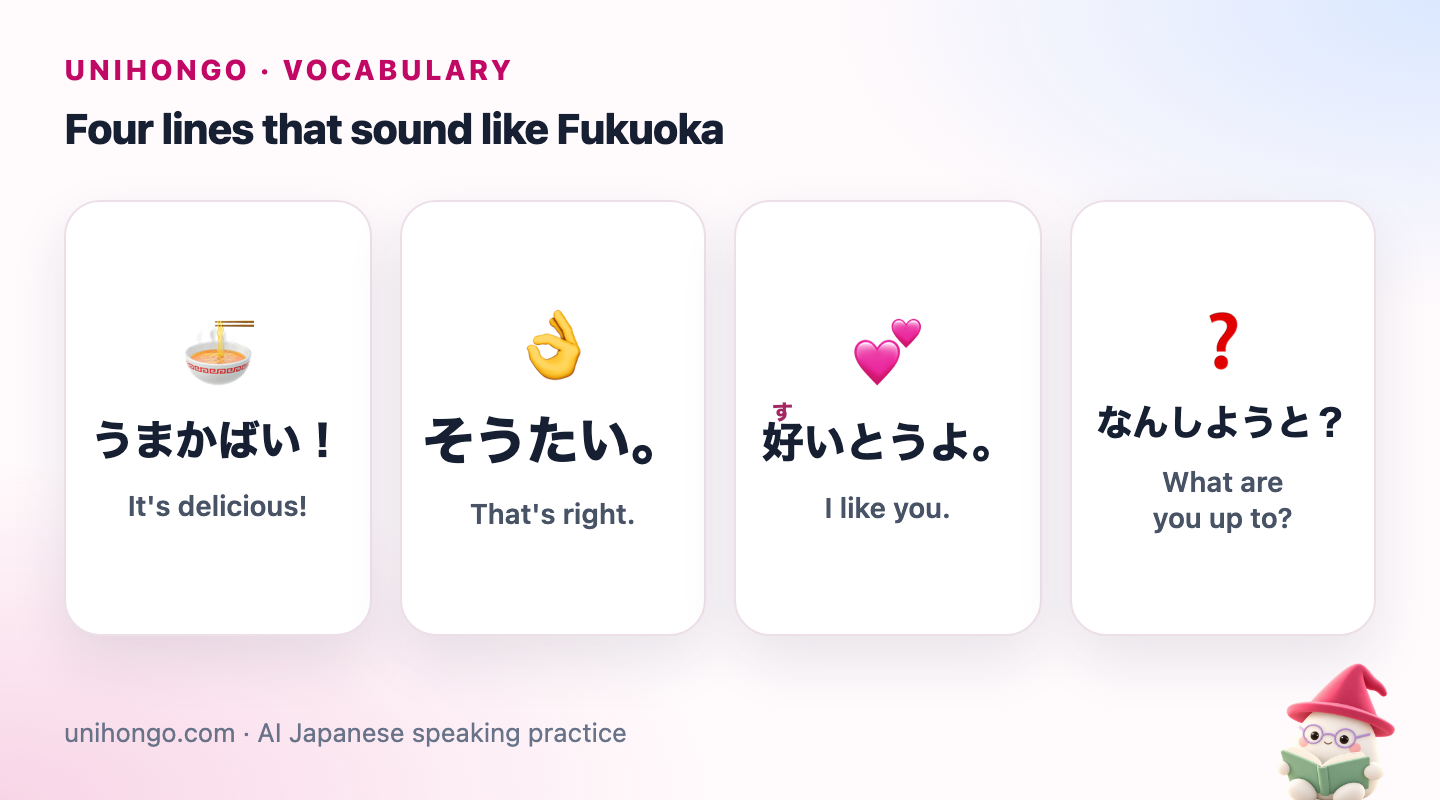
Hear these and you know you are in Fukuoka. Umaka bai shows two features at once: the -ka adjective and the ending bai. Sō tai is a friendly that's right. Suitō is the famous Hakata I like you. Nan shiyō to? is the everyday what are you doing?
| Japanese | Romaji | Meaning |
|---|---|---|
| うまかばい! | Umaka bai! | It's delicious! |
| そうたい。 | Sō tai. | That's right. |
| 好いとうよ。 | Suitō yo. | I like you. |
| なんしようと? | Nan shiyō to? | What are you up to? |
| Hakata | Standard | Meaning |
|---|---|---|
| umaka bai (うまかばい) | oishii yo (おいしいよ) | It's delicious! |
| sō tai (そうたい) | sō da yo (そうだよ) | That's right |
| suitō yo (好いとうよ) | suki da yo (好きだよ) | I like you |
| nan shiyō to? (なんしようと?) | nani shite iru no? (何しているの?) | What are you doing? |
The building blocks: ka, to, ken and ya
A small set of swaps explains most Hakata sentences. Adjectives that end in -i often end in -ka: yoka for ii, samuka for samui. Questions end in to where standard Japanese uses no. Ken means because, like kara. The copula is often ya, as in Kansai, though older speakers may also say ja.
| Japanese | Romaji | Meaning |
|---|---|---|
| 今日は寒かね。 | Kyō wa samuka ne. | It's cold today, isn't it? (standard: kyō wa samui ne) |
| よかよか。 | Yoka yoka. | It's fine, no problem. (standard: ii yo ii yo) |
| どこ行くと? | Doko iku to? | Where are you going? (standard: doko iku no?) |
| 雨やけん、タクシーで行こう。 | Ame ya ken, takushī de ikō. | It's raining, so let's take a taxi. (standard: ame da kara, takushī de ikō) |
| 知らんと? | Shiran to? | You don't know? (standard: shiranai no?) |
| どげんしたと? | Dogen shita to? | What's wrong? What happened? (standard: dō shita no?) |
Bai and tai: two endings with a difference
Bai and tai are the sentence endings people imitate when they joke about Fukuoka. Both add force, like yo or da yo, and many people use them without thinking about the difference. A common explanation is that bai pushes new information at the listener, I'm telling you, while tai states something the speaker sees as obvious, explains a reason or agrees. Speakers describe them in different ways, so use this as a guide to listening rather than a strict rule.
Among younger speakers you also hear ttai and tchan, as in suki tchan, I really like it, you know, which sounds casual and friendly. These are good listening words; you do not need to produce them.
| Japanese | Romaji | Meaning |
|---|---|---|
| この店、安かばい。 | Kono mise, yasuka bai. | This shop is cheap, I'm telling you. (standard: kono mise, yasui yo) |
| そりゃそうたい。 | Sorya sō tai. | Well, of course. (standard: sorya sō da yo) |
| 明日は休みっちゃん。 | Ashita wa yasumi tchan. | I'm off tomorrow, you know. (casual; standard: ashita wa yasumi na n da) |
| ばってん、高かよ。 | Batten, takaka yo. | But it's expensive. (batten sounds older; standard: demo, takai yo) |
Shiyō and shitō: what is happening and what has happened
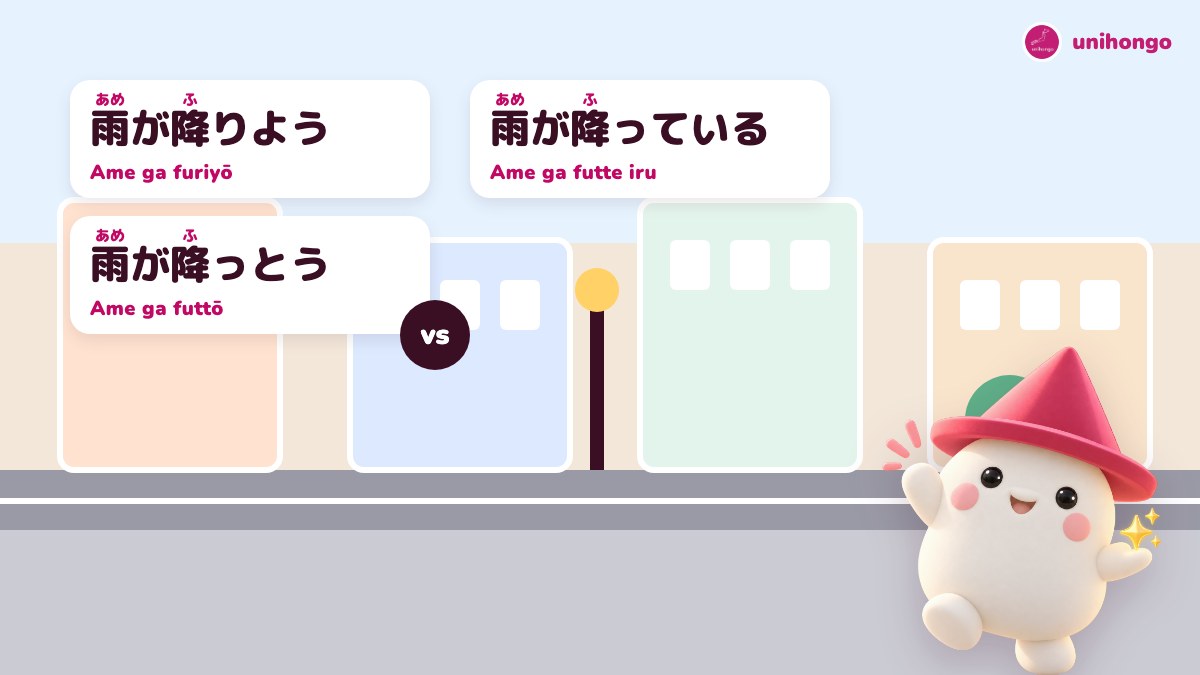
Here Hakata-ben is more precise than standard Japanese. Standard -te iru covers both an action in progress and a finished state: ame ga futte iru can mean it is raining or, in some contexts, that it has rained. Many Hakata speakers split the two. The -yō form shows an action in progress, and the -tō form shows a state after something has happened.
This trips up learners because shiyō looks like the standard volitional form, let's do. In Hakata, nan shiyō to? is not what shall we do?; it is what are you doing right now? Younger speakers do not always keep the split, but you will hear it clearly from many people.
| Japanese | Romaji | Meaning |
|---|---|---|
| 雨が降りよう。 | Ame ga furiyō. | It's raining right now. (standard: ame ga futte iru) |
| 雨が降っとう。 | Ame ga futtō. | It has rained; the ground is wet. (standard: ame ga futte iru / futta) |
| いま、ご飯食べよう。 | Ima, gohan tabeyō. | I'm eating right now. (standard: ima, gohan o tabete iru) |
| もう、ご飯食べとう。 | Mō, gohan tabetō. | I've already eaten. (standard: mō, gohan o tabeta) |
Suitō and other warm words
Suitō, I like you, is the most famous Hakata phrase. It comes from suite iru, which is suki de iru in older style, contracted the Hakata way. You will see it on souvenirs, in pop songs and in television dramas set in Fukuoka. In real life it is a real confession, so treat it like suki da in standard Japanese: personal, and not something to say to a waiter.
The playful tottōto is another favourite. It means has someone taken this seat?, and the reply can be the same sounds, it has been taken. Fukuoka people enjoy the joke, which comes from totte iru, taken or reserved.
| Japanese | Romaji | Meaning |
|---|---|---|
| 好いとうと? | Suitō to? | Do you like me? (standard: suki na no?) |
| ずっと好いとうよ。 | Zutto suitō yo. | I've always liked you. (standard: zutto suki da yo) |
| この席、とっとーと? | Kono seki, tottōto? | Is this seat taken? (standard: kono seki, totte iru no?) |
| とっとーと。 | Tottōto. | Yes, it's taken. (standard: totte iru yo) |
A short chat between friends
Two friends meet near Tenjin. One speaks Hakata-ben; the other, a learner, answers in standard casual Japanese. This mix is very common and perfectly natural: you do not need to answer in dialect to be understood or liked.
| Japanese | Romaji | Meaning |
|---|---|---|
| あ、なんしようと? | A, nan shiyō to? | Friend: Oh, what are you up to? (standard: nani shite iru no?) |
| 買い物してる。ラーメン食べに行かない? | Kaimono shiteru. Rāmen tabe ni ikanai? | You: Shopping. Want to go for ramen? |
| よかね!近くにうまか店があるけん。 | Yoka ne! Chikaku ni umaka mise ga aru ken. | Friend: Sounds good! There's a great place nearby. (standard: ii ne! Chikaku ni oishii mise ga aru kara) |
| ほんと?行こう行こう。 | Honto? Ikō ikō. | You: Really? Let's go. |
| 替え玉もせんと? | Kaedama mo sen to? | Friend: Aren't you getting a noodle refill too? (standard: kaedama mo shinai no?) |
| する!お腹すいてるから。 | Suru! Onaka suiteru kara. | You: I am! I'm starving. |
How much Hakata-ben to use
- Understand first: ka adjectives, to questions, ken for because and the shiyō form will carry you through most conversations.
- Use with friends: yoka, umaka, sō tai. Said with a smile, they usually go down well.
- Leave for listening: batten, tchan and heavy bai or tai at the end of every line, which can sound like an impression.
- Keep standard keigo for work, shops and anyone older, even in Fukuoka.
- Do not try to copy the pitch. Fukuoka intonation differs from Tokyo's, and an exaggerated accent sounds like teasing.
A Hakata week with Mocchi and AI Sensei
On day one, type /quiz Hakata endings to Mocchi and ask it to give you a standard sentence to change into Hakata-ben and back. Mocchi explains each answer and remembers the forms you confused, such as shiyō and shitō, so the next quiz starts there.
Later in the week, open AI Sensei with Hana-sensei and choose the Japanese cuisine topic. Ask the Sensei to play a friend from Fukuoka chatting about ramen and mentaiko, reply in casual standard Japanese, and try one yoka ne or umaka. The session report shows which of your sentences sounded natural and which need work.