
Four lines that carry a whole shift
Watch any restaurant or hotel lobby in Japan for ten minutes and you will hear the same handful of lines again and again. They are already in correct keigo, they are short, and they cover the moments that happen to every guest: arriving, asking for something, waiting and settling in.
Adding mase to kudasai, as in omachi kudasaimase, is a softer, more hospitable version used mainly in service. It is natural from staff to guests and would sound odd in an office.
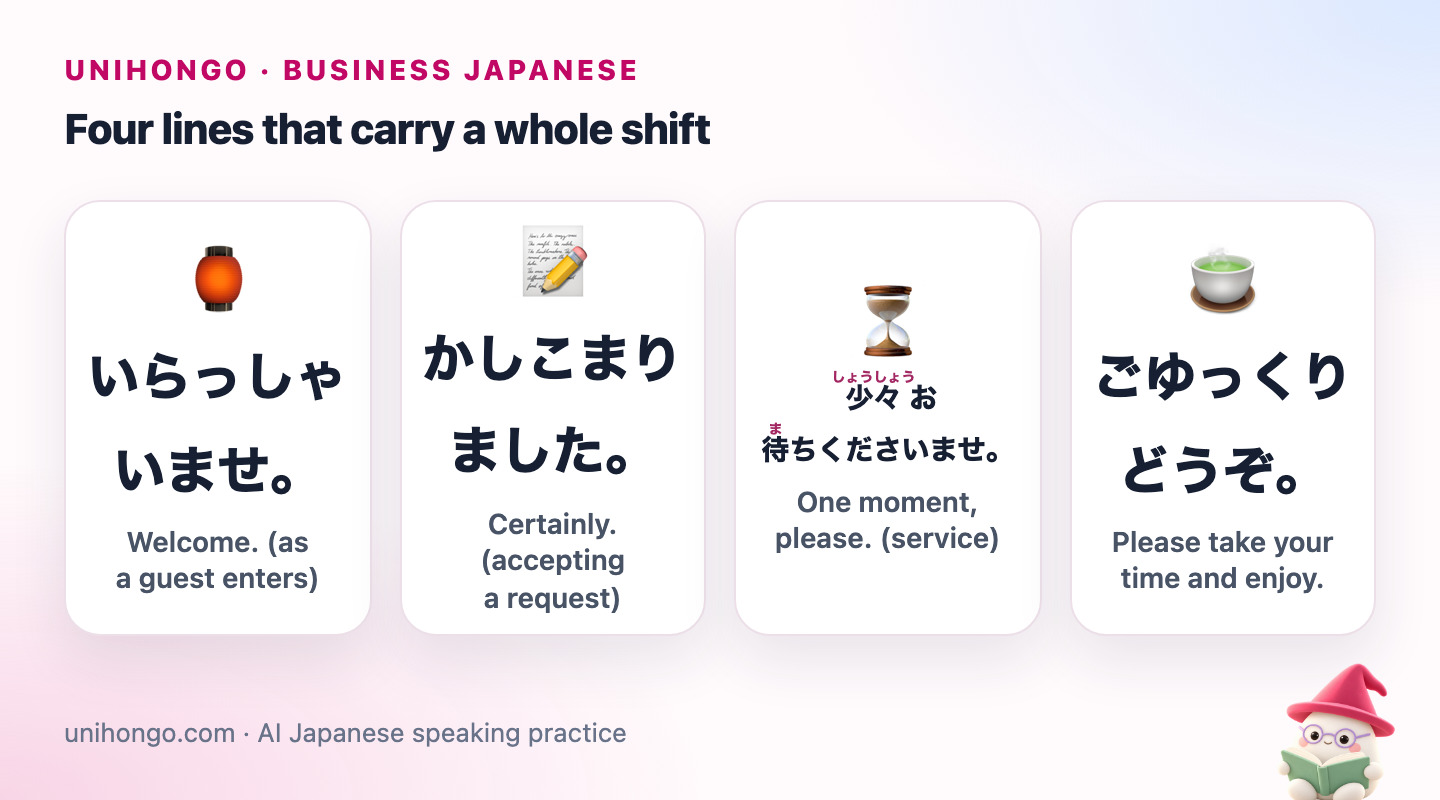
| Japanese | Romaji | Meaning |
|---|---|---|
| いらっしゃいませ。 | Irasshaimase. | Welcome. (as a guest enters) |
| かしこまりました。 | Kashikomarimashita. | Certainly. (accepting a request) |
| 少々お待ちくださいませ。 | Shōshō omachi kudasaimase. | One moment, please. (service) |
| ごゆっくりどうぞ。 | Goyukkuri dōzo. | Please take your time and enjoy. |
| 申し訳ございません。 | Mōshiwake gozaimasen. | I am very sorry. |
| ありがとうございました。 | Arigatō gozaimashita. | Thank you very much. (as they leave) |
To a friend, a coworker and a guest
New staff often know polite Japanese already and wonder why it is not enough. The comparison below shows the gap. The plain polite version is correct and would be fine with a coworker, but to a guest it sounds like an office worker, not a host. Service keigo raises the guest with respectful forms and the honorific sama, and presents things with de gozaimasu.
| Japanese | Romaji | Meaning |
|---|---|---|
| 何にする? | Nani ni suru? | What are you having? (casual) |
| 何にしますか。 | Nani ni shimasu ka. | What will you have? (polite) |
| ご注文はお決まりでしょうか。 | Gochūmon wa okimari deshō ka. | Are you ready to order? (service keigo) |
| 何人? | Nannin? | How many? (casual) |
| 何人ですか。 | Nannin desu ka. | How many people? (polite) |
| 何名様でいらっしゃいますか。 | Nanmei sama de irasshaimasu ka. | How many in your party? (service keigo) |
| はい、これ。 | Hai, kore. | Here you go. (casual) |
| こちら、コーヒーです。 | Kochira, kōhī desu. | Here is your coffee. (polite) |
| こちら、ご注文のコーヒーでございます。 | Kochira, gochūmon no kōhī de gozaimasu. | Here is the coffee you ordered. (service keigo) |
A restaurant visit from the door to the change
This dialogue follows a guest pair through a small restaurant. The amounts are examples. Notice the counter mei with sama for people, the verb oazukari itashimasu for taking the guest's money, and okaeshi for the change; these three are the lines new staff most often get wrong at the register.
| Japanese | Romaji | Meaning |
|---|---|---|
| いらっしゃいませ。何名様でいらっしゃいますか。 | Irasshaimase. Nanmei sama de irasshaimasu ka. | Staff: Welcome. How many in your party? |
| 二人です。 | Futari desu. | Guest: Two. |
| 二名様ですね。お席へご案内いたします。 | Nimei sama desu ne. Oseki e goannai itashimasu. | Staff: Two. I'll show you to your table. |
| ご注文がお決まりになりましたら、お呼びください。 | Gochūmon ga okimari ni narimashitara, oyobi kudasai. | Staff: Please call me when you're ready to order. |
| カレーライスを二つください。 | Karē raisu o futatsu kudasai. | Guest: Two curry rice, please. |
| カレーライスがお二つですね。かしこまりました。 | Karē raisu ga ofutatsu desu ne. Kashikomarimashita. | Staff: Two curry rice. Certainly. |
| お待たせいたしました。カレーライスでございます。 | Omatase itashimashita. Karē raisu de gozaimasu. | Staff: Sorry to keep you waiting. Your curry rice. |
| お皿をお下げしてもよろしいでしょうか。 | Osara o osage shite mo yoroshii deshō ka. | Staff: May I take your plates? |
| お会計は千八百円でございます。 | Okaikei wa sen happyaku en de gozaimasu. | Staff: That comes to 1,800 yen. |
| 二千円お預かりいたします。 | Nisen en oazukari itashimasu. | Staff: Out of 2,000 yen. |
| 二百円のお返しでございます。 | Nihyaku en no okaeshi de gozaimasu. | Staff: Here is your 200 yen change. |
| ありがとうございました。またお越しくださいませ。 | Arigatō gozaimashita. Mata okoshi kudasaimase. | Staff: Thank you. Please come again. |
Checking a guest in at a hotel
Front-desk Japanese is a little more formal than restaurant Japanese, because guests stay longer and the desk handles money, rules and complaints. The structure is the same: welcome, confirm the booking with respectful verbs for the guest, give information with de gozaimasu and humble verbs for the hotel's own actions.
| Japanese | Romaji | Meaning |
|---|---|---|
| いらっしゃいませ。チェックインでいらっしゃいますか。 | Irasshaimase. Chekkuin de irasshaimasu ka. | Staff: Welcome. Are you checking in? |
| ご予約のお名前を伺ってもよろしいでしょうか。 | Goyoyaku no onamae o ukagatte mo yoroshii deshō ka. | Staff: May I have the name on the reservation? |
| スミス様、二泊でご予約を承っております。 | Sumisu sama, nihaku de goyoyaku o uketamawatte orimasu. | Staff: Ms Smith, we have you down for two nights. |
| こちらにご記入をお願いいたします。 | Kochira ni gokinyū o onegai itashimasu. | Staff: Please fill in this form. |
| お部屋は八階の805号室でございます。 | Oheya wa hachikai no happyaku go gōshitsu de gozaimasu. | Staff: Your room is 805 on the eighth floor. |
| 朝食は七時から十時まで、二階のレストランでご用意しております。 | Chōshoku wa shichiji kara jūji made, nikai no resutoran de goyōi shite orimasu. | Staff: Breakfast is served 7 to 10 in the second-floor restaurant. |
| ごゆっくりお過ごしくださいませ。 | Goyukkuri osugoshi kudasaimase. | Staff: We hope you have a relaxing stay. |
Saying no to a guest without saying no
Every shift brings a request you cannot meet: a full restaurant, a sold-out dish, a room change on a busy night. Service Japanese almost never says dekimasen bare. It opens with a cushion word, states the fact, and offers what you can do. If you need to fetch your manager, remember the uchi-soto rule: to a guest, your manager is tenchō or the manager's surname without san, and you use the humble mairimasu for fetching them.
| Japanese | Romaji | Meaning |
|---|---|---|
| あいにく満席でございます。 | Ainiku manseki de gozaimasu. | I'm afraid we're fully booked. |
| 十五分ほどでお席をご用意できますが、いかがでしょうか。 | Jūgofun hodo de oseki o goyōi dekimasu ga, ikaga deshō ka. | We can seat you in about fifteen minutes; would that suit you? |
| 申し訳ございません。こちらは本日売り切れでございます。 | Mōshiwake gozaimasen. Kochira wa honjitsu urikire de gozaimasu. | I'm sorry, that dish is sold out today. |
| ただいま確認してまいります。 | Tadaima kakunin shite mairimasu. | I'll go and check right away. |
| 店長を呼んでまいります。 | Tenchō o yonde mairimasu. | I'll go and get the manager. |
| お部屋の変更はいたしかねます。 | Oheya no henkō wa itashikanemasu. | I'm afraid we cannot change the room. |
Itashikanemasu, I am unable to do, is very formal and final. Use it for firm rules, and soften it with mōshiwake gozaimasen ga in front. For anything that might still be possible, say kakunin shite mairimasu and check first.
Manual keigo that many guests notice
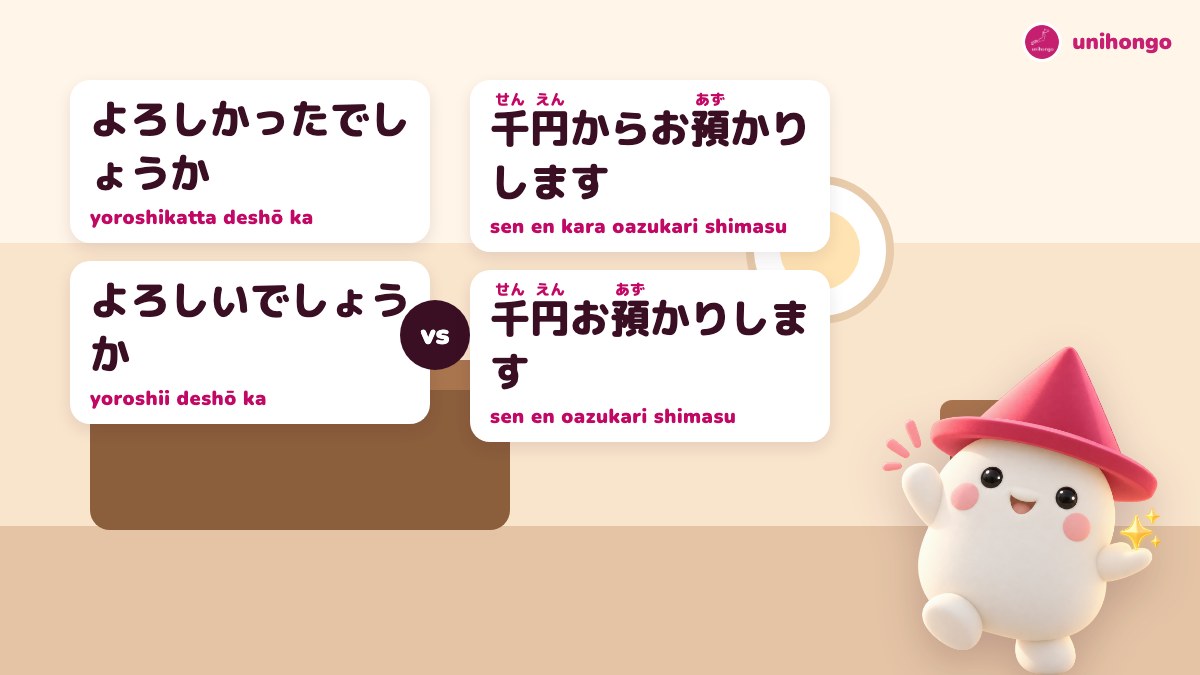
Some phrases spread through restaurant and convenience-store manuals and are now heard everywhere. Linguists and etiquette guides often criticise them, and opinions differ on how wrong they really are. You will not be fired for saying them, but the safer forms make you sound more careful, and they are what most keigo textbooks teach.
| Japanese | Romaji | Meaning |
|---|---|---|
| ご注文は以上でよろしかったでしょうか。 | Gochūmon wa ijō de yoroshikatta deshō ka. | Was that everything? (past tense: often criticised) |
| ご注文は以上でよろしいでしょうか。 | Gochūmon wa ijō de yoroshii deshō ka. | Is that everything? (safer) |
| 千円からお預かりします。 | Sen en kara oazukari shimasu. | Taking from 1,000 yen. (kara: often criticised) |
| 千円お預かりします。 | Sen en oazukari shimasu. | Out of 1,000 yen. (safer) |
| こちらコーヒーになります。 | Kochira kōhī ni narimasu. | This becomes coffee. (very common, often criticised) |
| ご注文はお決まりになられましたか。 | Gochūmon wa okimari ni nararemashita ka. | Have you decided? (double keigo) |
Voice, bows and timing
- Speak a little higher and clearer than in conversation. Service lines are short, so the warmth is in the voice.
- Bow lightly on irasshaimase and more deeply on mōshiwake gozaimasen. Many workplaces teach their own angles; follow the training.
- Hand back change and receipts with both hands, and say the amount so the guest can check it.
- When you pass a guest in a corridor or between tables, a quiet shitsurei itashimasu is enough.
- Do not chat with coworkers in casual Japanese within the guests' hearing. Many managers notice this before any keigo error.
Run through a shift before your shift
Ask Mocchi to drill you on conversions: give me ten things a guest might hear in casual Japanese and make me turn each one into service keigo, then correct me. Mocchi checks every answer, explains which part was off, and picks up the ones you missed in your next /review.
Then rehearse with a voice on the other side. In AI Sensei, ask Hana-sensei to be a guest at your restaurant or hotel desk: someone who arrives without a booking, changes an order, asks for something you cannot provide and finally pays. Ask the Sensei to speak at real service speed once you are comfortable.