
Your room in four lines
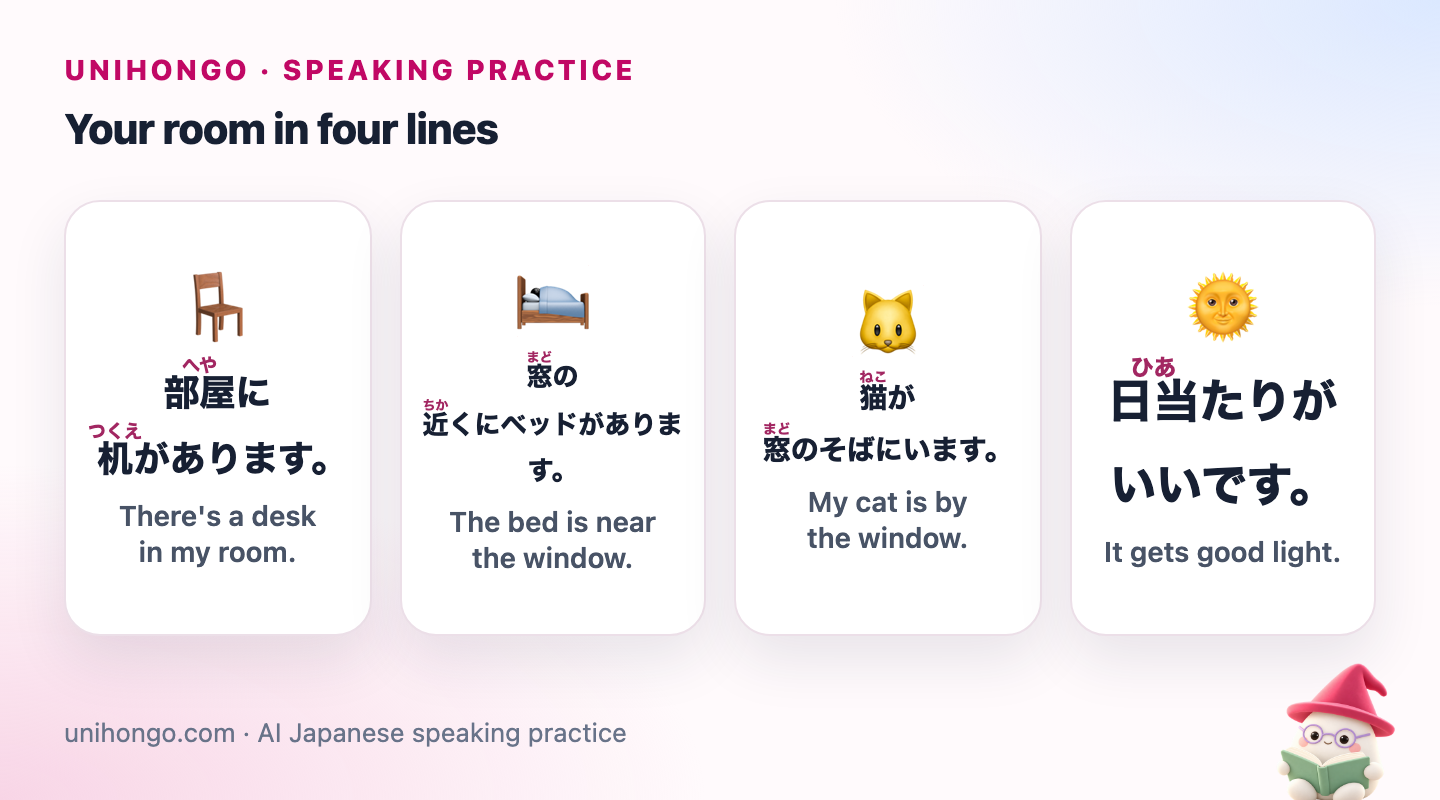
These four sentences are the skeleton of any room description: a thing that exists, a thing with a position, a living creature, and a quality of the room itself. Heya ni tsukue ga arimasu uses the pattern you will repeat for everything you own. Mado no chikaku ni, near the window, shows how a position word slots in before ni. The cat takes imasu because it is alive. Hiatari, literally sun-hitting, is the everyday word for how much light a room gets, and hiatari ga ii is the first thing Japanese speakers praise about a room.
| Japanese | Romaji | Meaning |
|---|---|---|
| 部屋に机があります。 | Heya ni tsukue ga arimasu. | There's a desk in my room. |
| 窓の近くにベッドがあります。 | Mado no chikaku ni beddo ga arimasu. | The bed is near the window. |
| 猫が窓のそばにいます。 | Neko ga mado no soba ni imasu. | My cat is by the window. |
| 日当たりがいいです。 | Hiatari ga ii desu. | It gets good light. |
The question you'll hear
Donna heya, what kind of room, is the open question, and it is usually followed by hitorigurashi desu ka, do you live alone, because the answer changes what the room is. Friends skip the grammar entirely: heya, hiroi?, with a rising tone. On a video call the request is heya, misete, show me your room, and refusing it with chirakatte iru kara, because it's a mess, is itself a normal answer.
| Japanese | Romaji | Meaning |
|---|---|---|
| どんな部屋に住んでいますか。 | Donna heya ni sunde imasu ka. | What kind of room do you live in? |
| 部屋、広い? | Heya, hiroi? | Friend: Is your room big? (casual) |
| 一人暮らしですか。 | Hitorigurashi desu ka. | Do you live alone? |
| 何階ですか。 | Nangai desu ka. | What floor is it on? |
| 部屋、見せて! | Heya, misete! | Friend: Show me your room! (casual) |
Three model answers
The beginner answer uses two adjectives and one list with to. The intermediate answer gives the size in mats, links two sentences with the te-form atte, and uses oite arimasu, has been placed, for an object someone put somewhere. The upper answer explains with node, uses tabi ni, every time, and ends with kedo ne, which turns a complaint into a shrug.
| Japanese | Romaji | Meaning |
|---|---|---|
| 部屋は小さいです。でも、明るいです。 | Heya wa chiisai desu. Demo, akarui desu. | Beginner: My room is small. But it's bright. |
| 机とベッドと本棚があります。 | Tsukue to beddo to hondana ga arimasu. | Beginner: There's a desk, a bed and a bookshelf. |
| 六畳のワンルームに一人で住んでいます。 | Rokujō no wanrūmu ni hitori de sunde imasu. | Intermediate: I live alone in a six-mat studio. |
| 窓の横に机があって、その上にパソコンが置いてあります。 | Mado no yoko ni tsukue ga atte, sono ue ni pasokon ga oite arimasu. | Intermediate: There's a desk beside the window, with my computer on it. |
| 狭いですが、駅から近いので気に入っています。 | Semai desu ga, eki kara chikai node ki ni itte imasu. | Intermediate: It's cramped, but I like it because it's near the station. |
| 南向きで日当たりがいいので、朝は自然に目が覚めます。 | Minamimuki de hiatari ga ii node, asa wa shizen ni me ga samemasu. | Upper: It faces south and gets good light, so I wake up naturally in the morning. |
| 壁には旅行の写真を貼っていて、見るたびに元気が出ます。 | Kabe ni wa ryokō no shashin o hatte ite, miru tabi ni genki ga demasu. | Upper: I've put travel photos on the wall, and they cheer me up every time I look. |
| 本当はもう少し収納が欲しいんですけどね。 | Hontō wa mō sukoshi shūnō ga hoshii n desu kedo ne. | Upper: Honestly I'd like a bit more storage, though. |
Oite arimasu, from oku, to put, plus te arimasu, describes a thing that is where it is because someone placed it there. Pasokon ga arimasu is also correct; oite arimasu adds the sense of a room you arranged yourself.
Arimasu, imasu and the position words
The whole description runs on one frame: A no position ni B ga arimasu, B is at the position of A. The position words are nouns, so they attach with no and take ni afterwards. Learn them in pairs.
| Japanese | Romaji | Meaning |
|---|---|---|
| ベッドの下に箱があります。 | Beddo no shita ni hako ga arimasu. | There are boxes under the bed. |
| 本棚の隣に観葉植物があります。 | Hondana no tonari ni kan'yō shokubutsu ga arimasu. | There's a houseplant next to the bookshelf. |
| 部屋の奥に窓があります。 | Heya no oku ni mado ga arimasu. | There's a window at the far end of the room. |
| ルームメイトが隣の部屋にいます。 | Rūmumēto ga tonari no heya ni imasu. | My roommate is in the next room. |
| 床には何も置いていません。 | Yuka ni wa nani mo oite imasen. | I keep nothing on the floor. |
| Japanese | Romaji | Meaning |
|---|---|---|
| 上 / 下 | ue / shita | on top of / under |
| 横 / 隣 | yoko / tonari | beside / next to |
| 前 / 後ろ | mae / ushiro | in front of / behind |
| 奥 / 手前 | oku / temae | at the far end / on the near side |
| 近く / そば | chikaku / soba | near / right by |
| 真ん中 / 角 | mannaka / kado | in the middle / in the corner |
Arimasu is for things, including plants, and imasu for people and animals. The rule holds even when the thing feels alive: a plant takes arimasu, a goldfish takes imasu.
Size, layout and the words you'll hear about a room
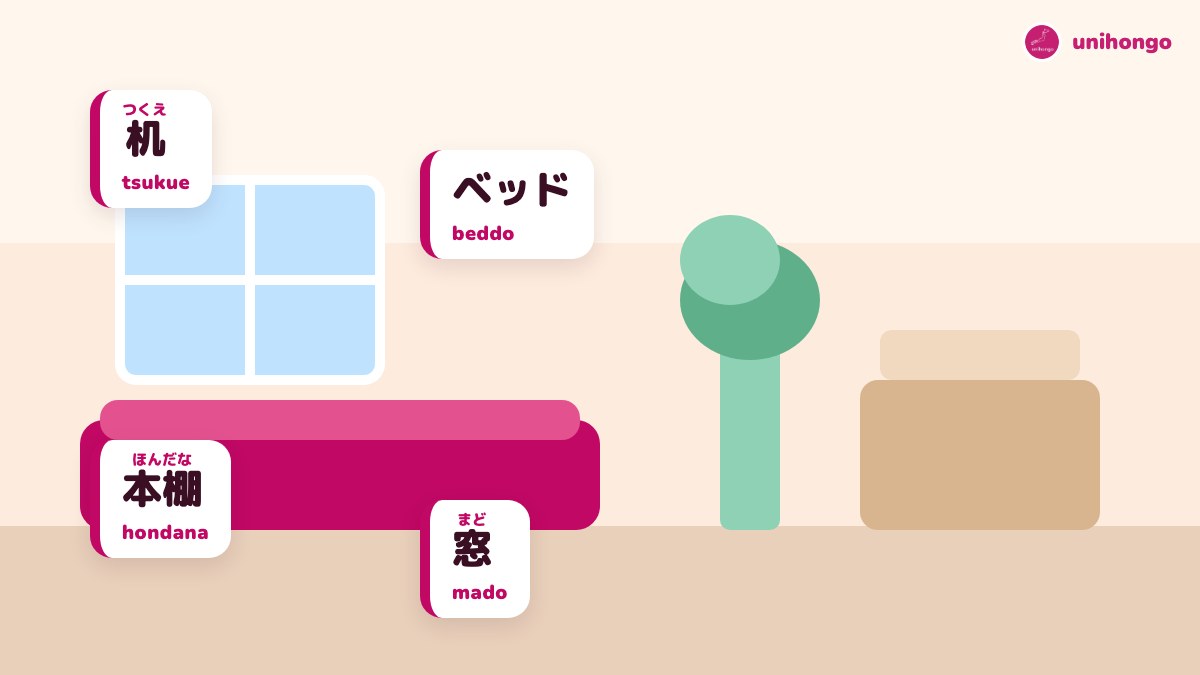
Japanese rooms are sized in tatami mats, jō, even when the floor is wood, and the layout is named with the letters you see on rental listings. You do not need the full estate-agent vocabulary, but the words in this table come up in every conversation about where someone lives, and hiatari and minamimuki are what people ask about first. The scene below is the room from the cards, labelled the way you would describe it.
| Japanese | Romaji | Meaning |
|---|---|---|
| 八畳ぐらいです。 | Hachijō gurai desu. | It's about eight mats. |
| ロフト付きです。 | Rofuto tsuki desu. | It has a loft. |
| 二階建ての二階に住んでいます。 | Nikaidate no nikai ni sunde imasu. | I'm on the second floor of a two-storey building. |
| キッチンは別です。 | Kitchin wa betsu desu. | The kitchen is separate. |
| 押し入れがあるので、布団をしまえます。 | Oshiire ga aru node, futon o shimaemasu. | There's a built-in closet, so I can put the futon away. |
| Term | Romaji | What it means in a description |
|---|---|---|
| ワンルーム | wanrūmu | one room with the kitchen inside it: a studio |
| 1K / 1LDK | wan kē / wan eru dī kē | one room plus a kitchen / plus a living-dining-kitchen |
| 六畳 | rokujō | six mats, roughly ten square metres; mat sizes vary by region |
| 南向き | minamimuki | facing south, the sunny side people hope for |
| 日当たり | hiatari | how much sun the room gets |
| 収納 | shūnō | storage: closets, cupboards, the space under the bed |
Tsuki, attached, after a noun means the room comes with that thing: rofuto tsuki, with a loft; basu toire tsuki, with bath and toilet. It is the suffix you will hear most in any talk about rooms.
What you like about it, and what you'd change
A description becomes a conversation when you add an opinion. Ichiban ii tokoro wa, the best thing about it is, followed by a koto desu clause, is the frame. Ki ni itte imasu, I'm fond of it, is the verb of liking a place you chose. For the downside, nanten, drawback, and the wish form hirokereba ii noni, if only it were bigger, say it without complaining. Chirakatte imasu, it's messy, is the honest state of most rooms and is said with a laugh.
| Japanese | Romaji | Meaning |
|---|---|---|
| この部屋の一番いいところは、静かなことです。 | Kono heya no ichiban ii tokoro wa, shizuka na koto desu. | The best thing about this room is that it's quiet. |
| 窓からの景色が気に入っています。 | Mado kara no keshiki ga ki ni itte imasu. | I love the view from the window. |
| 狭いけど、居心地がいいです。 | Semai kedo, igokochi ga ii desu. | It's small, but cosy. |
| もう少し広ければいいのにと思います。 | Mō sukoshi hirokereba ii noni to omoimasu. | I wish it were a bit bigger. |
| 今はちょっと散らかっています。 | Ima wa chotto chirakatte imasu. | It's a bit messy right now. |
| 壁が薄いのが難点です。 | Kabe ga usui no ga nanten desu. | The thin walls are the drawback. |
Reactions, follow-ups and the video-call tour
When someone shows you their room, react to the light, the tidiness or one object, then ask one practical question. Eki kara chikai desu ka, is it near the station, is the question Japanese speakers ask most, because the station decides everything about a Japanese flat. Among friends, asking the rent is common in Japan; with people you know less well, stick to the station and the floor. The rows below run as a short video-call exchange.
| Japanese | Romaji | Meaning |
|---|---|---|
| ほら、これが私の部屋。 | Hora, kore ga watashi no heya. | You: Look, this is my room. |
| 明るいね。きれいにしてるね。 | Akarui ne. Kirei ni shiteru ne. | Friend: It's bright. You keep it tidy. |
| 今日だけだよ。普段は散らかってる。 | Kyō dake da yo. Fudan wa chirakatteru. | You: Only today. Normally it's a mess. |
| その棚、どこで買ったの? | Sono tana, doko de katta no? | Friend: Where did you get that shelf? |
| 駅から近いですか。 | Eki kara chikai desu ka. | Is it near the station? (polite) |
| 歩いて五分です。 | Aruite gofun desu. | Five minutes on foot. |
| 今度遊びに来てください。 | Kondo asobi ni kite kudasai. | Come over sometime. |
Asobi ni kuru, to come to hang out, is the verb for visiting a friend's home. Asobi ni kite kudasai is the polite invitation; asobi ni kite is the casual one, and both are said far more often than they are literally meant, so wait for a date before packing a gift.
Mistakes and register notes
- Heya wa tsukue ga arimasu. The place takes ni: heya ni tsukue ga arimasu. Wa after heya only works when the room is the topic and what follows describes it: heya wa hiroi desu.
- Shokubutsu ga imasu. Plants are not alive in grammar; shokubutsu ga arimasu.
- Ōkii heya for a spacious room. Not wrong, but hiroi and semai are the words people use for rooms and flats.
- Watashi no heya in every sentence. Say it once, then drop it; or use uchi, my place, for the whole flat.
- Sunde imasu for a flat and imasu for a room are both fine, but sumimasu is a future plan, not where you live now.
- Register: arimasu and imasu with people you have just met; aru and iru with friends, where hiroi? and misete carry the whole conversation.
Describe the room you are sitting in
The room around you is the one set of true sentences you can practise without inventing anything. Type your clockwise description to Mocchi and ask it with /correct to check every particle, then ask for a /quiz on ue, shita and tonari using your own furniture; because Mocchi keeps track of the wa-for-ni slip, that quiz comes back to it until it stops happening. When the sentences are right, open AI Sensei, choose Hana-sensei, and ask Hana-sensei to play a friend on a video call who wants a tour of the room and keeps asking where things are and why you put them there.
Signing in at unihongo.com/login with a free account is the whole set-up.