
Your fitness life in four lines
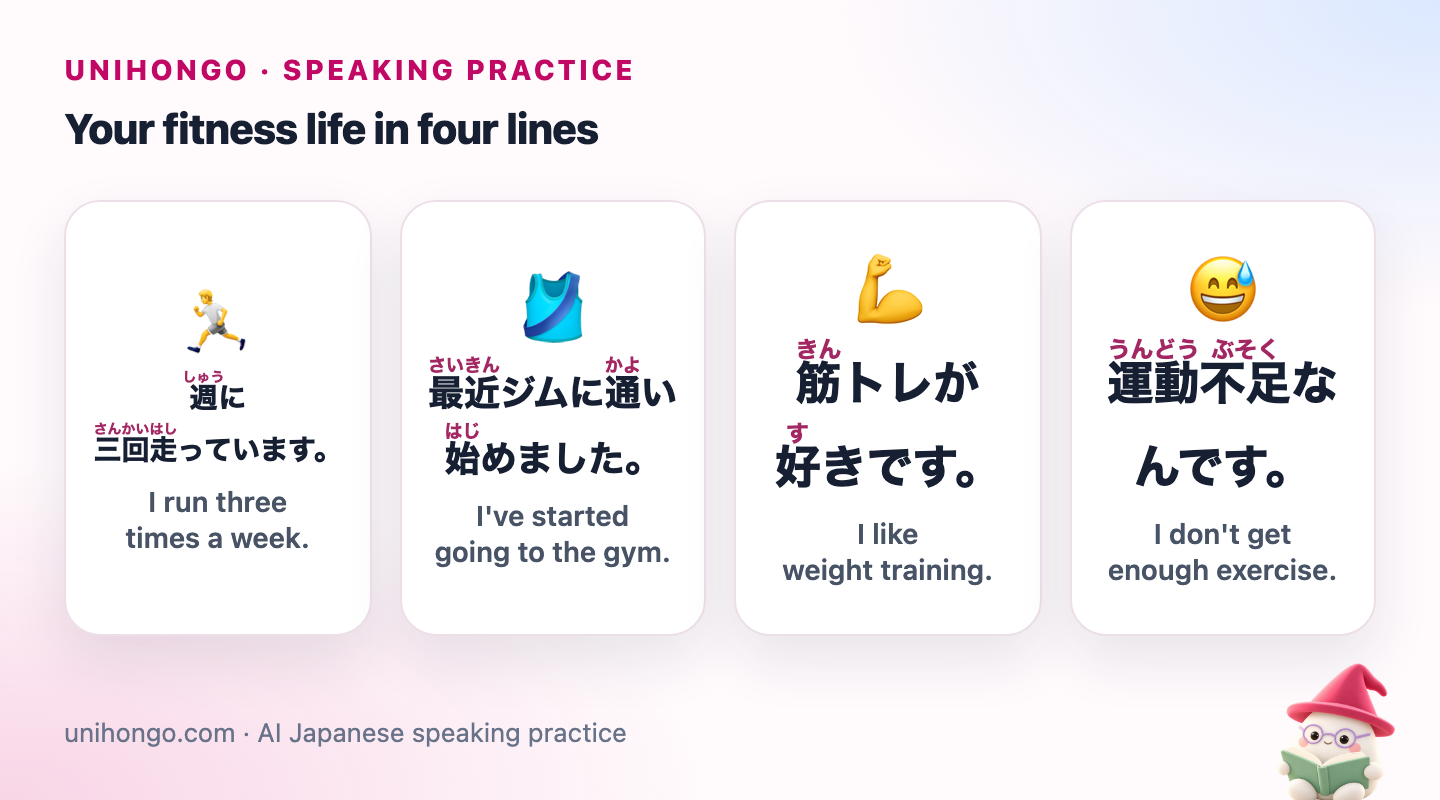
The four cards cover the sentence you will say most, a recent start, a preference and the honest alternative. Hashitte imasu, from hashiru, with a frequency word is the model for any activity. Kayoihajimemashita joins kayou, to go regularly, with hajimeru, to start. Kintore is short for kinniku torēningu, muscle training. Undō busoku, literally exercise shortage, is the phrase for not getting enough, and nan desu gives it the tone of a confession.
| Japanese | Romaji | Meaning |
|---|---|---|
| 週に三回走っています。 | Shū ni sankai hashitte imasu. | I run three times a week. |
| 最近ジムに通い始めました。 | Saikin jimu ni kayoihajimemashita. | I've started going to the gym. |
| 筋トレが好きです。 | Kintore ga suki desu. | I like weight training. |
| 運動不足なんです。 | Undō busoku nan desu. | I don't get enough exercise. |
The question you'll hear
Undō, exercise, is the word in the polite question; supōtsu asks about sports you play, which is a different thing in Japanese, and kenkō no tame ni, for your health, is how older people often frame it. Among friends fudan, normally, replaces the formal phrasing and the particles vanish.
| Japanese | Romaji | Meaning |
|---|---|---|
| 何か運動していますか。 | Nanika undō shite imasu ka. | Do you do any exercise? |
| 普段、運動してる? | Fudan, undō shiteru? | Friend: Do you exercise normally? |
| スポーツは何かやっていますか。 | Supōtsu wa nanika yatte imasu ka. | Do you play any sports? |
| 健康のために何かしていますか。 | Kenkō no tame ni nanika shite imasu ka. | Do you do anything for your health? |
| ジム、行ってるの? | Jimu, itteru no? | Friend: Do you go to a gym? |
Three model answers
The beginner answer gives one activity and one preference. The intermediate answer adds kara for since when, a frequency, and the story of how it became a habit with shūkan ni narimashita. The upper answer explains the trigger with node, uses namatte kita, got out of shape, and states a goal with mokuhyō wa … koto desu.
| Japanese | Romaji | Meaning |
|---|---|---|
| 週末にジョギングをします。 | Shūmatsu ni jogingu o shimasu. | Beginner: I go jogging at the weekend. |
| ヨガが好きです。 | Yoga ga suki desu. | Beginner: I like yoga. |
| 半年前からジムに通っています。週に二、三回です。 | Hantoshi mae kara jimu ni kayotte imasu. Shū ni ni, sankai desu. | Intermediate: I've been going to the gym for six months, two or three times a week. |
| 最初は続かなかったんですが、今は習慣になりました。 | Saisho wa tsuzukanakatta n desu ga, ima wa shūkan ni narimashita. | Intermediate: At first I couldn't keep it up, but now it's a habit. |
| 在宅勤務で体がなまってきたので、朝のランニングを始めました。 | Zaitaku kinmu de karada ga namatte kita node, asa no ranningu o hajimemashita. | Upper: Working from home made me sluggish, so I took up morning runs. |
| 目標は来年のハーフマラソンを完走することです。 | Mokuhyō wa rainen no hāfu marason o kansō suru koto desu. | Upper: My goal is to finish next year's half marathon. |
Ni, sankai, two or three times, puts two numbers side by side with a tiny pause between them. It is how Japanese speakers say roughly, and it sounds much more natural than a precise count.
Activities, verbs and the grammar of keeping going
Most activities are loanwords plus suru, and the native ones have their own verbs. The table gives the set you will need; the rows after it show the four patterns for starting, deciding, making a point of and keeping up.
| Japanese | Romaji | Meaning |
|---|---|---|
| 階段を使うようにしています。 | Kaidan o tsukau yō ni shite imasu. | I make a point of taking the stairs. |
| 毎朝ストレッチをすることにしました。 | Maiasa sutorecchi o suru koto ni shimashita. | I've decided to stretch every morning. |
| 一日一万歩歩いています。 | Ichinichi ichimanpo aruite imasu. | I walk ten thousand steps a day. |
| 三か月続いています。 | Sankagetsu tsuzuite imasu. | I've kept it up for three months. |
| 筋肉痛です。 | Kinnikutsū desu. | I'm sore. (muscle pain) |
| Activity | Japanese (romaji) | Say it with |
|---|---|---|
| running / jogging | ランニング / ジョギング (ranningu / jogingu) | o suru, or hashiru, to run |
| weight training | 筋トレ (kintore) | o suru |
| yoga / stretching | ヨガ / ストレッチ (yoga / sutorecchi) | o suru |
| swimming | 水泳 (suiei) | o suru, or oyogu, to swim |
| walking | ウォーキング / 散歩 (wōkingu / sanpo) | o suru, or aruku, to walk |
| cycling | サイクリング (saikuringu) | o suru, or jitensha ni noru |
Tsuzuku, to continue, is intransitive: the habit itself continues, sankagetsu tsuzuite imasu. Tsuzukeru is what you do to it: tsuzukete imasu, I am continuing it. Both are fine; the first sounds a touch more modest.
Goals, progress and honest confessions
Goals use tai, want to, often softened with to omotte imasu, I'm thinking of. Progress uses herimashita, decreased, for weight, and nikuku narimashita, became less prone to, for tiredness. The trigger is often a kenkō shindan, the annual health check many workplaces require, and mentioning it is a common and relatable reason. Sabotte imasu, I'm slacking, is said with a laugh and is probably the most frequent fitness sentence in Japan.
| Japanese | Romaji | Meaning |
|---|---|---|
| 体力をつけたいんです。 | Tairyoku o tsuketai n desu. | I want to build up my stamina. |
| 少し痩せたいと思っています。 | Sukoshi yasetai to omotte imasu. | I'm hoping to lose a little weight. |
| 健康診断の結果が良くなかったので。 | Kenkō shindan no kekka ga yoku nakatta node. | My health check results weren't great, so… |
| 二か月で三キロ減りました。 | Nikagetsu de sankiro herimashita. | I've lost three kilos in two months. |
| 前より疲れにくくなりました。 | Mae yori tsukarenikuku narimashita. | I get tired less easily than before. |
| 最近さぼっています。 | Saikin sabotte imasu. | I've been slacking lately. |
Reactions and follow-ups, in the park
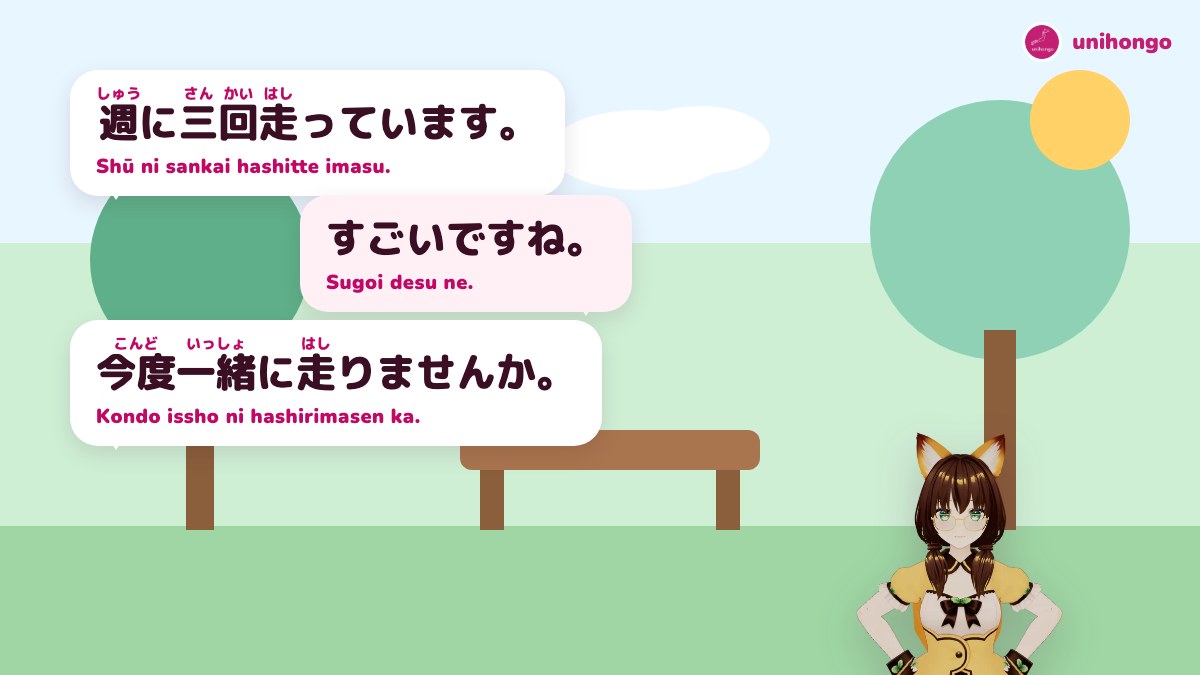
When someone tells you about their routine, the expected reaction is sugoi desu ne plus a remark about keeping it up, because consistency is what Japanese speakers admire. Then an invitation, kondo issho ni, together sometime, or a caution, muri shinaide, don't overdo it, which is kindness rather than doubt. If you do nothing, say so: it is a perfectly normal answer and often leads to being invited.
| Japanese | Romaji | Meaning |
|---|---|---|
| すごいですね。続いていますね。 | Sugoi desu ne. Tsuzuite imasu ne. | Impressive, you're keeping it up. |
| いえ、まだ三か月です。 | Ie, mada sankagetsu desu. | Oh, it's only been three months. |
| 私も始めようかな。 | Watashi mo hajimeyō kana. | Maybe I should start too. |
| どこのジムですか。 | Doko no jimu desu ka. | Which gym? |
| 今度一緒に走りませんか。 | Kondo issho ni hashirimasen ka. | Shall we run together sometime? |
| 無理しないでくださいね。 | Muri shinaide kudasai ne. | Don't overdo it. |
| 私は全然運動していません。 | Watashi wa zenzen undō shite imasen. | I don't exercise at all. |
Mistakes and register notes
- Ekusasaizu for exercise. It exists but sounds like a fitness video; undō is the everyday word.
- Jimu ni ikimasu for a habit. One trip; for a routine say jimu ni kayotte imasu.
- Daietto for a way of eating. In Japanese it means losing weight; for food habits say shokuji ni ki o tsukete imasu, I watch what I eat.
- Asking a coworker's weight or saying they look bigger. Keep comments to your own progress, and accept yasemashita ne as the compliment it is.
- Ichiman aruku for ten thousand steps. The counter is ho, and ichimanpo is the set phrase.
- Register: shite imasu and kayotte imasu with new acquaintances; shiteru and kayotteru with friends, and sabotteru with a laugh.
Keep the words in training
Paste the activity table to Mocchi and type /create-flashcards with a photo of your own gym, park or running shoes; then /review-flashcards runs them with spaced repetition, and because Mocchi keeps track of the words you miss, the ones you never say, like kinnikutsū, come round more often. For the conversation itself, open AI Sensei and ask Ibuki-sensei to play a gym acquaintance who asks what you do, how long you have kept it up and whether you want to run together; ask Ibuki-sensei to switch to casual halfway, as a new gym friend would.
It all runs on a free account; unihongo.com/login is the door.
Your turn
- Say what exercise you do, how often and since when.
- Explain what made you start, with node.
- State one goal with tai to omotte imasu.
- Confess honestly with sabotte imasu, and say what you plan to do about it.
- React to a friend's routine with sugoi desu ne and one follow-up question.