
Your phone in four lines
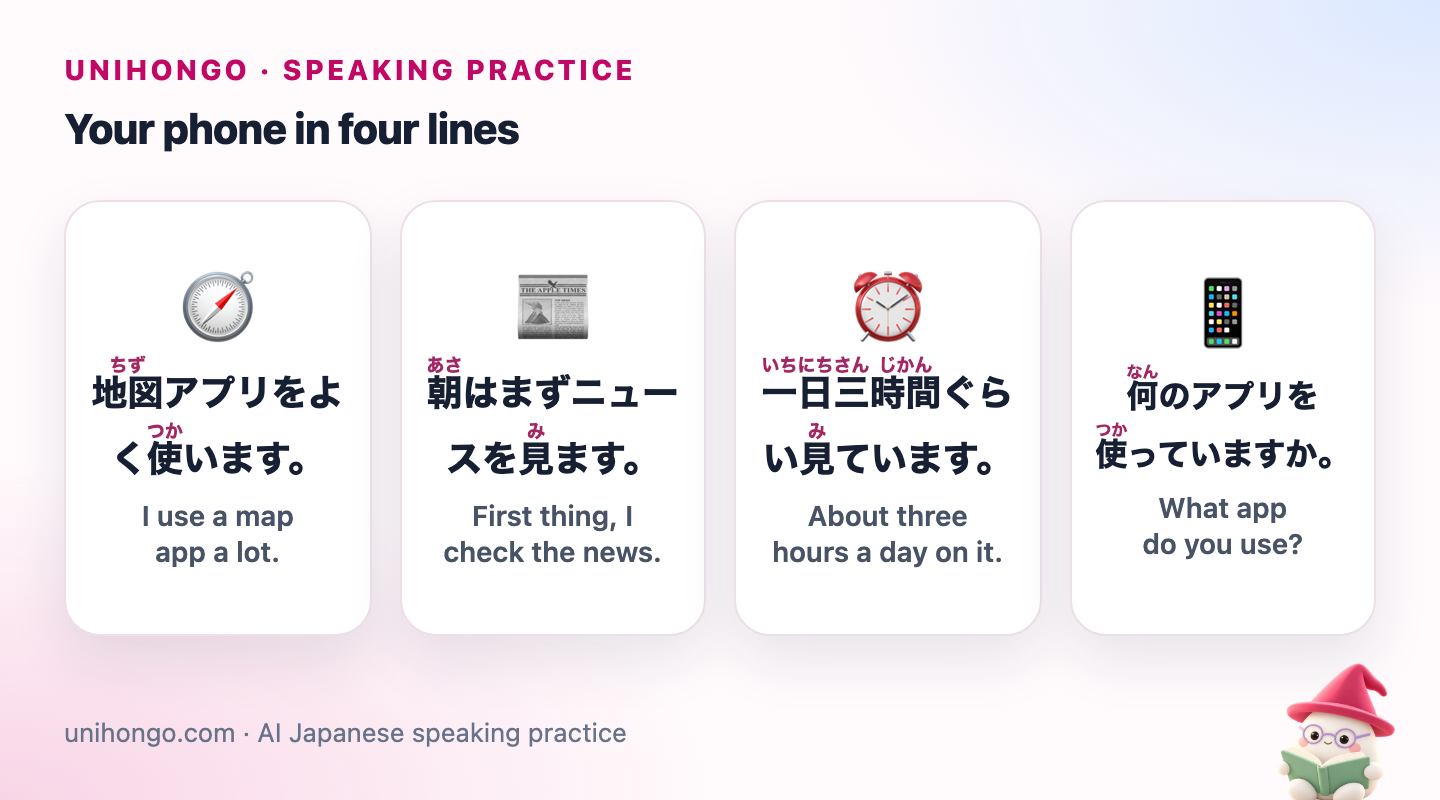
The four cards cover a habit, a routine, a confession and the question. Yoku tsukaimasu, I use a lot, is the model sentence for any app. Asa wa mazu, in the morning first of all, is how you describe the first thing you open. Ichinichi sanjikan gurai, about three hours a day, is the screen-time answer, and gurai keeps it honest. Nan no apuri, what app, with o tsukatte imasu ka, is the question you will ask most, because the answer is often the most useful app you will find in Japan.
| Japanese | Romaji | Meaning |
|---|---|---|
| 地図アプリをよく使います。 | Chizu apuri o yoku tsukaimasu. | I use a map app a lot. |
| 朝はまずニュースを見ます。 | Asa wa mazu nyūsu o mimasu. | First thing, I check the news. |
| 一日三時間ぐらい見ています。 | Ichinichi sanjikan gurai mite imasu. | About three hours a day on it. |
| 何のアプリを使っていますか。 | Nan no apuri o tsukatte imasu ka. | What app do you use? |
The question you'll hear
Sumaho, from sumātofon, is the word for a phone; keitai, the older word for a mobile, is still heard but sounds a little dated to younger speakers. The polite question is about the apps you use often; the casual one, sumaho de nani shiteru no, is a friend leaning over. Nani de, with what, asks about the tool: renraku wa nani de shiteru asks which app you use to stay in touch, and the answer is usually one word.
| Japanese | Romaji | Meaning |
|---|---|---|
| よく使うアプリは何ですか。 | Yoku tsukau apuri wa nan desu ka. | What apps do you use a lot? |
| スマホで何してるの? | Sumaho de nani shiteru no? | Friend: What are you doing on your phone? |
| 一日どのくらいスマホを見ますか。 | Ichinichi dono kurai sumaho o mimasu ka. | How long are you on your phone a day? |
| 連絡は何でしてる? | Renraku wa nani de shiteru? | Friend: What do you use to message? |
| それ、何のアプリですか。 | Sore, nan no apuri desu ka. | What app is that? |
Three model answers
The beginner answer names one app and adds a second with mo. The intermediate answer walks through the day with the te-form, mite, and adds a family habit with a frequency, then a study app with ni mo, for that as well. The upper answer tells the screen-time story with mitara, when I looked, mo after the number for as much as, and sasuga ni, which means even I had to admit; the second sentence uses yō ni shite imasu for a rule you set yourself.
| Japanese | Romaji | Meaning |
|---|---|---|
| 毎日LINEを使います。 | Mainichi LINE o tsukaimasu. | Beginner: I use LINE every day. |
| ゲームもします。 | Gēmu mo shimasu. | Beginner: I play games too. |
| 朝はニュースアプリを見て、通勤中は音楽を聞いています。 | Asa wa nyūsu apuri o mite, tsūkinchū wa ongaku o kiite imasu. | Intermediate: In the morning I check a news app, and on my commute I listen to music. |
| 家族とは週に一回ビデオ通話をしています。 | Kazoku to wa shū ni ikkai bideo tsūwa o shite imasu. | Intermediate: I video-call my family once a week. |
| 日本語の勉強にも、単語アプリを使っています。 | Nihongo no benkyō ni mo, tango apuri o tsukatte imasu. | Intermediate: I use a vocabulary app for Japanese too. |
| スクリーンタイムを見たら一日四時間もあって、さすがに減らそうと思いました。 | Sukurīn taimu o mitara ichinichi yojikan mo atte, sasuga ni herasō to omoimashita. | Upper: I checked my screen time, saw four hours a day, and decided I really had to cut down. |
| 寝る前はスマホを別の部屋に置くようにしています。 | Neru mae wa sumaho o betsu no heya ni oku yō ni shite imasu. | Upper: I make a point of leaving my phone in another room before bed. |
Mo after a quantity means as much as: yojikan mo, a whole four hours. It is how you show that the number surprised you, and it is the particle that turns a figure into a story.
The verbs and words of a phone
Most of the vocabulary is loanwords, but the verbs are native and the particle that matters is de, which marks the tool you do something with. Ireru, to put in, is what people say for installing, more often than the loanword daunrōdo suru. Kakin suru, to pay inside an app or a game, is a word you will hear from anyone who plays mobile games.
| Japanese | Romaji | Meaning |
|---|---|---|
| 地図アプリで駅を探します。 | Chizu apuri de eki o sagashimasu. | I find the station with a map app. |
| 翻訳アプリで読みます。 | Hon'yaku apuri de yomimasu. | I read it with a translation app. |
| 通知を切っています。 | Tsūchi o kitte imasu. | I keep notifications off. |
| 充電がすぐなくなります。 | Jūden ga sugu nakunarimasu. | The battery runs out fast. |
| 新しいアプリを入れました。 | Atarashii apuri o iremashita. | I installed a new app. |
| Japanese | Romaji | Meaning |
|---|---|---|
| アプリを入れる / 消す | apuri o ireru / kesu | install / delete an app |
| 開く / 閉じる | hiraku / tojiru | open / close |
| 充電する | jūden suru | to charge the battery |
| 通知 | tsūchi | a notification |
| 設定 | settei | settings |
| 課金する | kakin suru | to pay inside an app or game |
| スクリーンタイム | sukurīn taimu | screen time |
Kiru, to cut, is the verb for switching something off: tsūchi o kiru, turn notifications off; denwa o kiru, hang up. Its opposite for notifications is tsūchi o on ni suru, with the loanword on.
Asking what app to use, and recommending one
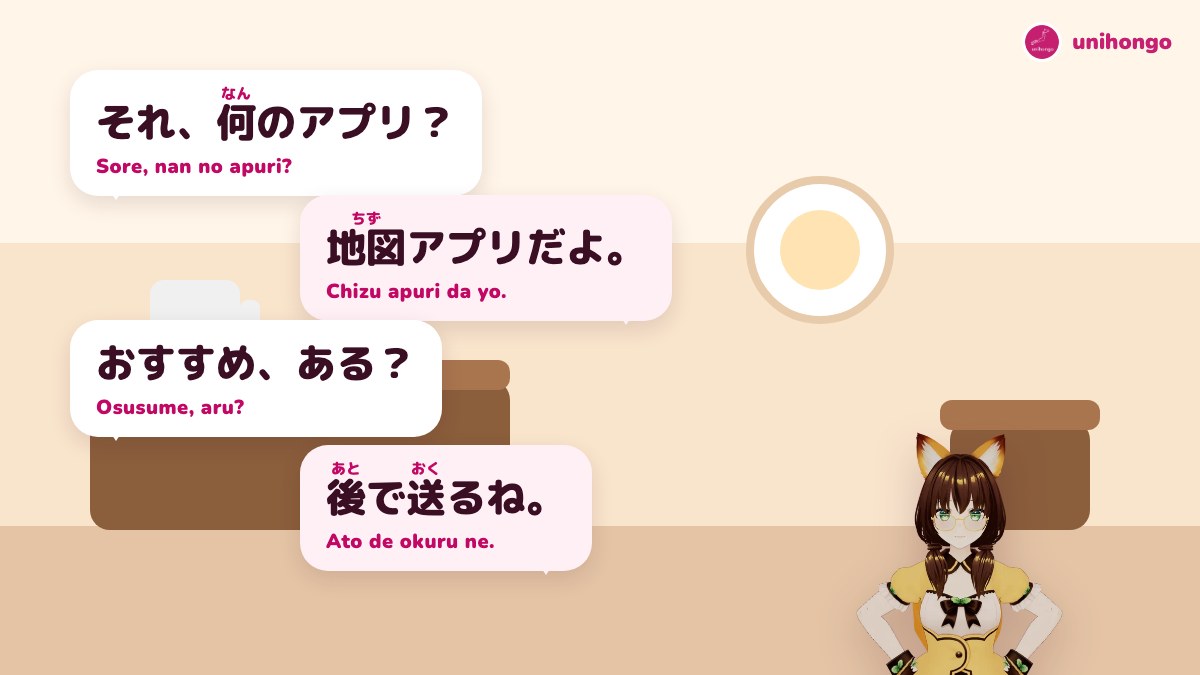
This is the part of the conversation that pays off, because the app a Japanese friend recommends for trains or deliveries is usually the one that works. Ask with ni, for the purpose, plus nan no apuri ga ii desu ka, what app is good. Recommend with osusume desu and one reason, and compare with no hō ga tsukaiyasui, is easier to use. Adding a friend on a messaging app by QR code is how most new friendships in Japan move onto the phone, and the scene below shows the exchange.
| Japanese | Romaji | Meaning |
|---|---|---|
| 日本語の勉強に、何のアプリがいいですか。 | Nihongo no benkyō ni, nan no apuri ga ii desu ka. | What app is good for studying Japanese? |
| 電車の乗り換えは何で調べてる? | Densha no norikae wa nani de shirabeteru? | Friend: What do you use to look up train connections? |
| これがおすすめです。無料ですよ。 | Kore ga osusume desu. Muryō desu yo. | I recommend this one. It's free. |
| それ、使いやすい? | Sore, tsukaiyasui? | Friend: Is that easy to use? |
| 前のより、こっちの方が使いやすいです。 | Mae no yori, kotchi no hō ga tsukaiyasui desu. | This one is easier to use than the old one. |
| QRコードで友達追加できますよ。 | QR kōdo de tomodachi tsuika dekimasu yo. | You can add me as a friend with a QR code. |
| 後で送りますね。 | Ato de okurimasu ne. | I'll send it to you later. |
Screen time and honest confessions
Admitting that you look at your phone too much is a reliable way to make a Japanese listener laugh and agree. Tsui, without meaning to, with te shimau, end up doing, is the grammar of a bad habit. Miru senmon, a look-only specialist, is the self-mocking label for someone who reads social media but never posts, and it is common. For the effort to change, herashite imasu, I'm cutting down, and minai yō ni shite imasu, I try not to look, are the honest, slightly unsuccessful verbs.
| Japanese | Romaji | Meaning |
|---|---|---|
| ついスマホを見てしまいます。 | Tsui sumaho o mite shimaimasu. | I end up looking at my phone without meaning to. |
| スマホがないと落ち着きません。 | Sumaho ga nai to ochitsukimasen. | I feel uneasy without my phone. |
| SNSは見る専門です。 | SNS wa miru senmon desu. | I only read social media, I never post. |
| 最近、SNSを減らしています。 | Saikin, SNS o herashite imasu. | I've been cutting down on social media lately. |
| 寝る前に見ないようにしています。 | Neru mae ni minai yō ni shite imasu. | I try not to look at it before bed. |
| 電車の中ではほとんどみんなスマホを見ていますね。 | Densha no naka de wa hotondo minna sumaho o mite imasu ne. | On the train nearly everyone is on their phone, aren't they? |
SNS, said esu enu esu, is the Japanese word for social media; sōsharu media is understood but much less common in conversation.
Reactions and follow-ups
Phone talk runs on agreement and curiosity. Wakarimasu, I know what you mean, answers a confession; benrisō, looks handy, answers an app; namae, nante iu no, what's it called, is the follow-up that leads to the recommendation. When the other person gives a screen-time number, the teasing reaction chotto ōi desu ne, that's a bit much, is fine between friends and best left unsaid to a boss.
| Japanese | Romaji | Meaning |
|---|---|---|
| 私もです。 | Watashi mo desu. | Me too. |
| わかります。 | Wakarimasu. | I know what you mean. |
| それ、便利そうですね。 | Sore, benrisō desu ne. | That looks handy. |
| 名前、何ていうの? | Namae, nante iu no? | Friend: What's it called? |
| 後で入れてみます。 | Ato de irete mimasu. | I'll try installing it later. |
| 四時間はちょっと多いですね。 | Yojikan wa chotto ōi desu ne. | Four hours is a bit much. |
| どんなゲームですか。 | Donna gēmu desu ka. | What kind of game is it? |
Mistakes and register notes
- Appu for an app. Appu means an increase or an upgrade; the app is apuri.
- Sumaho o asobu for playing on your phone. The phone is the tool: sumaho de asobu, or sumaho de gēmu o suru.
- Denwa suru for messaging. Denwa is a voice call; a message is messēji o okuru, or the app name plus suru: LINE suru is normal among friends.
- Daunrōdo for every install. Correct, but ireru, to put in, is what people say, and kesu is to delete.
- Keitai denwa in full. Understood, but long and formal; sumaho or keitai is what people say.
- Register: tsukatte imasu and mite imasu with people you have just met; tsukatteru and miteru with friends, and nani de shiraberu? without the polite ending.
Your home screen as a word list
Every icon on your first screen is a word you already use in Japanese, so make them cards. Take a screenshot of your home screen, give it to Mocchi with /create-flashcards, and ask for one card per app with what you do in it, chizu apuri de eki o sagasu and the rest; Mocchi keeps track of which katakana words you miss and brings them back in /review-flashcards. Then open Kotoba Stack in the games and choose your own flashcards as the word source, so the same apps come at you at speed. Later, when a friend asks nan no apuri, the words will already be in your mouth.
A free account is all it takes, and unihongo.com/login works on the phone you are describing.