
Your trip in four lines
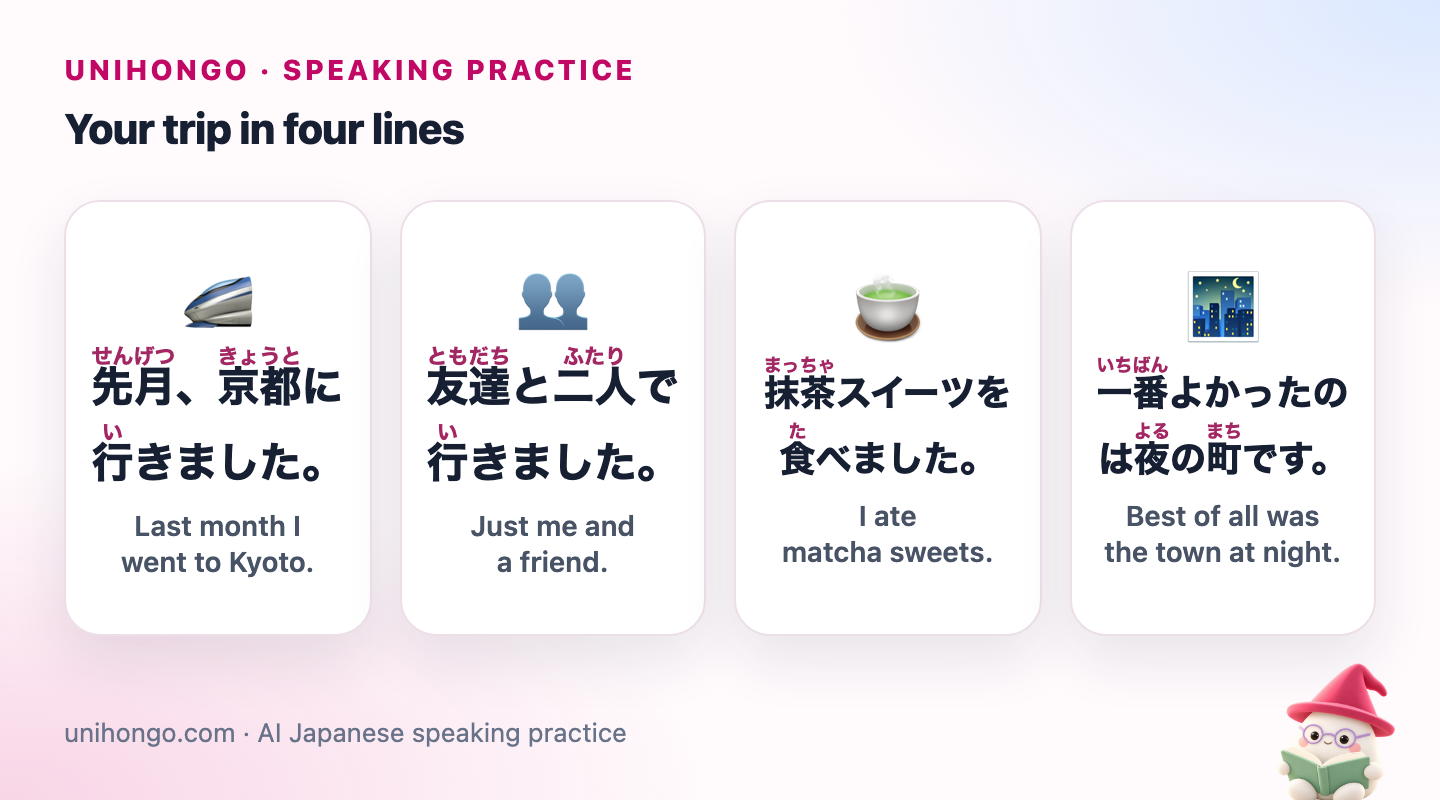
The four cards are the skeleton of every recap: when and where, who with, one thing you ate, and the best part. Sengetsu, last month, sets the time; ni ikimashita is the plain past of to go. Tomodachi to futari de, with a friend, the two of us, is how Japanese says who went, with the number of people in de. Suītsu, sweets, is the everyday word for desserts and cakes. Ichiban yokatta no wa, the best part was, is the sentence the listener is waiting for.
| Japanese | Romaji | Meaning |
|---|---|---|
| 先月、京都に行きました。 | Sengetsu, Kyōto ni ikimashita. | Last month I went to Kyoto. |
| 友達と二人で行きました。 | Tomodachi to futari de ikimashita. | Just me and a friend. |
| 抹茶スイーツを食べました。 | Matcha suītsu o tabemashita. | I ate matcha sweets. |
| 一番よかったのは夜の町です。 | Ichiban yokatta no wa yoru no machi desu. | Best of all was the town at night. |
The question you'll hear
Ryokō wa dō deshita ka, how was the trip, is the polite opener, and after a long weekend people ask it before you have sat down. Friends ask doko itteta no, where were you, with itteta, a contraction of itte ita, which means you were away somewhere. The follow-ups come fast: who with, how many nights, and the one that matters, nani ga ichiban yokatta, what was the best part.
| Japanese | Romaji | Meaning |
|---|---|---|
| 旅行はどうでしたか。 | Ryokō wa dō deshita ka. | How was the trip? |
| どこ行ってたの? | Doko itteta no? | Friend: Where did you go? (casual) |
| 誰と行ったんですか。 | Dare to itta n desu ka. | Who did you go with? |
| 何泊したんですか。 | Nanpaku shita n desu ka. | How many nights did you stay? |
| 何が一番よかったですか。 | Nani ga ichiban yokatta desu ka. | What was the best part? |
Three model answers
The beginner answer is two short sentences, place and one adjective in the past. The intermediate answer uses itte kimashita, counts nights, samples two activities with tari-tari and names the best part. The upper answer handles a disappointment gracefully with megumarenakatta, were not blessed with, and sono bun, which means but to make up for it, then tells of a local tip with te moratta and omotta ijō ni, more than I expected.
| Japanese | Romaji | Meaning |
|---|---|---|
| 沖縄に行きました。海がきれいでした。 | Okinawa ni ikimashita. Umi ga kirei deshita. | Beginner: I went to Okinawa. The sea was beautiful. |
| とても楽しかったです。 | Totemo tanoshikatta desu. | Beginner: It was a lot of fun. |
| 先週、友達と三泊四日で北海道に行ってきました。 | Senshū, tomodachi to sanpaku yokka de Hokkaidō ni itte kimashita. | Intermediate: Last week I went to Hokkaido with a friend for four days and three nights. |
| 海鮮丼を食べたり、温泉に入ったりしました。 | Kaisendon o tabetari, onsen ni haittari shimashita. | Intermediate: We ate seafood rice bowls, went to a hot spring, that kind of thing. |
| 一番よかったのは、夜景です。 | Ichiban yokatta no wa, yakei desu. | Intermediate: The best part was the night view. |
| 天気には恵まれなかったんですが、その分、ゆっくり美術館を回れました。 | Tenki ni wa megumarenakatta n desu ga, sono bun, yukkuri bijutsukan o mawaremashita. | Upper: We weren't lucky with the weather, but that meant we could take our time around the museums. |
| 地元の人に教えてもらった食堂が、思った以上に当たりでした。 | Jimoto no hito ni oshiete moratta shokudō ga, omotta ijō ni atari deshita. | Upper: A diner a local told us about turned out to be an even better find than I expected. |
Itte kimashita, from iku plus kuru, says you went and are now back. It is the verb of the Monday recap, and it is what people say about any outing, from a trip abroad to a run to the konbini.
The past tense a trip needs
Six verbs and three adjective endings carry almost every recap. The verbs all take mashita; the adjectives split into i-adjectives, which change inside, and na-adjectives, which take deshita. The rows after the table add the words for how long and how you got there.
| Japanese | Romaji | Meaning |
|---|---|---|
| 二泊三日でした。 | Nihaku mikka deshita. | It was three days and two nights. |
| 日帰りで行きました。 | Higaeri de ikimashita. | It was a day trip. |
| 新幹線で行きました。 | Shinkansen de ikimashita. | We went by shinkansen. |
| 旅館に泊まりました。 | Ryokan ni tomarimashita. | We stayed at a ryokan. |
| ご飯がとてもおいしかったです。 | Gohan ga totemo oishikatta desu. | The food was really good. |
| 景色がきれいでした。 | Keshiki ga kirei deshita. | The scenery was beautiful. |
| Verb | Past polite | Use it for |
|---|---|---|
| 行く iku | ikimashita / itte kimashita | went / went and came back |
| 見る miru | mimashita | saw: sights, a show, the view |
| 食べる taberu | tabemashita | ate: the dish, the local food |
| 泊まる tomaru | tomarimashita | stayed: at a hotel, a ryokan, a friend's |
| 乗る noru | norimashita | took: a train, a bus, a boat |
| 買う kau | kaimashita | bought: souvenirs |
Adjectives in the past: tanoshikatta desu, it was fun; oishikatta desu, it was delicious; samukatta desu, it was cold. Na-adjectives and nouns take deshita: kirei deshita, it was beautiful; shizuka deshita, it was quiet.
Tell it in order
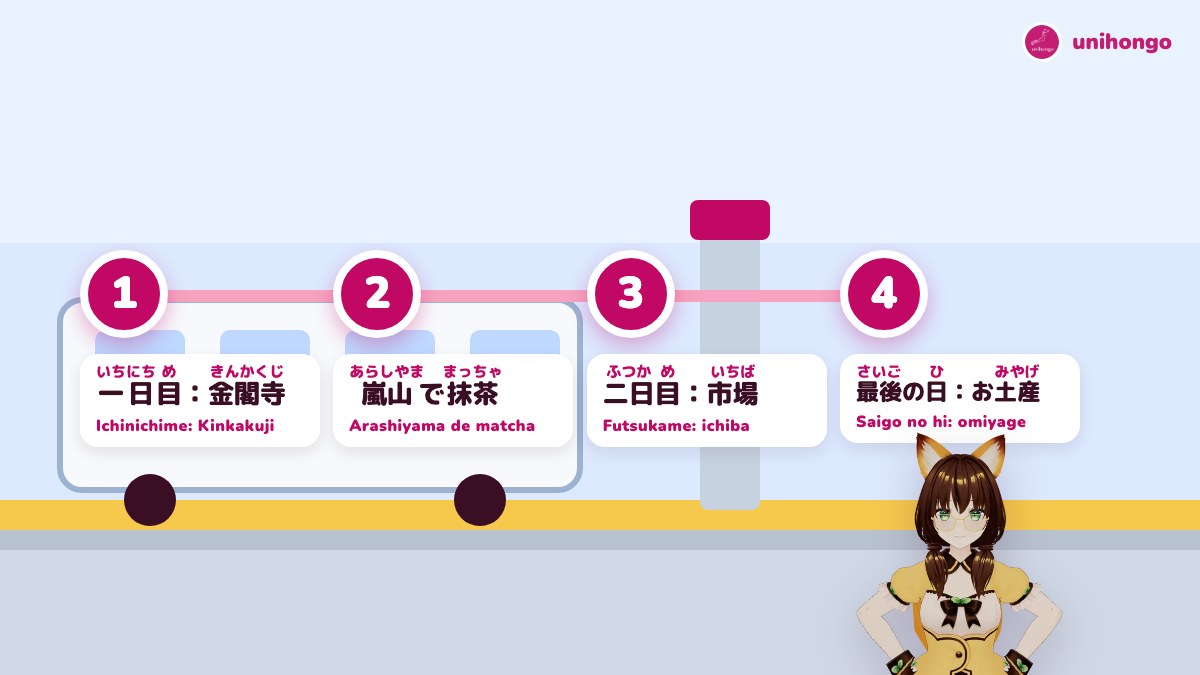
Once the recap is longer than four sentences, it needs order words, and the ones for a trip are the days: ichinichime, futsukame, mikkame, day one, two, three, with me making the number an ordinal. Sorekara, and then, links events inside a day, and saigo no hi wa, on the last day, closes it. Keep one event per sentence, and finish with a small human detail; the train-home nap is the classic. The scene below lays the three days out as a line.
| Japanese | Romaji | Meaning |
|---|---|---|
| 一日目は金閣寺に行きました。 | Ichinichime wa Kinkakuji ni ikimashita. | Day one we went to Kinkaku-ji. |
| それから、嵐山で抹茶を飲みました。 | Sorekara, Arashiyama de matcha o nomimashita. | Then we had matcha in Arashiyama. |
| 二日目は朝から市場を回りました。 | Futsukame wa asa kara ichiba o mawarimashita. | Day two we went round the market from the morning. |
| 最後の日は、お土産を買って帰りました。 | Saigo no hi wa, omiyage o katte kaerimashita. | On the last day we bought souvenirs and went home. |
| 帰りの電車で寝てしまいました。 | Kaeri no densha de nete shimaimashita. | I fell asleep on the train home. |
Mawaru, to go round, is the verb for exploring a market, a town or a set of temples: ichiba o mawaru, machi o mawaru. It sounds much more like a traveller than iku on its own.
The best part, the surprises and the let-downs
The highlight sentence has three forms, from the plain ichiban yokatta no wa to the warmer ichiban no omoide wa, my best memory, and the slightly formal inshō ni nokotte imasu, has stayed with me. Honest recaps also include the surprise, with omotta yori, more than I expected, and the let-down, which Japanese softens with zannen nagara, unfortunately. End with mata ikitai, I want to go again, or a plan for next time with itte mitai, and the listener has somewhere to take the conversation.
| Japanese | Romaji | Meaning |
|---|---|---|
| 一番の思い出は、朝の竹林です。 | Ichiban no omoide wa, asa no chikurin desu. | My best memory is the bamboo grove in the morning. |
| 思ったより人が多かったです。 | Omotta yori hito ga ōkatta desu. | It was more crowded than I expected. |
| 残念ながら、雨でした。 | Zannen nagara, ame deshita. | Unfortunately, it rained. |
| 店の人がとても親切でした。 | Mise no hito ga totemo shinsetsu deshita. | The shop staff were very kind. |
| また行きたいです。 | Mata ikitai desu. | I want to go again. |
| 次は秋に行ってみたいです。 | Tsugi wa aki ni itte mitai desu. | Next time I'd like to try going in autumn. |
Reactions, follow-ups and the omiyage moment
The listener's job is short reactions and one question at a time: ii desu ne, urayamashii, I'm jealous, and then photos, food and the best part. In many Japanese workplaces people bring back a box of sweets to share after a trip, though how strictly this is expected varies a lot by office and by generation; if you do, the handover is two lines. The rows below run as the Monday exchange, souvenir included.
| Japanese | Romaji | Meaning |
|---|---|---|
| いいですね。うらやましい。 | Ii desu ne. Urayamashii. | Coworker: Nice. I'm jealous. |
| 写真、ありますか。 | Shashin, arimasu ka. | Coworker: Do you have photos? |
| 何を食べましたか。 | Nani o tabemashita ka. | Coworker: What did you eat? |
| それは残念でしたね。 | Sore wa zannen deshita ne. | Coworker: That's a shame. |
| これ、お土産です。どうぞ。 | Kore, omiyage desu. Dōzo. | You: This is a souvenir for you. Please. |
| わあ、ありがとうございます。 | Wā, arigatō gozaimasu. | Coworker: Oh, thank you! |
| 今度、おすすめを教えてください。 | Kondo, osusume o oshiete kudasai. | Coworker: Tell me your recommendations sometime. |
Urayamashii, enviable, is said about the trip, not the person, and it is a compliment: it means you had a good time and they are pleased for you. Reply with a modest ie, or hand over the omiyage.
Mistakes and register notes
- Tanoshii deshita. The past goes into the i-adjective: tanoshikatta desu. The same for oishikatta and samukatta.
- Kirekatta. Kirei is a na-adjective, so it is kirei deshita; the same for shizuka deshita and nigiyaka deshita.
- Kyōto o ryokō shimashita. Possible, but Kyōto ni ryokō ni ikimashita or simply Kyōto ni ikimashita is what people say.
- Sanhaku for three nights. It is sanpaku; and one night is ippaku.
- Switching to the present halfway. Once the recap starts in mashita, stay there until mata ikitai desu, which is the one present-tense line.
- Register: ikimashita and tanoshikatta desu with coworkers; itta and tanoshikatta with friends, and doko itteta no is the casual question you will be asked.
Tell the trip twice
A recap gets good the second time you tell it, so tell it once to Mocchi and once to AI Sensei. Paste your six sentences to Mocchi with /correct, then ask /explain on the upper-level sentence about the weather to see how n desu ga and sono bun fit together; because Mocchi keeps track of where you went, later quizzes and example sentences use your own trip. Then open AI Sensei, choose Haru-sensei and ask Haru-sensei to play a coworker on Monday morning who asks how the trip was, reacts, asks about food and photos, and finally asks what you recommend; the session report afterwards shows you every tanoshii deshita that slipped out.
The first retelling is a free account away, at unihongo.com/login.