
Eight patience proverbs in brief
Each proverb below paints a small picture: a stone, a road, a boat, a fruit tree. The literal image makes them much easier to remember than an abstract meaning.
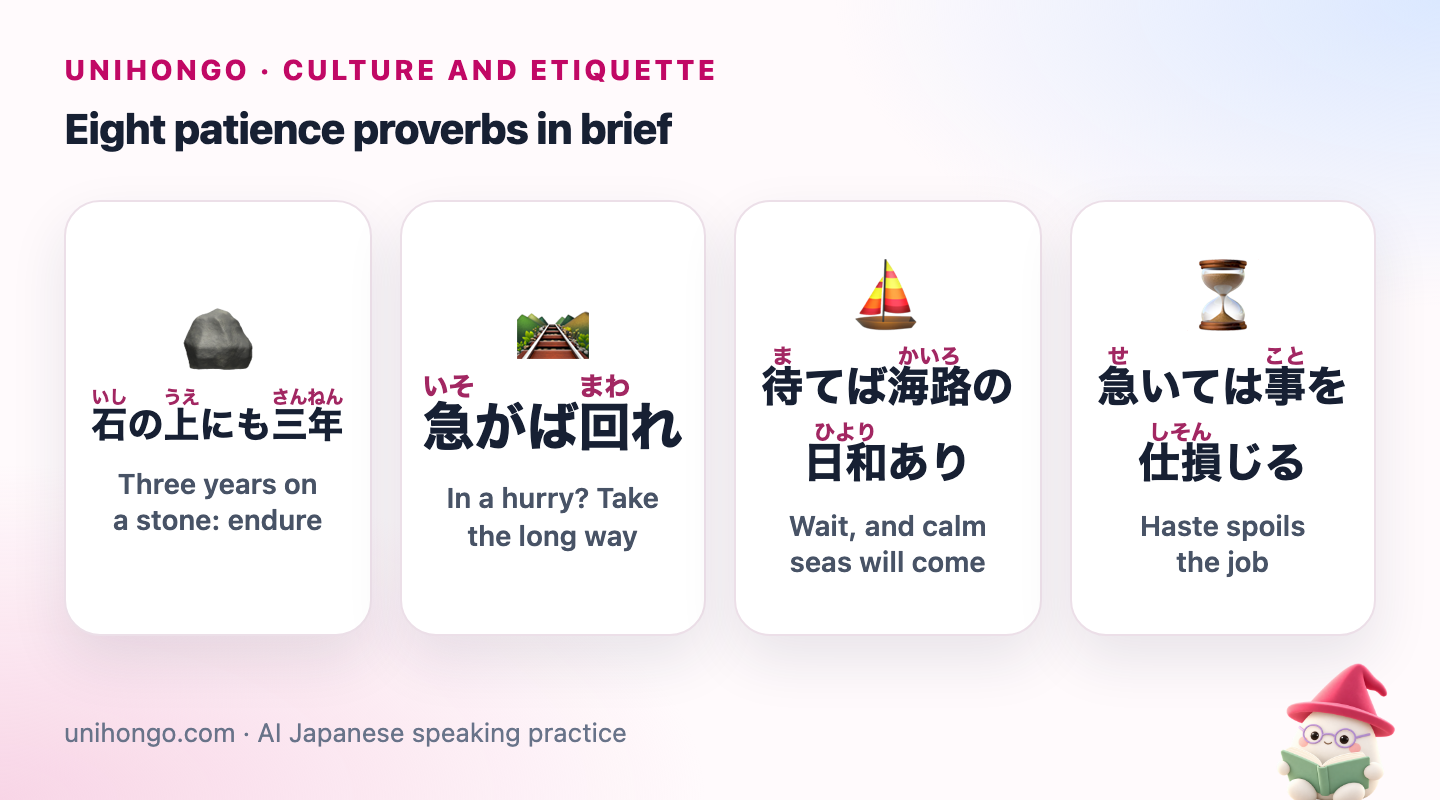
| Japanese | Romaji | Meaning |
|---|---|---|
| 石の上にも三年 | Ishi no ue ni mo san nen | Three years on a stone: endure |
| 急がば回れ | Isogaba maware | In a hurry? Take the long way |
| 待てば海路の日和あり | Mateba kairo no hiyori ari | Wait, and calm seas will come |
| 急いては事を仕損じる | Seite wa koto o shisonjiru | Haste spoils the job |
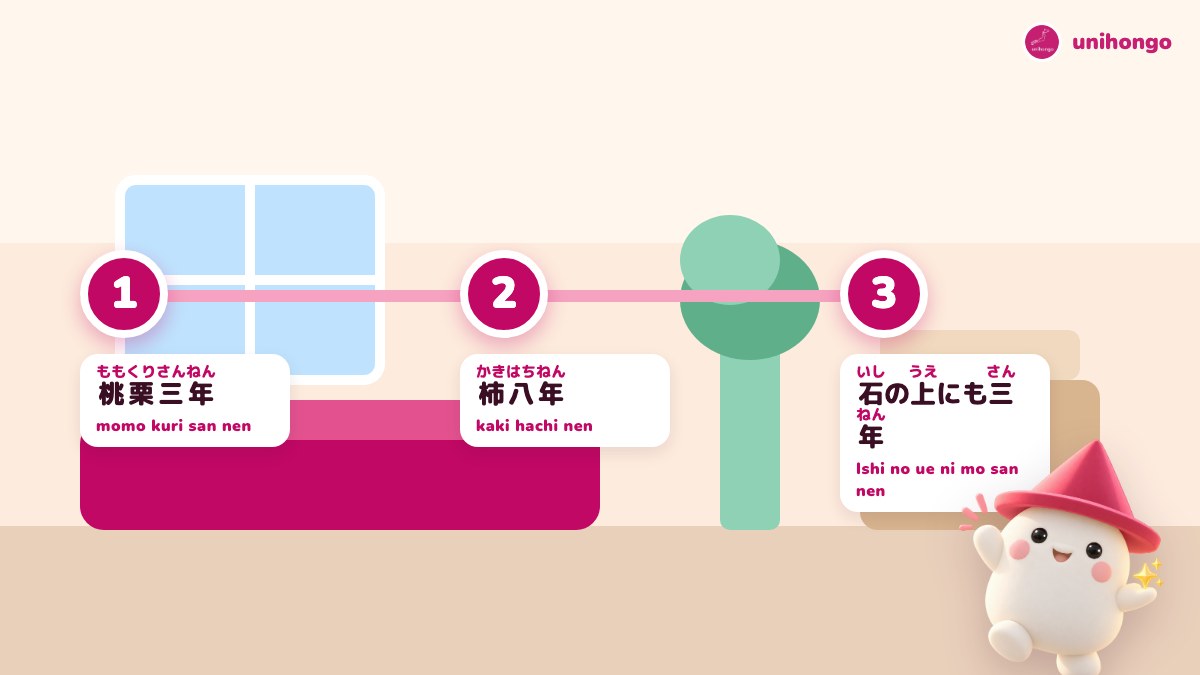
| 桃栗三年柿八年 | Momo kuri san nen kaki hachi nen | Fruit trees take years: be patient |
| 雨降って地固まる | Ame futte ji katamaru | After rain, the ground hardens |
| 短気は損気 | Tanki wa sonki | A short temper is your own loss |
| 堪忍袋の緒が切れる | Kanninbukuro no o ga kireru | The patience bag's cord snaps |
石の上にも三年: endurance, and its critics
The image is simple: a stone is cold, but if you sit on it long enough, it warms up. In the same way, a hard situation often improves if you stay with it. The number three just means a long time. People use it about learning a craft, settling into a new city, building a business or getting used to a new job, and they often say it looking back: it took three years, but it worked out.
The proverb has a second life as an argument about work. For decades it was common advice to new graduates: stay at your first company for at least three years. Many people still believe that, while others say it keeps people in bad workplaces. As a learner, the safest use is about yourself or about a skill, not as advice telling someone else to put up with things. If you do use it as advice, soften it with でも、無理はしないで, but don't push yourself too hard.
| Japanese | Romaji | Meaning |
|---|---|---|
| 日本語も石の上にも三年ですね。 | Nihongo mo ishi no ue ni mo san nen desu ne. | Japanese takes years of sitting on the stone too. |
| 石の上にも三年と思って続けました。 | Ishi no ue ni mo san nen to omotte tsuzukemashita. | I told myself it takes time, and kept going. |
| でも、無理はしないでね。 | Demo, muri wa shinaide ne. | But don't push yourself too hard. (casual) |
急がば回れ vs 急いては事を仕損じる
急がば回れ, if you are in a hurry, go round, is one of the most used proverbs in everyday Japanese. A common explanation links it to an old poem about crossing Lake Biwa: the boat looked faster, but sudden winds made the land route round the lake more reliable. Today it covers any choice between a risky shortcut and a safe detour: cramming the night before versus reviewing every day, or skipping basic grammar to jump into anime.
急いては事を仕損じる says that rushing makes you fail at the task. It is more of a warning about mistakes made in haste, and it sounds a little more formal. Both are often said to someone who is about to rush, and both pair well with a calm suggestion.
| Japanese | Romaji | Meaning |
|---|---|---|
| 急がば回れで、基礎からやり直そう。 | Isogaba maware de, kiso kara yarinaosō. | Slow is fast: let's redo the basics. |
| 急いては事を仕損じるよ。落ち着いて。 | Seite wa koto o shisonjiru yo. Ochitsuite. | Rushing causes mistakes. Calm down. |
| Proverb | Focus | Typical moment |
|---|---|---|
| 急がば回れ | The detour is faster in the end | Choosing a study method or a route |
| 急いては事を仕損じる | Haste causes errors | Someone about to send, sign or decide too fast |
| 善は急げ | Opposite advice: do good things now | A good idea that should not wait |
Notice the last row. Japanese, like English, has proverbs that point in opposite directions. Which one fits depends on whether the risk is acting too fast or waiting too long.
Waiting for good weather and fruit trees
待てば海路の日和あり means if you wait, there will be good weather for a sea voyage. Sailors could not change the weather; they could only wait for the right day. People use it to tell someone that a bad patch will pass, often with a relaxed tone. It sounds slightly old-fashioned, and many people shorten it to 待てば海路の日和ありって言うし, as the saying goes.
桃栗三年柿八年, peaches and chestnuts take three years and persimmons eight, is about the time between planting and harvest. It means worthwhile results take years, and it is sometimes extended with a humorous extra line about other fruit trees, which varies by region. 雨降って地固まる, after rain the ground firms up, is about relationships: a quarrel, once resolved, can leave people closer than before. You will hear it at weddings and after a team has worked through a conflict.
| Japanese | Romaji | Meaning |
|---|---|---|
| 待てば海路の日和ありって言うし。 | Mateba kairo no hiyori ari tte iu shi. | As they say, good weather will come. |
| 桃栗三年柿八年、気長にやろう。 | Momo kuri san nen kaki hachi nen, kinaga ni yarō. | Good things take years; let's be patient. |
| 雨降って地固まるだね。 | Ame futte ji katamaru da ne. | The fight brought us closer, didn't it. |
When patience runs out: 短気は損気 and 堪忍袋
短気は損気 is a neat rhyme: tanki, a short temper, is sonki, a loss. Losing your temper costs you more than anyone else. Parents say it to children and friends say it half-jokingly when someone is about to snap.
堪忍袋の緒が切れる paints patience as a bag tied with a cord; when it is too full, the cord breaks. It is used when someone who has been tolerant finally gets angry, and it is common in both conversation and news reports about disputes. Say it about yourself with care: it signals real anger.
| Japanese | Romaji | Meaning |
|---|---|---|
| 短気は損気だよ。 | Tanki wa sonki da yo. | Losing your temper only hurts you. |
| ついに堪忍袋の緒が切れた。 | Tsui ni kanninbukuro no o ga kireta. | My patience finally snapped. |
Mini dialogue: a new hire and a senior colleague
Two months into a new job, a learner admits to a senior colleague that it is harder than expected. The senior uses one proverb and then something practical, which is the most natural pattern.
| Japanese | Romaji | Meaning |
|---|---|---|
| 仕事、なかなか慣れなくて。 | Shigoto, nakanaka narenakute. | You: I'm just not getting used to the job. |
| 最初はみんなそうだよ。まだ二か月でしょう? | Saisho wa minna sō da yo. Mada nikagetsu deshō? | Senior: Everyone's like that at first. It's only been two months, right? |
| はい。早く一人でできるようになりたいんですが。 | Hai. Hayaku hitori de dekiru yō ni naritai n desu ga. | You: Yes. I want to manage on my own soon. |
| 急がば回れだよ。まずはマニュアルをしっかり覚えよう。 | Isogaba maware da yo. Mazu wa manyuaru o shikkari oboeyō. | Senior: Slow is fast. First learn the manual properly. |
| わかりました。ありがとうございます。 | Wakarimashita. Arigatō gozaimasu. | You: Understood. Thank you. |
Common mistakes with patience proverbs
- Telling someone in a bad situation 石の上にも三年 as if it were a rule. It can sound dismissive; share your own experience instead.
- Mixing up 急がば回れ and 善は急げ. One says take the safe road, the other says act now.
- Reading 日和 as nichiwa. In this proverb it is hiyori, good weather.
- Using 堪忍袋の緒が切れる for mild irritation. It is for patience that has run out after a long time.
How to quote a proverb without lecturing
A proverb about patience can easily sound like a lecture, especially from a learner. Japanese speakers soften them with small framing phrases, and copying these makes you sound far more natural.
って言うでしょう and って言うし, as they say, present the proverb as common wisdom rather than your own judgement. と言いますが is the polite equivalent and often introduces a gentle but: they say this, but in your case it might be different. じゃないけど, it's not quite the proverb but, lets you allude to a saying playfully. Finally, many people only say the first half of a proverb and let the listener complete it in their head, such as 急がば… with a smile. This works with very famous sayings only, and with people who know them.
The other softener is to apply the proverb to yourself first. 私も石の上にも三年だと思って頑張りました, I also told myself to give it three years, shares an experience instead of giving advice, and the listener can draw their own conclusion.
| Japanese | Romaji | Meaning |
|---|---|---|
| 急がば回れって言うでしょう。 | Isogaba maware tte iu deshō. | You know what they say: slow is fast. |
| 石の上にも三年と言いますが、無理は禁物です。 | Ishi no ue ni mo san nen to iimasu ga, muri wa kinmotsu desu. | They say give it three years, but don't overdo it. (polite) |
| 待てば海路の日和ありじゃないけど、待ってみたら? | Mateba kairo no hiyori ari ja nai kedo, matte mitara? | Not to quote proverbs, but why not wait and see? |
| 私も最初の一年は大変でした。 | Watashi mo saisho no ichinen wa taihen deshita. | My first year was hard too. |
Rehearse the slow-down talk out loud
Patience proverbs usually appear in a conversation where one person is stressed and the other calms them down, so they are worth saying, not just reading. Start by asking Mocchi something like: give me three situations where 急がば回れ fits and one where 善は急げ fits better. Mocchi explains the difference and remembers which pair confused you for your next review.
Then open AI Sensei, choose Yamada-sensei and ask Yamada-sensei to play a senior colleague at your first job in Japan. Describe a problem in polite Japanese, listen for the proverb Yamada-sensei chooses, and try answering with one of your own. The session report lists the phrases and corrections afterwards.