
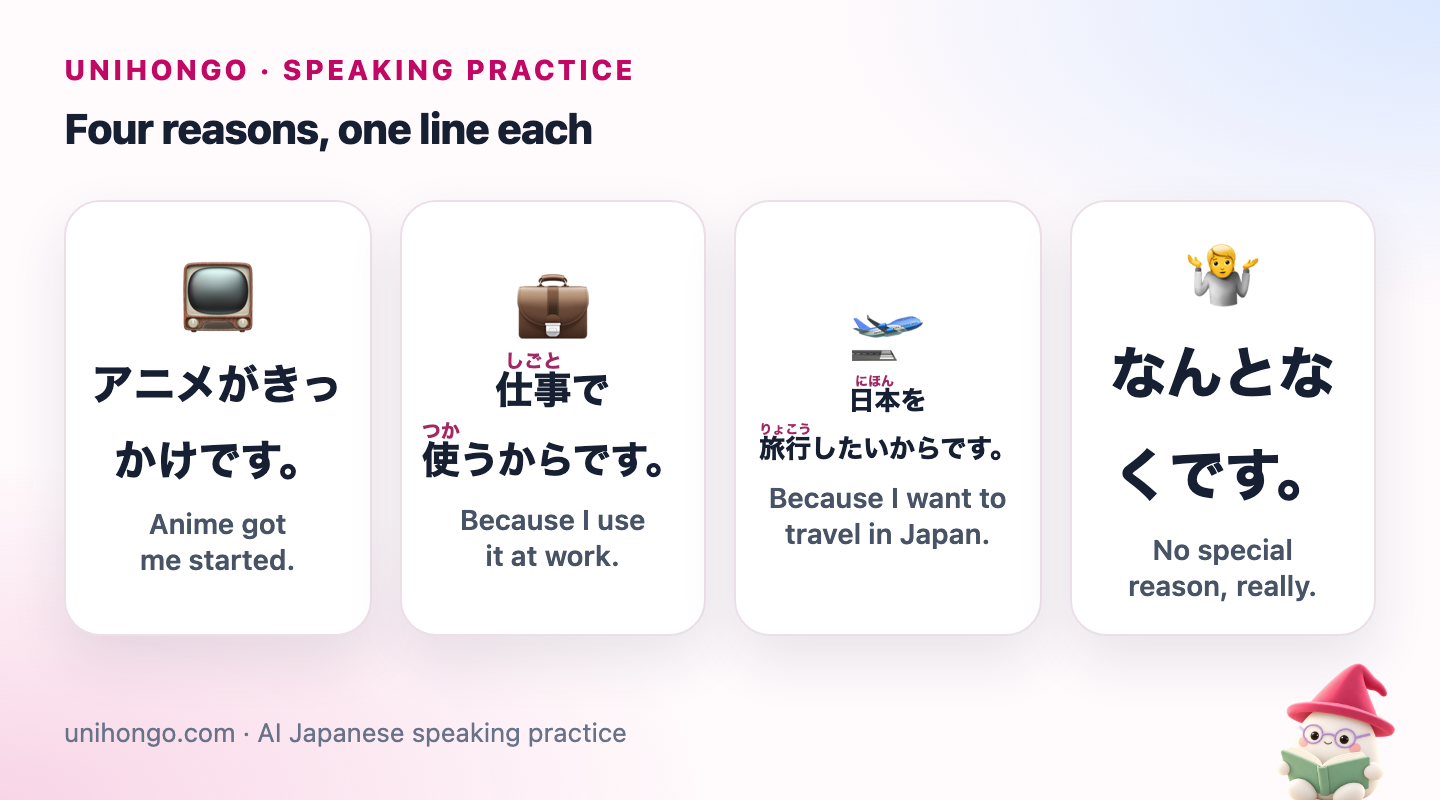
Four reasons, one line each
Each of these lines is a full answer. Kikkake (きっかけ) means the trigger or the thing that started something, and X ga kikkake desu is the single most natural way to say what got you into Japanese. Kara desu, because, works with any reason. Nantonaku, somehow, for no particular reason, is said with a small laugh and is completely acceptable; many Japanese people choose hobbies the same way.
| Japanese | Romaji | Meaning |
|---|---|---|
| アニメがきっかけです。 | Anime ga kikkake desu. | Anime got me started. |
| 仕事で使うからです。 | Shigoto de tsukau kara desu. | Because I use it at work. |
| 日本を旅行したいからです。 | Nihon o ryokō shitai kara desu. | Because I want to travel in Japan. |
| なんとなくです。 | Nantonaku desu. | No special reason, really. |
The question you'll hear, and what comes before it
The polite question ends in n desu ka, which signals real curiosity rather than an interrogation. Friends shorten it to nande nihongo? with a rising tone. Very often the question is preceded by a compliment, nihongo jōzu desu ne, even after a single konnichiwa; it is a friendly opener, not an assessment, and the modest reply madamada desu is the expected move before you answer why.
| Japanese | Romaji | Meaning |
|---|---|---|
| どうして日本語を勉強しているんですか。 | Dōshite nihongo o benkyō shite iru n desu ka. | Why are you studying Japanese? (polite) |
| なんで日本語勉強してるの? | Nande nihongo benkyō shiteru no? | Friend: Why are you learning Japanese? (casual) |
| きっかけは何ですか。 | Kikkake wa nan desu ka. | What got you started? |
| 日本語、上手ですね。 | Nihongo, jōzu desu ne. | Your Japanese is good. |
| いえいえ、まだまだです。 | Ieie, madamada desu. | Oh no, I've got a long way to go. |
Three model answers
At beginner level, two short sentences without connectors are enough. The intermediate answer joins the trigger and the start with the te-form, mitakute, and adds a present-tense sentence about what you enjoy now. The upper answer uses uchi ni, in the course of, to show how the reason changed, and yō ni naritai, want to become able to, for a goal.
| Japanese | Romaji | Meaning |
|---|---|---|
| アニメが好きだからです。 | Anime ga suki da kara desu. | Beginner: Because I like anime. |
| 日本に行きたいです。 | Nihon ni ikitai desu. | Beginner: I want to go to Japan. |
| 日本のアニメを字幕なしで見たくて、勉強を始めました。 | Nihon no anime o jimaku nashi de mitakute, benkyō o hajimemashita. | Intermediate: I started because I wanted to watch anime without subtitles. |
| 今は日本の友達と話すのが楽しいです。 | Ima wa Nihon no tomodachi to hanasu no ga tanoshii desu. | Intermediate: Now I enjoy talking with my Japanese friends. |
| 最初は仕事で必要だったんですが、勉強するうちに日本の文化そのものに興味が出てきました。 | Saisho wa shigoto de hitsuyō datta n desu ga, benkyō suru uchi ni Nihon no bunka sono mono ni kyōmi ga dete kimashita. | Upper: At first I needed it for work, but as I studied I became interested in Japanese culture itself. |
| 妻が日本人なので、義理の両親と直接話せるようになりたいんです。 | Tsuma ga nihonjin na node, giri no ryōshin to chokusetsu hanaseru yō ni naritai n desu. | Upper: My wife is Japanese, so I want to be able to talk to her parents directly. |
The upper answers end in n desu or dete kimashita, which both carry the feel of explaining something to a listener who asked. That tone is what makes a long answer sound like sharing instead of lecturing.
The grammar of reasons
Five patterns cover every reason you will ever give. Choose by how direct you want to sound and by whether the reason is a cause, a purpose or a trigger.
| Japanese | Romaji | Meaning |
|---|---|---|
| 好きだからです。 | Suki da kara desu. | Because I like it. |
| 仕事で必要なので。 | Shigoto de hitsuyō na node. | Because I need it for work. (softer) |
| 旅行のために勉強しています。 | Ryokō no tame ni benkyō shite imasu. | I'm studying for travel. |
| 日本の音楽がきっかけで始めました。 | Nihon no ongaku ga kikkake de hajimemashita. | Japanese music is what got me started. |
| 特に理由はないんです。 | Toku ni riyū wa nai n desu. | There's no particular reason. |
| Pattern | Feel | Use it when |
|---|---|---|
| 〜から(です) | direct because | a quick, clear reason, especially to friends |
| 〜ので | soft because | explaining politely, giving a reason you were not asked for |
| 〜んです | explaining tone | adding background so the listener understands you |
| 〜がきっかけ | the trigger | naming what started it, without claiming it is the whole reason |
| 〜のために | purpose | a goal in the future: travel, work, a test |
Two rules catch most learners. Before kara and n desu, a noun or na-adjective needs da or na: suki da kara desu, suki na n desu. And a reason ending in kara desu answers a question; a reason ending in node or n desu can also open a topic you were not asked about.
Honest reasons and how to say each one
Below are the reasons learners actually have, in the form Japanese people expect to hear them. Say the specific thing: the game, the band, the city, the person. A specific detail turns a stock answer into a conversation, because the listener can ask about it. If your reason is a partner or a grandparent, giri no, in-law, and sobo, grandmother, are the words you need; if it is a move or a job, yotei, plan, carries the sentence.
| Japanese | Romaji | Meaning |
|---|---|---|
| ゲームの日本語が読みたくて。 | Gēmu no nihongo ga yomitakute. | I wanted to read the Japanese in games. |
| 来年、日本に引っ越す予定なんです。 | Rainen, Nihon ni hikkosu yotei nan desu. | I'm planning to move to Japan next year. |
| 大学で専攻しています。 | Daigaku de senkō shite imasu. | I'm majoring in it at university. |
| 祖母が日本人なんです。 | Sobo ga nihonjin nan desu. | My grandmother is Japanese. |
| 趣味です。楽しいから続いています。 | Shumi desu. Tanoshii kara tsuzuite imasu. | It's a hobby. I keep going because it's fun. |
| 日本の会社で働きたいんです。 | Nihon no kaisha de hatarakitai n desu. | I want to work at a Japanese company. |
What they'll say back, and how to keep it going
Your reason triggers a predictable set of follow-ups: how long you have been studying, whether kanji is hard, and which anime, band or city you meant. Have the answers ready, and have one question of your own: asking what the other person likes turns the interview into a conversation.
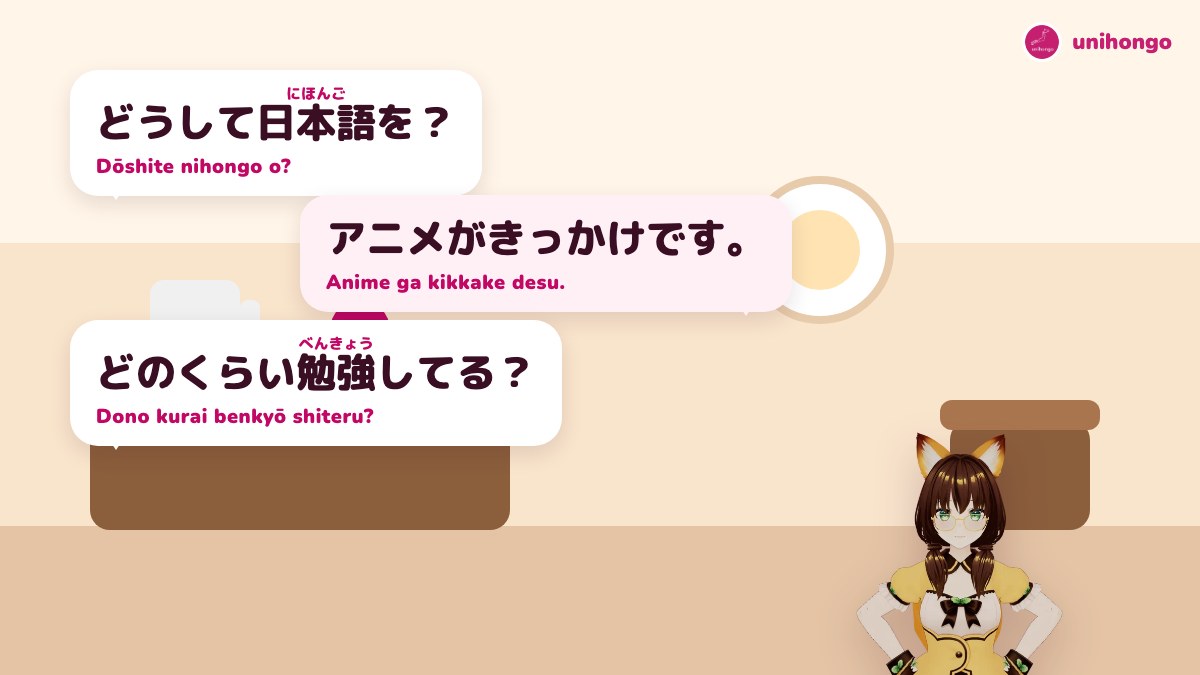
| Japanese | Romaji | Meaning |
|---|---|---|
| へえ、すごいですね。 | Hē, sugoi desu ne. | Friend: Wow, that's impressive. |
| どのくらい勉強していますか。 | Dono kurai benkyō shite imasu ka. | How long have you been studying? |
| 一年ぐらいです。 | Ichinen gurai desu. | About a year. |
| 漢字は難しくないですか。 | Kanji wa muzukashiku nai desu ka. | Isn't kanji hard? |
| 難しいですが、おもしろいです。 | Muzukashii desu ga, omoshiroi desu. | It's hard, but interesting. |
| 好きなアニメは何ですか。 | Suki na anime wa nan desu ka. | Which anime do you like? |
| そちらは英語を勉強したことがありますか。 | Sochira wa eigo o benkyō shita koto ga arimasu ka. | Have you ever studied English yourself? |
Dono kurai asks about duration; answer with a length plus gurai, about. Ichinen gurai, sankagetsu gurai, about three months. If you started and stopped, say mata hajimemashita, I started again, which many people find relatable.
Mistakes and register notes
- Suki kara desu. Missing da: it is suki da kara desu, and in polite speech suki na node.
- Answering only nihongo ga suki desu. True, but it answers what, not why; add kara desu or kikkake.
- A long résumé of reasons. Give one, then let the listener ask; three reasons at once sounds rehearsed.
- Laughing off the compliment in English. The Japanese reply madamada desu is short and expected.
- Nande to a senior person. Use dōshite or n desu ka forms yourself; nande is for friends.
- Register: kara desu and n desu for people you have just met; kara and nan da yo without desu for friends.
Turn your reason into a plan
Your answer to why is also the best starting point for how. Tell Mocchi your reason in one line and type /plan: it builds a personal study plan around that goal, your level and the time you have, and because it keeps track of the reason, later chats and quizzes lean towards anime vocabulary, work phrases or travel lines as appropriate. For speaking, pick Haru-sensei in AI Sensei and ask for a self-introduction conversation in which Haru-sensei asks why you study Japanese and keeps asking follow-ups until you run out of answers.
Everything above works on a free account: sign in at unihongo.com/login and start with the one line you prepared.
Your turn
- Say your reason in one line with kikkake desu.
- Say it again with n desu and add what you enjoy now.
- Answer how long you have been studying, with gurai.
- Answer whether kanji is hard, honestly, in two sentences.
- Ask the other person one question about their own language learning.