
Your childhood in four lines
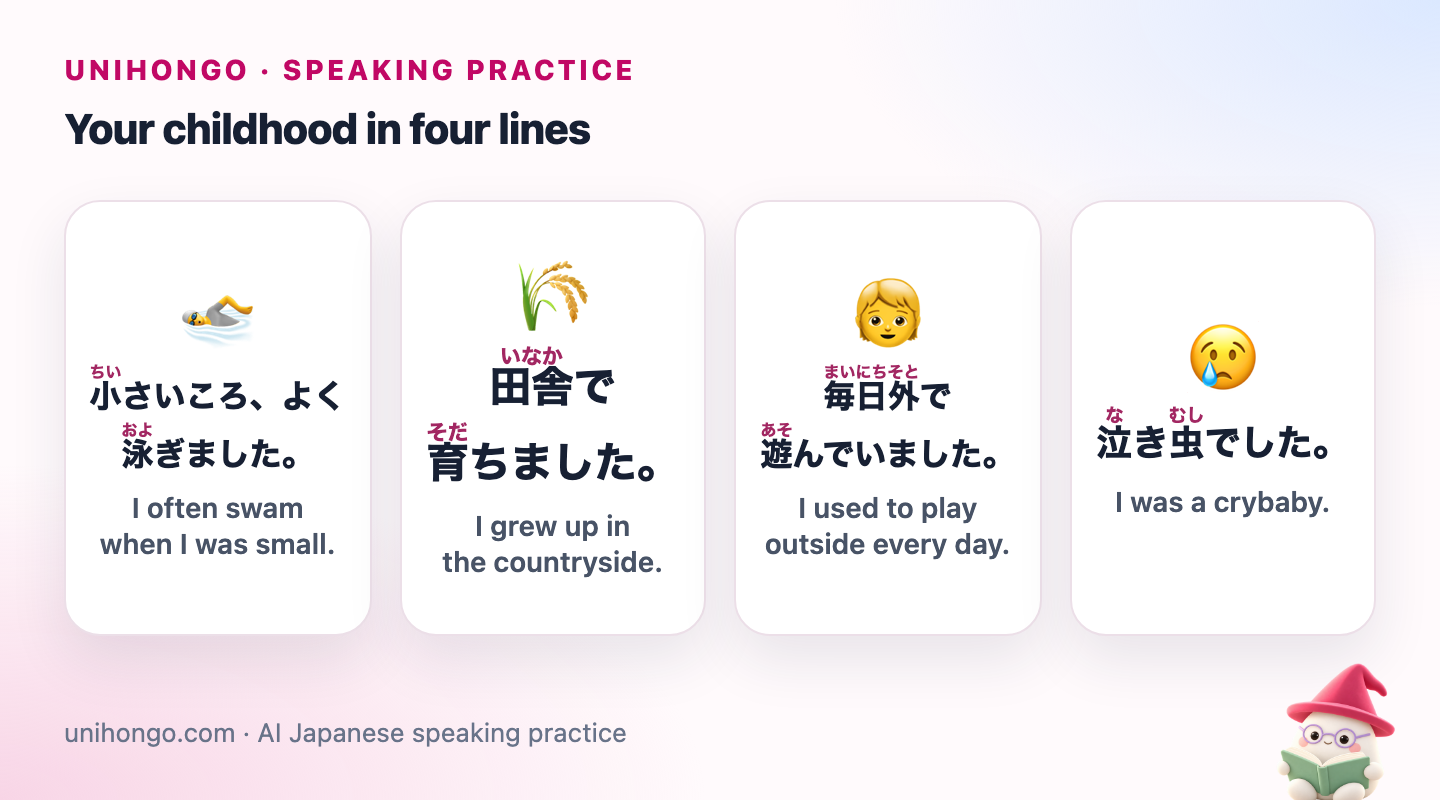
The four cards carry a time phrase, a place, a habit and a personality. Chiisai koro is interchangeable with kodomo no koro. Sodatsu, to grow up, is the verb of hometowns. Asonde imashita, was playing, in the te-imashita form, describes how things were day after day. Nakimushi, crybaby, is one of a family of mushi words for childhood types; yowamushi, coward, is another.
| Japanese | Romaji | Meaning |
|---|---|---|
| 小さいころ、よく泳ぎました。 | Chiisai koro, yoku oyogimashita. | I often swam when I was small. |
| 田舎で育ちました。 | Inaka de sodachimashita. | I grew up in the countryside. |
| 毎日外で遊んでいました。 | Mainichi soto de asonde imashita. | I used to play outside every day. |
| 泣き虫でした。 | Nakimushi deshita. | I was a crybaby. |
The question you'll hear
Donna ko deshita ka, what kind of child were you, is the open question. Doko de sodatta n desu ka asks about place and usually follows the where-are-you-from question once people realise your birthplace and your hometown may differ. The dream question, nani ni naritakatta, what did you want to become, is a favourite among friends because the answers are funny.
| Japanese | Romaji | Meaning |
|---|---|---|
| 子どものころ、どんな子でしたか。 | Kodomo no koro, donna ko deshita ka. | What were you like as a child? |
| どこで育ったんですか。 | Doko de sodatta n desu ka. | Where did you grow up? |
| 小さいとき、何になりたかった? | Chiisai toki, nani ni naritakatta? | Friend: What did you want to be when you were little? |
| 子どものころの夢は何でしたか。 | Kodomo no koro no yume wa nan deshita ka. | What was your childhood dream? |
| 兄弟はいますか。 | Kyōdai wa imasu ka. | Do you have siblings? |
Three model answers
The beginner version uses the plain past, which is perfectly fine for childhood as long as a time phrase sets the scene. The intermediate version adds a place with no stacked twice, a tari-tari sample of summer activities, and a personality with to omoimasu. The upper version gives a family reason with node, uses koto ga ōkatta, it was often the case that, and bakari, nothing but, to paint the picture.
| Japanese | Romaji | Meaning |
|---|---|---|
| 子どものころ、サッカーが好きでした。 | Kodomo no koro, sakkā ga suki deshita. | Beginner: I liked football as a child. |
| 毎日友達と遊びました。 | Mainichi tomodachi to asobimashita. | Beginner: I played with friends every day. |
| 海の近くの小さい町で育ちました。 | Umi no chikaku no chiisai machi de sodachimashita. | Intermediate: I grew up in a small town near the sea. |
| 夏はよく海で泳いだり、魚を釣ったりしていました。 | Natsu wa yoku umi de oyoidari, sakana o tsuttari shite imashita. | Intermediate: In summer I used to swim in the sea and fish, things like that. |
| 大人しい子だったと思います。 | Otonashii ko datta to omoimasu. | Intermediate: I think I was a quiet child. |
| 両親が共働きだったので、学校の後は祖母の家で過ごすことが多かったです。 | Ryōshin ga tomobataraki datta node, gakkō no ato wa sobo no ie de sugosu koto ga ōkatta desu. | Upper: Both my parents worked, so after school I often stayed at my grandmother's. |
| 当時は本ばかり読んでいて、外で遊ぶのはあまり好きじゃなかったんです。 | Tōji wa hon bakari yonde ite, soto de asobu no wa amari suki ja nakatta n desu. | Upper: Back then I did nothing but read, and I didn't much like playing outside. |
To omoimasu after a personality word softens it: I think I was quiet. Japanese speakers often describe their younger selves this way, as if slightly unsure, and it sounds modest rather than evasive.
The grammar of past habits
English used to has four Japanese neighbours. They are not interchangeable, but the differences are about feel, not correctness, so pick the one that matches what you want the listener to picture.
| Japanese | Romaji | Meaning |
|---|---|---|
| よく祖父と釣りに行きました。 | Yoku sofu to tsuri ni ikimashita. | I often went fishing with my grandfather. |
| 当時はピアノを習っていました。 | Tōji wa piano o naratte imashita. | At the time I was taking piano lessons. |
| 昔はよく兄とけんかしたものです。 | Mukashi wa yoku ani to kenka shita mono desu. | I used to fight with my brother a lot. (nostalgic) |
| 休みの日は、ゲームをしたり、漫画を読んだりしていました。 | Yasumi no hi wa, gēmu o shitari, manga o yondari shite imashita. | On days off I'd play games, read manga, that kind of thing. |
| 父が毎晩本を読んでくれました。 | Chichi ga maiban hon o yonde kuremashita. | My father read to me every night. |
| Pattern | Feel | Best for |
|---|---|---|
| よく〜ました | I often did | a repeated activity: swimming, visiting, playing |
| 〜ていました | I was doing / it was so | a routine or state that continued: lessons, living somewhere, a habit |
| 〜たり〜たりしていました | things like A and B | a sample of activities without listing everything |
| 〜たものです | looking back fondly | nostalgia; slightly literary, common from older speakers |
A fifth pattern, the plain past with a time phrase, is always safe: kodomo no koro, sakkā o shimashita. Add yoku when it was frequent and switch to te imashita when you mean a period rather than an event.
Where you grew up, your family, your school
Umareru is to be born and sodatsu is to grow up; joining them with the te-form gives the standard biography sentence. Shusshin, origin, answers where you are from in one word. For siblings, Japanese counts the family: sannin kyōdai means three siblings in total, including you, and suekko, youngest, or chōnan, eldest son, gives your place. Tenkō, changing school, and hikkosu, moving house, explain a childhood that moved around.
| Japanese | Romaji | Meaning |
|---|---|---|
| ロンドンで生まれて、田舎で育ちました。 | Rondon de umarete, inaka de sodachimashita. | I was born in London and grew up in the countryside. |
| 一人っ子でした。 | Hitorikko deshita. | I was an only child. |
| 三人兄弟の末っ子です。 | Sannin kyōdai no suekko desu. | I'm the youngest of three. |
| 小学校のとき、二回転校しました。 | Shōgakkō no toki, nikai tenkō shimashita. | I changed schools twice in primary school. |
| 父の仕事で、よく引っ越しました。 | Chichi no shigoto de, yoku hikkoshimashita. | We moved a lot for my father's job. |
| 家の近くに川があって、そこでよく遊びました。 | Ie no chikaku ni kawa ga atte, soko de yoku asobimashita. | There was a river near our house, and I often played there. |
Shōgakkō no toki uses toki, not koro, because primary school is a defined period with a start and an end. Koro is for a vaguer age: chiisai koro, around when I was small.
Then and now
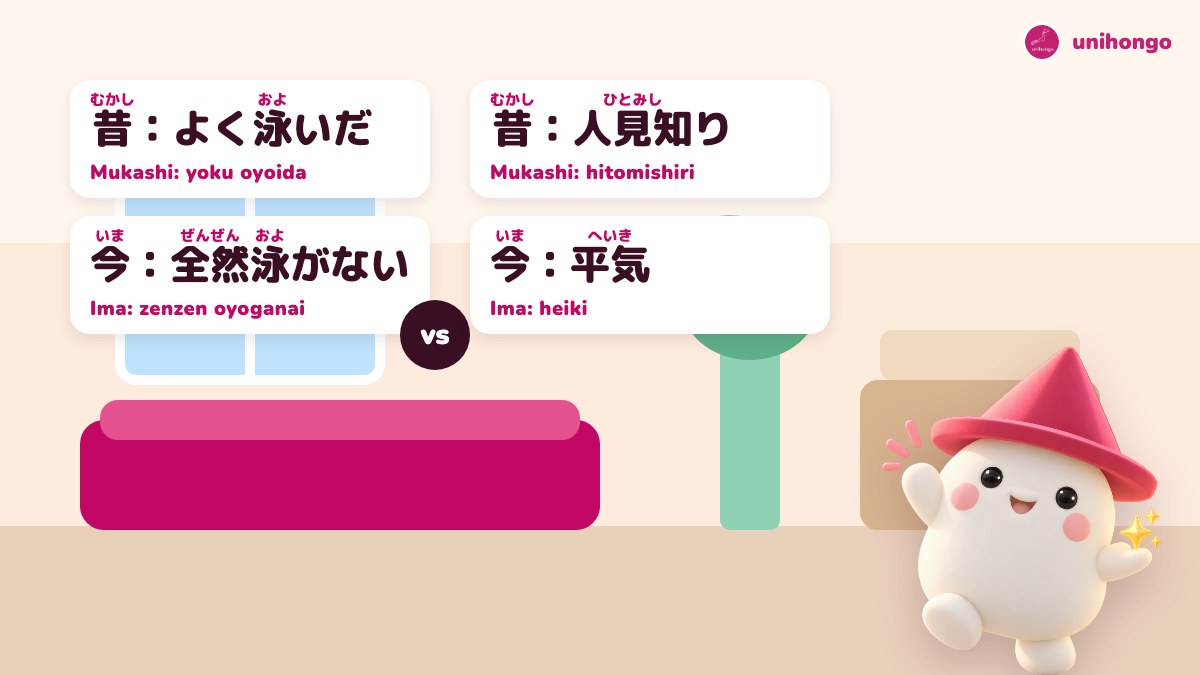
A memory becomes a conversation when you connect it to the present. The frame is mukashi wa or kodomo no koro wa, followed by ga, but, and ima wa. Two verb endings carry the change: yō ni narimashita, came to do, for things you started, and naku narimashita, stopped doing, for things you gave up. The scene below sets the child against the adult.
| Japanese | Romaji | Meaning |
|---|---|---|
| 昔は野菜が嫌いでしたが、今は大好きです。 | Mukashi wa yasai ga kirai deshita ga, ima wa daisuki desu. | I hated vegetables as a kid, but now I love them. |
| 子どものころは人見知りでしたが、今は平気です。 | Kodomo no koro wa hitomishiri deshita ga, ima wa heiki desu. | I was shy as a child, but now I'm fine. |
| 今はもう全然泳がなくなりました。 | Ima wa mō zenzen oyoganaku narimashita. | These days I don't swim at all any more. |
| 大人になってから、魚が食べられるようになりました。 | Otona ni natte kara, sakana ga taberareru yō ni narimashita. | Since becoming an adult I've been able to eat fish. |
| 今でもたまに実家の川を思い出します。 | Ima demo tama ni jikka no kawa o omoidashimasu. | Even now I sometimes think of the river back home. |
Reactions and follow-ups
The classic reaction to a childhood story is natsukashii, that takes me back, said even about someone else's memory when it reminds the listener of their own. Igai desu ne, that's surprising, is the reaction when the story does not match the adult in front of them, and it is a compliment. Keep two follow-ups ready for the other person's story, because they will tell one.
| Japanese | Romaji | Meaning |
|---|---|---|
| 懐かしい! | Natsukashii! | Friend: Ah, nostalgic! |
| 私もです。 | Watashi mo desu. | Me too. |
| 今も泳ぎますか。 | Ima mo oyogimasu ka. | Do you still swim? |
| どんな町でしたか。 | Donna machi deshita ka. | What kind of town was it? |
| へえ、意外ですね。 | Hē, igai desu ne. | Oh, that's surprising. |
| ご両親は厳しかったですか。 | Goryōshin wa kibishikatta desu ka. | Were your parents strict? |
Mistakes and register notes
- Oyogu ni narete imashita for I used to swim. Nareru is accustomed to; say yoku oyogimashita.
- Wakai koro for childhood. Wakai is youth, roughly teens and twenties; childhood is kodomo no koro.
- Chiisai toki for a whole period. Not wrong, but koro is what people say for a vague stretch of early life.
- Shimashita for every memory. Mix in yoku and te imashita, or the story sounds like a list of events.
- Kibishii about your own parents to a stranger. It can sound like criticism; soften with chotto, or save it for friends.
- Register: deshita and mashita for most listeners; datta and ta with friends, where natsukashii na with a sigh is the perfect reaction.
Make the four patterns stick
Type /grammar to Mocchi and ask it to compare yoku shimashita, te imashita, tari-tari and ta mono desu using one of your own memories; it explains each one, rewrites your sentence in all four, and because it keeps track of the pair you confuse, later /review sessions keep testing exactly that. Then take the story to AI Sensei: ask Sakura-sensei to play an old friend you have not seen since school, who remembers you differently and asks what you were really like, and let the then-and-now sentences do the work.
A free account at unihongo.com/login is all you need to put one memory into Japanese tonight.