
Your season in four lines
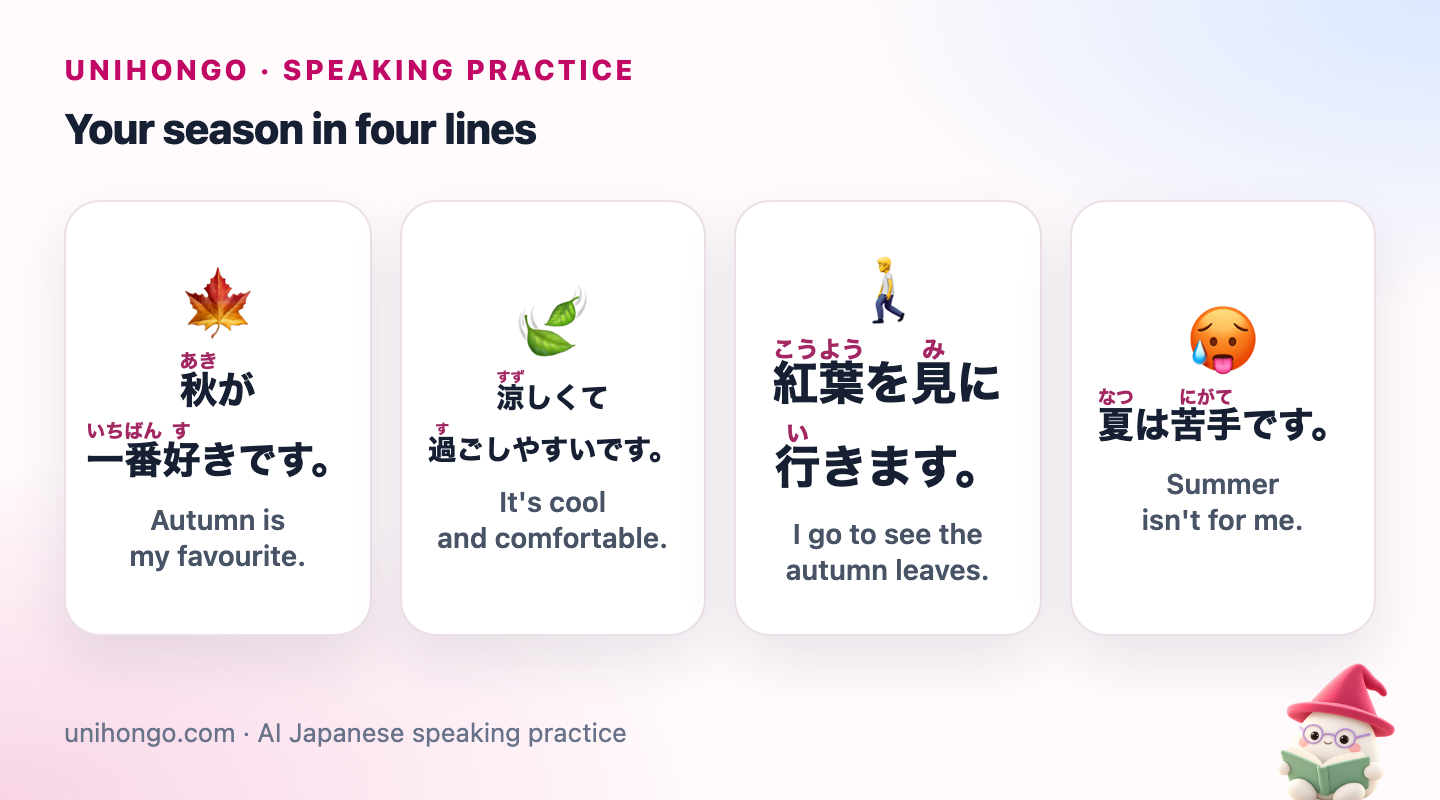
The four cards are a complete answer: the season, a reason with two adjectives, what you do, and the season you avoid. Ichiban, number one, before suki makes it a favourite. Suzushikute sugoshiyasui links cool and easy to live in with the te-form, which is how Japanese stacks adjectives. Kōyō o mi ni iku, go to see the autumn leaves, uses the ni iku purpose pattern. Nigate, a weak point, is the kind way to say a season is not for you.
| Japanese | Romaji | Meaning |
|---|---|---|
| 秋が一番好きです。 | Aki ga ichiban suki desu. | Autumn is my favourite. |
| 涼しくて過ごしやすいです。 | Suzushikute sugoshiyasui desu. | It's cool and comfortable. |
| 紅葉を見に行きます。 | Kōyō o mi ni ikimasu. | I go to see the autumn leaves. |
| 夏は苦手です。 | Natsu wa nigate desu. | Summer isn't for me. |
The question you'll hear
Kisetsu is the word for season, and dono kisetsu ga ichiban, which season most, is the full polite question. Friends cut it to suki na kisetsu wa? with a rising tone. Two related questions arrive in the same breath: whether you are all right with the heat, because many Japanese people assume a foreigner will struggle with summer, and whether your country has four seasons, which is asked with genuine interest.
| Japanese | Romaji | Meaning |
|---|---|---|
| どの季節が一番好きですか。 | Dono kisetsu ga ichiban suki desu ka. | Which season do you like best? |
| 好きな季節は? | Suki na kisetsu wa? | Friend: Favourite season? (casual) |
| 暑いのは平気ですか。 | Atsui no wa heiki desu ka. | Are you OK with the heat? |
| 日本の夏は初めてですか。 | Nihon no natsu wa hajimete desu ka. | Is this your first Japanese summer? |
| そちらの国にも四季がありますか。 | Sochira no kuni ni mo shiki ga arimasu ka. | Does your country have four seasons too? |
Three model answers
The beginner answer gives the season and one adjective. The intermediate answer stacks two reasons with shi … shi, which means and also, with the feeling that there are more, then adds an activity and a season you like less with ga. The upper answer compares with home using node for the reason, and uses kirai ni naremasen, I can't bring myself to dislike it, which is a very natural way to be fond of something difficult.
| Japanese | Romaji | Meaning |
|---|---|---|
| 春が好きです。桜がきれいです。 | Haru ga suki desu. Sakura ga kirei desu. | Beginner: I like spring. The cherry blossoms are pretty. |
| 夏は暑いです。苦手です。 | Natsu wa atsui desu. Nigate desu. | Beginner: Summer is hot. Not for me. |
| 秋が一番好きです。涼しいし、食べ物もおいしいし。 | Aki ga ichiban suki desu. Suzushii shi, tabemono mo oishii shi. | Intermediate: Autumn is my favourite. It's cool, and the food is good too. |
| 毎年、紅葉を見に山へ行きます。 | Maitoshi, kōyō o mi ni yama e ikimasu. | Intermediate: Every year I go to the mountains to see the autumn leaves. |
| 冬も好きですが、朝起きるのがつらいです。 | Fuyu mo suki desu ga, asa okiru no ga tsurai desu. | Intermediate: I like winter too, but getting up in the morning is hard. |
| 私の国には梅雨がないので、最初の六月はかなり驚きました。 | Watashi no kuni ni wa tsuyu ga nai node, saisho no rokugatsu wa kanari odorokimashita. | Upper: My country has no rainy season, so my first June here was quite a shock. |
| 暑さには弱いんですが、夏祭りと花火のある夏は嫌いになれません。 | Atsusa ni wa yowai n desu ga, natsumatsuri to hanabi no aru natsu wa kirai ni naremasen. | Upper: I don't cope well with heat, but I can't dislike a summer that has festivals and fireworks. |
A sentence that ends in shi trails off on purpose: suzushii shi, oishii shi… and so on. It sounds relaxed and native, and it saves you from building a long sentence you cannot finish.
Weather words in sentences
Six adjectives cover almost everything you will say about a season. They are i-adjectives except sawayaka, so they link with kute and take katta in the past. The table gives the set; the rows show them doing real work, including the natte kimashita pattern for a change that has started.
| Japanese | Romaji | Meaning |
|---|---|---|
| 春は暖かくて気持ちがいいです。 | Haru wa atatakakute kimochi ga ii desu. | Spring is warm and feels good. |
| 七月は蒸し暑くて大変です。 | Shichigatsu wa mushiatsukute taihen desu. | July is humid and hard going. |
| 朝晩は肌寒くなりました。 | Asaban wa hadazamuku narimashita. | Mornings and evenings have turned chilly. |
| 冬は空気が乾燥します。 | Fuyu wa kūki ga kansō shimasu. | In winter the air gets dry. |
| だんだん涼しくなってきましたね。 | Dandan suzushiku natte kimashita ne. | It's gradually getting cooler, isn't it? |
| Japanese | Romaji | Meaning |
|---|---|---|
| 暖かい / 涼しい | atatakai / suzushii | warm (spring) / cool (autumn), both pleasant |
| 暑い / 寒い | atsui / samui | hot / cold, the weather words |
| 蒸し暑い | mushiatsui | hot and humid, the Japanese summer word |
| 肌寒い | hadazamui | chilly on the skin, early autumn mornings |
| 爽やか | sawayaka | crisp and fresh, a na-adjective |
| 過ごしやすい | sugoshiyasui | comfortable to live in, easy to get through |
Natte kimashita, has come to be, says a change has begun and is still going, which is exactly what you want in the first cool week of September. Add ne and you have the greeting half of Japan uses that week.
What you do in each season, and which camp you're in
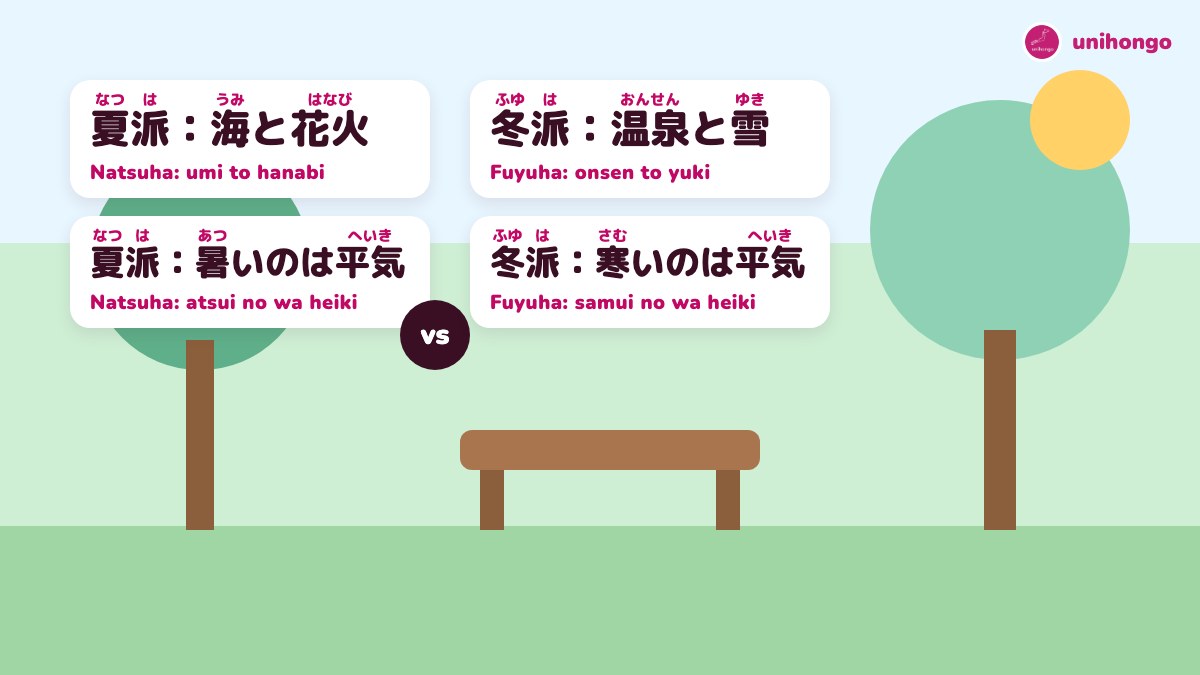
Each season in Japan has an outing attached to it, and naming yours is the quickest way to sound as if you live here rather than visit. Hanami in spring, the sea and fireworks in summer, momijigari in autumn, hot springs in winter: these are common choices, though what people actually do varies by region and by family. The suffix ha, faction, makes a team out of a preference: natsuha, a summer person, fuyuha, a winter person. Asking natsuha desu ka, fuyuha desu ka is a light and very common way to keep the topic going, and the scene below puts the two camps side by side.
| Japanese | Romaji | Meaning |
|---|---|---|
| 春は友達と花見をします。 | Haru wa tomodachi to hanami o shimasu. | In spring I do hanami with friends. |
| 夏は海に行ったり、花火を見たりします。 | Natsu wa umi ni ittari, hanabi o mitari shimasu. | In summer I go to the sea, watch fireworks, that sort of thing. |
| 秋は紅葉狩りに行きます。 | Aki wa momijigari ni ikimasu. | In autumn I go leaf-viewing. |
| 冬は温泉に入るのが楽しみです。 | Fuyu wa onsen ni hairu no ga tanoshimi desu. | In winter I look forward to the hot springs. |
| 夏派ですか、冬派ですか。 | Natsuha desu ka, fuyuha desu ka. | Are you a summer person or a winter person? |
Giving the reason and comparing with home
The reason for a season is usually the weather or an event, and two patterns carry it: suki na no wa … kara desu, the reason I like it is that, and plain kara after an adjective. Comparison with your own country is the natural second half, because the person asking wants to know. Yori, than, and ni kurabete, compared with, do the work, and ichinenjū, all year round, is the word for a climate without seasons. Kisetsu no kawarime, the turn of the season, is a phrase you will hear constantly, usually about catching colds.
| Japanese | Romaji | Meaning |
|---|---|---|
| 秋が好きなのは、涼しいからです。 | Aki ga suki na no wa, suzushii kara desu. | I like autumn because it's cool. |
| 日本の夏は私の国より蒸し暑いです。 | Nihon no natsu wa watashi no kuni yori mushiatsui desu. | Japanese summer is more humid than back home. |
| 私の国は一年中暖かいです。 | Watashi no kuni wa ichinenjū atatakai desu. | My country is warm all year round. |
| 冬に比べて、春は出かけやすいです。 | Fuyu ni kurabete, haru wa dekakeyasui desu. | Compared with winter, spring is easier to get out in. |
| 季節の変わり目は体調を崩しやすいです。 | Kisetsu no kawarime wa taichō o kuzushiyasui desu. | I tend to get ill when the seasons change. |
| 雪は見たことがありませんでした。 | Yuki wa mita koto ga arimasen deshita. | I had never seen snow. |
Mita koto ga arimasen deshita, had never seen, is the past of the experience pattern, and it is the sentence that makes a Japanese listener want to take you to Hokkaido.
Reactions, follow-ups and a lunchtime exchange
Seasons are a topic where agreement is the normal reaction: watashi mo, me too, or the mild surprise of igai when a foreigner picks the humid summer. The follow-ups are about whether you have seen the season's event yet and where they recommend seeing it; take the recommendation and say ikitai desu. The rows below run as a short exchange between coworkers at lunch in early November.
| Japanese | Romaji | Meaning |
|---|---|---|
| だんだん寒くなってきましたね。 | Dandan samuku natte kimashita ne. | Coworker: It's getting cold, isn't it? |
| そうですね。でも、秋は一番好きです。 | Sō desu ne. Demo, aki wa ichiban suki desu. | You: It is. But autumn is my favourite. |
| 私も秋派です。紅葉はもう見ましたか。 | Watashi mo akiha desu. Kōyō wa mō mimashita ka. | Coworker: Me too. Have you seen the leaves yet? |
| まだです。どこがおすすめですか。 | Mada desu. Doko ga osusume desu ka. | You: Not yet. Where do you recommend? |
| 高尾山がいいですよ。今週末がちょうどいいと思います。 | Takaosan ga ii desu yo. Konshūmatsu ga chōdo ii to omoimasu. | Coworker: Mount Takao is good. This weekend should be just right. |
| 行ってみます。夏は苦手ですが、秋は最高ですね。 | Itte mimasu. Natsu wa nigate desu ga, aki wa saikō desu ne. | You: I'll try it. Summer isn't for me, but autumn is the best. |
| へえ、意外ですね。 | Hē, igai desu ne. | Coworker: Oh, that's surprising. |
Chōdo ii, just right, is the phrase for the peak: of the leaves, of the blossoms, of the temperature. Kōyō no mikoro, the best time to see the leaves, is the word on every weather report in November.
Mistakes and register notes
- Haru ga suki desu, sakura. The reason needs a verb: sakura ga saku kara desu, because the cherry blossoms bloom, or sakura ga kirei da kara desu.
- Shīzun for the season of the year. Shīzun is for sports and sales seasons; the four seasons are kisetsu, and spring is haru, never supuringu.
- Samui for a cold drink or a cold wind on your hands. Samui is the air and the weather; a cold object or wind on the skin is tsumetai.
- Writing 熱い for hot weather. Spoken, atsui is one sound; written, the weather is 暑い and a hot cup is 熱い.
- Kirai for a season you mildly dislike. Nigate is the softer word and what most people say; kirai can sound like a strong feeling.
- Register: ichiban suki desu to people you have just met; ichiban suki, or just aki kana, autumn I guess, among friends, where natsuha? on its own is a full question.
Argue for your season out loud
Type /kaiwa to Mocchi and say you want to talk about seasons and weather; it suggests the conversation, reminds you of the te-form linking you practised, and hands you to AI Sensei. There, choose Sakura-sensei and ask Sakura-sensei to take the opposite side: if you are an autumn person, Sakura-sensei is a summer person, and Sakura-sensei has to ask why until you have used kara, shi … shi and yori at least once each. Afterwards, send the lines you fumbled back to Mocchi with /explain; since it keeps track of what you were working on, the explanation lands on your own sentences.
Nothing to install: a free account at unihongo.com/login opens the chat where this starts.