
Eight effort proverbs at a glance
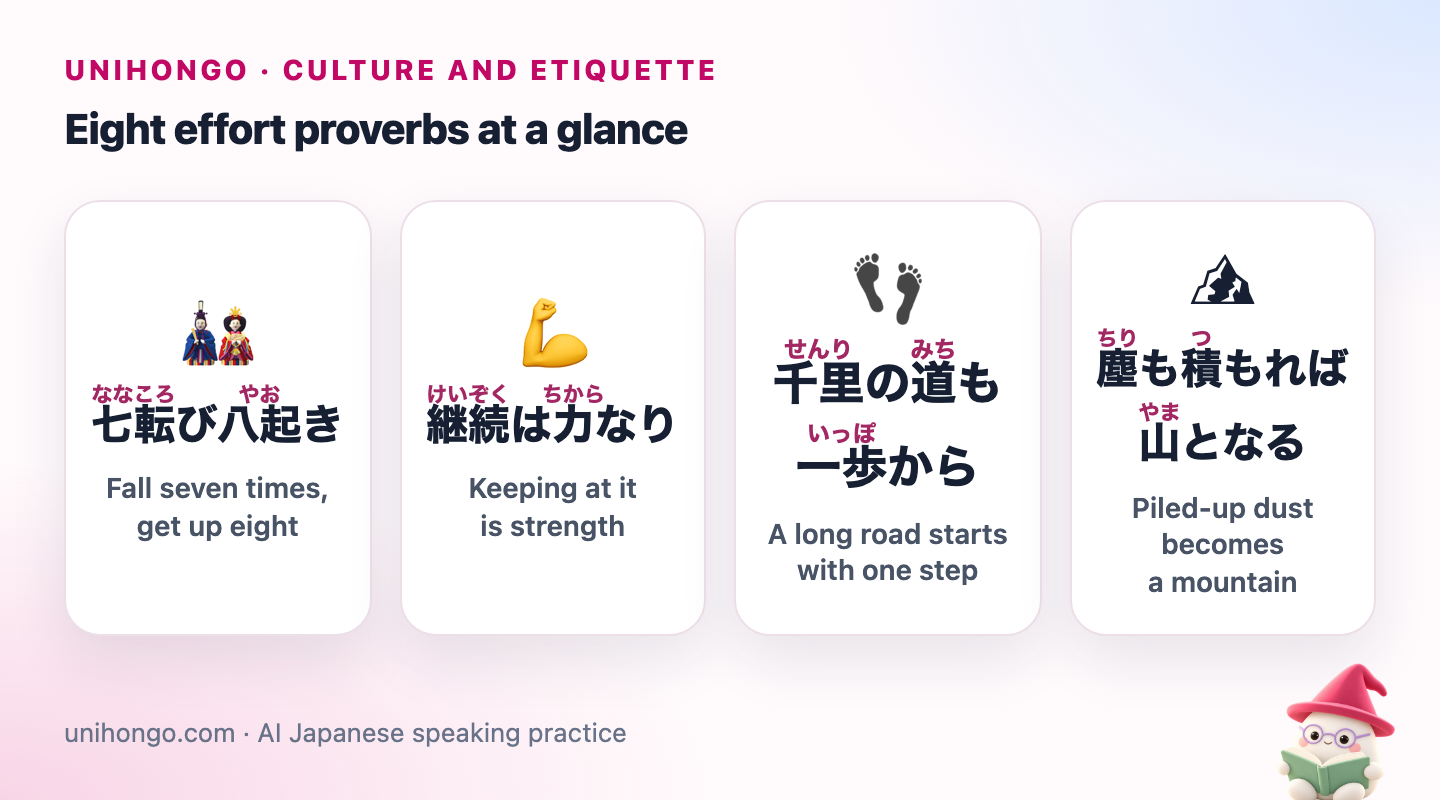
Here are the eight sayings this guide covers, with a short literal meaning and the real point of each. The first four are the ones you are most likely to see on a wall or hear in a speech.
| Japanese | Romaji | Meaning |
|---|---|---|
| 七転び八起き | Nanakorobi yaoki | Fall seven times, get up eight |
| 継続は力なり | Keizoku wa chikara nari | Keeping at it is strength |
| 千里の道も一歩から | Senri no michi mo ippo kara | A long road starts with one step |
| 塵も積もれば山となる | Chiri mo tsumoreba yama to naru | Piled-up dust becomes a mountain |
| 為せば成る | Naseba naru | If you do it, it gets done |
| 習うより慣れよ | Narau yori nare yo | Practice beats lessons |
| 好きこそ物の上手なれ | Suki koso mono no jōzu nare | You get good at what you love |
| 三日坊主 | mikka bōzu | A three-day monk: a quitter |
七転び八起き and 三日坊主: falling down and giving up
七転び八起き literally says fall down seven times, get up eight. The extra rise is the point: whatever happens, you end on your feet. It is closely tied to the Daruma doll, a round red figure weighted at the bottom so it always rolls upright, and you will often see the two together on shop shelves around New Year and before exams. People say it to cheer someone up after a failure, and it also appears as a personal motto. In conversation it usually comes as a short comment followed by だよ or ですね.
三日坊主 is its opposite. A 坊主 is a Buddhist monk, and the image is a person who enters a temple full of zeal and leaves after three days because the life is too hard. Today it simply means someone who starts things and drops them quickly: a diet, a diary, a gym membership, a language app. It is one of the most everyday words in this list, and it is often used with a laugh about yourself.
| Japanese | Romaji | Meaning |
|---|---|---|
| 失敗しても、七転び八起きだよ。 | Shippai shite mo, nanakorobi yaoki da yo. | Even if you fail, just get back up. (casual) |
| 私、何をしても三日坊主なんです。 | Watashi, nani o shite mo mikka bōzu nan desu. | Whatever I start, I give up in three days. |
| 今年こそ三日坊主にならないぞ。 | Kotoshi koso mikka bōzu ni naranai zo. | This year I won't give up after three days! |
| 日記は三日坊主で終わった。 | Nikki wa mikka bōzu de owatta. | My diary lasted three days. |
継続は力なり and 千里の道も一歩から: small steps, every day
継続は力なり means continuing is itself a kind of power. The なり at the end is classical Japanese for です, which gives it the feel of a motto. It is a favourite of teachers, coaches and anyone writing about study habits, and a Japanese teacher may well write it on the board on the first day of a course. In speech it often comes after a story: I practised a little every day for a year, and now I can read the news. 継続は力なりですね.
千里の道も一歩から comes from a Chinese classic. A 里 was an old unit of distance, so a thousand ri is a very long journey, and even that begins with a single step. It is the natural thing to say to someone who feels overwhelmed at the start of something big, such as a new job, a thesis or the JLPT N2. The English saying a journey of a thousand miles begins with a single step comes from the same Chinese source, so this pair is a genuine match.
塵も積もれば山となる, even dust becomes a mountain if it piles up, is the more down-to-earth cousin. People use it about saving coins, learning five words a day or tidying for ten minutes, and it can also be a warning: small costs add up too.
| Japanese | Romaji | Meaning |
|---|---|---|
| 継続は力なりって本当ですね。 | Keizoku wa chikara nari tte hontō desu ne. | It's true that keeping at it pays off. |
| 千里の道も一歩からだから、まずは五十音から。 | Senri no michi mo ippo kara da kara, mazu wa gojūon kara. | Every long road starts with a step, so begin with kana. |
| 一日五個でも、塵も積もれば山となるよ。 | Ichinichi goko demo, chiri mo tsumoreba yama to naru yo. | Even five a day adds up over time. |
為せば成る, 習うより慣れよ and 好きこそ物の上手なれ
為せば成る means if you act, it can be done. The full saying, usually credited to the Edo-period lord Uesugi Yōzan, goes on to say that if you do not act, nothing gets done, and that when things fail it is because people did not act. Most people only quote the first half. It sounds strong and a little old-fashioned, so it fits a speech, a banner or a team chant better than a chat over coffee.
習うより慣れよ says get used to it rather than learn it: skills come from doing, not from explanation. Language learners love it, and it is a fair description of how speaking improves. 好きこそ物の上手なれ says that what you love, you get good at, because you keep doing it without being forced. Parents use it about children's hobbies, and it is a kind way to praise someone's skill in something they clearly enjoy.
| Japanese | Romaji | Meaning |
|---|---|---|
| 為せば成る!最後まで頑張ろう。 | Naseba naru! Saigo made ganbarō. | It can be done! Let's give it everything. (team talk) |
| 文法より、習うより慣れよですよ。 | Bunpō yori, narau yori nare yo desu yo. | More than grammar, it's about practice. |
| 好きこそ物の上手なれですね。 | Suki koso mono no jōzu nare desu ne. | You're good because you love it. |
Mini dialogue: after a failed exam
A learner tells a Japanese friend that the JLPT result came back as a fail. Notice that the friend uses only one proverb, at the right moment, and then moves on to something practical. That is how proverbs usually sound in real conversation.
| Japanese | Romaji | Meaning |
|---|---|---|
| 試験、落ちちゃった。 | Shiken, ochichatta. | You: I failed the exam. |
| そっか、残念だったね。何点足りなかったの? | Sokka, zannen datta ne. Nanten tarinakatta no? | Friend: Oh no, that's a shame. How many points short? |
| 聴解があと少しだった。 | Chōkai ga ato sukoshi datta. | You: Listening was just a little short. |
| 七転び八起きだよ。十二月にまた受けよう。 | Nanakorobi yaoki da yo. Jūnigatsu ni mata ukeyō. | Friend: Get back up. Let's take it again in December. |
| うん。今度は毎日少しずつ聞くよ。 | Un. Kondo wa mainichi sukoshi zutsu kiku yo. | You: Yeah. This time I'll listen a bit every day. |
| いいね。継続は力なり、だね。 | Ii ne. Keizoku wa chikara nari, da ne. | Friend: Good. Keeping at it is what counts. |
Close English equivalents
Some of these have honest English partners; others only overlap. Use the table to remember the idea, not as an exact translation.
| Japanese | Closest English idea | How close |
|---|---|---|
| 七転び八起き | If at first you don't succeed, try, try again | Similar spirit |
| 継続は力なり | Slow and steady wins the race | Partial |
| 千里の道も一歩から | A journey of a thousand miles begins with a single step | Same source |
| 塵も積もれば山となる | Every little helps; many a little makes a mickle | Close |
| 習うより慣れよ | Practice makes perfect | Close |
| 三日坊主 | A quitter; someone who never sticks with anything | No proverb, same idea |
Mistakes learners make with effort proverbs
- Quoting a proverb as a full sentence with です after every one. Usually a short だね or ですね is enough, or the proverb alone as a reaction.
- Using 為せば成る in a casual chat about homework. It sounds like a banner; say 頑張ればできるよ instead.
- Calling a colleague 三日坊主 to their face. Use it about yourself, or with close friends who will laugh.
- Reading 一歩 as ichiho. It is ippo, with a doubled p, as in 一歩ずつ, one step at a time.
- Stacking several proverbs in one reply. One well-placed saying sounds wise; three sound like a calendar.
Everyday effort words that travel with these proverbs
Proverbs are the seasoning; the main dish is the ordinary vocabulary of effort. In real conversation you will hear 頑張る, コツコツ and 諦めない far more often than any proverb, and the proverb usually appears at the end, as a short summary of what was just said.
コツコツ is an onomatopoeic word for steady, patient work, like the sound of tapping a little at a time. It is the spoken partner of 継続は力なり, and it carries real praise: someone who studies コツコツ is reliable and quietly determined. 地道に is similar but stresses unglamorous, down-to-earth effort. 諦めない, not giving up, is the plain version of 七転び八起き. When you want to praise effort rather than talent, which is common and kind in Japan, these words are often better than a proverb, because they sound personal rather than quoted.
Notice also how Japanese praises the process. Saying 頑張ったね, you worked hard, after an exam is natural whatever the result, and many people value it more than a comment on the score.
| Japanese | Romaji | Meaning |
|---|---|---|
| 毎日コツコツ勉強しています。 | Mainichi kotsukotsu benkyō shite imasu. | I study steadily, a little every day. |
| 地道に続けるしかないですね。 | Jimichi ni tsuzukeru shika nai desu ne. | There's nothing for it but to keep at it. |
| 最後まで諦めないで。 | Saigo made akiramenaide. | Don't give up until the end. |
| 結果はともかく、よく頑張ったね。 | Kekka wa tomokaku, yoku ganbatta ne. | Whatever the result, you worked really hard. |
| 努力が実を結びました。 | Doryoku ga mi o musubimashita. | My efforts bore fruit. (polite, written feel) |
Keep the momentum with a daily habit
The irony of effort proverbs is that reading them is easy and living them is not. Ask Mocchi on Unihongo to build a small daily plan around your goal with /plan, for example ten minutes a day towards N4 listening; each finished task ticks itself off in the chat, which is the most practical cure for 三日坊主 there is. Mocchi also keeps track of the points you keep missing, so a later /quiz can return to the proverbs you mixed up.
When you want to say these lines aloud, start a session with Haru-sensei in AI Sensei and ask Haru-sensei to play a friend whose exam went badly. Comfort the friend with one proverb and a practical suggestion, then check the session report for the corrections.