
Your pet in four lines
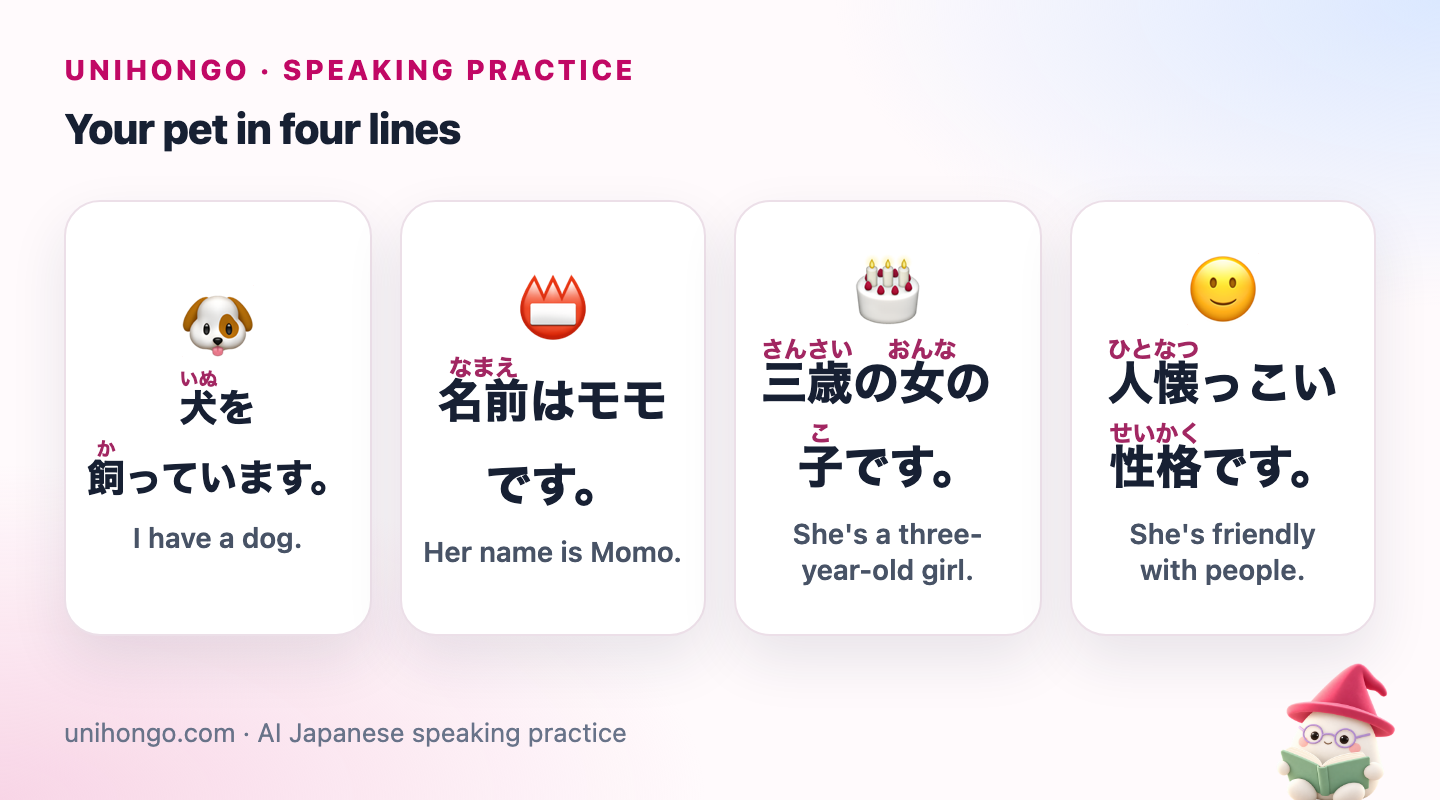
These four sentences are a complete pet introduction, and they are the ones you will say most often. Kau (飼う) is the verb for keeping an animal; katte imasu is its continuous polite form. For age, owners count with sai exactly as for people. For sex, many owners say onna no ko or otoko no ko, girl or boy, rather than the clinical mesu and osu, though both are normal.
Hitonatsukkoi, friendly with people, is one of the most useful personality words, because it is what everyone hopes to hear about a dog or cat they are about to meet.
| Japanese | Romaji | Meaning |
|---|---|---|
| 犬を飼っています。 | Inu o katte imasu. | I have a dog. |
| 名前はモモです。 | Namae wa Momo desu. | Her name is Momo. |
| 三歳の女の子です。 | Sansai no onna no ko desu. | She's a three-year-old girl. |
| 人懐っこい性格です。 | Hitonatsukkoi seikaku desu. | She's friendly with people. |
The question you'll hear
The polite question uses the same verb you will answer with, so listen for katte. Among friends the particle and the i of imasu disappear: nanika katteru? Inu-ha or neko-ha, dog faction or cat faction, is a playful version that asks which side you are on even if you own neither.
If your pet lives with your family rather than with you, say so with jikka, your parents' home. It explains why you talk about a dog but live in a tiny flat.
| Japanese | Romaji | Meaning |
|---|---|---|
| ペットを飼っていますか。 | Petto o katte imasu ka. | Do you have a pet? (polite) |
| 何か飼ってる? | Nanika katteru? | Friend: Got any pets? (casual) |
| 犬派?猫派? | Inuha? Nekoha? | Friend: Dog person or cat person? |
| 実家で犬を飼っています。 | Jikka de inu o katte imasu. | My family back home has a dog. |
Three model answers
The beginner version is two sentences and already sounds like a real answer. The intermediate version adds a breed, a counter and a daily routine. The upper version tells a small story, with a contrast between then and now, and uses hodo, so much that, to make the personality vivid.
| Japanese | Romaji | Meaning |
|---|---|---|
| 猫を飼っています。名前はソラです。 | Neko o katte imasu. Namae wa Sora desu. | Beginner: I have a cat. His name is Sora. |
| 二歳です。とてもかわいいです。 | Nisai desu. Totemo kawaii desu. | Beginner: He's two. He's very cute. |
| 柴犬を一匹飼っています。名前はハチで、五歳のオスです。 | Shibainu o ippiki katte imasu. Namae wa Hachi de, gosai no osu desu. | Intermediate: I have one Shiba Inu. He's called Hachi, a five-year-old male. |
| 元気で、散歩が大好きです。 | Genki de, sanpo ga daisuki desu. | Intermediate: He's lively and loves his walks. |
| 毎朝と夕方、散歩に連れて行きます。 | Maiasa to yūgata, sanpo ni tsurete ikimasu. | Intermediate: I take him for a walk every morning and evening. |
| 三年前に保護猫を引き取りました。 | Sannen mae ni hogoneko o hikitorimashita. | Upper: Three years ago I adopted a rescue cat. |
| 最初は人見知りでしたが、今は膝の上で寝るほど甘えん坊です。 | Saisho wa hitomishiri deshita ga, ima wa hiza no ue de neru hodo amaenbō desu. | Upper: She was shy at first, but now she's so clingy she sleeps on my lap. |
| 留守番が苦手なので、長い旅行はなかなかできません。 | Rusuban ga nigate na node, nagai ryokō wa nakanaka dekimasen. | Upper: She hates being left alone, so long trips are hard for us. |
Notice how the intermediate answer links name and sex with de, the te-form of desu: Hachi de, gosai no osu desu. One sentence instead of two is the easiest way to sound a level higher.
Counters, care verbs and the words you need
Three counters cover almost every pet. The sound changes of hiki are the only hard part, and they are the same ones you meet with hon and fun.
| Japanese | Romaji | Meaning |
|---|---|---|
| 朝と夜、ごはんをあげます。 | Asa to yoru, gohan o agemasu. | I feed her morning and evening. |
| 週に二回ブラッシングをします。 | Shū ni nikai burasshingu o shimasu. | I brush her twice a week. |
| トイレを毎日掃除します。 | Toire o mainichi sōji shimasu. | I clean the litter tray every day. |
| 年に一回、動物病院に連れて行きます。 | Nen ni ikkai, dōbutsu byōin ni tsurete ikimasu. | Once a year I take her to the vet. |
| 爪を切るのが大変です。 | Tsume o kiru no ga taihen desu. | Cutting her claws is a struggle. |
| Animal | Counter | One, two, three |
|---|---|---|
| Dogs, cats, hamsters, fish, rabbits | 匹 hiki | ippiki, nihiki, sanbiki |
| Horses, cows, often large dogs | 頭 tō | ittō, nitō, santō |
| Birds (and, by tradition, rabbits) | 羽 wa | ichiwa, niwa, sanba |
Daily care is a set of fixed verb phrases. Esa o ageru is to feed; some owners say gohan o ageru, give a meal, which sounds warmer. Sanpo ni tsurete iku is to take for a walk. For a cat, toire o sōji suru covers the litter tray, and dōbutsu byōin, animal hospital, is the everyday word for the vet.
No pet yet? Saying you'd like one
Half the people asked this question do not have a pet, and the answer is just as good a conversation. Kaitai desu, I want to keep one, with itsuka, someday, is the wish. The reason you cannot is usually one of three: the building, an allergy, or time. Many rental flats in Japan are petto fuka, no pets allowed, and saying so gets an understanding nod. A childhood pet, in the past form katte imashita, is a nice way to show you are an animal person anyway.
| Japanese | Romaji | Meaning |
|---|---|---|
| 今は飼っていませんが、いつか犬を飼いたいです。 | Ima wa katte imasen ga, itsuka inu o kaitai desu. | I don't have one now, but someday I'd like a dog. |
| うちのマンションはペット不可なんです。 | Uchi no manshon wa petto fuka nan desu. | My apartment building doesn't allow pets. |
| 猫アレルギーなので、飼えません。 | Neko arerugī na node, kaemasen. | I'm allergic to cats, so I can't have one. |
| 子どものころ、ハムスターを飼っていました。 | Kodomo no koro, hamusutā o katte imashita. | I had a hamster when I was a child. |
| 実家に犬がいます。 | Jikka ni inu ga imasu. | There's a dog at my parents' house. |
What they'll ask next, and how to react
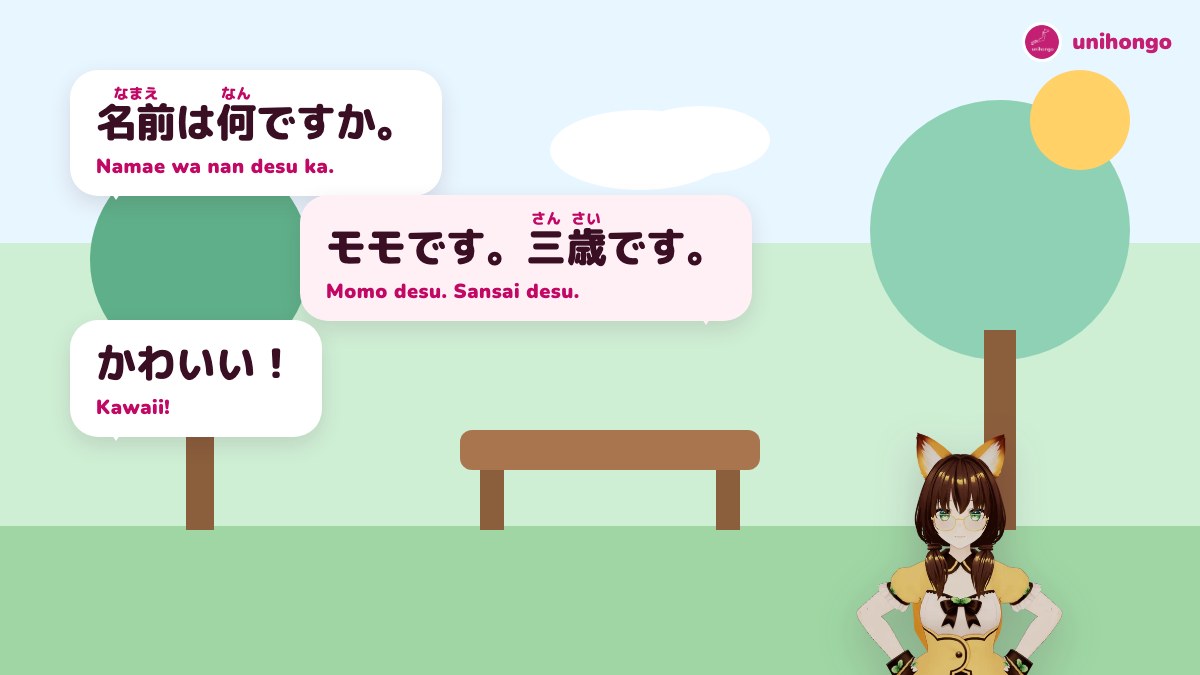
After the introduction, the same four questions arrive in almost every conversation: the name, the age, the breed and the photo. Prepare them so you are never caught out. When the other person is the owner, your job is reactions: kawaii is the universal one, and asking to see a photo is always welcome.
| Japanese | Romaji | Meaning |
|---|---|---|
| 名前は何ですか。 | Namae wa nan desu ka. | What's its name? |
| 何歳ですか。 | Nansai desu ka. | How old? |
| 種類は何ですか。 | Shurui wa nan desu ka. | What breed is it? |
| 写真、ありますか。 | Shashin, arimasu ka. | Do you have a photo? |
| かわいい! | Kawaii! | So cute! |
| へえ、いいですね。 | Hē, ii desu ne. | Oh, how nice. |
| 写真見せて! | Shashin misete! | Friend: Show me a photo! (casual) |
| うちの子は、もう十歳なんです。 | Uchi no ko wa, mō jussai nan desu. | Owner: Our little one is ten already. |
Uchi no ko, literally our child, is how many owners refer to a pet, and it sounds affectionate rather than silly. When you hear it, reply about the animal by name, not with kare or kanojo.
Mini dialogue: lunch at work
| Japanese | Romaji | Meaning |
|---|---|---|
| ペット、飼っていますか。 | Petto, katte imasu ka. | Coworker: Do you have a pet? |
| はい、猫を一匹飼っています。 | Hai, neko o ippiki katte imasu. | You: Yes, I have one cat. |
| いいですね。名前は? | Ii desu ne. Namae wa? | Coworker: Nice. What's the name? |
| ソラです。四歳の男の子です。 | Sora desu. Yonsai no otoko no ko desu. | You: Sora. He's a four-year-old boy. |
| 写真ありますか。見たいです。 | Shashin arimasu ka. Mitai desu. | Coworker: Do you have a photo? I'd love to see. |
| ありますよ。これです。 | Arimasu yo. Kore desu. | You: I do. Here. |
| かわいい!目が大きいですね。 | Kawaii! Me ga ōkii desu ne. | Coworker: Cute! What big eyes. |
Mistakes and register notes
- Motte imasu for a pet. That is for objects in your hand or possessions; animals take katte imasu.
- Kare and kanojo for the dog. Use the name or uchi no ko, or just drop the subject.
- Inu o suki desu. The thing you like takes ga: inu ga suki desu.
- Sanhiki for three animals. It is sanbiki; and one is ippiki, six is roppiki, eight is happiki.
- Asking a stranger how much the pet cost. Among close friends it may be fine; otherwise ask about breed, age or character instead.
- Register: katte imasu with people you have just met; katteru with friends. The personality words do not change.
Let your pet do the teaching
Your pet is the easiest study partner you have, because you will never run out of true sentences about it. Type your five-line introduction to Mocchi with /correct and ask it to turn the corrections into three quiz questions; Mocchi keeps track of your pet's name and the points you missed, so a review a week later picks up the same material. Then open AI Sensei, choose Hana-sensei and ask Hana-sensei to play a neighbour you meet on a walk who wants to know everything about your dog; the session report afterwards lists the words you reached for and did not have.
A free account at unihongo.com/login is enough to try both tonight.
Your turn
- Introduce your pet, or the pet you would like, in four sentences.
- Describe one day of pet care from morning to night, with time words.
- Explain why you cannot have a pet at the moment, using nan desu.
- Ask a friend four questions about their pet without pausing.
- Tell the story of how your pet came to live with you, in the past tense.