
Grammar that tells you where you stand
One quick test: can you use these N2 patterns, not just recognise them? Each one appears often in N2 reading and listening, and each has a nuance that the exam likes to test. If you can explain what each one adds compared with a simpler pattern, that is a good sign.
Ni mo kakawarazu (despite) is formal and often written. Wake de wa nai (it's not that) softens or corrects a possible misunderstanding. Zaru o enai (have no choice but to) expresses reluctant necessity, more formally than shika nai.
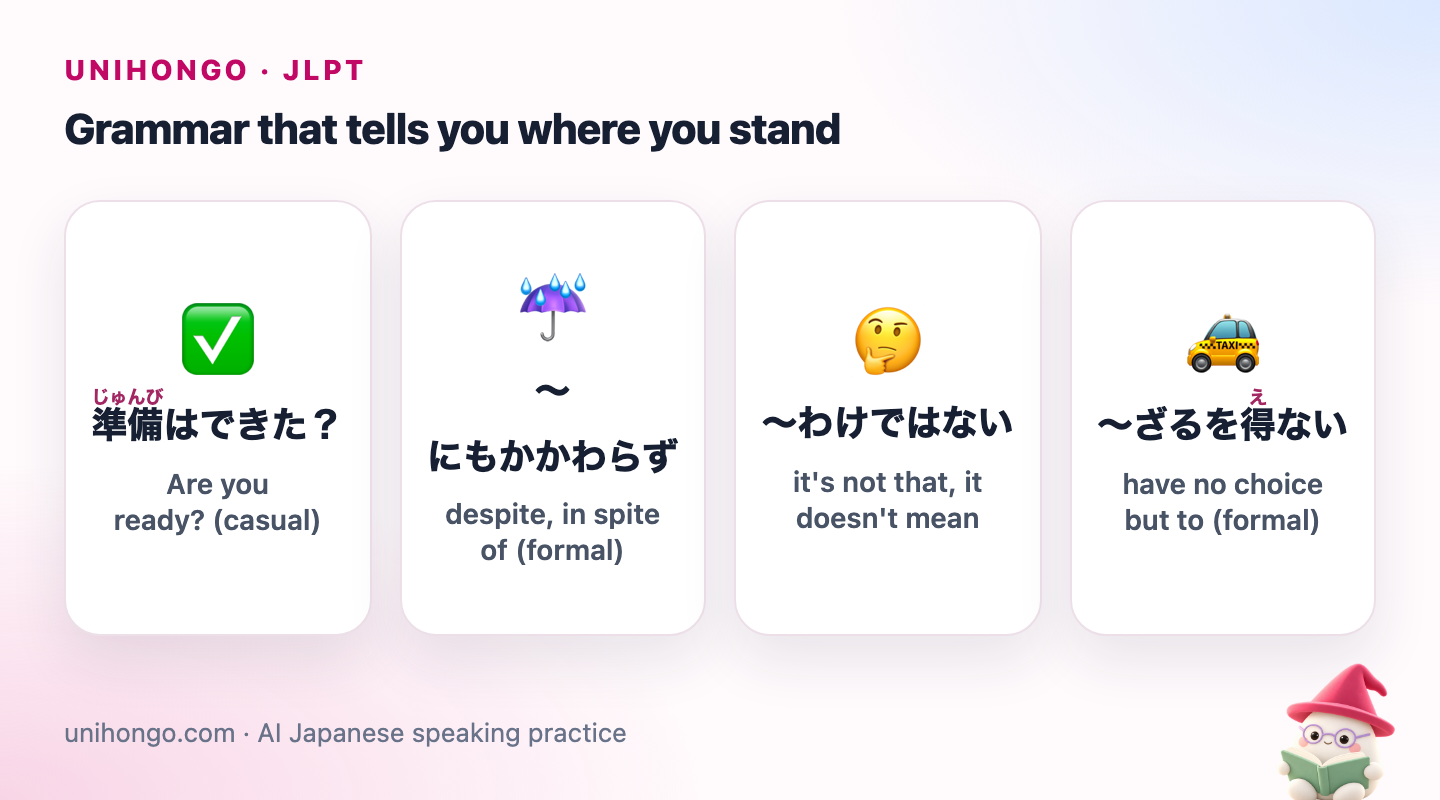
| Japanese | Romaji | Meaning |
|---|---|---|
| 準備はできた? | Junbi wa dekita? | Are you ready? (casual) |
| 〜にもかかわらず | ni mo kakawarazu | despite, in spite of (formal) |
| 〜わけではない | wake de wa nai | it's not that, it doesn't mean |
| 〜ざるを得ない | zaru o enai | have no choice but to (formal) |
| 雨にもかかわらず、大勢の人が集まった。 | Ame ni mo kakawarazu, ōzei no hito ga atsumatta. | Despite the rain, a large crowd gathered. |
| 日本語が嫌いなわけではない。 | Nihongo ga kirai na wake de wa nai. | It's not that I dislike Japanese. |
| 終電を逃したので、タクシーで帰らざるを得なかった。 | Shūden o nogashita node, takushī de kaerazaru o enakatta. | I missed the last train, so I had no choice but to take a taxi home. |
Seven signs you are ready
- Your N3 practice test scores are comfortably above the pass line in every section, not just in total.
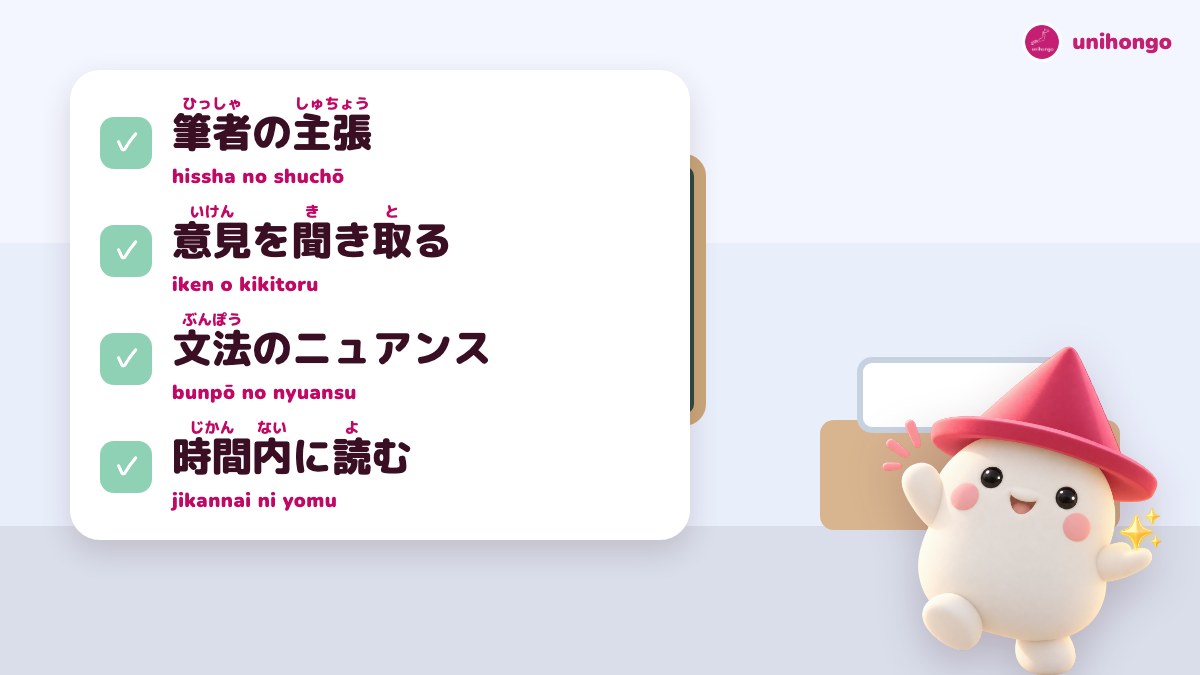
- You can read a short opinion column and state the author's claim in one sentence without a dictionary for most lines.
- You can follow two people disagreeing at natural speed and say who thinks what.
- You can tell apart N2 grammar pairs, such as ni taishite and ni tsuite, by meaning and context, not only by memory of the textbook example.
- Kanji compounds you have not studied are often readable, because you know the parts.
- You can finish a timed reading section without rushing the last passage.
- On a first N2 mock test, you are near the pass line, and no section is far below 19 points.
Five or more signs: register and spend your remaining time on mock tests and your weakest section. Three or four: you can sit it, but plan a strict schedule around the missing signs. Two or fewer: a further three to six months on reading and listening usually gives a better result.
Signs to wait a little longer
| Area | Sign you are ready | Sign to wait |
|---|---|---|
| Reading | You find the main claim on the first read | You understand every sentence but miss the point of the paragraph |
| Listening | You follow opinions and reasons at natural speed | You catch facts and numbers but not what speakers think |
| Grammar | You explain the nuance of look-alike patterns | You recognise patterns but cannot use them in your own sentence |
| Vocabulary | You guess unknown compounds from their kanji | You stop at every unknown compound |
| Time | You finish reading with a few minutes to spare | The last passage is always a guess |
Pairs that test nuance
N2 often puts two patterns with similar English translations side by side. Write your own sentence for each before reading the examples; if yours fits the same slot, the sign is green.
| Japanese | Romaji | Meaning |
|---|---|---|
| 兄が静かなのに対して、弟はよく話す。 | Ani ga shizuka na no ni taishite, otōto wa yoku hanasu. | While my older brother is quiet, my younger brother talks a lot. (contrast) |
| 環境問題について話し合った。 | Kankyō mondai ni tsuite hanashiatta. | We discussed environmental problems. (topic) |
| 留学をきっかけに、料理を始めた。 | Ryūgaku o kikkake ni, ryōri o hajimeta. | Studying abroad was what got me cooking. (trigger) |
| 努力したからこそ、合格できた。 | Doryoku shita kara koso, gōkaku dekita. | It was precisely because I worked hard that I passed. (emphasis) |
| 高いからといって、品質がいいとは限らない。 | Takai kara to itte, hinshitsu ga ii to wa kagiranai. | Just because it's expensive doesn't mean the quality is good. |
Timing: when to sit N2
The JLPT is held in July and December in many countries, but some test sites offer only one session a year, and registration usually closes a few months before the test. For the exam on Sunday 6 December 2026, registration has already closed in many places. If you are registered, use the last weeks for mock tests and your weakest section. If not, the next session in many countries is in July, and registration for it typically opens in the spring; check the official site and your local host institution.
- Three to six months before: take a first full mock test and list the missing signs.
- Two months before: one timed reading passage every day; listening to opinions daily.
- Last month: a full mock test each week, then review every wrong item.
- Last week: light review only, and practise the exam timing once.
Mistakes when deciding about N2
- Judging readiness by the number of grammar points finished. Recognition is not the same as passing timed sections.
- Looking only at the total mock score. A strong total with one section under 19 still fails.
- Avoiding listening because it feels uncomfortable. Opinion listening is a large part of N2.
- Sitting N2 only because a job advert asks for it, without a realistic plan for the gap. A clear plan for the next session is often better than a rushed attempt.
- Forgetting that speaking is not tested. Passing N2 does not mean you can hold an N2-level conversation, and employers often check that separately.
Check the signs with Unihongo
Write your own sentence for each N2 pair and send them to Mocchi with /correct. Mocchi fixes the sentences, explains the nuance you missed and keeps a note of the patterns you struggle with, so a later /jlpt session can give you more practice on exactly those.
For the last sign, take a full N2 mock test on Unihongo. It follows the real sections and time limits and estimates your score, so you can check your three section scores against the minimum before you decide.