
What N5 actually asks of you
The N5 paper has two parts. The first covers language knowledge (kana, kanji and vocabulary, then grammar) and reading. The second is listening. You answer everything by multiple choice on a mark sheet, so there is no handwriting and no speaking.
Because the paper is multiple choice, you only need to recognise the right answer, not produce it. That is good news for a three-month plan: you can spend most of your time on recognition, reading kanji words, picking the right particle and catching key words by ear, and less on handwriting. It is still worth saying sentences aloud, because spoken practice makes grammar stick faster than silent reading.
Four words sum up the three months: the goal, the script you learn first, the words, and the listening section that many learners underestimate.
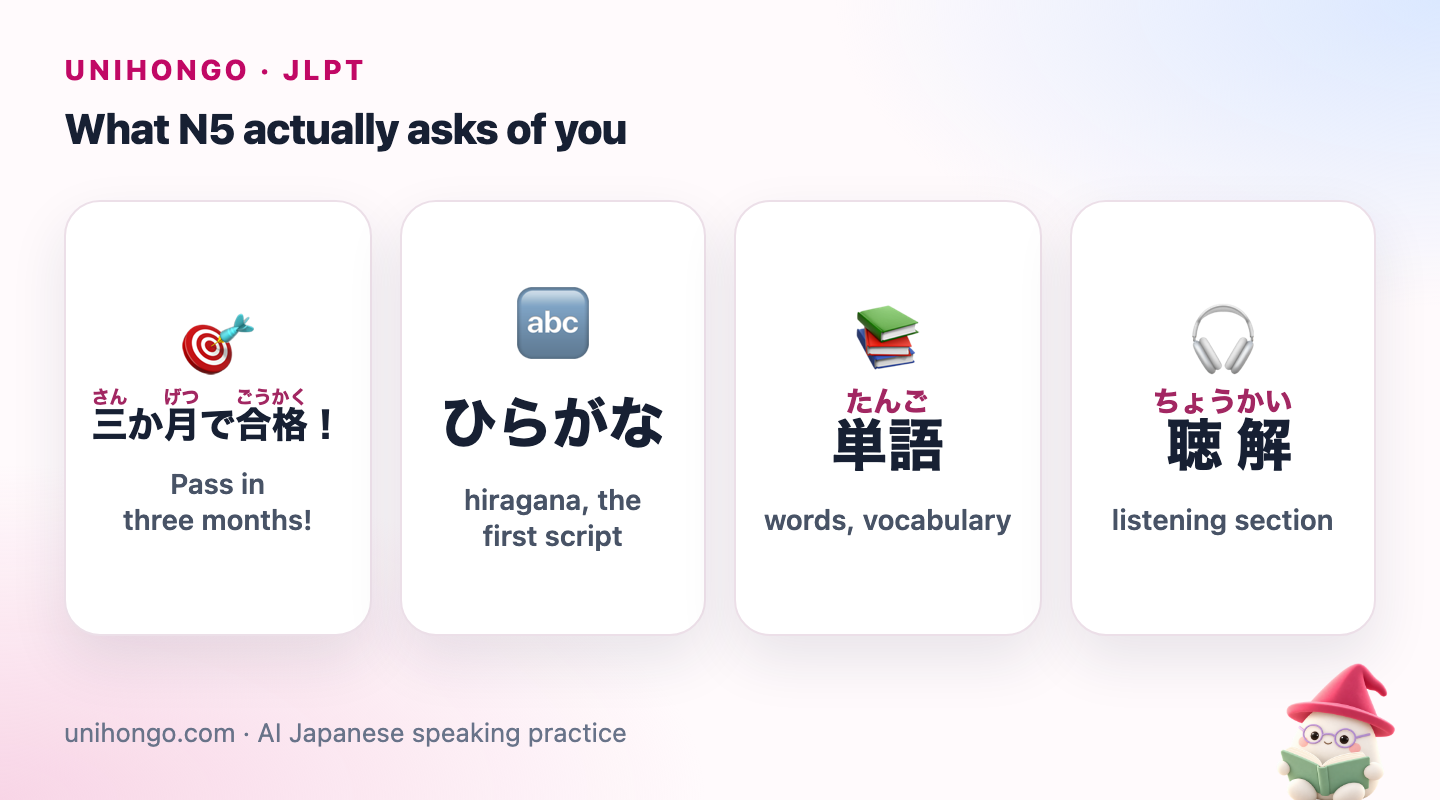
| Japanese | Romaji | Meaning |
|---|---|---|
| 三か月で合格! | Sankagetsu de gōkaku! | Pass in three months! |
| ひらがな | hiragana | hiragana, the first script |
| 単語 | tango | words, vocabulary |
| 聴解 | chōkai | listening section |
| Scoring section | Points | Minimum to pass |
|---|---|---|
| Language knowledge (vocabulary, grammar) and reading | 0 to 120 | 38 |
| Listening | 0 to 60 | 19 |
| Total | 0 to 180 | 80 |
The 12-week plan
The plan assumes you are starting with no or very little Japanese. If you already read kana, use weeks 1 and 2 for extra vocabulary and start grammar early.
Each week, aim for a modest, steady amount of new material rather than big weekend pushes: one or two grammar points, around 60 to 80 words and a few kanji words. Spread the words over the week, and review the previous days' words every day before adding new ones. Most learners forget a large part of new words within days without review, so the review habit matters as much as the new material.
| Weeks | Main focus | By the end you can |
|---|---|---|
| 1 to 2 | Hiragana and katakana, greetings, numbers | Read all kana slowly; count to 100 |
| 3 to 4 | Desu sentences, kore and sore, particles wa, no, ka | Introduce yourself and ask what things are |
| 5 to 6 | Masu verbs, particles o, ni, de, e, time words | Describe your day and weekly routine |
| 7 to 8 | Past tense, adjectives, arimasu and imasu, counters | Talk about yesterday; say where things are |
| 9 | Full mock test, then review | Know your weakest section |
| 10 to 11 | Weakest section first; te kudasai, tai, mashō | Reach the pass line in every section |
| 12 | Light review, exam timing, rest | Sit the exam calmly |
Kanji run alongside from week 3: a handful of exam words a day, such as 山, 川, 日本, 先生, 学校, always read inside a word. By week 12, many learners can read most N5 kanji words even if they cannot write them, which is all the exam asks.
Sentences you should know cold by week 8
These lines use the core N5 grammar. If you can read them at once and say them from the English, your grammar is on track.
| Japanese | Romaji | Meaning |
|---|---|---|
| 私は学生です。 | Watashi wa gakusei desu. | I am a student. |
| 毎日学校へ行きます。 | Mainichi gakkō e ikimasu. | I go to school every day. |
| 図書館で本を読みました。 | Toshokan de hon o yomimashita. | I read a book in the library. |
| 机の上にかばんがあります。 | Tsukue no ue ni kaban ga arimasu. | There's a bag on the desk. |
| このりんごを三つください。 | Kono ringo o mittsu kudasai. | Three of these apples, please. |
| 日曜日に映画を見たいです。 | Nichiyōbi ni eiga o mitai desu. | I want to see a film on Sunday. |
N5 listening: the section people underestimate
The N5 listening is slow and clear, but it plays once, and the questions turn on details: which picture, what time, how many. Many learners who pass the reading easily come close to the listening minimum, because they practised with their eyes only.
| Japanese | Romaji | Meaning |
|---|---|---|
| 女の人は何時に家を出ますか。 | Onna no hito wa nanji ni ie o demasu ka. | What time will the woman leave home? |
| 八時半に出ます。 | Hachiji han ni demasu. | Woman: I'll leave at half past eight. |
| あ、やっぱり八時にします。 | A, yappari hachiji ni shimasu. | Woman: Oh, actually, I'll make it eight. |
Your check-in in week 9
Week 9 is the turning point. Take a full mock test under exam conditions, with both parts timed and no pauses, then look at each section against its minimum rather than at the total.
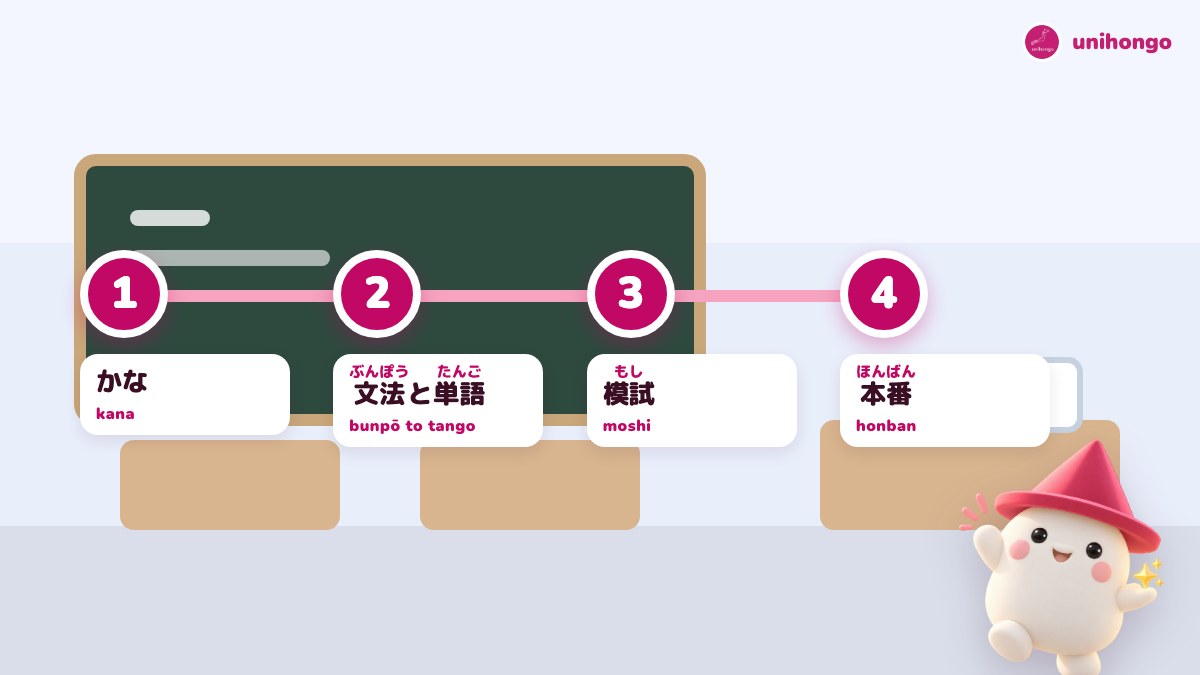
- Comfortably above both minimums: keep going with mixed review and one more mock test in week 11.
- Close to a minimum: give that section two thirds of your time in weeks 10 and 11.
- Well below in both: consider moving to the next session, and use the extra time calmly instead of cramming.
Look at why you lost points, not just where. In language knowledge, wrong answers often come from kanji readings you half know; in reading, from running out of time; in listening, from missing a change such as yappari. Each cause has a different fix, so write the cause next to every wrong item.
When three months is too short
- You can only study one or two hours a week. Plan five or six months instead.
- You are still unsure of kana at the end of week 3. Spend another week on it; everything later depends on it.
- You skipped listening practice until the last month. Start it now, even if the exam has to wait.
- Your week 9 mock test is far below the minimums. A later session with a calm plan is better than a rushed one.
- Life gets in the way: illness, moving, a new job. The plan can stretch; the exam is offered again.
Common N5 mistakes
- Learning kanji as single characters with all their readings. N5 tests words, so learn 時間 jikan and 時計 tokei rather than every reading of 時.
- Skipping katakana. Many N5 words are loanwords, such as テレビ and コーヒー.
- Never timing the reading section. Even easy passages take longer when the clock is running.
- Studying only from lists. Words in short sentences stick better and help you in reading.
Three months with Mocchi
Tell Mocchi your exam date and how much time you have, and type /plan: Mocchi builds a personal path with small daily tasks for kana, words and grammar, and you can ask it to adjust the plan after your week 9 mock test. Each day, /vocab gives you a short N5 word set and quizzes you on the ones you missed before.
For week 9, take the N5 mock test on Unihongo. It follows the real sections and time limits, includes listening, and gives you an estimated score to compare with the minimums.