
Four lines that mark the journey
Most learners pass through four moments that they remember clearly: the first time they can honestly say they speak a little, the day they say what they wanted to say instead of what they could say, the first joke they get without an explanation, and the first time a sentence arrives in Japanese before English.
None of these moments arrives on a fixed date. They depend less on how many years you have studied than on how much Japanese you hear and use. A learner who talks for a few minutes most days often reaches the second moment sooner than one who studies grammar for hours but rarely speaks. That is the main message of this guide: each milestone is unlocked by a kind of practice, not by time alone.
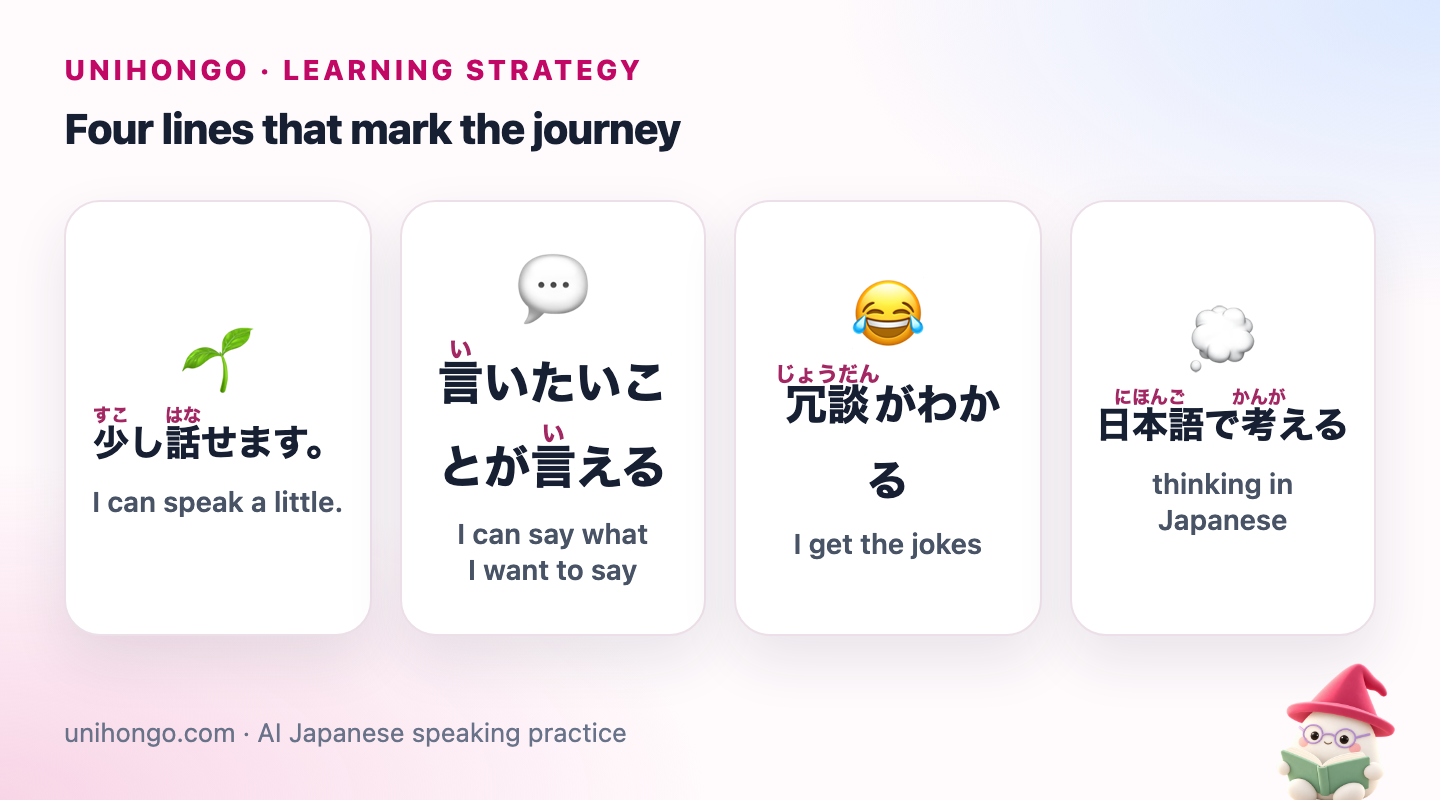
| Japanese | Romaji | Meaning |
|---|---|---|
| 少し話せます。 | Sukoshi hanasemasu. | I can speak a little. |
| 言いたいことが言える | iitai koto ga ieru | I can say what I want to say |
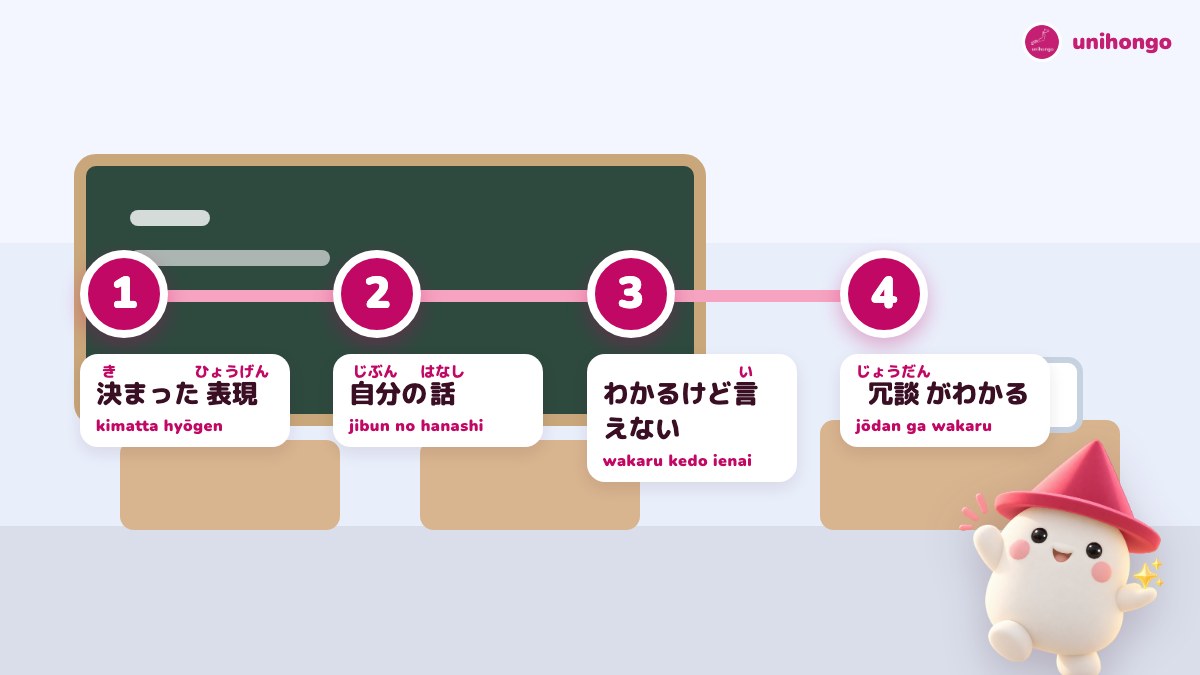
| 冗談がわかる | jōdan ga wakaru | I get the jokes |
| 日本語で考える | nihongo de kangaeru | thinking in Japanese |
The seven milestones at a glance
| Milestone | What it feels like | Rough level | What unlocks the next step |
|---|---|---|---|
| 1. Survival | You get through a shop or station with set phrases | Early N5 | Learning questions and answers in pairs |
| 2. Scripted exchanges | Conversations work if they follow the textbook | N5 to N4 | Talking about your own life, not textbook topics |
| 3. Your own day | You can tell a short story about yesterday | N4 | Reasons and opinions: node, kara, to omoimasu |
| 4. The long middle | You understand much more than you can say | N3 to N2 | Regular speaking and shadowing |
| 5. Joining in | You can join a group conversation, a beat late | N2 | Natural-speed listening and reactions |
| 6. Switching gears | You move between casual and polite without planning | N2 and above | Real situations with different people |
| 7. Nuance and humour | Jokes, irony and indirect refusals land | N1 and above | Years of real conversation, dramas and reading |
The levels are rough: plenty of learners reach milestone 5 with N3 grammar because they talk a lot, and plenty with N1 sit at milestone 4 because they mostly read.
Milestones can also slip. After a long break, you may drop back a stage for a few weeks; the knowledge is still there, but the speed returns only with use. That is normal and usually recovers much faster than the first time.
Milestones 1 to 3: from phrases to your own story
At milestone 1, every exchange is a small victory and also a small risk: if the clerk says anything unexpected, you are lost. Milestone 2 feels more stable, but only as long as the conversation follows a script. The big jump to milestone 3 comes when you stop practising textbook topics and start talking about your real life, with your own words.
| Japanese | Romaji | Meaning |
|---|---|---|
| これをください。 | Kore o kudasai. | Milestone 1: This one, please. |
| お仕事は何ですか。 | Oshigoto wa nan desu ka. | Milestone 2: What do you do for work? |
| 昨日、友達とラーメンを食べに行ったんですけど、すごく混んでいました。 | Kinō, tomodachi to rāmen o tabe ni itta n desu kedo, sugoku konde imashita. | Milestone 3: Yesterday I went for ramen with a friend, but it was really crowded. |
The milestone 3 sentence is long, but notice how it is built: one event, kedo, then what happened. That simple linking, n desu kedo, is one of the clearest signs that you have moved from phrases to storytelling.
Milestone 4: the long middle
This is where most learners spend the longest, and where many give up. You can follow a lot of what you hear, and you know plenty of grammar, but in conversation the words come too slowly. You spend the silence building sentences while the other person moves on.
It feels like a plateau, but it is not standing still: your comprehension is growing, and your speaking is catching up more slowly. The way through is volume of speaking, not more grammar. Short, frequent output with grammar you already know does more than one more textbook.
Practical ways through include shadowing natural conversations, retelling in Japanese a video you just watched, keeping a short spoken diary and having regular conversations where you are allowed to be slow. Many learners also find that learning whole chunks, such as n desu kedo or tte iu ka, speeds them up more than learning new single words, because each chunk saves several small decisions.
| Japanese | Romaji | Meaning |
|---|---|---|
| わかるけど、言えない。 | Wakaru kedo, ienai. | I understand, but I can't say it. (casual) |
| なんて言えばいいかな。 | Nante ieba ii ka na. | How should I put it… (thinking aloud) |
| つまり、こういうことですか。 | Tsumari, kō iu koto desu ka. | So you mean something like this? |
Milestones 5 and 6: joining in and switching gears
Milestone 5 is the first group conversation you follow from start to end and actually join, even if you are a beat behind. Reactions matter here more than sentences: hē, sō nan da and wakaru keep you present while you listen.
Milestone 6 is when you stop planning your register. You speak casually to a friend, switch to desu and masu with a shop clerk, and use simple keigo with a client, without stopping to decide. It usually comes from real variety: different people, different places, different relationships.
| Japanese | Romaji | Meaning |
|---|---|---|
| へえ、そうなんだ。 | Hē, sō nan da. | Oh, really? (casual reaction) |
| わかる! | Wakaru! | I know what you mean! (casual) |
| それ、いいね。 | Sore, ii ne. | Friend: That sounds good. |
| では、明日の三時でよろしいでしょうか。 | Dewa, ashita no sanji de yoroshii deshō ka. | Shall we say three o'clock tomorrow, then? (business) |
Milestone 7: nuance and humour
The last stage is about what is not said. You understand that iketara iku can mean probably not, you notice when someone is being ironic, and you catch wordplay in a variety show. Many fluent learners say this stage never really ends, and that is fine; native speakers also keep learning new slang and new references.
| Japanese | Romaji | Meaning |
|---|---|---|
| 行けたら行くね。 | Iketara iku ne. | I'll come if I can. (often a soft no) |
| それはちょっと… | Sore wa chotto… | That's a bit… (polite hesitation or refusal) |
Mistakes that slow the journey
- Measuring fluency by JLPT level alone. Speaking milestones need speaking practice.
- Waiting until you are ready to speak. Readiness comes from speaking, not before it.
- Comparing yourself with learners who live in Japan or speak a related language. Compare with your own recording from last month.
- Learning only polite Japanese. Milestone 5 and beyond need casual speech too.
- Treating the long middle as failure. It is the normal stage, and it ends with practice.
Move to the next milestone with Unihongo
Ask Mocchi something like: which fluency milestone do my recent mistakes suggest, and what should I practise this month? Mocchi keeps notes on your level, goals and the points you keep missing, so the answer is based on your own history, and Mocchi can turn it into plan steps with /adjust-plan.
For milestones 4 to 6, regular conversation is what moves you. Open AI Sensei and ask Haru-sensei to make weekend plans with you in casual Japanese, then switch to polite speech halfway through. The session report shows your corrections and new vocabulary.