
Four skills, four separate answers
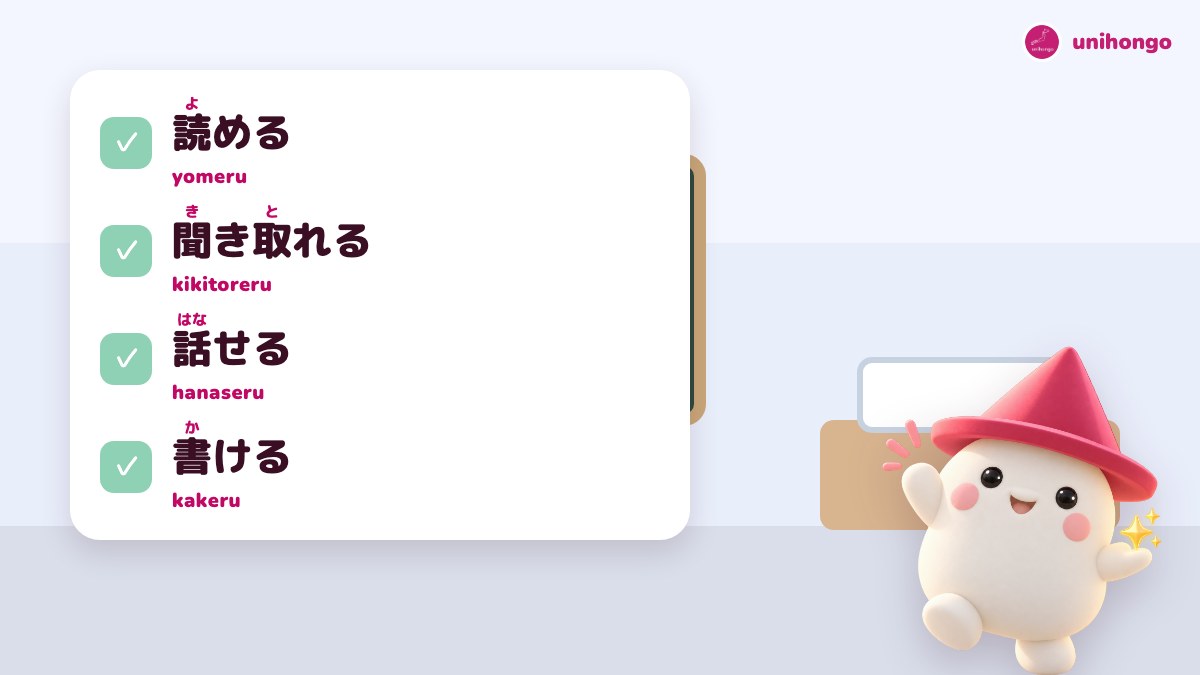
Before you pick a label, ask four different questions. Can I read it? Can I catch it by ear at normal speed? Can I say it without preparing? Can I write it? The words below are the ones Japanese teachers use for these abilities, and they make a good self-check: yomeru, kikitoreru, hanaseru, kakeru.
Many learners have a spiky profile. That is not a problem to hide; it is the most useful information you can get, because it tells you which skill gives you the most progress for your time.
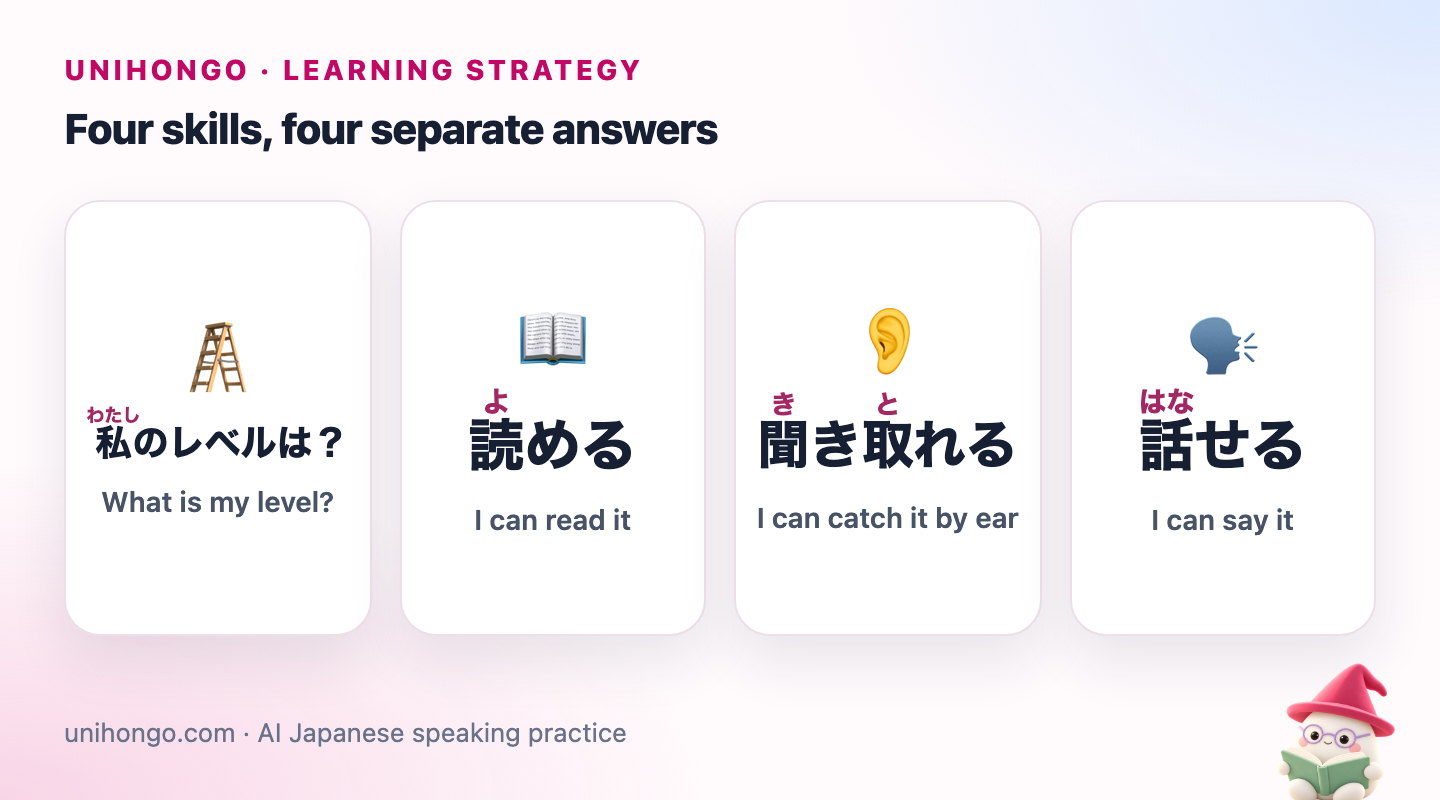
| Japanese | Romaji | Meaning |
|---|---|---|
| 私のレベルは? | Watashi no reberu wa? | What is my level? |
| 読める | yomeru | I can read it |
| 聞き取れる | kikitoreru | I can catch it by ear |
| 話せる | hanaseru | I can say it |
| 書ける | kakeru | I can write it |
A rough map: stages, JLPT and CEFR
This table shows how stages, JLPT levels and CEFR levels are commonly compared. It is a rough guide: the JLPT tests only reading and listening, the CEFR describes all four skills, and the JLPT organisers relate scores to CEFR in their own way. If an official comparison matters to you, for a visa, a job or a university, check the official JLPT website and the requirements of the organisation that asks.
| Stage | JLPT (rough) | CEFR (rough) | What you can usually do |
|---|---|---|---|
| Beginner | N5 | A1 | Introduce yourself, numbers, prices, simple questions |
| Elementary | N4 | A2 | Talk about your day, your past weekend and simple plans |
| Intermediate | N3 | B1 | Explain reasons, tell a story, handle most daily situations |
| Upper intermediate | N2 | B2 | Follow news and opinions, discuss familiar topics at natural speed |
| Advanced | N1 | C1 and above | Discuss abstract topics, read editorials, adjust tone with ease |
The sentence ladder
Each step has two sentences built on grammar that is typical for that stage. Read the Japanese with the English covered; then cover the Japanese and try to say it from the English. Be honest about pauses: if you needed more than five seconds to start, it is not yet a speaking tick.
| Japanese | Romaji | Meaning |
|---|---|---|
| 毎朝七時に起きます。 | Maiasa shichiji ni okimasu. | Step 1: I get up at seven every morning. |
| 駅はどこですか。 | Eki wa doko desu ka. | Step 1: Where is the station? |
| 週末は友達と映画を見に行きました。 | Shūmatsu wa tomodachi to eiga o mi ni ikimashita. | Step 2: At the weekend I went to see a film with a friend. |
| 写真を撮ってもいいですか。 | Shashin o totte mo ii desu ka. | Step 2: May I take a photo? |
| 雨が降っていたので、出かけるのをやめました。 | Ame ga futte ita node, dekakeru no o yamemashita. | Step 3: It was raining, so I decided not to go out. |
| 日本に来てから、料理をするようになりました。 | Nihon ni kite kara, ryōri o suru yō ni narimashita. | Step 3: Since coming to Japan, I've started cooking. |
| 便利になった反面、人と話す機会が減ったと思います。 | Benri ni natta hanmen, hito to hanasu kikai ga hetta to omoimasu. | Step 4: Life got more convenient, but I think we talk to people less. |
| 忙しいからといって、休まないわけにはいかない。 | Isogashii kara to itte, yasumanai wake ni wa ikanai. | Step 4: Being busy doesn't mean you can skip rest. |
| その案には一理あるものの、費用の面で懸念が残ります。 | Sono an ni wa ichiri aru mono no, hiyō no men de kenen ga nokorimasu. | Step 5: The idea has some merit, but concerns about cost remain. |
Your reading level is the highest step where you understood both sentences at once. Your speaking level is the highest step where you could say both, or a close version, without long pauses. Do not count a step as passed if you only understood it after checking the English.
The one-minute speaking task
Sentences tell you about grammar; a minute of free speech tells you about real speaking. Set a timer, pick the task for the highest step where you ticked speaking, and talk for one minute without notes. Record it and listen back.
- Step 1: introduce yourself: name, country, job or studies, one hobby.
- Step 2: describe what you did last weekend, in order.
- Step 3: explain why you are learning Japanese and what has been hard, with reasons.
- Step 4: give your opinion on working from home, with one advantage and one drawback.
- Step 5: argue for a change you would make in your city, and answer one objection.
Quick listening and reading checks
For listening, choose a short audio at normal speed for the step you think you are at: a station announcement, a short podcast episode for learners, or a news clip. Listen once without text and write three things you understood. Then check the transcript. If you caught the main point and most details, the step fits.
For reading, time yourself on a short text: a notice, a blog post, a news article. At your real reading level, you can follow the main point on the first read and only need a dictionary for a few words, not for every line.
| Step | Listening check | Reading check |
|---|---|---|
| 1 | Slow, clear questions about prices and times | Signs, menus, simple messages in hiragana and basic kanji |
| 2 | A short polite conversation about plans | A short email or diary entry |
| 3 | A casual conversation between friends | A simple blog post or a notice from a city office |
| 4 | A news clip or a short talk with opinions | An opinion column or a long article |
| 5 | A discussion or lecture on an abstract topic | An editorial or essay |
Putting the results together
Write your result as a profile with one line per skill, for example: reading step 3, listening step 2, speaking step 2, writing step 2. That profile tells you what to do next far better than a single level.
- If speaking is two steps below reading, spend the next month mainly on speaking aloud with grammar you already know.
- If listening is the lowest, add daily short audio at your level and shadow it.
- If reading is the lowest, add graded readers and learn kanji in words, not alone.
- If all four are level, move up: start materials one step above.
Common self-placement mistakes
- Taking the level of your textbook as your level. Finishing a book means you met the material, not that you can use it.
- Counting what you understand after reading the translation. The test is understanding before you check.
- Using only the JLPT result. It tells you nothing about speaking or writing.
- Testing yourself once and treating the result as fixed. Levels move, and a recheck every two or three months keeps your plan honest.
- Comparing yourself with other learners instead of your own last result.
Check your level with Mocchi and AI Sensei
Tell Mocchi what you found, for example: I read at about step 3 but speak at step 2, what should I focus on? Mocchi keeps notes on your level and goals, so later quizzes and the study plan it builds start from the right place instead of from zero.
For the speaking check, open AI Sensei and ask Ibuki-sensei for a five-minute self-introduction conversation with a few follow-up questions. The session report afterwards lists your strengths and corrections, which shows clearly which step your speaking is at.