
The four lines that carry most work calls
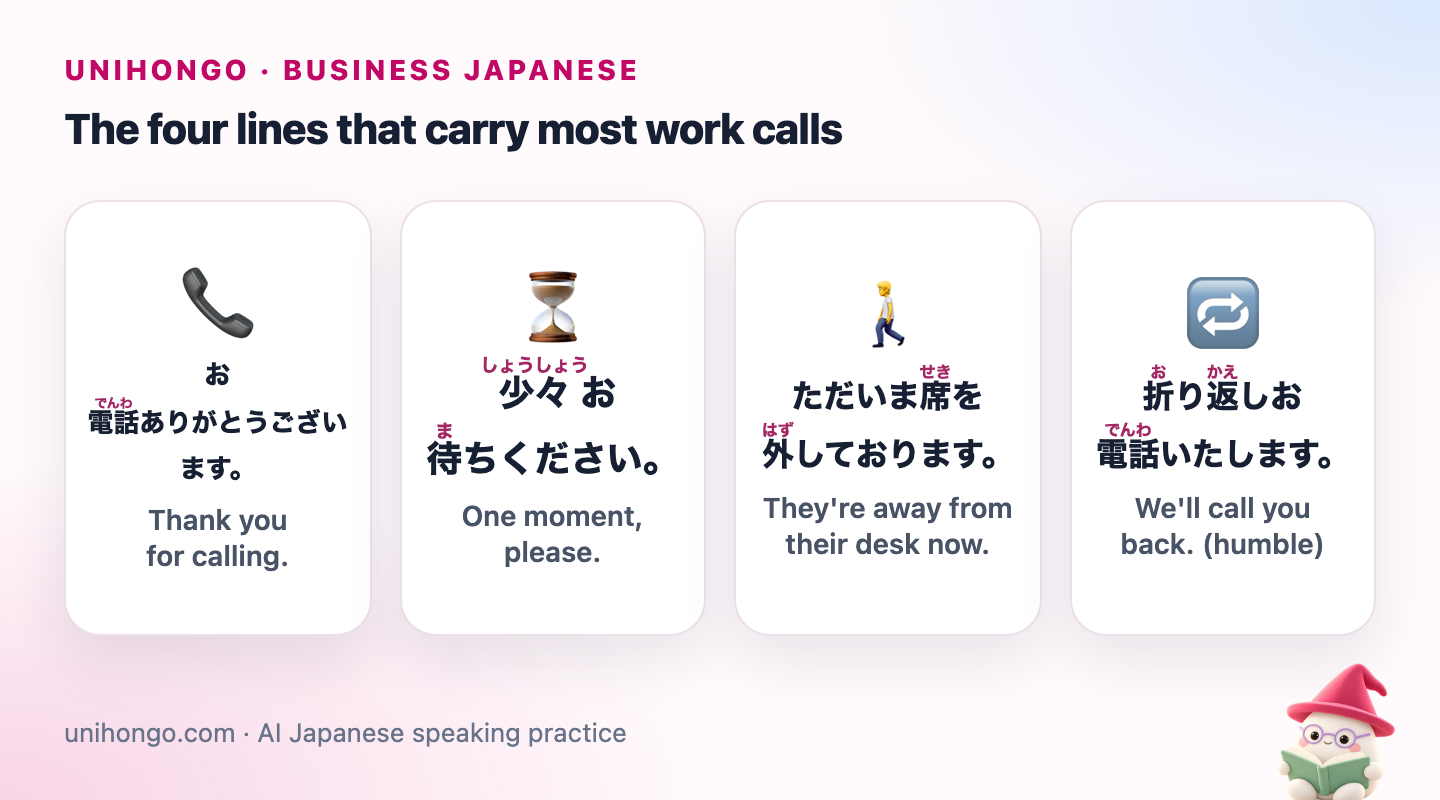
Most incoming calls at a Japanese office follow the same path: you greet, you identify the company, you find out who the caller wants, and either you transfer the call or you explain that the person is unavailable and take a message. Four lines do most of the work, and every one of them is already keigo, so you do not have to build them from grammar rules under pressure.
Many offices also have a habit worth copying: if the phone rang more than about three times before you picked up, start with omatase itashimashita, sorry to keep you waiting. It sounds small, but callers notice it.
| Japanese | Romaji | Meaning |
|---|---|---|
| お電話ありがとうございます。 | Odenwa arigatō gozaimasu. | Thank you for calling. |
| 少々お待ちください。 | Shōshō omachi kudasai. | One moment, please. |
| ただいま席を外しております。 | Tadaima seki o hazushite orimasu. | They're away from their desk now. |
| 折り返しお電話いたします。 | Orikaeshi odenwa itashimasu. | We'll call you back. (humble) |
| はい、さくら商事でございます。 | Hai, Sakura Shōji de gozaimasu. | Yes, Sakura Trading speaking. (formal) |
| お待たせいたしました。 | Omatase itashimashita. | Sorry to have kept you waiting. |
The same request in three registers
Learners often know the casual form and the desu/masu form of a sentence but freeze when they need the phone version. Seeing the three side by side helps: the meaning stays the same, and only the distance changes. The casual line is for friends and family. The plain polite line is correct Japanese and fine with a colleague you know, but on a company line to an outside caller it sounds a little bare. The keigo line is what the caller expects.
| Japanese | Romaji | Meaning |
|---|---|---|
| ちょっと待って。 | Chotto matte. | Hang on. (casual) |
| 少し待ってください。 | Sukoshi matte kudasai. | Please wait a little. (polite) |
| 少々お待ちいただけますか。 | Shōshō omachi itadakemasu ka. | Could you hold a moment? (keigo) |
| 誰? | Dare? | Who is it? (casual) |
| お名前は何ですか。 | Onamae wa nan desu ka. | What is your name? (polite, but blunt) |
| 失礼ですが、どちら様でしょうか。 | Shitsurei desu ga, dochira sama deshō ka. | May I ask who is calling? (keigo) |
| 伝えておくね。 | Tsutaete oku ne. | I'll tell them. (casual) |
| 伝えておきます。 | Tsutaete okimasu. | I'll tell them. (polite) |
| 申し伝えます。 | Mōshitsutaemasu. | I will pass that on. (humble) |
| Register | Who hears it on a work phone | What it signals |
|---|---|---|
| Casual | Nobody on a company line; only private calls with friends | Closeness; on a work line it sounds careless |
| Plain polite (desu/masu) | A colleague calling from another floor | Correct and friendly, but thin for an outside caller |
| Keigo (respectful + humble) | Customers, clients, suppliers, anyone outside | That you are speaking for the company |
Model call: the person they want is out
This is the most common call a junior employee handles. The caller wants your colleague Tanaka, who is in a meeting. Notice three things: the caller uses Tanaka-sama and respectful verbs, you use plain Tanaka and humble verbs, and you repeat the phone number back before ending the call.
| Japanese | Romaji | Meaning |
|---|---|---|
| お電話ありがとうございます。さくら商事営業部、リーでございます。 | Odenwa arigatō gozaimasu. Sakura Shōji eigyōbu, Rī de gozaimasu. | You: Thank you for calling. Sakura Trading sales, Lee speaking. |
| 青山電機の佐藤と申します。いつもお世話になっております。 | Aoyama Denki no Satō to mōshimasu. Itsumo osewa ni natte orimasu. | Caller: This is Sato of Aoyama Electric. Thank you for your support. |
| こちらこそ、お世話になっております。 | Kochira koso, osewa ni natte orimasu. | You: Thank you for yours, too. |
| 恐れ入りますが、田中様はいらっしゃいますか。 | Osoreirimasu ga, Tanaka sama wa irasshaimasu ka. | Caller: Excuse me, is Mr Tanaka available? |
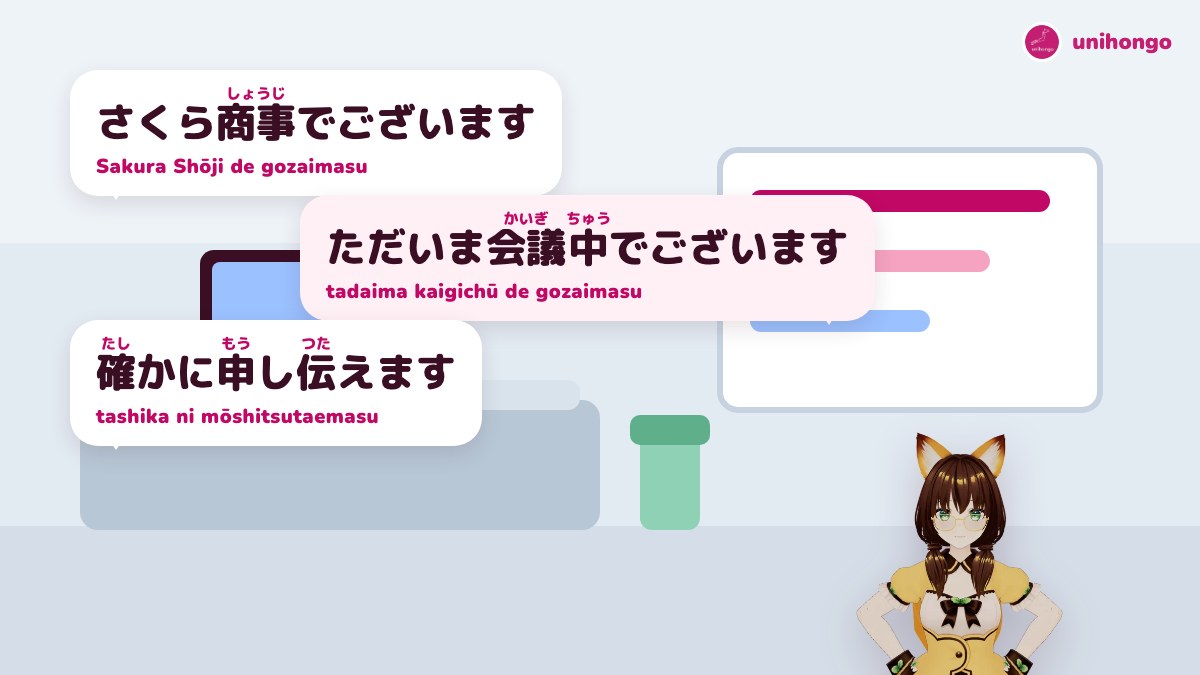
| 申し訳ございません。田中はただいま会議中でございます。 | Mōshiwake gozaimasen. Tanaka wa tadaima kaigichū de gozaimasu. | You: I'm very sorry. Tanaka is in a meeting at the moment. |
| 何時ごろお戻りになりますか。 | Nanji goro omodori ni narimasu ka. | Caller: Around what time will he be back? |
| 三時には戻る予定です。 | Sanji ni wa modoru yotei desu. | You: Tanaka should be back by three. |
| 戻りましたら、こちらからお電話いたしましょうか。 | Modorimashitara, kochira kara odenwa itashimashō ka. | You: Shall we call you back when Tanaka returns? |
| はい、お願いします。 | Hai, onegai shimasu. | Caller: Yes, please. |
| 念のため、お電話番号を伺ってもよろしいでしょうか。 | Nen no tame, odenwa bangō o ukagatte mo yoroshii deshō ka. | You: Just in case, may I have your number? |
| 03-1234-5678です。 | Zero san no ichi ni san yon no go roku nana hachi desu. | Caller: It's 03-1234-5678. |
| 復唱いたします。青山電機の佐藤様、03-1234-5678ですね。 | Fukushō itashimasu. Aoyama Denki no Satō sama, zero san no ichi ni san yon no go roku nana hachi desu ne. | You: Let me repeat: Mr Sato of Aoyama Electric, 03-1234-5678. |
| 確かに申し伝えます。私、リーが承りました。 | Tashika ni mōshitsutaemasu. Watakushi, Rī ga uketamawarimashita. | You: I'll be sure to pass it on. This was Lee. |
| よろしくお願いいたします。失礼いたします。 | Yoroshiku onegai itashimasu. Shitsurei itashimasu. | Caller: Thank you. Goodbye. |
Taking a message that nobody has to call back about
A message slip is only useful if your colleague can act on it without phoning you first. Get these six things, and confirm the spelling of names you are unsure of. Asking how a name is written is normal and polite; guessing is not.
| Japanese | Romaji | Meaning |
|---|---|---|
| よろしければ、ご伝言を承りましょうか。 | Yoroshikereba, godengon o uketamawarimashō ka. | If you like, shall I take a message? |
| お名前はどのような漢字でしょうか。 | Onamae wa dono yō na kanji deshō ka. | How is your name written in kanji? |
| 恐れ入りますが、お電話が少々遠いようです。 | Osoreirimasu ga, odenwa ga shōshō tōi yō desu. | Sorry, I'm having trouble hearing you. |
| もう一度お願いできますか。 | Mō ichido onegai dekimasu ka. | Could you say that once more? |
| かしこまりました。 | Kashikomarimashita. | Certainly. (humble, very common) |
- The caller's name and company, with the kanji if you can get it
- Their phone number, repeated back digit by digit
- What the call is about, in one line
- Whether they want a call back, will call again, or just want the message passed on
- The time of the call
- Your own name, so your colleague knows whom to ask
Uchi and soto: lower your own colleagues
This is the rule that surprises learners most. Inside the office you call your manager Tanaka-buchō and use respectful verbs about them. The moment you speak to an outside caller, your manager becomes part of your side, uchi, and the caller is soto. You drop san and the job title after the name, and you use humble verbs about your own manager, exactly as you would about yourself.
It can feel disrespectful to your boss, but the opposite is true: honouring your own colleague in front of a client sounds as if you are raising your company above the client.
| Japanese | Romaji | Meaning |
|---|---|---|
| 田中さんはいらっしゃいません。 | Tanaka san wa irasshaimasen. | Mr Tanaka isn't in. (wrong to an outsider) |
| あいにく田中は外出しております。 | Ainiku Tanaka wa gaishutsu shite orimasu. | I'm afraid Tanaka is out. (correct) |
| 部長の田中が申しておりました。 | Buchō no Tanaka ga mōshite orimashita. | Our manager, Tanaka, mentioned it. (to an outsider) |
| You are talking about your manager Tanaka | To a colleague inside | To an outside caller |
|---|---|---|
| How you name them | Tanaka-buchō or Tanaka-san | Tanaka, or buchō no Tanaka |
| Is in a meeting | Kaigi ni dete irasshaimasu (respectful) | Kaigichū de gozaimasu (formal) |
| Is out of the office | Gaishutsu sarete imasu | Gaishutsu shite orimasu (humble) |
| Said something | Osshatte imashita | Mōshite orimashita (humble) |
Transferring a call and picking one up
When the person is at their desk, you put the caller on hold and pass the call on, telling your colleague who is calling before you transfer. The colleague who picks up opens with a fixed line that tells the caller the transfer worked.
| Japanese | Romaji | Meaning |
|---|---|---|
| 田中でございますね。ただいま代わります。 | Tanaka de gozaimasu ne. Tadaima kawarimasu. | You: For Tanaka? I'll put you through. |
| 田中さん、青山電機の佐藤様からお電話です。 | Tanaka san, Aoyama Denki no Satō sama kara odenwa desu. | You, to a colleague: Call from Mr Sato, Aoyama Electric. |
| お電話代わりました。田中です。 | Odenwa kawarimashita. Tanaka desu. | Colleague: Tanaka speaking; I've taken the call. |
| 担当の者に代わりますので、少々お待ちください。 | Tantō no mono ni kawarimasu node, shōshō omachi kudasai. | I'll pass you to the person in charge; one moment. |
Notice that inside the office, talking to Tanaka, you use Tanaka-san again. The uchi-soto switch happens in the same minute, depending on who is listening.
Over-keigo traps and other common mistakes
Once learners discover keigo, they tend to stack it. Two honorific forms on one verb, nijū keigo or double keigo, is one of the commonest errors among Japanese new hires too, and it is the kind of thing a careful caller notices. A few forms such as ukagatte orimasu are so widely used in business that people accept them; the ones below are the ones to fix first.
| Japanese | Romaji | Meaning |
|---|---|---|
| おっしゃられました。 | Osshararemashita. | Said (double keigo: avoid) |
| おっしゃいました。 | Osshaimashita. | Said (correct respectful form) |
| 拝見させていただきます。 | Haiken sasete itadakimasu. | I'll take a look (over-humble) |
| 拝見します。 | Haiken shimasu. | I'll take a look (correct humble form) |
| よろしかったでしょうか。 | Yoroshikatta deshō ka. | Was that all right? (many dislike this) |
| よろしいでしょうか。 | Yoroshii deshō ka. | Is that all right? (the safe form) |
- Saying ryōkai shimashita to a customer: many people find it too casual; use shōchi itashimashita or kashikomarimashita.
- Answering with moshi moshi on an incoming business call: many companies train staff to start with the greeting and company name instead.
- Using de gozaimasu for the caller, as in Satō-sama de gozaimasu ka. It works in some service settings, but Satō-sama de irasshaimasu ka is the respectful form.
- Hanging up first. With customers, many people wait for the caller to hang up, or put the receiver down gently after a short pause.
Rehearse a whole call before the phone rings
Ask Mocchi something specific, such as: give me five sentences about my boss that I must convert from inside-the-office keigo to outside-caller keigo, then check my answers. Mocchi explains each correction, and because it keeps notes on what you keep missing, the uchi-soto switch will come back in later reviews until it sticks.
Then make it real with your voice. In AI Sensei, choose Yamada-sensei and ask the Sensei to play a client calling for your manager. Take the call, explain that your manager is out, take a number and repeat it back. Ask the Sensei to speak at normal office speed the second time; the session report lists the forms you got wrong.