
The frame around every work email
Think of a Japanese work email as a picture in a frame. The frame has five parts: the recipient's name with company and department, an opening greeting, a line saying who you are, the body, and a closing line followed by your signature. Readers skim the frame to see whether you understand the relationship, then read the body for the content.
Of the frame lines, four come up so often that they are worth learning before anything else. The first is for people outside the company you already work with, the second closes nearly every email, the third opens a first contact, and the fourth opens internal mail.
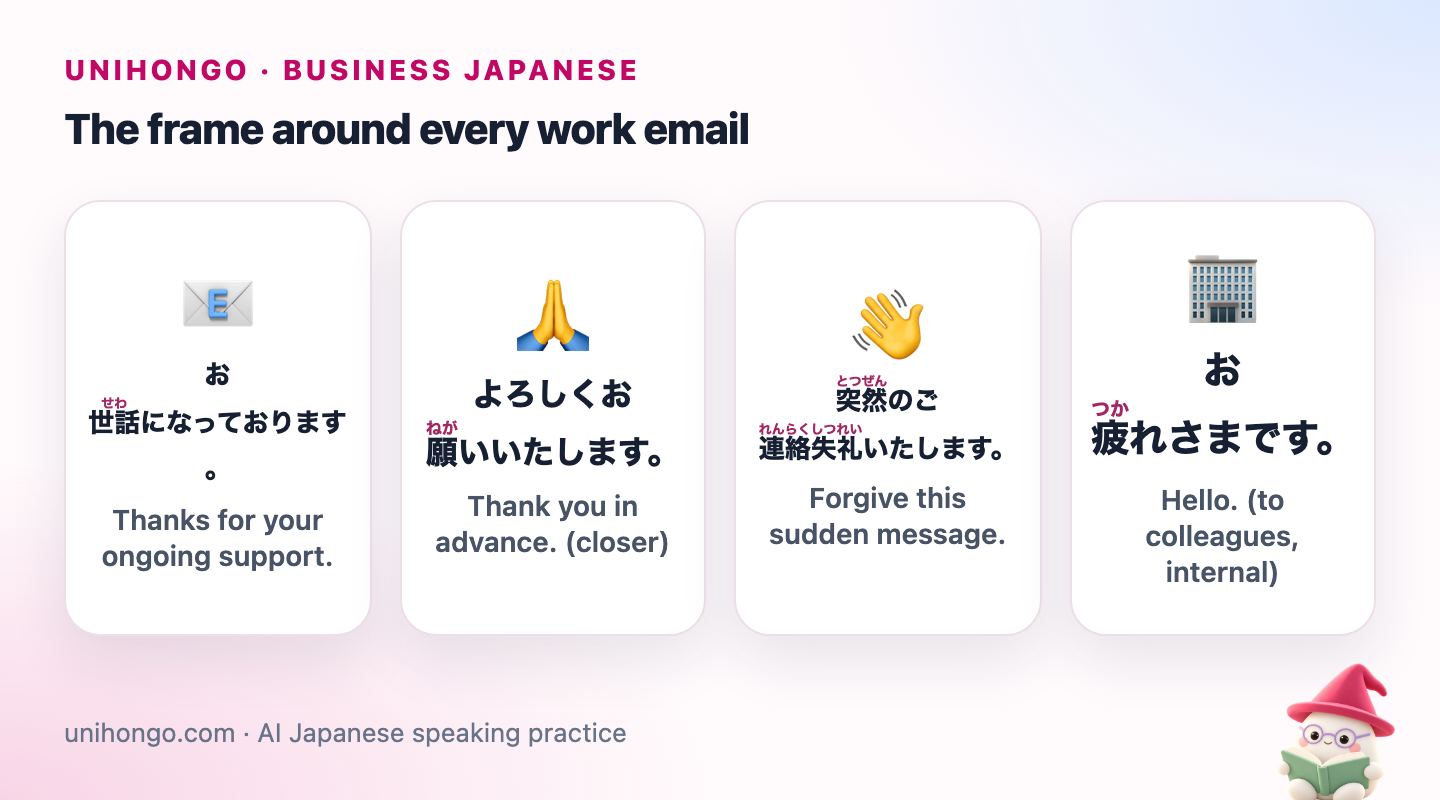
| Japanese | Romaji | Meaning |
|---|---|---|
| お世話になっております。 | Osewa ni natte orimasu. | Thanks for your ongoing support. |
| よろしくお願いいたします。 | Yoroshiku onegai itashimasu. | Thank you in advance. (closer) |
| 突然のご連絡失礼いたします。 | Totsuzen no gorenraku shitsurei itashimasu. | Forgive this sudden message. |
| お疲れさまです。 | Otsukaresama desu. | Hello. (to colleagues, internal) |
One message in three registers
Here is the same short message, sending a file and asking the reader to check it, written to a friend, to a colleague on your team and to a client. The content barely changes; the frame and the verbs do. The casual version would be fine in a chat app. The plain polite version is natural for internal mail. The keigo version is what a client expects.
| Japanese | Romaji | Meaning |
|---|---|---|
| 資料送るね。見ておいて! | Shiryō okuru ne. Mite oite! | Friend: Sending the file. Have a look! (casual) |
| お疲れさまです。資料を送ります。確認をお願いします。 | Otsukaresama desu. Shiryō o okurimasu. Kakunin o onegai shimasu. | Colleague: Hi. Here's the file. Please check it. (polite) |
| お世話になっております。資料をお送りいたします。ご確認のほど、よろしくお願いいたします。 | Osewa ni natte orimasu. Shiryō o ookuri itashimasu. Gokakunin no hodo, yoroshiku onegai itashimasu. | Client: I am sending the file. I would be grateful if you could check it. (keigo) |
| Part | Friend | Colleague | Client |
|---|---|---|---|
| Opening | None, or a quick hi | Otsukaresama desu | Osewa ni natte orimasu |
| Verb for sending | Okuru (plain) | Okurimasu (polite) | Ookuri itashimasu (humble) |
| Request | Mite oite | Kakunin o onegai shimasu | Gokakunin no hodo, yoroshiku onegai itashimasu |
| Closing | None or an emoji | Yoroshiku onegai shimasu | Yoroshiku onegai itashimasu |
Choosing the opening line by situation
The opener has to match what has happened between you and the reader. Most of the time that is the standard osewa ni natte orimasu, but a few situations replace or extend it. Adding the situation line right after the greeting is common: thank them for yesterday's meeting, or apologise for a slow reply, before you get to the point.
| Japanese | Romaji | Meaning |
|---|---|---|
| いつもお世話になっております。 | Itsumo osewa ni natte orimasu. | Thank you, as always, for your support. |
| 初めてご連絡いたします。 | Hajimete gorenraku itashimasu. | This is my first time writing to you. |
| 度々失礼いたします。 | Tabitabi shitsurei itashimasu. | Sorry to write again so soon. |
| ご連絡が遅くなり、申し訳ございません。 | Gorenraku ga osoku nari, mōshiwake gozaimasen. | I apologise for my late reply. |
| 先日はお時間をいただき、ありがとうございました。 | Senjitsu wa ojikan o itadaki, arigatō gozaimashita. | Thank you for your time the other day. |
| ご無沙汰しております。 | Gobusata shite orimasu. | It has been a long time since I last wrote. |
Tabitabi shitsurei itashimasu is useful when you send a second email the same day, for example because you forgot an attachment. Gobusata shite orimasu is for people you have not contacted for months; it is humble and slightly formal, so it suits clients and older contacts.
Saying who you are
After the opener, name yourself with your company. In external mail, use de gozaimasu or desu after your name; to a new contact, to mōshimasu is standard. Do not add san or any title to your own name, and in Japanese your company comes first, then your department if needed, then your name.
| Japanese | Romaji | Meaning |
|---|---|---|
| さくら商事のリーでございます。 | Sakura Shōji no Rī de gozaimasu. | This is Lee from Sakura Trading. (formal) |
| さくら商事営業部のリーと申します。 | Sakura Shōji eigyōbu no Rī to mōshimasu. | My name is Lee, Sakura Trading sales. (first contact) |
| 佐藤様のご紹介でご連絡いたしました。 | Satō sama no goshōkai de gorenraku itashimashita. | I am writing on Mr Sato's recommendation. |
Closing lines from everyday to very formal
The closing line works like a bow at the end of the message. Yoroshiku onegai itashimasu is the default. You can make it fit the body by adding what you are asking for, or by adding hikitsuzuki, going forward, when the relationship continues. For a serious request, an apology or a senior reader, step up to nanitozo and mōshiagemasu.
| Japanese | Romaji | Meaning |
|---|---|---|
| 引き続き、よろしくお願いいたします。 | Hikitsuzuki, yoroshiku onegai itashimasu. | I look forward to continuing to work with you. |
| ご確認のほど、よろしくお願いいたします。 | Gokakunin no hodo, yoroshiku onegai itashimasu. | I would be grateful if you could check it. |
| ご検討いただけますと幸いです。 | Gokentō itadakemasu to saiwai desu. | I would be grateful if you could consider it. |
| 今後ともよろしくお願いいたします。 | Kongo tomo yoroshiku onegai itashimasu. | I hope we can keep working together. |
| 何卒よろしくお願い申し上げます。 | Nanitozo yoroshiku onegai mōshiagemasu. | With my sincere thanks in advance. (very formal) |
| 取り急ぎ、ご連絡まで。 | Toriisogi, gorenraku made. | Just a quick note for now. |
A complete model email, line by line
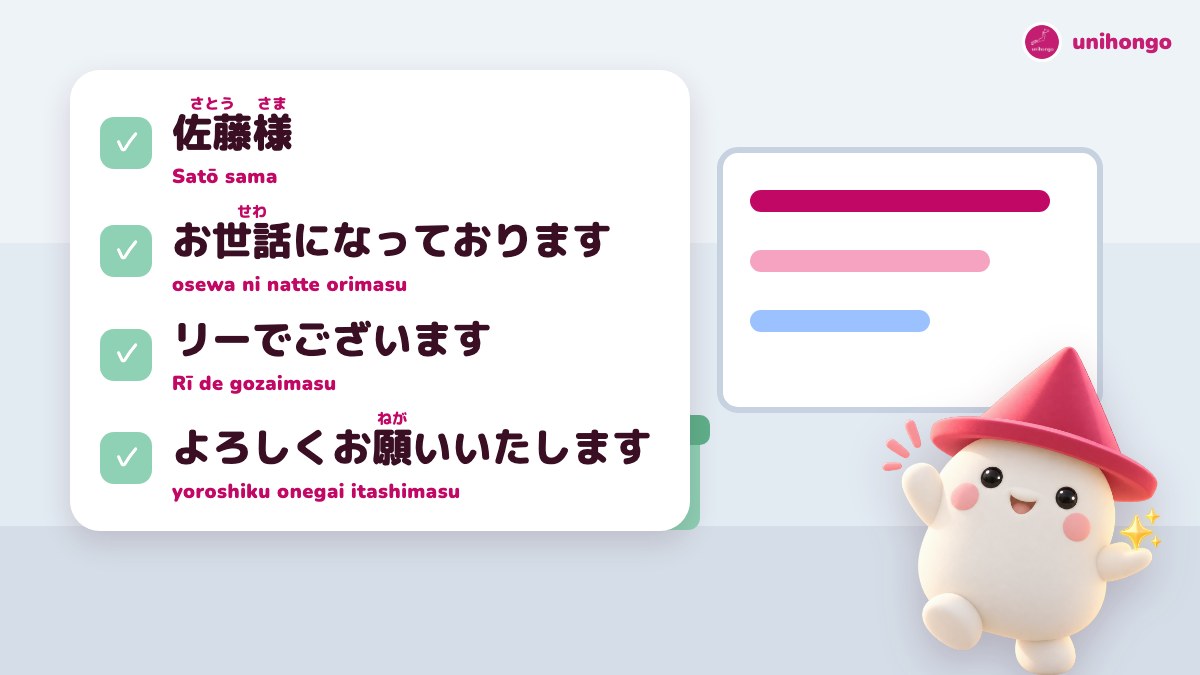
Here is a short email to a client after a meeting, sending the materials they asked for. Every line is in the frame except the two in the middle. Read it aloud once; the rhythm of the frame lines is part of what makes them stick.
| Japanese | Romaji | Meaning |
|---|---|---|
| 株式会社青山電機 営業部 佐藤様 | Kabushiki gaisha Aoyama Denki eigyōbu Satō sama | Mr Sato, Sales Department, Aoyama Electric Co., Ltd. |
| いつもお世話になっております。さくら商事のリーでございます。 | Itsumo osewa ni natte orimasu. Sakura Shōji no Rī de gozaimasu. | Thank you as always. This is Lee from Sakura Trading. |
| 先日はお打ち合わせのお時間をいただき、ありがとうございました。 | Senjitsu wa ouchiawase no ojikan o itadaki, arigatō gozaimashita. | Thank you for your time at the meeting the other day. |
| ご依頼の資料を添付いたしましたので、ご確認ください。 | Goirai no shiryō o tenpu itashimashita node, gokakunin kudasai. | I have attached the materials you asked for; please check them. |
| ご不明な点がございましたら、お気軽にお知らせください。 | Gofumei na ten ga gozaimashitara, okigaru ni oshirase kudasai. | If anything is unclear, please feel free to let me know. |
| 引き続き、よろしくお願いいたします。 | Hikitsuzuki, yoroshiku onegai itashimasu. | I look forward to continuing to work with you. |
Mismatched openers and over-keigo
Most email mistakes are not grammar errors. They are frame lines that do not fit the relationship, or so much humble language that the reader has to dig for the request. These are the ones learners make most often.
| Japanese | Romaji | Meaning |
|---|---|---|
| 資料を送付させていただきます。 | Shiryō o sōfu sasete itadakimasu. | Allow me to send the file. (fine once, heavy if repeated) |
| 資料をお送りいたします。 | Shiryō o ookuri itashimasu. | I am sending the file. (clean humble form) |
- Osewa ni natte orimasu in a first email to a stranger: the reader has not looked after you yet. Use a first-contact opener.
- A title plus sama, as in Tanaka buchō sama. Many readers see this as a doubled honorific; write Tanaka buchō or Tanaka sama. On the address line, buchō Tanaka sama is often accepted.
- Minasama kakui: kakui already means everyone, so adding minasama doubles it. Write kakui alone or minasama alone.
- Sasete itadakimasu on every verb. One or two are fine; five in a short email sound servile. Plain humble forms such as ookuri itashimasu are cleaner.
- Gokurōsama desu to a client or a manager: many people feel it is for those below you. Use otsukaresama desu inside the company and osewa ni natte orimasu outside.
Build a frame you can reuse
Type a real situation into Mocchi, for example: I am writing to a client for the first time after a colleague introduced us; give me the opener, the self-introduction and the closer, and explain the level of each. Mocchi writes the frame lines, explains why each one fits, and remembers the situations you asked about, so you can ask for a quick quiz on them a few days later with /review.
To keep the lines in your head between emails, turn your five favourite openers and closers into cards with /create-flashcards, then play Flashcard Flip from the games page with your own deck. Matching the Japanese line to the situation, not just to a translation, is the skill you need when you sit down to write.