
Eight proverbs about failure and mistakes
Three of these say even experts slip, one says failure teaches you, two are about regret and two are about prevention.
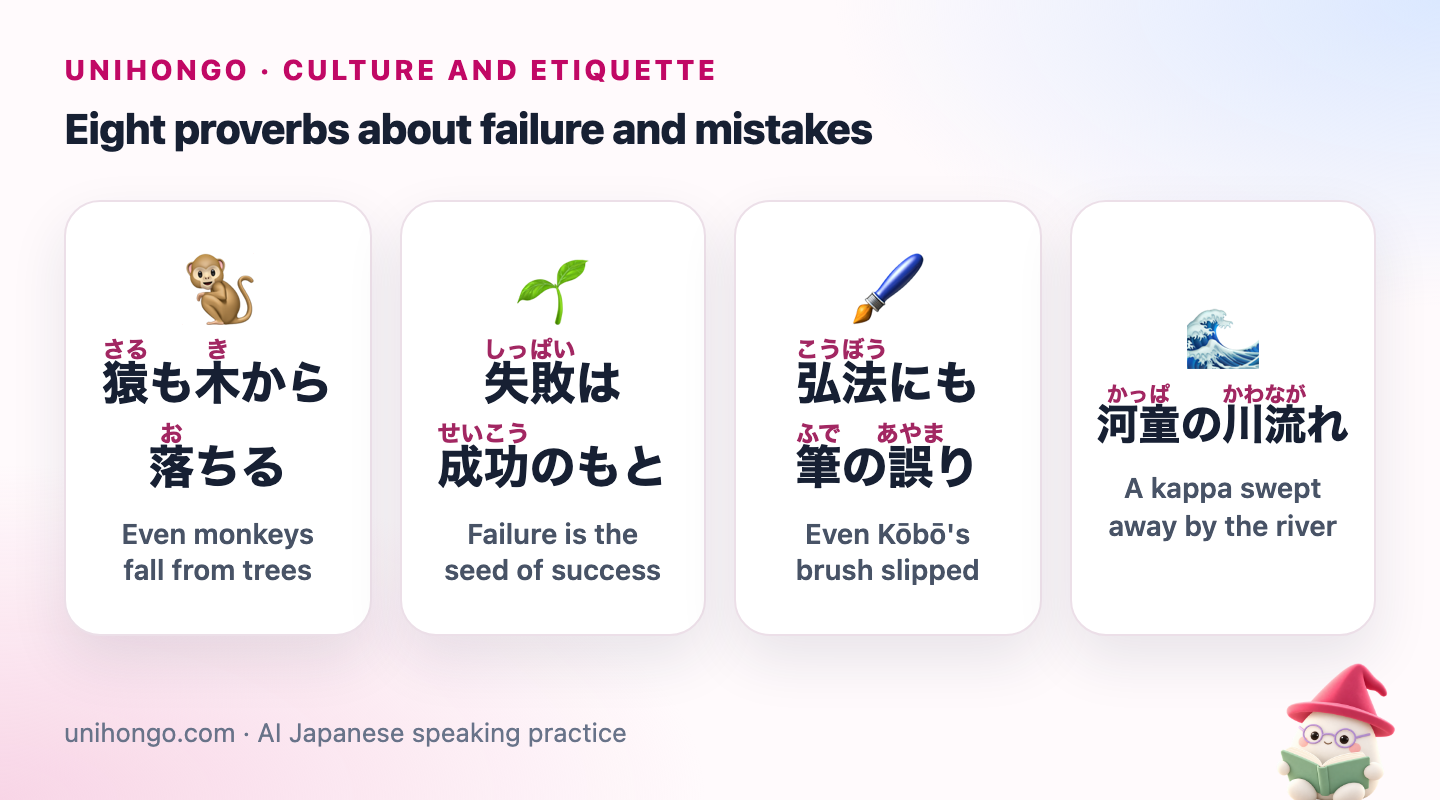
| Japanese | Romaji | Meaning |
|---|---|---|
| 猿も木から落ちる | Saru mo ki kara ochiru | Even monkeys fall from trees |
| 失敗は成功のもと | Shippai wa seikō no moto | Failure is the seed of success |
| 弘法にも筆の誤り | Kōbō ni mo fude no ayamari | Even Kōbō's brush slipped |
| 河童の川流れ | Kappa no kawanagare | A kappa swept away by the river |
| 後悔先に立たず | Kōkai saki ni tatazu | Regret never comes first |
| 覆水盆に返らず | Fukusui bon ni kaerazu | Spilt water won't go back in the tray |
| 転ばぬ先の杖 | Korobanu saki no tsue | A walking stick before you fall |
| 人の振り見て我が振り直せ | Hito no furi mite waga furi naose | See others' faults, fix your own |
Even experts slip: three ways to say it
猿も木から落ちる is the everyday version. Monkeys are expert climbers, yet even they sometimes fall. Friends say it when a skilled cook burns the rice or a star player misses an easy shot. 弘法にも筆の誤り refers to Kūkai, known as Kōbō Daishi, a monk celebrated as one of Japan's great calligraphers; even his brush slipped. It sounds a little more educated and fits written comments and polite speech. 河童の川流れ uses the kappa, a water creature from folklore that is a superb swimmer, yet even a kappa can be swept away by a current. It is the least common of the three in conversation.
All three carry a hidden compliment: they only make sense if the person is genuinely skilled. That is why they comfort people. But they also compare the person to a monkey or a kappa, so they suit friends, peers and yourself better than superiors or customers.
| Japanese | Romaji | Meaning |
|---|---|---|
| 料理上手のあなたが焦がすなんて、猿も木から落ちるだね。 | Ryōri jōzu no anata ga kogasu nante, saru mo ki kara ochiru da ne. | You burning food? Even monkeys fall from trees. |
| 弘法にも筆の誤りですよ。気にしないでください。 | Kōbō ni mo fude no ayamari desu yo. Ki ni shinaide kudasai. | Even masters slip. Please don't worry. (polite) |
| うっかりしていました。 | Ukkari shite imashita. | I wasn't paying attention. (about yourself) |
失敗は成功のもと: learning from failure
もと means origin or source, so 失敗は成功のもと says failure is where success comes from. It is said to someone who failed and is discouraged, and it is also a common motto in schools and laboratories. The tone is positive and forward-looking. A variant, 失敗は成功の母, failure is the mother of success, means the same.
One tip on timing: say it after the person has had a moment to feel bad, not immediately. Said too fast, any proverb can sound like you are brushing their feelings aside. Pair it with a concrete question: 次はどうする?, what will you do next time?
| Japanese | Romaji | Meaning |
|---|---|---|
| 失敗は成功のもとだよ。次はどうする? | Shippai wa seikō no moto da yo. Tsugi wa dō suru? | Failure teaches you. What will you do next time? |
| この失敗から学びました。 | Kono shippai kara manabimashita. | I learnt from this failure. |
Regret and prevention
後悔先に立たず literally says regret does not stand in front: you only feel it after the event, when it is too late. People say it when someone did not prepare, did not save their file or did not check the train times. 覆水盆に返らず, spilt water does not return to the tray, comes from a Chinese story about a broken marriage, and it means what is done cannot be undone, especially in relationships. It is close to the English no use crying over spilt milk, but it is heavier and more final.
転ばぬ先の杖, a walking stick before you fall, is the prevention side: prepare in advance. Insurance, backups and spare umbrellas are all 転ばぬ先の杖. 人の振り見て我が振り直せ, look at others' behaviour and correct your own, is about learning from other people's mistakes. Teachers love it, and it is a gentle way to say that you noticed something in someone else that you want to avoid yourself.
| Japanese | Romaji | Meaning |
|---|---|---|
| ちゃんと保存すればよかった。後悔先に立たずだ。 | Chanto hozon sureba yokatta. Kōkai saki ni tatazu da. | I should have saved it. Too late for regrets. |
| 転ばぬ先の杖で、バックアップを取っておこう。 | Korobanu saki no tsue de, bakkuappu o totte okō. | Better safe than sorry: let's make a backup. |
| 人の振り見て我が振り直せ、ですね。 | Hito no furi mite waga furi naose, desu ne. | Learn from others' mistakes, right? |
Mini dialogue: a small mistake at work
A learner sent a meeting invitation with the wrong time. A colleague of the same level reacts. Notice the apology comes first, and the proverb comes from the colleague, not the person who made the mistake.
| Japanese | Romaji | Meaning |
|---|---|---|
| すみません、会議の時間を間違えて送ってしまいました。 | Sumimasen, kaigi no jikan o machigaete okutte shimaimashita. | You: Sorry, I sent the wrong meeting time. |
| あ、本当だ。すぐ訂正すれば大丈夫ですよ。 | A, hontō da. Sugu teisei sureba daijōbu desu yo. | Colleague: Oh, so you did. It's fine if you correct it now. |
| 今、訂正のメールを送ります。 | Ima, teisei no mēru o okurimasu. | You: I'll send a correction email now. |
| 猿も木から落ちるですよ。いつも丁寧なんだから。 | Saru mo ki kara ochiru desu yo. Itsumo teinei nan da kara. | Colleague: Anyone can slip. You're always so careful. |
| ありがとうございます。次から二回確認します。 | Arigatō gozaimasu. Tsugi kara nikai kakunin shimasu. | You: Thank you. From now on I'll check twice. |
Reacting to your own mistake: a checklist
When you are the one who slipped, a proverb is rarely the first thing to say. Japanese workplaces generally expect the steps below, roughly in this order, though every team is different.
| Japanese | Romaji | Meaning |
|---|---|---|
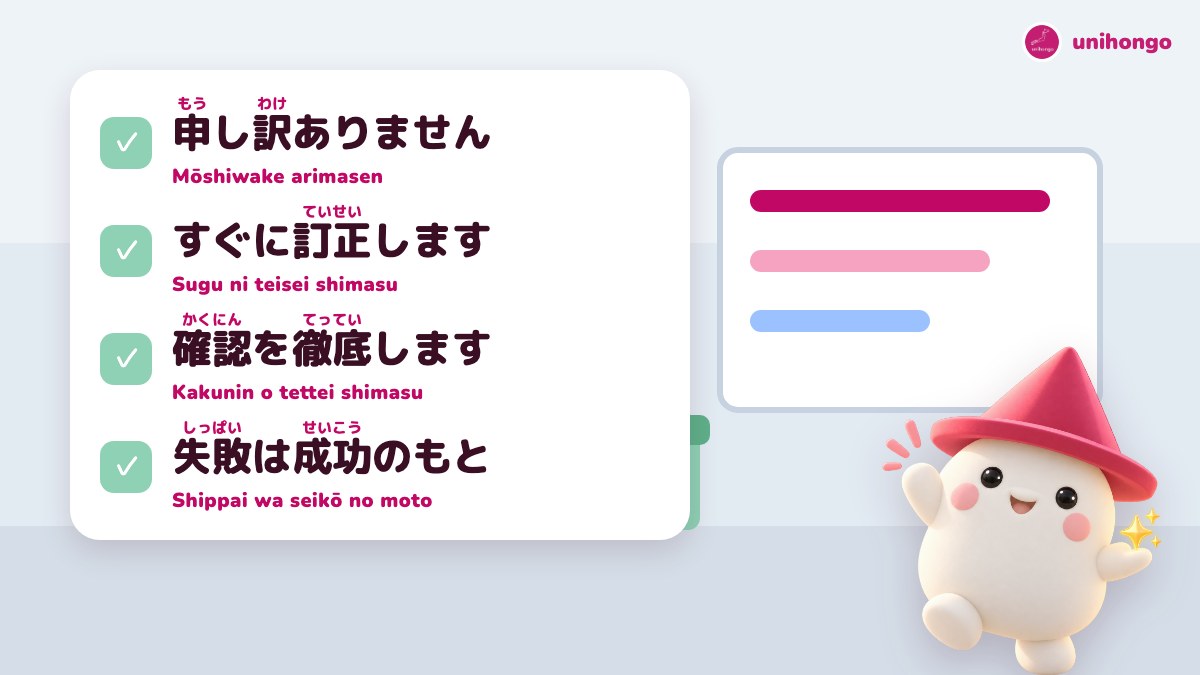
| 申し訳ありません。すぐに訂正します。 | Mōshiwake arimasen. Sugu ni teisei shimasu. | I'm very sorry. I'll correct it right away. |
| 今後は確認を徹底します。 | Kongo wa kakunin o tettei shimasu. | From now on I'll check thoroughly. |
- Apologise clearly: 申し訳ありません or, with peers, すみません.
- Say what you will do now: すぐに訂正します, I will correct it right away.
- Say how you will prevent it: 今後は確認を徹底します, I will check thoroughly from now on.
- Leave the proverb to others. If you use one about yourself, keep it light and only after the fix is done.
English matches and false friends
| Japanese | English idea | Watch out |
|---|---|---|
| 猿も木から落ちる | Even Homer nods; nobody's perfect | Compares the person to a monkey |
| 失敗は成功のもと | Failure is a stepping stone to success | Close match |
| 覆水盆に返らず | No use crying over spilt milk | Japanese is more final, often about relationships |
| 転ばぬ先の杖 | Better safe than sorry | Close match |
| 後悔先に立たず | It's too late for regrets | Said after the fact, not as advice in advance |
Mistake words: ミス, 失敗, 間違い and うっかり
Before reaching for a proverb, it helps to pick the right word for the mistake itself. Japanese has several, and learners often use 失敗 for everything.
間違い is an error, a wrong answer or a wrong choice: a typo, the wrong platform, a miscalculation. ミス, from English, is the everyday word at work for a slip, and it often appears in compounds like 入力ミス, a typing error, or ケアレスミス, a careless mistake. 失敗 is a failure: the plan did not work, the cake collapsed, the exam went badly. It is bigger and often about an outcome. うっかり is not a noun but an adverb for doing something absent-mindedly, and うっかりミス is a classic phrase for a silly slip.
The size of the word matters. Calling a typo 失敗 makes it sound dramatic; calling a failed project ミス makes it sound too small. Match the word to the scale, then choose the proverb: 猿も木から落ちる for a skilled person's small slip, 失敗は成功のもと for a real failure you can learn from.
| Japanese | Romaji | Meaning |
|---|---|---|
| 入力ミスがありました。 | Nyūryoku misu ga arimashita. | There was a typing error. |
| うっかり鍵を忘れちゃった。 | Ukkari kagi o wasurechatta. | I absent-mindedly forgot my keys. |
| 答えを間違えました。 | Kotae o machigaemashita. | I got the answer wrong. |
| Word | Scale | Typical example |
|---|---|---|
| 間違い | An error or wrong choice | A wrong answer, the wrong train |
| ミス | A slip at work or in a game | A typo, a missed shot |
| 失敗 | A failed attempt or outcome | A failed exam, a collapsed cake |
| うっかり | Absent-minded (adverb) | Forgetting your keys |
Make a mistake log you actually review
The proverbs say mistakes teach you, and the best way to prove it is to keep a log of your own Japanese mistakes. Mocchi on Unihongo already does part of this: it keeps notes on the points you keep missing, so when you ask for /review, the questions lean on your weak spots. Try sending Mocchi a short paragraph about a recent slip with /correct, then ask which proverb would fit it.
To lock the eight proverbs in, have Mocchi make flashcards with /create-flashcards, then play Flashcard Flip on the games page with your own deck. A few rounds a week is enough for the readings to stick.