
The visit in four moments
A client visit has four moments where the words are close to fixed: entering a room, introducing yourself, receiving a card and leaving. If those four lines come out smoothly, the rest of the visit, the actual meeting, can be in simpler polite Japanese and nobody will mind.
Shitsurei itashimasu does a lot of work. Literally I commit a rudeness, it is said when you knock and enter, when you sit after being invited, when you interrupt, and when you leave. Its plain polite form, shitsurei shimasu, is what you hear among colleagues.
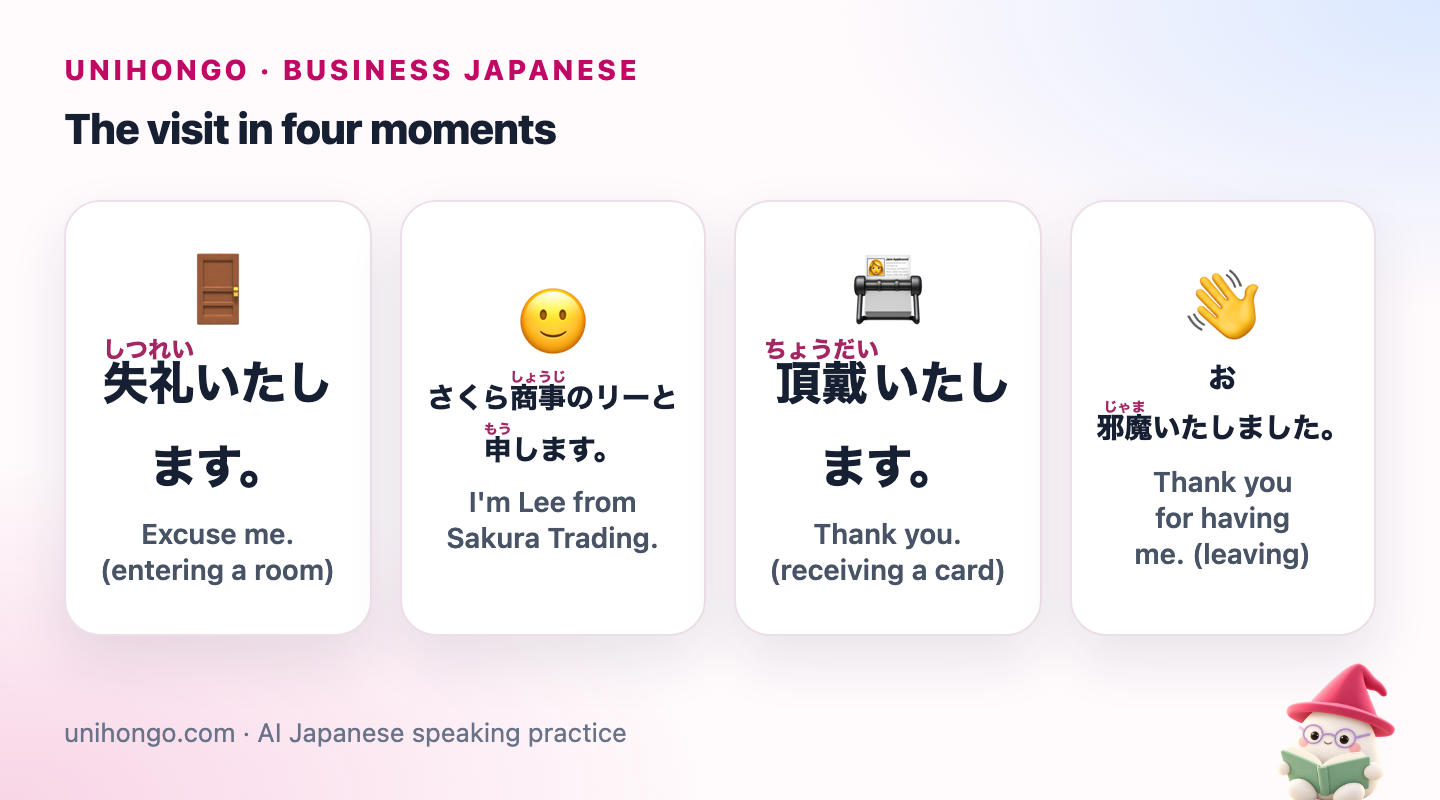
| Japanese | Romaji | Meaning |
|---|---|---|
| 失礼いたします。 | Shitsurei itashimasu. | Excuse me. (entering a room) |
| さくら商事のリーと申します。 | Sakura Shōji no Rī to mōshimasu. | I'm Lee from Sakura Trading. |
| 頂戴いたします。 | Chōdai itashimasu. | Thank you. (receiving a card) |
| お邪魔いたしました。 | Ojama itashimashita. | Thank you for having me. (leaving) |
Arriving in three registers
Compare how you would say the same things arriving at a friend's flat, at a colleague's desk and at a client's reception. The friend version is relaxed, the colleague version is polite but direct, and the client version adds two layers: humble verbs for what you do, and the formal frame that tells the receptionist exactly what to do next.
| Japanese | Romaji | Meaning |
|---|---|---|
| 着いたよ。田中さんいる? | Tsuita yo. Tanaka san iru? | I'm here. Is Tanaka around? (casual) |
| 着きました。田中さんはいますか。 | Tsukimashita. Tanaka san wa imasu ka. | I've arrived. Is Tanaka in? (polite) |
| 営業部の田中様と三時にお約束をいただいております。 | Eigyōbu no Tanaka sama to sanji ni oyakusoku o itadaite orimasu. | I have a three o'clock appointment with Mr Tanaka in Sales. (keigo) |
| ちょっと見せて。 | Chotto misete. | Let me see. (casual) |
| 見てもいいですか。 | Mite mo ii desu ka. | May I look? (polite) |
| 拝見してもよろしいでしょうか。 | Haiken shite mo yoroshii deshō ka. | May I take a look? (humble) |
Many visitors in Japan arrive five to ten minutes early, take off their coat before entering the building, and carry it folded over the arm. Customs vary by company and season, so watch what others do, but arriving at the reception desk exactly on time, rather than very early, is a common habit.
At the reception desk
Large offices have a staffed desk; many smaller ones have a phone or tablet in the lobby on which you call the department. In both cases the content is the same: who you are, whom you are seeing, and when. The receptionist will use humble forms about their own colleague, so listen for Tanaka without sama; that is the uchi-soto rule at work, not rudeness.
| Japanese | Romaji | Meaning |
|---|---|---|
| いらっしゃいませ。 | Irasshaimase. | Receptionist: Welcome. |
| さくら商事のリーと申します。営業部の田中様と三時にお約束をいただいております。 | Sakura Shōji no Rī to mōshimasu. Eigyōbu no Tanaka sama to sanji ni oyakusoku o itadaite orimasu. | You: I'm Lee of Sakura Trading. I have a three o'clock with Mr Tanaka in Sales. |
| さくら商事のリー様ですね。お待ちしておりました。 | Sakura Shōji no Rī sama desu ne. Omachi shite orimashita. | Receptionist: Lee of Sakura Trading, yes. We've been expecting you. |
| ただいま田中を呼んでまいりますので、こちらでお待ちください。 | Tadaima Tanaka o yonde mairimasu node, kochira de omachi kudasai. | Receptionist: I'll fetch Tanaka now; please wait here. |
| ありがとうございます。 | Arigatō gozaimasu. | You: Thank you. |
| お世話になっております。さくら商事のリーと申します。 | Osewa ni natte orimasu. Sakura Shōji no Rī to mōshimasu. | You, on a lobby phone: Hello, I'm Lee of Sakura Trading. |
Being shown in and taking a seat
When your host comes to fetch you, follow them and wait to be told where to sit. In many Japanese meeting rooms the seat farthest from the door is the guest seat, kamiza, and the host will usually point you to it. Do not sit until they invite you, and say shitsurei itashimasu as you sit. Put your bag on the floor beside your chair rather than on the table.
| Japanese | Romaji | Meaning |
|---|---|---|
| どうぞ、こちらへ。 | Dōzo, kochira e. | Host: This way, please. |
| どうぞおかけください。 | Dōzo okake kudasai. | Host: Please have a seat. |
| 失礼いたします。 | Shitsurei itashimasu. | You: Thank you. (as you sit down) |
| 本日はお忙しいところ、お時間をいただきありがとうございます。 | Honjitsu wa oisogashii tokoro, ojikan o itadaki arigatō gozaimasu. | You: Thank you for making time for us today. |
The business card exchange, line by line
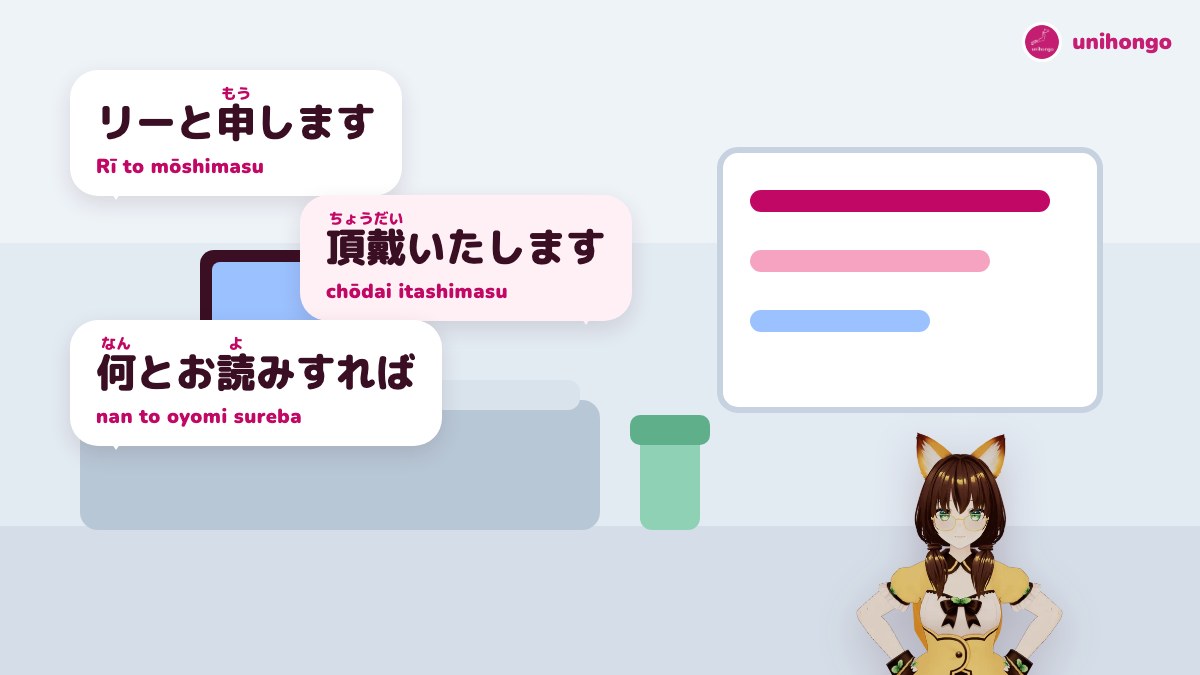
Business cards, meishi, are usually exchanged standing up, at the start, before anyone sits. The visitor normally offers first. Hold your card with both hands, facing the other person so they can read it, and say your full introduction. When you receive their card, take it with both hands, say chōdai itashimasu, and read it for a moment. During the meeting, many people keep the cards on the table in the order people are sitting.
| Japanese | Romaji | Meaning |
|---|---|---|
| はじめまして。さくら商事営業部のリーと申します。 | Hajimemashite. Sakura Shōji eigyōbu no Rī to mōshimasu. | You: How do you do. I'm Lee, Sakura Trading sales. |
| よろしくお願いいたします。 | Yoroshiku onegai itashimasu. | You: It's a pleasure to meet you. |
| 青山電機の田中です。よろしくお願いいたします。 | Aoyama Denki no Tanaka desu. Yoroshiku onegai itashimasu. | Host: I'm Tanaka of Aoyama Electric. Pleased to meet you. |
| 頂戴いたします。 | Chōdai itashimasu. | You: Thank you. (taking the card) |
| 失礼ですが、お名前は何とお読みすればよろしいでしょうか。 | Shitsurei desu ga, onamae wa nan to oyomi sureba yoroshii deshō ka. | You: Excuse me, how should I read your name? |
| 申し訳ございません。ただいま名刺を切らしておりまして。 | Mōshiwake gozaimasen. Tadaima meishi o kirashite orimashite. | You: I'm so sorry, I've run out of cards. |
| 申し遅れました。 | Mōshiokuremashita. | Forgive me for not introducing myself sooner. |
Small talk, then business
Most hosts open with a minute of small talk: the weather, the journey, whether you found the office easily. Answer briefly and positively, then let the host move to business, or move there yourself with sassoku desu ga, if I may get straight to it.
| Japanese | Romaji | Meaning |
|---|---|---|
| お足元の悪い中、ありがとうございます。 | Oashimoto no warui naka, arigatō gozaimasu. | Host: Thank you for coming in this weather. |
| すぐにお分かりになりましたか。 | Sugu ni owakari ni narimashita ka. | Host: Did you find us easily? |
| はい、駅からすぐでしたので。 | Hai, eki kara sugu deshita node. | You: Yes, it's right by the station. |
| 早速ですが、本日の資料をご説明させていただきます。 | Sassoku desu ga, honjitsu no shiryō o gosetsumei sasete itadakimasu. | You: If I may, I'll walk you through today's materials. |
Leaving the room and the building
Thank your host for their time, pack up, and stand. Say shitsurei itashimasu at the meeting-room door. If the host walks you to the lift or the entrance, thank them again there; kochira de kekkō desu politely tells them they need not come further. Many people bow as the lift doors close and keep work talk out of the lift.
| Japanese | Romaji | Meaning |
|---|---|---|
| 本日は貴重なお時間をいただき、ありがとうございました。 | Honjitsu wa kichō na ojikan o itadaki, arigatō gozaimashita. | Thank you for your valuable time today. |
| それでは、失礼いたします。 | Soredewa, shitsurei itashimasu. | Well then, I'll take my leave. |
| こちらで結構です。 | Kochira de kekkō desu. | Please, there's no need to see me further. |
| 今後ともよろしくお願いいたします。 | Kongo tomo yoroshiku onegai itashimasu. | I look forward to working with you. |
Over-humble and misplaced keigo
Two kinds of mistake are common on visits. The first is stacking humble forms on one verb until it sounds servile. The second is using a humble verb for the client's action, which lowers them; the verb mairu, for example, is humble, so it fits your own coming and going but never the client's.
| Japanese | Romaji | Meaning |
|---|---|---|
| お伺いさせていただきます。 | Oukagai sasete itadakimasu. | I will visit. (stacked humble: avoid) |
| 伺います。 | Ukagaimasu. | I will visit. (clean humble form) |
| こちらに参られますか。 | Kochira ni mairaremasu ka. | Will you come here? (humble for the client: wrong) |
| こちらにいらっしゃいますか。 | Kochira ni irasshaimasu ka. | Will you come here? (correct respectful) |
| ご覧になられましたか。 | Goran ni nararemashita ka. | Have you seen it? (double keigo) |
| ご覧になりましたか。 | Goran ni narimashita ka. | Have you seen it? (correct) |
Rehearse the visit from desk to lift
Start with Mocchi: type the details of a visit you have coming up, the client's company, the person and the time, and ask for your reception line, your card-exchange line and two small-talk answers. Mocchi writes them, explains which verbs are humble and which are respectful, and keeps track of the forms you hesitate over.
Then walk through it aloud with Ibuki-sensei in AI Sensei. Ask the Sensei to play the receptionist first and then the client, to bring up the weather or the journey before business, and to correct you whenever you use a humble verb for the client.