
Eight sayings about love and couples
Six of these are proverbs; the last two are well-known set expressions that come up just as often when people talk about love.
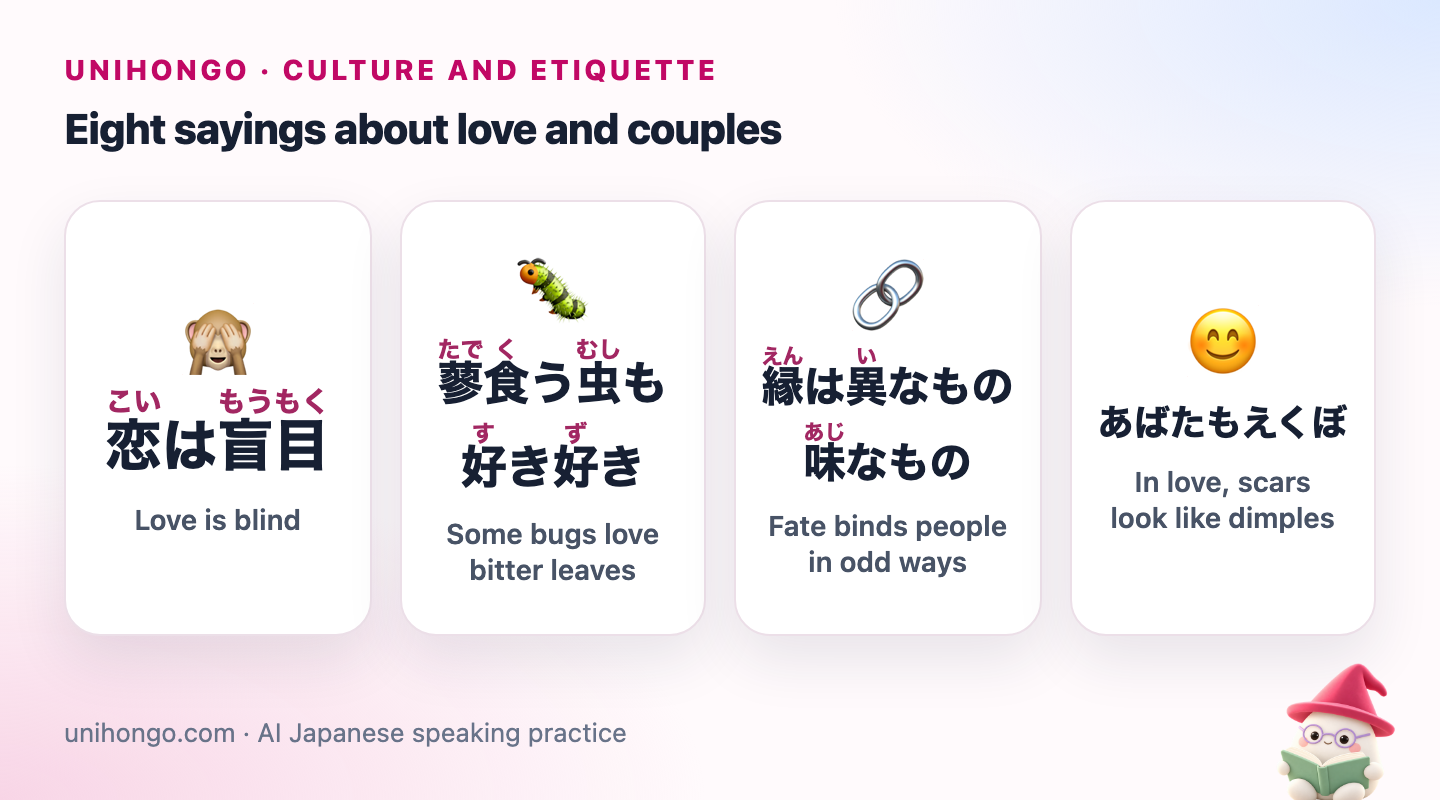
| Japanese | Romaji | Meaning |
|---|---|---|
| 恋は盲目 | Koi wa mōmoku | Love is blind |
| 蓼食う虫も好き好き | Tade kuu mushi mo sukizuki | Some bugs love bitter leaves |
| 縁は異なもの味なもの | En wa i na mono aji na mono | Fate binds people in odd ways |
| あばたもえくぼ | Abata mo ekubo | In love, scars look like dimples |
| 割れ鍋に綴じ蓋 | Warenabe ni tojibuta | Every cracked pot has its lid |
| 夫婦喧嘩は犬も食わない | Fūfu genka wa inu mo kuwanai | Not even dogs eat a couple's fight |
| 惚れた弱み | horeta yowami | The weakness of being in love |
| 運命の赤い糸 | unmei no akai ito | The red thread of fate |
恋は盲目 and あばたもえくぼ: love changes what you see
恋は盲目 is the Japanese version of the English love is blind, and it is used exactly the same way: about a friend who cannot see that a partner is unreliable, or about yourself, looking back at an old relationship. Because it came from English, it sounds neutral and modern rather than old-fashioned.
あばたもえくぼ is the native Japanese way to say something similar. あばた are pockmarks, scars from illness, and えくぼ are dimples. To someone in love, even a scar looks like a charming dimple. It is softer than 恋は盲目 and often describes how small faults become endearing: a partner's messy handwriting, a bad singing voice. People also use it outside romance, for a fan who loves everything about an idol.
| Japanese | Romaji | Meaning |
|---|---|---|
| 恋は盲目って言うけど、本当だね。 | Koi wa mōmoku tte iu kedo, hontō da ne. | They say love is blind, and it's true. |
| 彼の字が下手なところも好き。 | Kare no ji ga heta na tokoro mo suki. | I even love his bad handwriting. |
| あばたもえくぼだね。 | Abata mo ekubo da ne. | Love makes the flaws look cute, huh. |
蓼食う虫も好き好き: tastes differ
蓼, water pepper, is so bitter that it is used as a sharp garnish, yet some insects happily live on it. The proverb says that everyone's taste is different, and there is a fan for everything. It is used about food, fashion, music and partners.
Here is the trap: if you say it about a specific person's partner, you are suggesting the partner is the bitter weed. Among close friends it can be a joke; about someone you do not know well, or to their face, it is rude. A safe use is about yourself: 蓼食う虫も好き好きだから, everyone has their own taste, when defending a hobby people find strange. A shorter, more neutral line is 好みは人それぞれ, tastes vary from person to person.
| Japanese | Romaji | Meaning |
|---|---|---|
| 納豆が好き?蓼食う虫も好き好きだね。 | Nattō ga suki? Tade kuu mushi mo sukizuki da ne. | You like natto? Each to their own. |
| 好みは人それぞれだよ。 | Konomi wa hito sorezore da yo. | Everyone has different tastes. (neutral) |
縁は異なもの and the red thread
縁 is a bond or connection that fate brings about. 縁は異なもの味なもの says these bonds are strange and also delightful: a couple who met because one of them took the wrong train, or two people who argued at their first meeting and later married. The full form has a nice rhythm and is popular in wedding speeches; in conversation people often stop at 縁は異なもの.
運命の赤い糸 is the red thread of fate, from an old Chinese legend in which an invisible thread ties the little fingers of two people destined to marry. It is not a proverb but a romantic image you will meet constantly in songs, manga and dramas. People say it with a smile, often slightly ironically.
| Japanese | Romaji | Meaning |
|---|---|---|
| 二人が出会ったのは駅の忘れ物センターなんです。 | Futari ga deatta no wa eki no wasuremono sentā nan desu. | The two of them met at a station lost-and-found. |
| 縁は異なもの味なもの、ですね。 | En wa i na mono aji na mono, desu ne. | Fate works in odd and lovely ways, doesn't it. |
| 運命の赤い糸かもね。 | Unmei no akai ito ka mo ne. | Maybe it's the red thread of fate. |
Couples: 割れ鍋に綴じ蓋, 夫婦喧嘩 and 惚れた弱み
割れ鍋に綴じ蓋 says a cracked pot has a mended lid to match: everyone has a partner who suits them, flaws and all. It is a warm, humble thing to say about your own marriage, as in うちは割れ鍋に綴じ蓋です, we are a good match, faults included. About another couple it implies both of them are cracked, so do not use it in a toast or to someone's face.
夫婦喧嘩は犬も食わない, even a dog will not eat a married couple's quarrel, means couples' arguments are trivial and blow over, so outsiders should not get involved. People say it when someone is asked to take sides. 惚れた弱み, the weakness of having fallen for someone, explains why you cannot refuse your partner anything, and is usually said with a resigned laugh.
| Japanese | Romaji | Meaning |
|---|---|---|
| うちは割れ鍋に綴じ蓋ですよ。 | Uchi wa warenabe ni tojibuta desu yo. | We're a good match, flaws and all. (about yourself) |
| 夫婦喧嘩は犬も食わないから、放っておこう。 | Fūfu genka wa inu mo kuwanai kara, hōtte okō. | Couples' fights blow over; let's stay out of it. |
| 頼まれると断れないんだ。惚れた弱みだね。 | Tanomareru to kotowarenai n da. Horeta yowami da ne. | I can't say no when asked. I'm too in love. |
Mini dialogue: gossip over coffee
Two friends talk about a mutual friend's new relationship. Watch how the sayings soften the gossip.
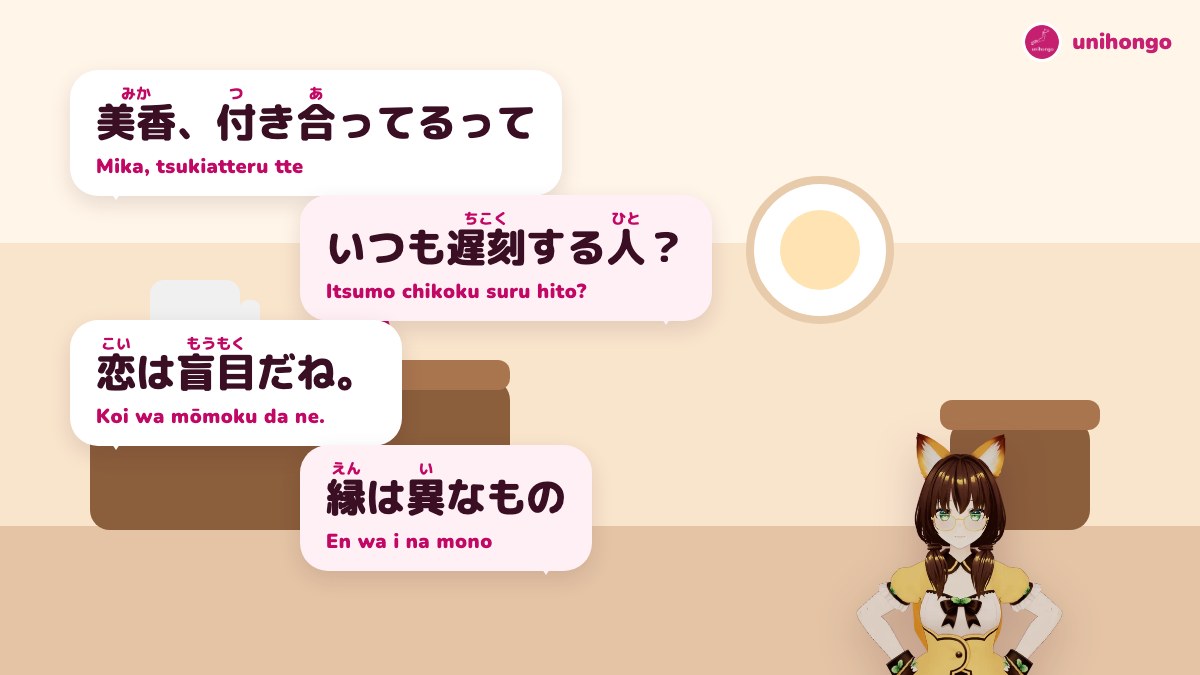
| Japanese | Romaji | Meaning |
|---|---|---|
| 聞いた?美香、あの山田さんと付き合ってるんだって。 | Kiita? Mika, ano Yamada san to tsukiatteru n datte. | Friend: Did you hear? Mika's dating Yamada. |
| えっ、いつも遅刻するあの人? | E, itsumo chikoku suru ano hito? | You: What, the guy who's always late? |
| そう。でも美香は気にしてないみたい。 | Sō. Demo Mika wa ki ni shitenai mitai. | Friend: Yes. But Mika doesn't seem to mind. |
| 恋は盲目だね。 | Koi wa mōmoku da ne. | You: Love is blind, huh. |
| まあ、縁は異なものって言うし、幸せならいいよね。 | Mā, en wa i na mono tte iu shi, shiawase nara ii yo ne. | Friend: Well, fate is strange. If she's happy, that's what matters. |
English equivalents and safe use
| Japanese | Nearest English | Safe to say about others? |
|---|---|---|
| 恋は盲目 | Love is blind | Yes, lightly |
| 蓼食う虫も好き好き | There's no accounting for taste | Only among close friends |
| 縁は異なもの味なもの | Love works in mysterious ways | Yes, even in speeches |
| あばたもえくぼ | Beauty is in the eye of the beholder | Yes, lightly |
| 割れ鍋に綴じ蓋 | Every pot has its lid | No, use it about yourself |
| 夫婦喧嘩は犬も食わない | Never come between a couple | Yes |
Love words that come before the proverbs
Love proverbs comment on a story. To tell the story, you need the plain vocabulary of romance, and Japanese has some compact words for situations English needs a whole phrase for.
一目惚れ is love at first sight. 片思い is one-sided love, a crush that is not returned, and 両思い is the happy moment when the feeling is mutual. 告白, literally confession, is the custom of telling someone your feelings and asking them to go out with you; in many Japanese relationships this moment marks the official start. 付き合う means to go out with someone, and 遠距離恋愛, often shortened to 遠距離, is a long-distance relationship. Customs around confession and dating vary a lot between people and generations, so treat these as common patterns, not rules.
Once you can tell the story, the proverb becomes the natural comment: 一目惚れだったんだって。恋は盲目だね, apparently it was love at first sight; love is blind, huh.
| Japanese | Romaji | Meaning |
|---|---|---|
| 一目惚れでした。 | Hitomebore deshita. | It was love at first sight. |
| ずっと片思いだったんだ。 | Zutto kataomoi datta n da. | It was one-sided for ages. |
| やっと両思いになった! | Yatto ryōomoi ni natta! | At last the feeling is mutual! |
| 昨日、告白されたの。 | Kinō, kokuhaku sareta no. | Someone told me they liked me yesterday. |
| 今、遠距離恋愛中です。 | Ima, enkyori ren'ai chū desu. | I'm in a long-distance relationship now. |
Say it with the right tone
With love sayings, tone is everything, so practise them in context rather than as a list. Ask Mocchi on Unihongo to /explain the line 蓼食う虫も好き好きだね and to tell you when it would sound teasing and when it would sound rude. Mocchi can then give you three situations and ask you to choose the right saying for each.
To hear the sayings in real speech, start AI Sensei with Sakura-sensei and ask Sakura-sensei to play a friend who wants to talk about a new relationship, in casual Japanese. Comment kindly with one saying, and check the session report for tone and grammar notes.