
The four parts of a good request
A request at work usually has four parts: a cushion that apologises for the trouble, the request itself, a reason or deadline that helps the other person decide, and thanks. Japanese listeners expect the cushion first. Starting straight with the verb, even a polite verb, can feel abrupt.
The four lines below are the building blocks. Combine them and you already have a complete, natural request: otesū desu ga, kore o mite itadakemasu ka. Kin'yōbi made ni onegai dekimasu ka. Tasukarimasu.
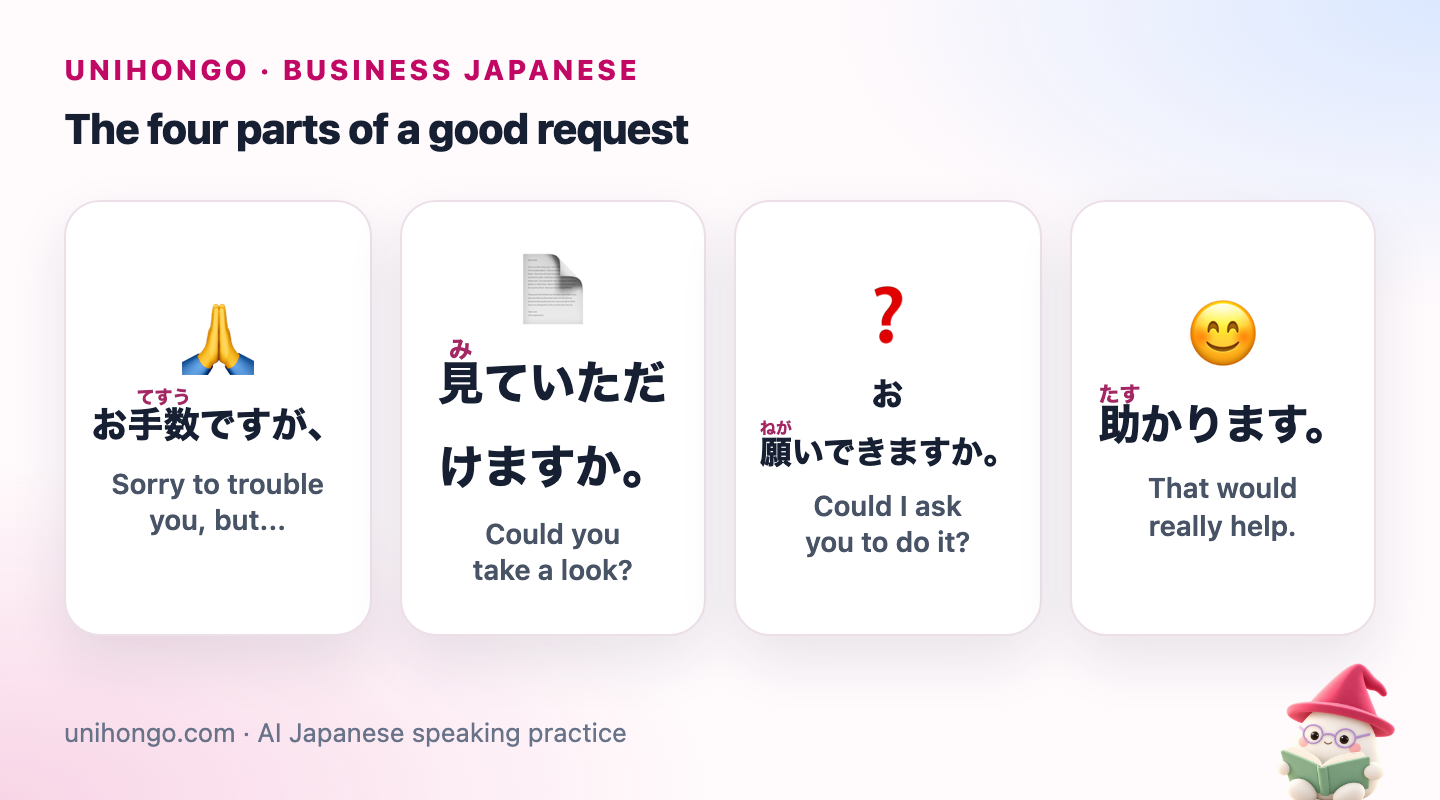
| Japanese | Romaji | Meaning |
|---|---|---|
| お手数ですが、 | Otesū desu ga, | Sorry to trouble you, but... |
| 見ていただけますか。 | Mite itadakemasu ka. | Could you take a look? |
| お願いできますか。 | Onegai dekimasu ka. | Could I ask you to do it? |
| 助かります。 | Tasukarimasu. | That would really help. |
The request ladder, one sentence on every rung
Here is one request, check this document, on five rungs. Each step down adds distance and softness. Negative questions, could you not, sound softer in Japanese than positive ones, because they leave more room to decline.
| Japanese | Romaji | Meaning |
|---|---|---|
| これ、見てくれる? | Kore, mite kureru? | Can you look at this? (casual) |
| これを見てもらえますか。 | Kore o mite moraemasu ka. | Could you look at this? (polite, to a peer) |
| こちらを確認していただけますか。 | Kochira o kakunin shite itadakemasu ka. | Could you check this? (respectful) |
| こちらをご確認いただけないでしょうか。 | Kochira o gokakunin itadakenai deshō ka. | Might you be able to check this? (softer keigo) |
| こちらをご確認いただけますと幸いです。 | Kochira o gokakunin itadakemasu to saiwai desu. | I would be grateful if you could check this. (written) |
| Pattern | Feel | Typical listener |
|---|---|---|
| te kureru? / te kurenai? | Casual, friendly | Friends, close peers in private |
| te moraemasu ka | Polite, direct | Peers and friendly colleagues |
| te itadakemasu ka | Respectful | Your manager, seniors, most clients |
| te itadakenai deshō ka | Respectful and soft | Bigger favors, senior people, clients |
| te itadakemasu to saiwai desu | Formal, written | Email to clients and senior staff |
Which rung to choose depends on two things: who the listener is, and how big the favor is. Asking your manager to glance at one slide can stay on te itadakemasu ka. Asking the same manager to give up a Saturday calls for te itadakenai deshō ka and a heavier cushion. Choosing a rung that is too high for a tiny favor sounds distant or even sarcastic, so match the effort you are asking for, not only the rank.
Cushion words and when each one fits
Cushion words, kusshon kotoba, are short phrases that go before a request, a question or bad news. They do not change the meaning, but they change how the request lands. Pick the one that matches the size of the favor and the situation; using the heaviest cushion for a tiny request sounds odd.
| Japanese | Romaji | Meaning |
|---|---|---|
| すみません、今少しよろしいでしょうか。 | Sumimasen, ima sukoshi yoroshii deshō ka. | Excuse me, do you have a moment? |
| 恐れ入りますが、 | Osoreirimasu ga, | I'm sorry to ask, but... (polite, all-purpose) |
| お忙しいところ申し訳ないのですが、 | Oisogashii tokoro mōshiwake nai no desu ga, | I'm sorry to bother you when you're busy, but... |
| 急なお願いで恐縮ですが、 | Kyū na onegai de kyōshuku desu ga, | I'm sorry this is so sudden, but... (formal) |
| もし可能でしたら、 | Moshi kanō deshitara, | If it's at all possible, |
Model dialogue: asking a senior to check your work
Here a newer employee asks a senior colleague, Satō, to check figures before tomorrow's meeting. The senior answers in friendly casual Japanese, which is normal from senior to junior; the junior stays in polite and respectful forms. Notice the reason, the deadline and the thanks.
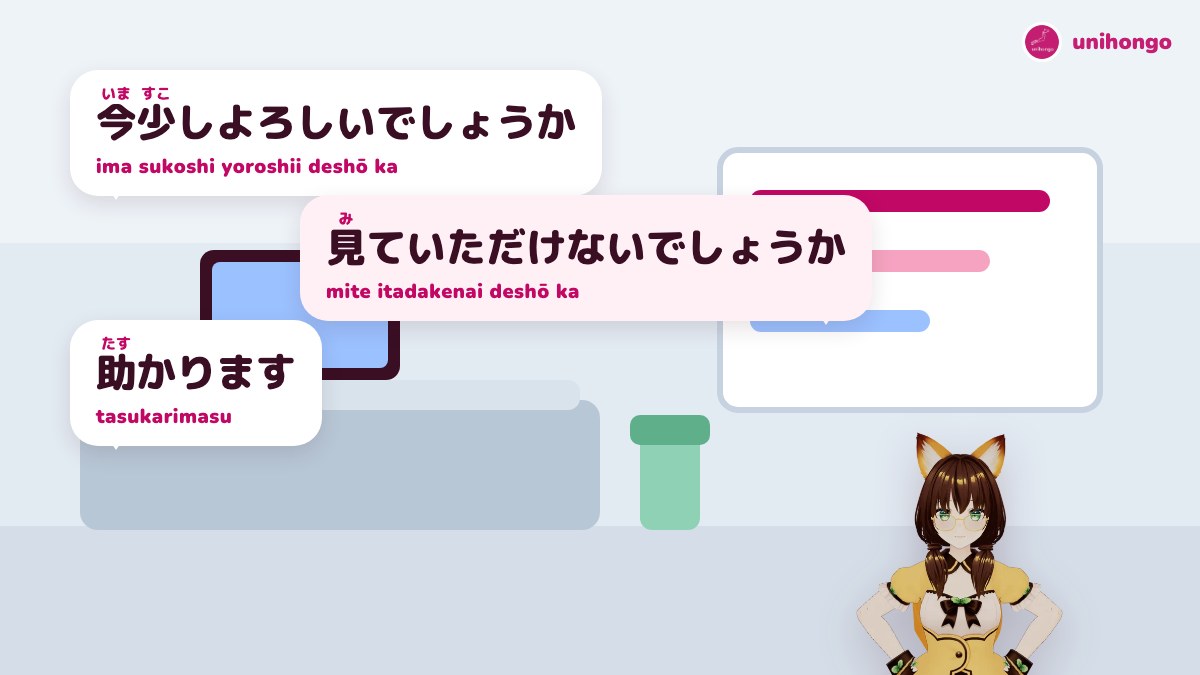
| Japanese | Romaji | Meaning |
|---|---|---|
| 佐藤さん、今少しよろしいでしょうか。 | Satō san, ima sukoshi yoroshii deshō ka. | You: Mr Sato, do you have a moment? |
| うん、どうしたの? | Un, dō shita no? | Senior: Sure, what's up? |
| お忙しいところ申し訳ないのですが、この資料を見ていただけないでしょうか。 | Oisogashii tokoro mōshiwake nai no desu ga, kono shiryō o mite itadakenai deshō ka. | You: Sorry to bother you, but could you possibly look at this document? |
| 明日の会議で使うもので、数字に間違いがないか心配でして。 | Ashita no kaigi de tsukau mono de, sūji ni machigai ga nai ka shinpai deshite. | You: It's for tomorrow's meeting, and I'm worried about the figures. |
| いいよ。いつまでに見ればいい? | Ii yo. Itsu made ni mireba ii? | Senior: Sure. By when do you need it? |
| できれば今日の五時までにお願いできますか。 | Dekireba kyō no goji made ni onegai dekimasu ka. | You: If possible, could you do it by five today? |
| わかった。四時ごろに声をかけるね。 | Wakatta. Yoji goro ni koe o kakeru ne. | Senior: OK. I'll give you a shout around four. |
| ありがとうございます。助かります。 | Arigatō gozaimasu. Tasukarimasu. | You: Thank you. That's a great help. |
| 先ほどはありがとうございました。おかげで間に合いました。 | Sakihodo wa arigatō gozaimashita. Okage de maniaimashita. | You, later: Thanks for earlier. Thanks to you, I made it in time. |
Asking a client in writing
With clients, most favors are asked in email, and the written forms are a little longer. The cushion grows into otesū o okake shimasu ga or gotabō no tokoro kyōshuku desu ga, and the request often ends in saiwai desu, I would be grateful. Give a clear date; a vague request is harder to say yes to.
| Japanese | Romaji | Meaning |
|---|---|---|
| お手数をおかけしますが、ご確認のほどよろしくお願いいたします。 | Otesū o okake shimasu ga, gokakunin no hodo yoroshiku onegai itashimasu. | Sorry for the trouble; I would be grateful if you could check it. |
| 恐れ入りますが、金曜日までにご返信いただけますと幸いです。 | Osoreirimasu ga, kin'yōbi made ni gohenshin itadakemasu to saiwai desu. | I would be grateful for your reply by Friday. |
| ご多忙のところ恐縮ですが、ご協力いただけないでしょうか。 | Gotabō no tokoro kyōshuku desu ga, gokyōryoku itadakenai deshō ka. | I know you are very busy, but could you possibly help us? |
Requests that sound like orders, and over-keigo
The most common mistake is a polite form that is still a directive. The second is mixing two keigo patterns into one verb. Both are easy to fix once you can hear them.
| Japanese | Romaji | Meaning |
|---|---|---|
| 確認してください。 | Kakunin shite kudasai. | Please check it. (an instruction to a senior) |
| 確認してほしいです。 | Kakunin shite hoshii desu. | I want you to check it. (too direct upward) |
| 確認してもらっていいですか。 | Kakunin shite moratte ii desu ka. | Is it OK if you check it? (common, but some find it presumptuous) |
| ご確認してください。 | Gokakunin shite kudasai. | Wrong mix: humble go...suru with kudasai |
| ご確認ください。 | Gokakunin kudasai. | Please check it. (correct, to clients in writing) |
- Go kakunin suru is a humble pattern for your own action, so it cannot be combined with kudasai for the other person's action.
- Te moratte ii desu ka is widespread among younger speakers, but it asks permission for the other person to do you a favor, which some listeners find odd. Te itadakemasu ka is safer upward.
- Stacking cushions, as in osoreirimasu ga, otesū desu ga, oisogashii tokoro mōshiwake arimasen ga, sounds anxious. One cushion is enough.
After the favor: thanks that close the loop
In many Japanese workplaces, thanking someone once when they agree is not quite enough. People often thank again when the favor is done, and sometimes once more the next day, saying how it helped. It costs one sentence and builds the trust that makes the next request easier.
| Japanese | Romaji | Meaning |
|---|---|---|
| 昨日はありがとうございました。とても助かりました。 | Kinō wa arigatō gozaimashita. Totemo tasukarimashita. | Thank you for yesterday. It really helped. |
| おかげさまで、無事に終わりました。 | Okagesama de, buji ni owarimashita. | Thanks to you, it went smoothly. |
| また何かあれば、いつでも言ってください。 | Mata nanika areba, itsudemo itte kudasai. | If you ever need anything, just let me know. |
Turn your own favors into practice
Tell Mocchi about a favor you really need, such as: I need my manager to approve my leave by Thursday; write the request at the right level and explain each part. Mocchi builds it with a cushion, a reason and a deadline, explains why it chose itadakemasu or itadakenai, and remembers your workplace details, so the next request you ask about starts from what it already knows.
To hear how it sounds in the room, ask Sakura-sensei in AI Sensei to play your busy senior colleague. Make the request, react when the Sensei asks for a later deadline, and thank them at the end. The session report shows which forms came out stiff or too direct.