
Eight luck proverbs at a glance
Here are eight sayings about fortune, from patient waiting to sudden windfalls to bad days that keep getting worse.
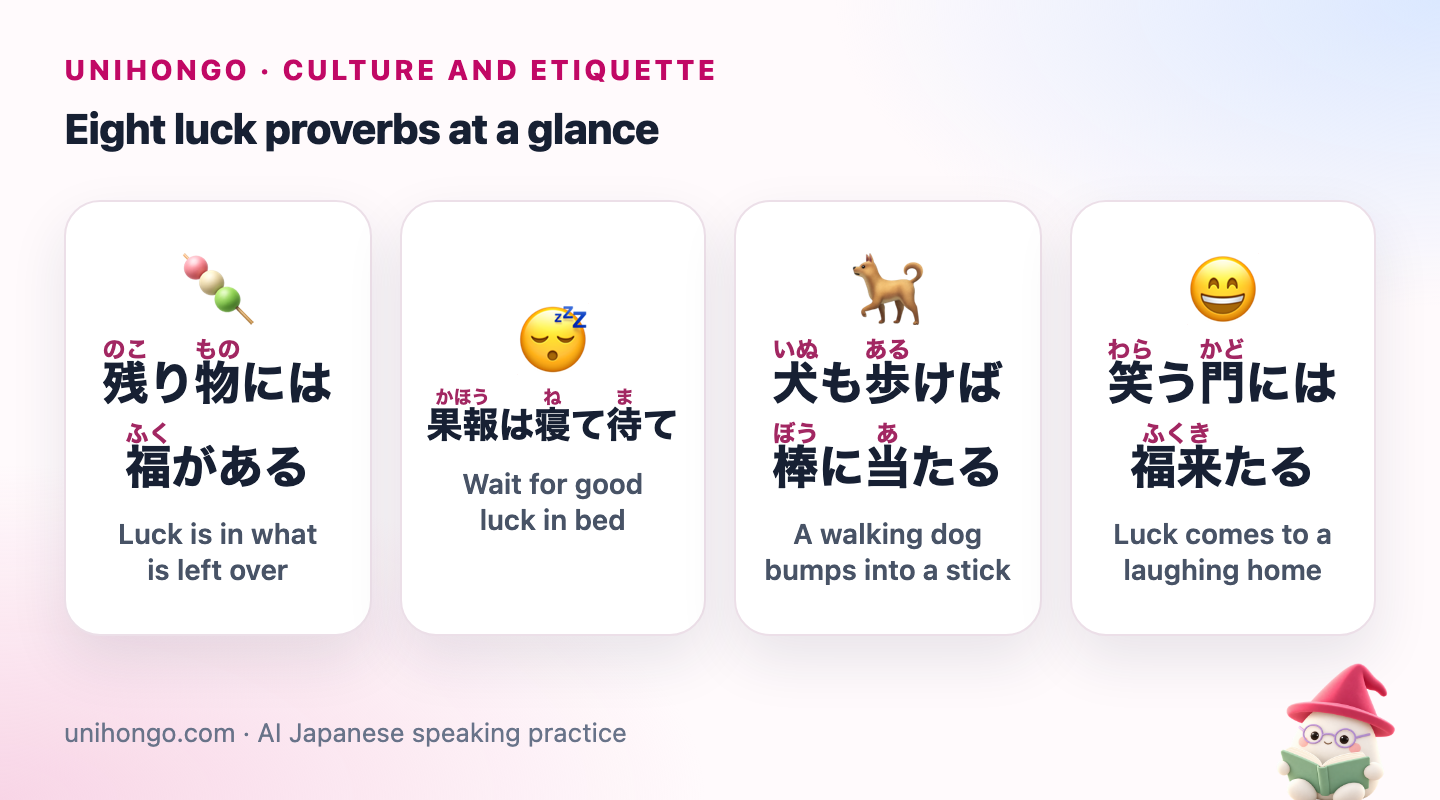
| Japanese | Romaji | Meaning |
|---|---|---|
| 残り物には福がある | Nokorimono ni wa fuku ga aru | Luck is in what is left over |
| 果報は寝て待て | Kahō wa nete mate | Wait for good luck in bed |
| 犬も歩けば棒に当たる | Inu mo arukeba bō ni ataru | A walking dog bumps into a stick |
| 笑う門には福来たる | Warau kado ni wa fuku kitaru | Luck comes to a laughing home |
| 棚からぼたもち | Tana kara botamochi | A rice cake falls off the shelf |
| 二度あることは三度ある | Nido aru koto wa sando aru | What happens twice happens thrice |
| 三度目の正直 | Sandome no shōjiki | Third time lucky |
| 泣きっ面に蜂 | Nakittsura ni hachi | A bee stings a crying face |
残り物には福がある and 棚ぼた: luck you did not plan
残り物には福がある is a cheerful line for when you get what is left. In a group, people often let others choose first, and the last person takes the remaining piece, prize or seat. Saying 残り物には福がある turns that small sacrifice into a joke about luck. It is very common at office snack time, raffles, gift exchanges and New Year lucky bags.
棚からぼたもち describes a sweet rice cake falling off a shelf straight into your mouth: luck you did nothing to earn. In conversation people almost always use the short form 棚ぼた, sometimes as an adjective, 棚ぼた的な, or in compounds like 棚ぼた勝利, a lucky win. It can sound a little self-deprecating, as if to say I did not deserve it.
| Japanese | Romaji | Meaning |
|---|---|---|
| 最後の一個だけど、残り物には福があるね。 | Saigo no ikko da kedo, nokorimono ni wa fuku ga aru ne. | It's the last one, but luck is in the leftovers. |
| じゃあ、私は最後でいいです。 | Jā, watashi wa saigo de ii desu. | Then I'm fine going last. |
| 席がアップグレードされた!棚ぼただ。 | Seki ga appugurēdo sareta! Tanabota da. | My seat got upgraded! What a windfall. |
果報は寝て待て: waiting the right way
果報 means good fortune, so 果報は寝て待て says wait for good fortune lying down. It does not mean be lazy. The idea is that once you have done what you can, luck is out of your hands, so relax and wait instead of worrying. People say it after an interview, an exam or an application, when there is nothing left to do but wait for the result.
Because it sounds relaxed, it suits friends and family. Said to a stressed colleague by a superior it can feel kind; said by someone who did nothing to help, it can sound dismissive.
| Japanese | Romaji | Meaning |
|---|---|---|
| 面接は終わったし、果報は寝て待てだね。 | Mensetsu wa owatta shi, kahō wa nete mate da ne. | The interview's done. Now just wait and relax. |
| 結果が気になって眠れない。 | Kekka ga ki ni natte nemurenai. | I can't sleep for thinking about the result. |
犬も歩けば棒に当たる: a proverb whose meaning shifted
This is the first card of the Edo iroha karuta, a traditional card game of proverbs, so many Japanese people know it from childhood. The original reading is a warning: a dog that wanders about will get hit with a stick, so if you poke your nose into things, you will run into trouble.
Today it is very often used the other way round: if you get out and do things, you may stumble on good luck. Both meanings appear in dictionaries. In practice, the situation makes it clear. A friend who found a great café by wandering a new neighbourhood might say it happily; a friend who got caught up in someone else's argument might say it with a sigh.
| Meaning | Tone | Example situation |
|---|---|---|
| Meddling brings trouble (older) | Warning | You got involved in a dispute that was not yours |
| Going out brings luck (common today) | Positive | You found a job lead at a random event |
Third time: 二度あることは三度ある vs 三度目の正直
These two give opposite forecasts, and Japanese speakers know it. 二度あることは三度ある, what happens twice happens a third time, is a warning: you have forgotten your umbrella twice this week, so watch out. 三度目の正直, the third time is the honest one, is hope: you failed the driving test twice, so this time it will work. People sometimes play them off against each other for a laugh.
笑う門には福来たる, luck comes through the gate of a laughing home, is a gentle, positive proverb about keeping your spirits up. It is a favourite on New Year cards and in family homes. 泣きっ面に蜂, a bee stings a face that is already crying, is bad luck on top of bad luck: you miss the last train and then it starts to rain. It is used for everyday misfortune with a rueful laugh, not for serious tragedies.
| Japanese | Romaji | Meaning |
|---|---|---|
| 二度あることは三度あるから、気をつけて。 | Nido aru koto wa sando aru kara, ki o tsukete. | It happened twice, so watch out for a third. |
| 三度目の正直で、今度こそ合格する! | Sandome no shōjiki de, kondo koso gōkaku suru! | Third time lucky: this time I'll pass! |
| 財布を忘れて、雨まで降ってきた。泣きっ面に蜂だ。 | Saifu o wasurete, ame made futte kita. Nakittsura ni hachi da. | I forgot my wallet, and now it's raining. Just my luck. |
Mini dialogue: drawing fortunes at a shrine
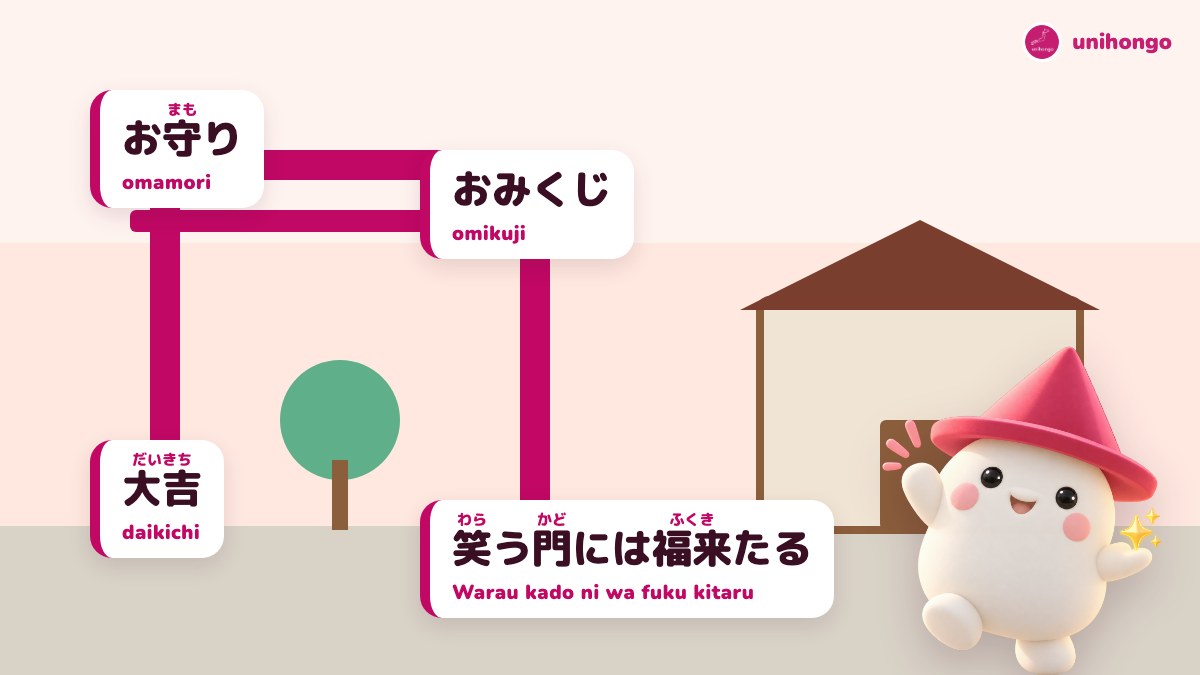
Two friends draw omikuji fortune slips after a New Year shrine visit. One gets a good result, the other a poor one, and proverbs do the comforting.
| Japanese | Romaji | Meaning |
|---|---|---|
| やった、大吉だ! | Yatta, daikichi da! | Friend: Yes, excellent luck! |
| いいなあ。私は凶だった。 | Ii nā. Watashi wa kyō datta. | You: Lucky you. I got bad luck. |
| 大丈夫、結んで帰れば平気だよ。 | Daijōbu, musunde kaereba heiki da yo. | Friend: It's fine, just tie it up here before we go. |
| そうだね。笑う門には福来たる、だね。 | Sō da ne. Warau kado ni wa fuku kitaru, da ne. | You: True. Keep smiling and luck will come. |
Tying a bad fortune slip to a rope or branch at the shrine, instead of taking it home, is a widespread custom, though practices vary by shrine and by person; some people tie every slip, and some keep good ones in their wallet.
When not to use a luck proverb
- Do not answer real misfortune, such as illness or a death, with 泣きっ面に蜂 or 二度あることは三度ある. They are for small everyday bad luck.
- Avoid 棚ぼた about someone else's promotion or success; it implies they did not earn it.
- 果報は寝て待て said to someone who has not done the work yet sounds like you are encouraging laziness.
- Do not read 果報 as kafō or 福 as fukū. They are kahō and fuku.
Everyday luck words: ついてる, 縁起 and 運
Proverbs about luck sit on top of a small set of very common words. You will hear these every day, often in places where English speakers would just say lucky or unlucky.
運がいい and 運が悪い are the neutral ways to say lucky and unlucky. In casual speech, ついてる and ついてない are even more common: 今日はついてない, today is not my day, is a classic sigh after a missed train and a spilt coffee. ラッキー, from English, is used as a cheerful exclamation. 縁起 is about omens: 縁起がいい describes things that are thought to bring good fortune, like a tea stalk floating upright in your cup, and 縁起が悪い describes things that are traditionally avoided, like giving certain gifts in certain numbers. Customs about omens vary by region and family, and many younger people treat them lightly.
These words pair naturally with the proverbs. 今日はついてないな、泣きっ面に蜂だ puts the plain feeling first and the proverb second, which is the natural order in conversation.
| Japanese | Romaji | Meaning |
|---|---|---|
| 今日は本当についてない。 | Kyō wa hontō ni tsuitenai. | Today is really not my day. |
| ラッキー!席が空いてた。 | Rakkī! Seki ga aiteta. | Lucky! There was a free seat. |
| 茶柱が立ってる。縁起がいいね。 | Chabashira ga tatteru. Engi ga ii ne. | A tea stalk is standing up. That's a good sign. |
| 運がよかったですね。 | Un ga yokatta desu ne. | That was lucky. (polite) |
Practise luck talk where it happens
Luck proverbs come alive at shrines, raffles and New Year, so practise them in that setting. First ask Mocchi on Unihongo for a quick drill: /quiz with the eight luck proverbs, mixing meanings and readings. Mocchi explains each answer and remembers the ones that tripped you up.
Then open AI Sensei, pick Ibuki-sensei and ask Ibuki-sensei to play a friend at a New Year shrine visit. Draw imaginary fortunes, react to good and bad results with a proverb each, and ask the Sensei to switch to casual speech so it feels like a real outing.