
In, out, push and pull
Four signs decide how you get through a door. 入口 and 出口 tell you which door to use, and 押す and 引く tell you what to do with your hand. On many doors you will see only the single kanji 押 or 引, without the kana.
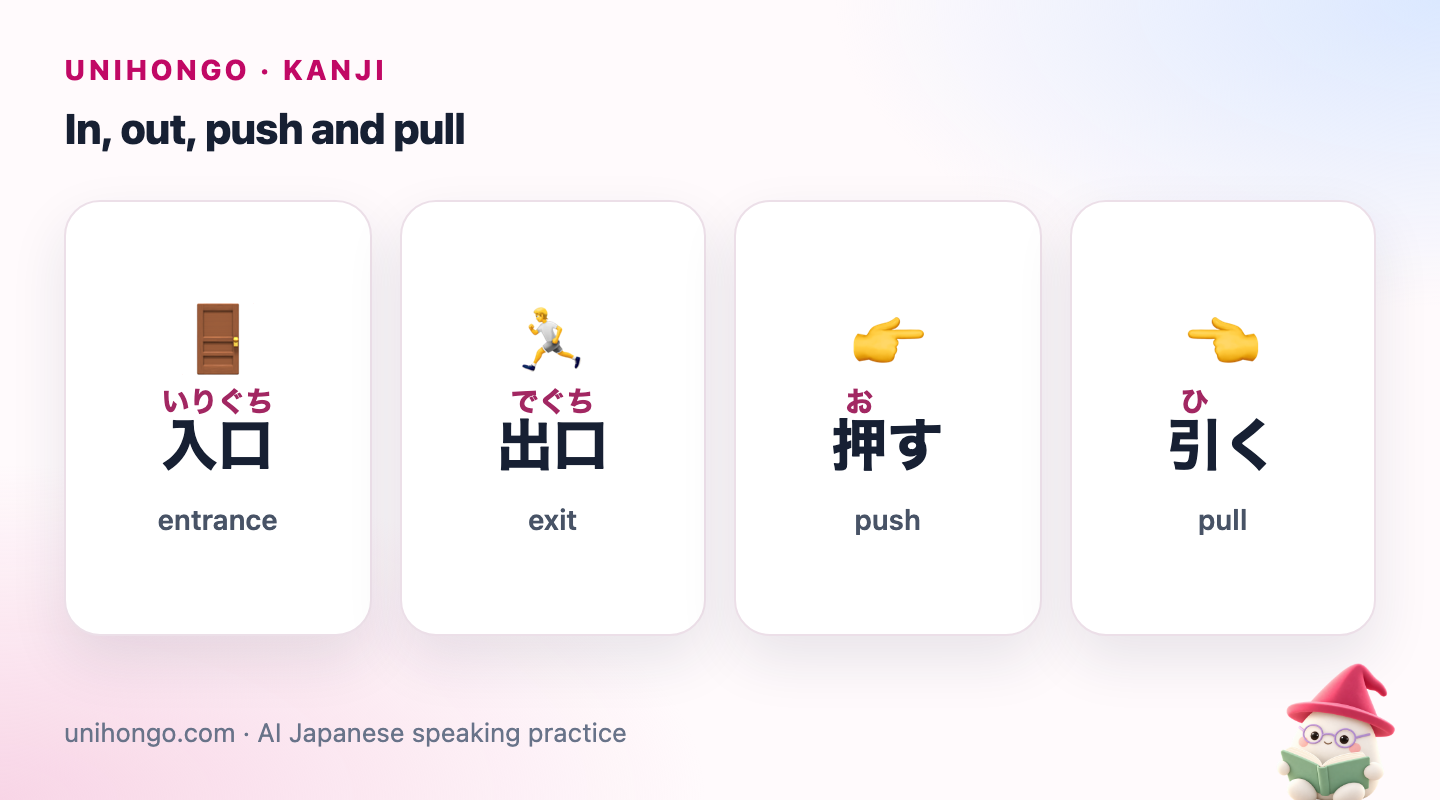
| Japanese | Romaji | Meaning |
|---|---|---|
| 入口 | iriguchi | entrance |
| 出口 | deguchi | exit |
| 押す | osu | push |
| 引く | hiku | pull |
入口 is also written 入り口 with the kana り, and both are correct. The 口 in these words is the kanji for mouth, used here for an opening: a way in is an entering mouth, and a way out is an exiting mouth.
Fourteen sign kanji as words
These words cover doors and buttons, shop doors, toilets and safety. The suffix 中, chū, in the middle of, turns a word into a status: open now, in use now, out of order now.
Buttons deserve a special mention. Toilet control panels in Japan often have many buttons, and the most important kanji is 止, stop, usually on an orange or red button. 流す, nagasu, means flush, and some toilets split it into 大, large, and 小, small, for a full or light flush. On ticket machines and intercoms, 取消, torikeshi, cancels and 呼出, yobidashi, calls a member of staff. You do not need to read every button, but these few save you a lot of guessing.
| Japanese | Romaji | Meaning |
|---|---|---|
| 非常口 | hijōguchi | emergency exit |
| 開く | hiraku | to open (lift button: 開) |
| 閉じる | tojiru | to close (lift button: 閉) |
| 営業中 | eigyōchū | open for business |
| 準備中 | junbichū | not open yet |
| 使用中 | shiyōchū | in use, occupied |
| 故障中 | koshōchū | out of order |
| 禁止 | kinshi | prohibited |
| 注意 | chūi | caution |
| 危険 | kiken | danger |
| 立入禁止 | tachiiri kinshi | no entry |
| お手洗い | otearai | toilets, restroom |
Readings and the parts inside
The table lists the main readings and a second word for each kanji, so you can see it working outside signs as well.
| Kanji | On reading | Kun reading | Another word |
|---|---|---|---|
| 入 | nyū | hai(ru), i(ru) | 入場 nyūjō, admission |
| 出 | shutsu | de(ru), da(su) | 出発 shuppatsu, departure |
| 口 | kō | kuchi | 人口 jinkō, population |
| 非 | hi | (none) | 非常 hijō, emergency |
| 常 | jō | tsune | 日常 nichijō, everyday life |
| 押 | ō | o(su) | 押し入れ oshiire, futon cupboard |
| 引 | in | hi(ku) | 引っ越し hikkoshi, moving house |
| 開 | kai | a(keru), hira(ku) | 開店 kaiten, opening a shop |
| 閉 | hei | shi(meru), to(jiru) | 閉店 heiten, closing a shop |
| 禁 | kin | (none) | 禁煙 kin'en, no smoking |
| 止 | shi | to(maru), ya(meru) | 中止 chūshi, cancellation |
| 注 | chū | soso(gu) | 注文 chūmon, order |
| 意 | i | (none) | 意味 imi, meaning |
| 危 | ki | abu(nai) | 危ない abunai, dangerous |
Notice that 非常, emergency, literally not usual: 非 means not and 常 means usual. Once you know this, 非常口 is easy to remember as the not-usual exit.
Shop doors and toilet doors
Small restaurants and shops hang a wooden or plastic sign on the door that turns over: one side says 営業中, the other 準備中. Many restaurants close between lunch and dinner, so 準備中 in mid-afternoon usually means come back later, not closed for good. Other door signs give the day's status or the regular closing day.
Toilets use 男 and 女, man and woman, often with colours: blue or black for men and red for women, though designs vary. 化粧室, keshōshitsu, literally powder room, and お手洗い are polite words for toilets on signs in department stores and hotels. On a toilet cubicle lock, red or 使用中 means occupied, and blue or 空き means free.
| Japanese | Romaji | Meaning |
|---|---|---|
| 本日休業 | honjitsu kyūgyō | closed today |
| 定休日 | teikyūbi | regular closing day |
| 男 | otoko | men |
| 女 | onna | women |
| 化粧室 | keshōshitsu | restroom (polite sign) |
| 空き | aki | vacant |
The two patterns: 禁止 and 注意
Most rule and warning signs are built the same way: a noun for the action or the danger, followed by 禁止 or 注意. Once you can read the second half, you know the type of sign immediately, even if the first half is new. The first half often uses kanji you already know, such as 駐車, parking, 撮影, photography, or 足元, around your feet.
Look for 危険 too. It is stronger than 注意 and is used for real danger, such as electricity, deep water or falling objects. In stations you will also see 駆け込み乗車はおやめください, please do not rush onto the train, a polite request rather than a 禁止 sign.
| Japanese | Romaji | Meaning |
|---|---|---|
| 駐車禁止 | chūsha kinshi | no parking |
| 撮影禁止 | satsuei kinshi | no photography |
| 禁煙 | kin'en | no smoking |
| 足元注意 | ashimoto chūi | watch your step |
| 頭上注意 | zujō chūi | mind your head |
| 関係者以外立入禁止 | kankeisha igai tachiiri kinshi | staff only, no entry |
Mini dialogue: asking about a sign
Staff use polite Japanese, often humble or formal phrases. You can stay with simple desu/masu.
| Japanese | Romaji | Meaning |
|---|---|---|
| すみません、ここは入れますか。 | Sumimasen, koko wa hairemasu ka. | You: Excuse me, can I go in here? |
| 申し訳ありません、こちらは関係者以外立入禁止です。 | Mōshiwake arimasen, kochira wa kankeisha igai tachiiri kinshi desu. | Staff: I'm sorry, this area is staff only. |
| そうですか。入口はどこですか。 | Sō desu ka. Iriguchi wa doko desu ka. | You: I see. Where is the entrance? |
| あちらの自動ドアからお入りください。 | Achira no jidō doa kara ohairi kudasai. | Staff: Please enter through the automatic doors over there. |
| ありがとうございます。 | Arigatō gozaimasu. | You: Thank you. |
お入りください is the respectful form of 入ってください, please come in. You will hear it from staff, but you do not need to use it yourself.
Look-alikes that matter on a sign
- 開 (open) vs 閉 (close): both have the gate 門. Inside 開 is a shape like two hands lifting a bar; inside 閉 is a single bar like a bolt. If in doubt on a lift, look for the arrow symbols too.
- 入 (enter) vs 人 (person) vs 八 (eight): in 入 the right stroke starts higher and leans over the left one.
- 引 (pull) vs 弓 (bow): 引 is a bow 弓 with a vertical line beside it, like a drawn string.
- 止 (stop) vs 正 (correct) vs 上 (up): 止 has no top stroke; 正 adds one.
- 禁 (forbid) is 林, two trees, over 示, an altar. The parts are visible, which makes it easy to recognise from a distance.
- 注 (pour, attention) vs 柱 (pillar) vs 住 (live): the left radical decides: water, tree or person.
Read signs at a glance
When you spot a sign you cannot read, type its text to Mocchi with /explain, for example /explain 関係者以外立入禁止. Mocchi splits it into 関係者, 以外, 立入 and 禁止, gives each reading, and keeps the words in your notes so a later /review brings them back.
For speed, add the fourteen sign words to your flashcards and use them in Kotoba Tank, one of Unihongo's games. Shooting the right answer before it reaches you trains the instant recognition that real signs demand: you rarely have time to stop and think in front of a lift.