
Go, come, go home and walk
Begin with a greeting that packs two movement kanji into one word. 行ってきます, literally I'll go and come back, is what you say every time you leave home. Then meet three verbs you will use every day.
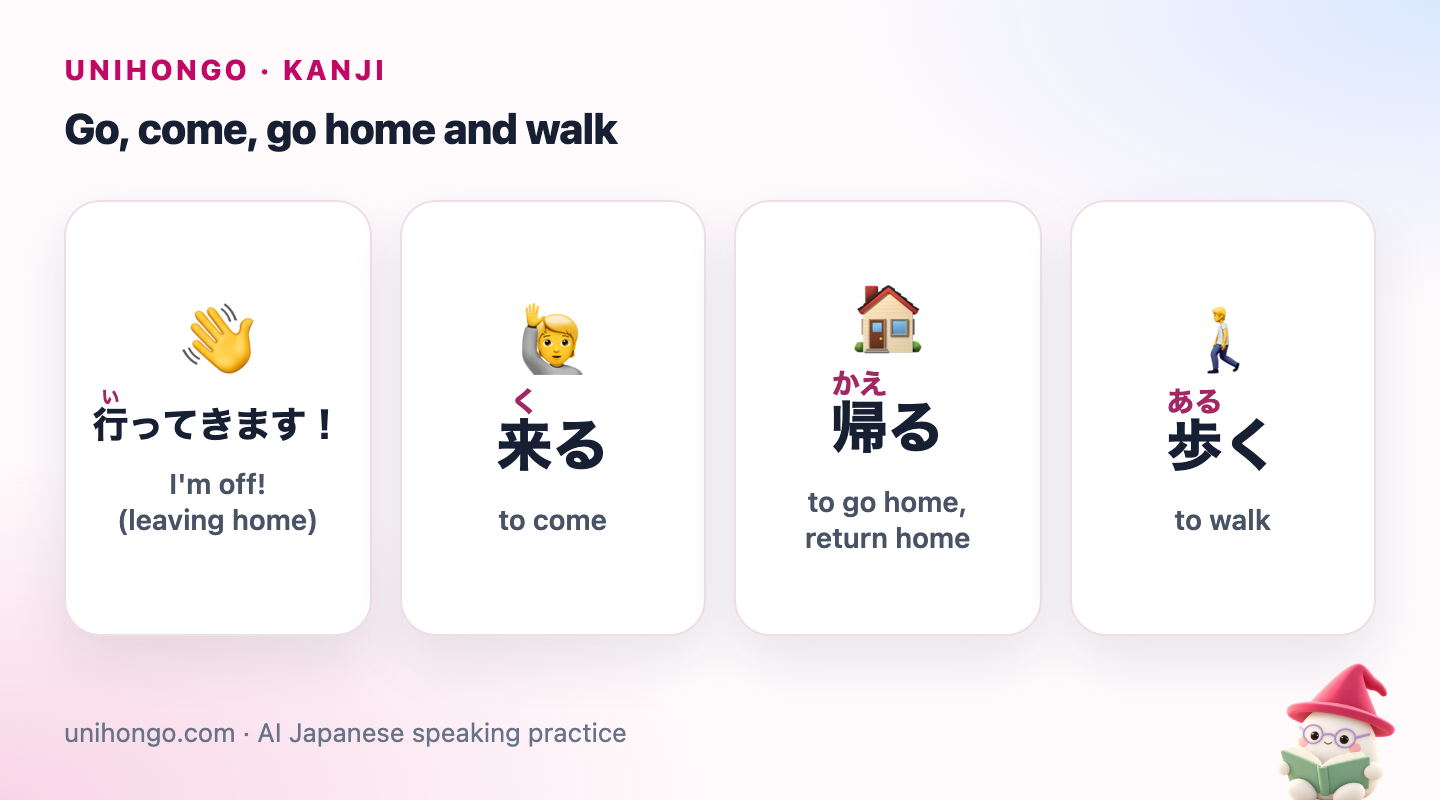
| Japanese | Romaji | Meaning |
|---|---|---|
| 行ってきます! | Ittekimasu! | I'm off! (leaving home) |
| 来る | kuru | to come |
| 帰る | kaeru | to go home, return home |
| 歩く | aruku | to walk |
In everyday writing, 行ってきます is often written in kana, いってきます, especially in messages. Both are correct; the kanji version makes the meaning go and come visible.
Fourteen movement verbs
These are the movement verbs you will use most, each with its kanji. The particle in the gloss shows how the verb is usually used.
| Japanese | Romaji | Meaning |
|---|---|---|
| 行く | iku | to go (に / へ a place) |
| 出る | deru | to go out, leave (を a place) |
| 入る | hairu | to enter (に a place) |
| 走る | hashiru | to run |
| 乗る | noru | to get on, ride (に a vehicle) |
| 降りる | oriru | to get off (を a vehicle) |
| 着く | tsuku | to arrive (に a place) |
| 通う | kayou | to commute, attend regularly |
| 渡る | wataru | to cross (を a road, bridge) |
| 戻る | modoru | to go back (to a recent place) |
| 登る | noboru | to climb (に / を a mountain) |
Readings and compounds you will see
As verbs, these kanji use their kun readings. In two-kanji words they switch to on readings, which is why 行 is i in 行く but kō in 旅行 and gyō in 行列. The compounds below are the ones you meet on signs, tickets and forms.
| Kanji | Verb | On reading | Common compound |
|---|---|---|---|
| 行 | 行く iku | kō, gyō | 旅行 ryokō, trip; 銀行 ginkō, bank |
| 来 | 来る kuru | rai | 来週 raishū, next week |
| 帰 | 帰る kaeru | ki | 帰国 kikoku, returning to one's country |
| 出 | 出る deru | shutsu | 出発 shuppatsu, departure |
| 入 | 入る hairu | nyū | 入学 nyūgaku, starting school |
| 歩 | 歩く aruku | ho | 歩道 hodō, pavement |
| 走 | 走る hashiru | sō | 競走 kyōsō, race |
| 乗 | 乗る noru | jō | 乗車券 jōshaken, train ticket |
| 降 | 降りる oriru | kō | 降車 kōsha, getting off |
| 着 | 着く tsuku | chaku | 到着 tōchaku, arrival |
| 通 | 通う kayou | tsū | 通学 tsūgaku, going to school |
| 渡 | 渡る wataru | to | 渡航 tokō, overseas travel |
| 戻 | 戻る modoru | rei | 戻す modosu, to put back (kun) |
| 登 | 登る noboru | tō, to | 登山 tozan, mountain climbing |
降 also means to fall, as in 雨が降る, ame ga furu, it rains. The same kanji covers coming down from a train and rain coming down from the sky. 戻 rarely appears in compounds in daily life; learn it as the verb.
The particle decides the meaning
Movement verbs come with particles, and getting them right matters more than the kanji. The rules are logical once you see them: に or へ marks where you go, を marks the place you leave or the path you move along, and で marks the means of transport.
へ, read e, puts a little more weight on direction, and に on the destination. In everyday speech they are often interchangeable with 行く and 来る. With 入る, 乗る and 着く, use に.
Add まで, made, when you want as far as or until: 駅まで歩きます, I'll walk as far as the station. まで fits verbs of continued movement such as 歩く, 走る and 行く, and it is common in directions: あの信号まで行って、右に曲がってください, go as far as that traffic light and turn right. を with a place, on the other hand, describes moving along or through it: 川沿いを走る, to run along the river.
| Japanese | Romaji | Meaning |
|---|---|---|
| 駅に行きます。 | Eki ni ikimasu. | I'm going to the station. |
| 家を出ました。 | Ie o demashita. | I left home. |
| 公園を歩きます。 | Kōen o arukimasu. | I walk through the park. |
| 電車に乗ります。 | Densha ni norimasu. | I get on the train. |
| 次の駅で降ります。 | Tsugi no eki de orimasu. | I'll get off at the next station. |
| バスで会社に通っています。 | Basu de kaisha ni kayotte imasu. | I commute to work by bus. |
Movement kanji on signs and at the station
The station is where these kanji pile up. Platform signs show 乗り場, noriba, the place to board; 〜行き, -yuki, means bound for, so 東京行き is a train bound for Tokyo. Announcements usually say yuki here, though iki is also heard. Road signs say 通行止め, road closed, and 歩行者, pedestrians. Arrival boards show 到着 and 出発.
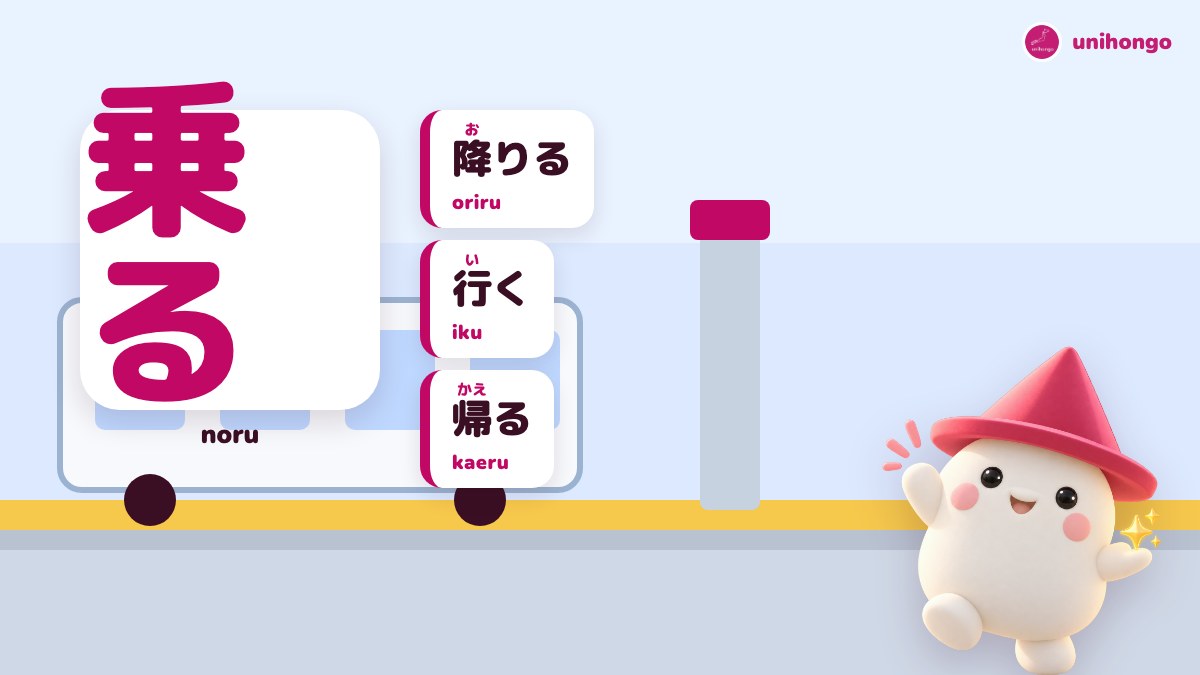
| Japanese | Romaji | Meaning |
|---|---|---|
| 乗り場 | noriba | boarding area, stop |
| 東京行き | Tōkyō yuki | bound for Tokyo |
| 通行止め | tsūkōdome | road closed |
| 歩行者専用 | hokōsha sen'yō | pedestrians only |
| 出発 | shuppatsu | departure |
Mini dialogue: on the way to meet a friend
A casual message exchange between friends. Watch 行く and 来る switch depending on who is moving towards whom.
| Japanese | Romaji | Meaning |
|---|---|---|
| 今どこ? | Ima doko? | Friend: Where are you now? |
| 今、駅に着いた。 | Ima, eki ni tsuita. | You: I just got to the station. |
| じゃあ、改札まで来て。 | Jā, kaisatsu made kite. | Friend: Then come to the ticket gate. |
| 分かった。今行く! | Wakatta. Ima iku! | You: OK. I'm coming now! |
| 急がなくていいよ。歩いてきて。 | Isoganakute ii yo. Aruite kite. | Friend: No rush. Just walk. |
| ありがとう。すぐ行くね。 | Arigatō. Sugu iku ne. | You: Thanks. Be right there. |
Notice 今行く for I'm coming. In Japanese the verb follows your movement from your own point of view, so going towards your friend is still 行く. 来る belongs to the friend's sentences, because you are coming to where they are.
At home the doorway greetings work the same way. Leaving: 行ってきます, and the person staying answers 行ってらっしゃい, itterasshai. Coming home: ただいま, and the answer is おかえり or, more politely, おかえりなさい.
Look-alikes and writing tips
- 来 (come) vs 米 (rice) vs 末 (end): 来 looks like 米 with an extra horizontal line on top; 末 has no dots at all.
- 歩 (walk) is 止, stop, on top of a shape like 少. The Chinese form 步 is slightly different at the bottom, so if you studied Chinese, check the Japanese form.
- 走 (run) has 土, earth, on top and a long sweep along the bottom; write the sweep last.
- 入 (enter) vs 人 (person): in 入 the right stroke starts higher.
- 帰 (return) vs 婦 (woman, wife): both share the broom-like right side; 帰 has two short strokes on the left.
- 行 is made of two parts, 彳 and 亍. Write the left part first, then the right, keeping a small gap between them.
Put the verbs on the move
Particles are where these verbs go wrong, so start there. Type to Mocchi: /grammar particles with 行く, 出る, 乗る and 降りる, then test me with ten sentences. Mocchi explains each choice, notes which particle trips you up and brings that pattern back in later practice.
For a quicker drill, play Sentence Builder in Unihongo's games. Putting 電車, に and 乗ります in the right order, again and again, makes 電車に乗る feel natural, so 電車を乗る stops sounding possible.