
Four seasons, four kanji
Start with the set and three weather words. 春夏秋冬 is a fixed expression you will see on calendars, product ranges and poems; each kanji on its own uses its native reading.
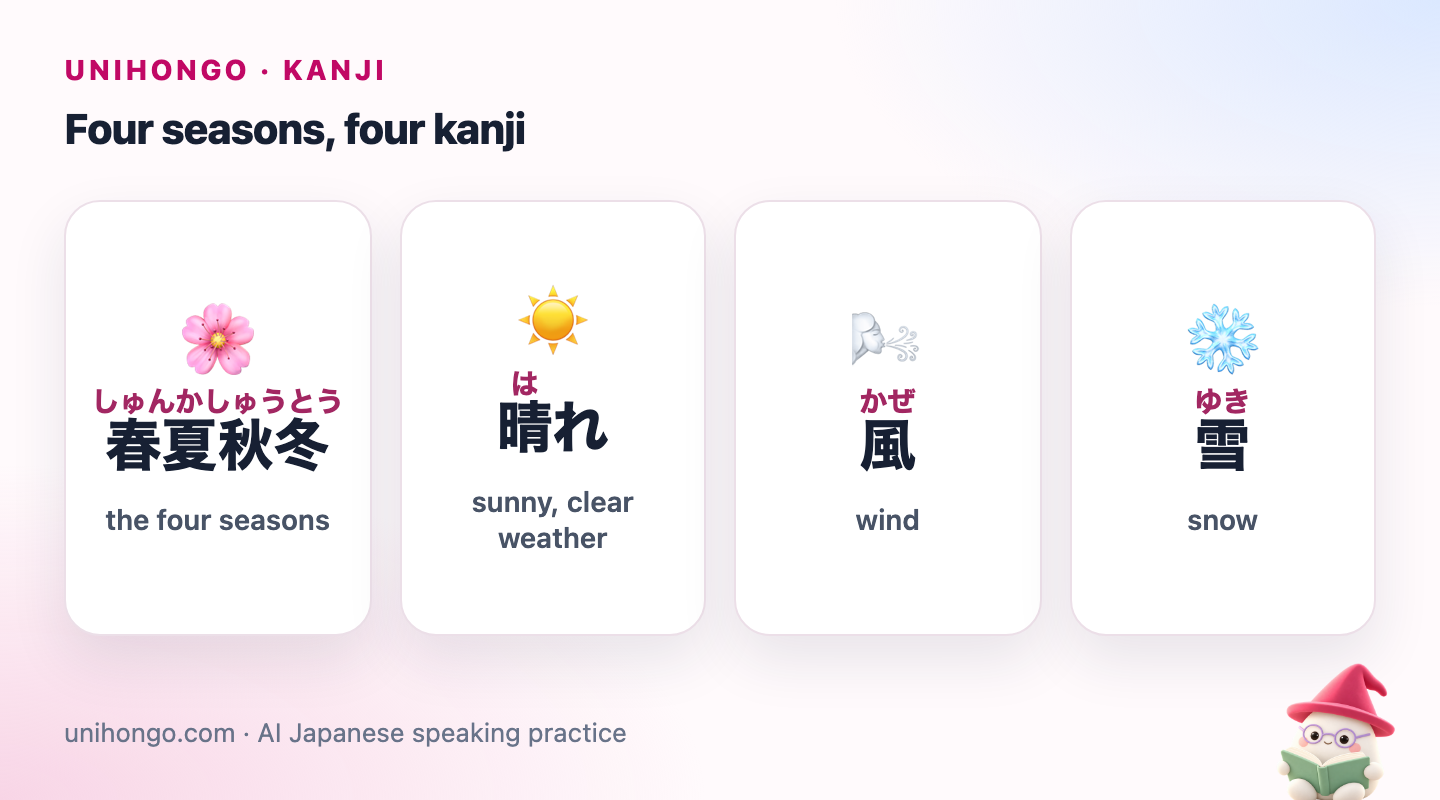
| Japanese | Romaji | Meaning |
|---|---|---|
| 春夏秋冬 | shunkashūtō | the four seasons |
| 晴れ | hare | sunny, clear weather |
| 風 | kaze | wind |
| 雪 | yuki | snow |
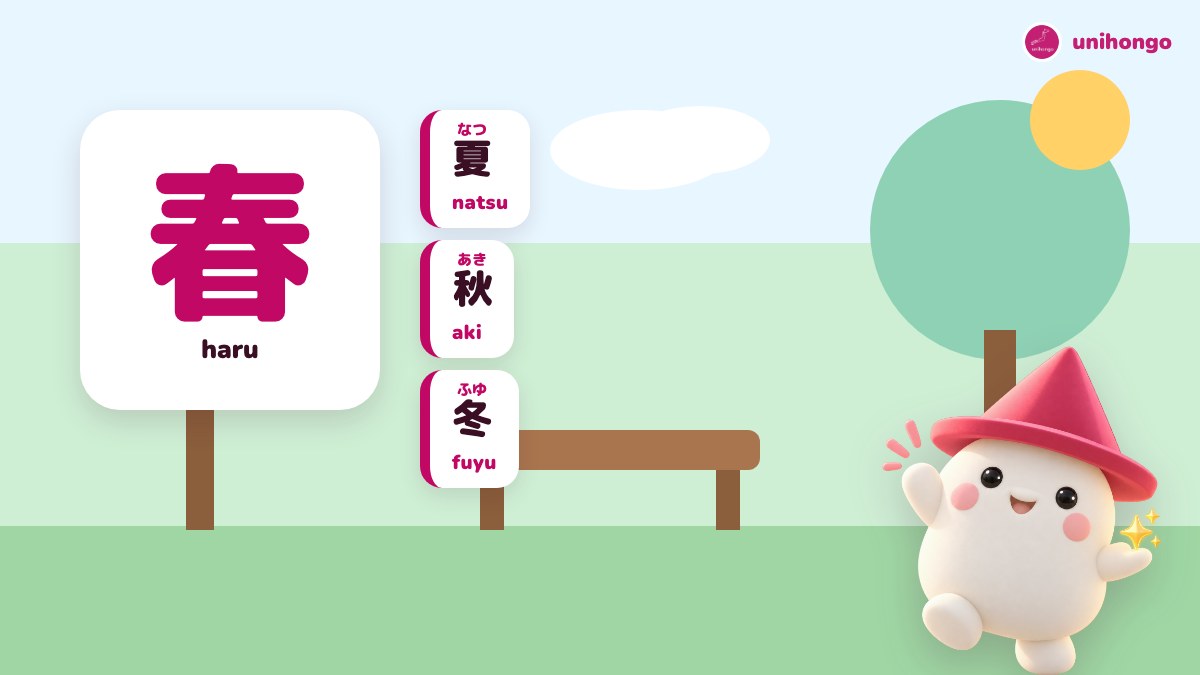
On their own the seasons are 春, 夏, 秋 and 冬: haru, natsu, aki, fuyu. In compounds the on readings appear, such as 立春, risshun, the traditional first day of spring in early February, and 冬季, tōki, the winter period, a word you see on notices about winter closing hours.
Seasonal words you use all year
These words show the season and weather kanji in everyday life. Most use the native readings, which is good news: if you know haru, natsu, aki and fuyu, you can already read half of them.
Pay attention to one small sound change. In 秋晴れ, akibare, the h of hare becomes b when the two words join. This softening is called rendaku, and it is common but not predictable: 夏祭り keeps matsuri, 初雪 keeps yuki, and 春休み keeps yasumi. So learn each seasonal word as a whole and check the reading once.
Two words in the list are worth extra attention because they look like something else. 曇り is the weather word, cloudy, written with the kana り; 曇 alone is what you see on forecast symbols. 晴れ着 contains 晴 but has nothing to do with the weather: 晴れ here means a special, formal occasion, so 晴れ着 is your best outfit for a celebration.
| Japanese | Romaji | Meaning |
|---|---|---|
| 春休み | haruyasumi | spring holidays |
| 夏祭り | natsumatsuri | summer festival |
| 秋晴れ | akibare | clear autumn weather |
| 冬休み | fuyuyasumi | winter holidays |
| 季節 | kisetsu | season |
| 梅雨 | tsuyu | rainy season |
| 曇り | kumori | cloudy weather |
| 風邪 | kaze | a cold (illness) |
| 初雪 | hatsuyuki | first snow of the year |
| 雪だるま | yukidaruma | snowman |
| 晴れ着 | haregi | best clothes for special days |
| 暑い | atsui | hot (weather) |
| 寒い | samui | cold (weather) |
Readings and memory hooks
Several of these kanji contain a clue to their meaning. The hooks below follow the visible parts; they are memory aids, not always the historical origin.
| Kanji | Readings | Memory hook | Common word |
|---|---|---|---|
| 春 | shun; haru | The sun 日 at the bottom of a growing plant | 青春 seishun, youth |
| 夏 | ka, ge; natsu | Shares the walking legs 夂 with 冬 | 夏休み natsuyasumi, summer holidays |
| 秋 | shū; aki | Grain 禾 next to fire 火: harvest time | 秋分 shūbun, autumn equinox |
| 冬 | tō; fuyu | Two drops of ice under walking legs | 冬季 tōki, winter period |
| 晴 | sei; ha(re) | Sun 日 plus blue 青: a blue sky | 晴天 seiten, fine weather |
| 曇 | don; kumo(ri) | Sun 日 covered by a cloud 雲 | 曇り空 kumorizora, cloudy sky |
| 風 | fū; kaze | A frame with a small insect inside | 台風 taifū, typhoon |
| 雪 | setsu; yuki | Rain 雨 on top | 大雪 ōyuki, heavy snow |
| 雨 | u; ame | Drops falling from the sky | 大雨 ōame, heavy rain |
| 季 | ki | Grain 禾 over child 子 | 季節 kisetsu, season |
| 節 | setsu | Bamboo on top: joints, divisions | 季節 kisetsu, season |
| 暑 | sho; atsu(i) | Sun 日 on top: hot weather | 暑中見舞い shochū mimai, summer card |
| 寒 | kan; samu(i) | Roof with ice dots below | 寒中見舞い kanchū mimai, winter card |
梅雨 and 風邪 are special readings of the whole word, so you cannot work them out from the single kanji. Learn them as units.
Seasonal expressions people really say
Weather small talk follows a script. The comment is less about information and more about sharing the moment, so agreement is the expected reply. These lines are polite; with friends, drop です and ね becomes the whole conversation: 寒いね.
Some expressions belong to particular times of year. 春一番, haru ichiban, is the first strong southerly wind of spring, which weather services announce for some regions in most years. 夏バテ, natsubate, is the tired, no-appetite feeling of a long hot summer, and people use it casually: 夏バテ気味です, I'm a bit worn out by the heat.
| Japanese | Romaji | Meaning |
|---|---|---|
| いいお天気ですね。 | Ii otenki desu ne. | Lovely weather, isn't it? |
| だんだん暖かくなってきましたね。 | Dandan atatakaku natte kimashita ne. | It's getting warmer, isn't it? |
| 梅雨が明けましたね。 | Tsuyu ga akemashita ne. | The rainy season is over. |
| 夏バテ気味です。 | Natsubate gimi desu. | I'm a bit worn out by the heat. |
| 風邪をひかないようにね。 | Kaze o hikanai yō ni ne. | Don't catch a cold. (casual, caring) |
Where you meet season kanji
Shops label limited seasonal products 季節限定, kisetsu gentei, and sometimes name the season directly: 春限定 or 冬季限定. Notices on shop doors and offices announce 夏季休業, summer closure, and 冬季休業, winter closure, with the dates. Midsummer and midwinter greeting cards start with 暑中見舞い or 寒中見舞い, and school calendars mark 春休み, 夏休み and 冬休み.
Kitchens follow the seasons too. Menus may mark spring dishes with 春, autumn ones with 秋 or 秋の味覚, autumn flavours, and winter hot-pot menus appear with 冬. Reading the season kanji often tells you what is new on the menu.
| Japanese | Romaji | Meaning |
|---|---|---|
| 季節限定 | kisetsu gentei | limited seasonal item |
| 夏季休業 | kaki kyūgyō | closed for summer |
| 暑中お見舞い申し上げます。 | Shochū omimai mōshiagemasu. | Summer greetings. (formal card opening) |
Mini dialogue: which season do you like?
A casual chat between two friends. Notice the plain forms and the sentence-final かな, which softens an answer like I guess.
| Japanese | Romaji | Meaning |
|---|---|---|
| どの季節が一番好き? | Dono kisetsu ga ichiban suki? | Friend: Which season do you like best? |
| 秋かな。涼しいし、食べ物がおいしいし。 | Aki kana. Suzushii shi, tabemono ga oishii shi. | You: Autumn, I guess. It's cool, and the food is good. |
| 分かる。私は春。桜が好きだから。 | Wakaru. Watashi wa haru. Sakura ga suki da kara. | Friend: I get it. Me, spring, because I love the cherry blossoms. |
| 夏は? | Natsu wa? | You: What about summer? |
| 夏は暑すぎる。でも夏祭りは好き。 | Natsu wa atsusugiru. Demo natsumatsuri wa suki. | Friend: Too hot. But I like summer festivals. |
| じゃあ、今年は一緒に行こう。 | Jā, kotoshi wa issho ni ikō. | You: Then let's go together this year. |
This is friend-to-friend speech. With a colleague or a teacher, the same chat would use desu and masu: どの季節が一番好きですか, 秋ですね, 涼しいですし. The ending 〜し、〜し lists reasons and suggests there could be more; it is very common when explaining a preference, in both casual and polite speech.
Seasons are also a reliable follow-up topic when a conversation stalls. Asking what someone does in summer, or whether their home town gets much snow, almost always gets a longer answer than a yes-or-no question.
Look-alikes and writing tips
- 秋 (autumn) vs 私 (I): both have the grain radical 禾 on the left. 秋 has fire 火, 私 has a small ム.
- 冬 (winter) vs 各 (each): both start with 夂. 冬 has two dots below; 各 has a mouth 口.
- 雪 (snow) vs 雷 (thunder) vs 雲 (cloud): all wear the rain radical; read the bottom part.
- 晴 (clear) vs 清 (pure) vs 静 (quiet): all contain 青, blue. The sun 日 on the left makes it weather.
- When writing the rain radical 雨 on top of another kanji, flatten it so the lower part has room, and write its four dots small.
- 風 is written outer frame first, then the inside; keep the frame wide at the bottom.
A season a week
Ask Mocchi for a reading made for you: /read a short text about the four seasons in Japan, at my level, then quiz me on the season kanji. Mocchi writes the text, explains any sentence you ask about with /explain, and remembers which kanji gave you trouble so they come back in review.
Then turn the thirteen words into flashcards and play Flashcard Flip in Unihongo's games. Matching 梅雨 to tsuyu and 風邪 to kaze against the clock is a quick way to lock in the special readings.