

The story: 電車が遅れた日
Read the text once without stopping. The narrator is going to meet a friend to see a film on a Sunday afternoon.
The story mixes two registers: polite narration and two casual quoted messages. When you reach a 「」 bracket, switch your mental voice to a friend's chat style. If you read the casual lines as if they were polite, the dropped particles and short forms will look like mistakes.
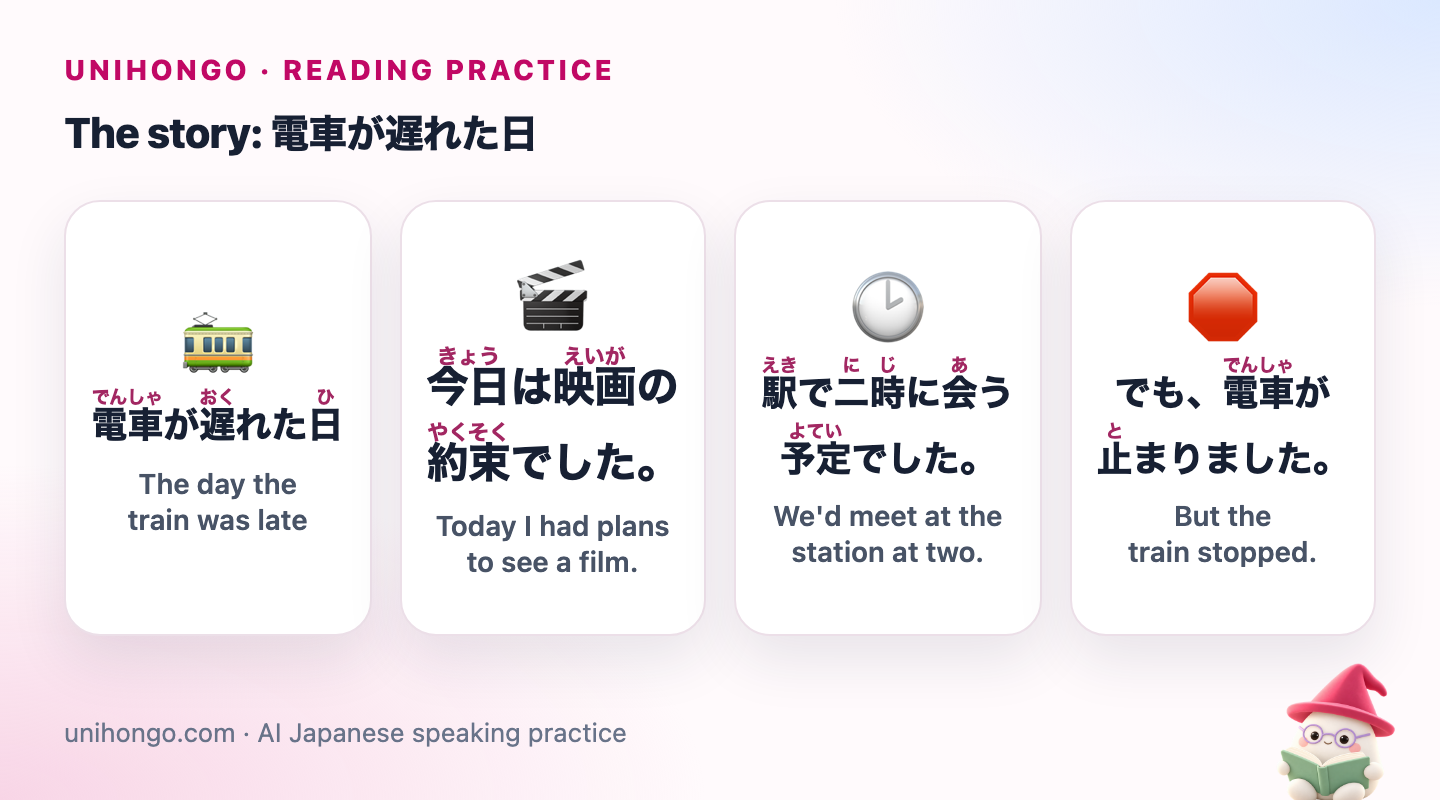
| Japanese | Romaji | Meaning |
|---|---|---|
| 電車が遅れた日 | Densha ga okureta hi | The day the train was late |
| 今日は映画の約束でした。 | Kyō wa eiga no yakusoku deshita. | Today I had plans to see a film. |
| 駅で二時に会う予定でした。 | Eki de niji ni au yotei deshita. | We'd meet at the station at two. |
| でも、電車が止まりました。 | Demo, densha ga tomarimashita. | But the train stopped. |
| 車内アナウンスによると、信号のトラブルがあったそうです。 | Shanai anaunsu ni yoru to, shingō no toraburu ga atta sō desu. | According to the announcement, there was a signal problem. |
| 電車は二十分ぐらい動きませんでした。 | Densha wa nijuppun gurai ugokimasen deshita. | The train didn't move for about twenty minutes. |
| 遅れることが分かったので、すぐ友だちにメッセージを送りました。 | Okureru koto ga wakatta node, sugu tomodachi ni messēji o okurimashita. | I knew I'd be late, so I messaged my friend right away. |
| 「ごめん、電車が止まってて、二十分ぐらい遅れそう。」 | "Gomen, densha ga tomattete, nijuppun gurai okuresō." | "Sorry, my train's stopped. Looks like I'll be twenty minutes late." |
| 友だちは「大丈夫だよ。カフェで待ってるね」と返事をくれました。 | Tomodachi wa "Daijōbu da yo. Kafe de matteru ne" to henji o kuremashita. | My friend replied, "No problem. I'll wait in a café." |
| 駅に着いた時、映画はもう始まっていました。 | Eki ni tsuita toki, eiga wa mō hajimatte imashita. | When I reached the station, the film had already started. |
| 私は走ってカフェに行って、もう一度謝りました。 | Watashi wa hashitte kafe ni itte, mō ichido ayamarimashita. | I ran to the café and apologised again. |
| 友だちは「次の回にしよう」と言いました。 | Tomodachi wa "Tsugi no kai ni shiyō" to iimashita. | My friend said, "Let's go to the next showing." |
| 次の回まで一時間あったので、二人でケーキを食べました。 | Tsugi no kai made ichijikan atta node, futari de kēki o tabemashita. | We had an hour until then, so we had cake together. |
| 遅延証明書をもらったことはありますが、友だちには使えません。 | Chien shōmeisho o moratta koto wa arimasu ga, tomodachi ni wa tsukaemasen. | I've had delay certificates before, but they don't work on friends. |
| 次は早めに家を出ようと思います。 | Tsugi wa hayame ni ie o deyō to omoimasu. | Next time, I'll leave home earlier. |
Vocabulary notes
These are the words you meet on train displays and in late-running messages.
| Japanese | Romaji | Meaning |
|---|---|---|
| 約束 | yakusoku | plans with someone, a promise |
| 予定 | yotei | plan, schedule |
| 車内アナウンス | shanai anaunsu | announcement inside the train |
| 信号 | shingō | signal, traffic light |
| 動く | ugoku | to move, to run (machines) |
| 返事 | henji | reply |
| 謝る | ayamaru | to apologise |
| 回 | kai | a showing, a round, a time |
| 遅延 | chien | delay (written, formal) |
| 早めに | hayame ni | a little early, earlier than usual |
約束 and 予定 are easy to mix up. 約束 is an arrangement with another person, so you can say 友だちと約束がある. 予定 is any plan on your schedule, with or without others. Also notice 遅れる (to be late) and 遅延 (delay): the same kanji 遅, but the second is the written word you see on station displays such as 遅延 or 運転見合わせ.
Grammar notes: two kinds of そう, quoting and resolutions
Pairs again: a line from the story first, a new example second.
| Japanese | Romaji | Meaning |
|---|---|---|
| アナウンスによると、トラブルがあったそうです。 | Anaunsu ni yoru to, toraburu ga atta sō desu. | From the text: The announcement said there was trouble. |
| 天気予報によると、明日は雨だそうです。 | Tenki yohō ni yoru to, ashita wa ame da sō desu. | According to the forecast, it'll rain tomorrow. |
| 二十分ぐらい遅れそう。 | Nijuppun gurai okuresō. | From the text: Looks like I'll be twenty minutes late. |
| 雨が降りそうですね。 | Ame ga furisō desu ne. | It looks like it's going to rain. |
| 友だちは「次の回にしよう」と言いました。 | Tomodachi wa "Tsugi no kai ni shiyō" to iimashita. | From the text: My friend said, "Let's go to the next one." |
| 先生は「明日はテストです」と言いました。 | Sensei wa "Ashita wa tesuto desu" to iimashita. | The teacher said, "There's a test tomorrow." |
| 次は早めに家を出ようと思います。 | Tsugi wa hayame ni ie o deyō to omoimasu. | From the text: Next time I'll leave earlier. |
| 今日は早く寝ようと思います。 | Kyō wa hayaku neyō to omoimasu. | I'm going to go to bed early tonight. |
The hearsay そうです takes a full plain form: あったそうです, 雨だそうです. The looks-like そう attaches to a verb stem: 遅れそう, 降りそう. In the story, the first is information the narrator heard; the second is the narrator's own prediction. Quotation with 「…」と言いました keeps the speaker's original words and register; in casual speech, と often becomes って.
Saying sorry when you are late
Japanese has several levels of apology, and lateness is where learners use them most. With friends, short casual forms are natural and a reason is optional. With teachers, colleagues and clients, use polite forms, give the reason briefly and say when you will arrive. Many people message before the meeting time rather than after, which counts as good manners in itself.
When you finally arrive, a second apology is normal, as the narrator does in the story. With friends, 待たせてごめん is warm and natural. In polite settings, お待たせしました or 遅くなって申し訳ありません is expected.
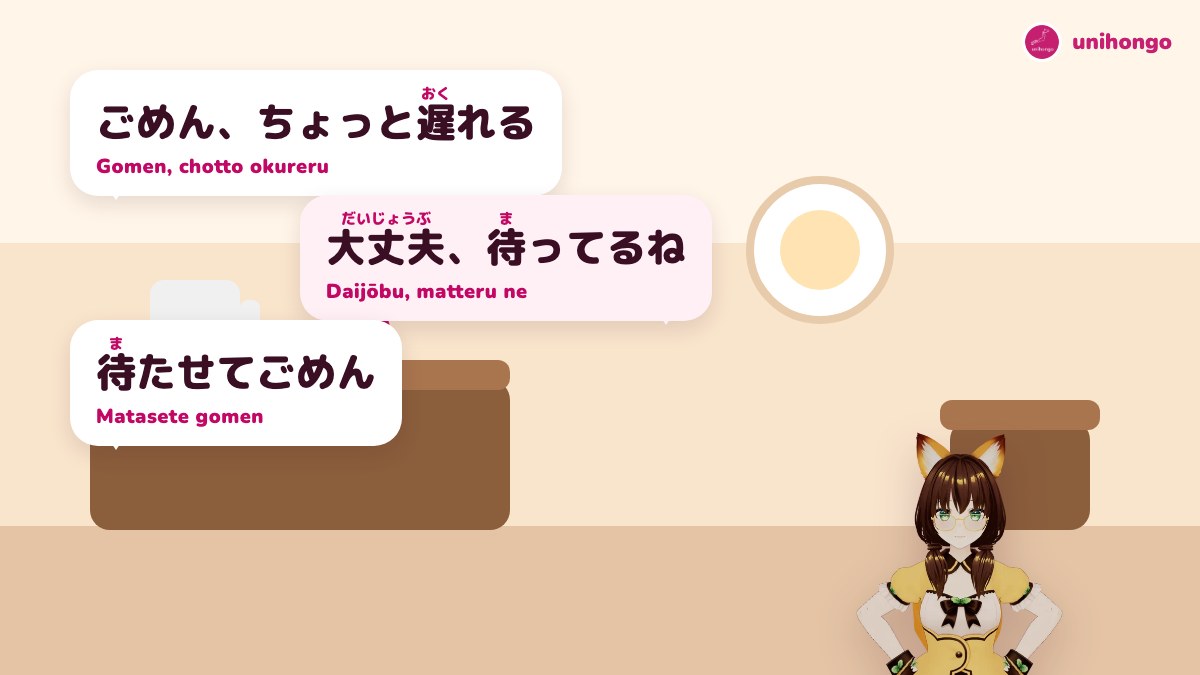
| Japanese | Romaji | Meaning |
|---|---|---|
| ごめん、ちょっと遅れる。 | Gomen, chotto okureru. | Sorry, I'll be a bit late. (casual) |
| 大丈夫、待ってるね。 | Daijōbu, matteru ne. | Friend: No worries, I'll wait. (casual) |
| 待たせてごめん。 | Matasete gomen. | Sorry to keep you waiting. (casual) |
| 遅くなってすみません。 | Osoku natte sumimasen. | Sorry I'm late. (polite) |
| 電車が遅れていて、十分ぐらい遅れます。 | Densha ga okurete ite, juppun gurai okuremasu. | My train is delayed; I'll be about ten minutes late. (polite) |
| お待たせして申し訳ありません。 | Omatase shite mōshiwake arimasen. | I'm very sorry to have kept you waiting. (formal) |
Reading traps in this text
- 遅れることが分かったので uses 分かる in the sense of found out or realised, not understood. こと turns 遅れる into the fact that I would be late.
- 返事をくれました is くれる used with a noun: my friend gave me a reply. You will see the same pattern in プレゼントをくれた.
- 映画はもう始まっていました is ている in the past for a state: the film had already started. It does not mean it was starting.
- 走ってカフェに行って uses 走って for manner: I went to the café by running, not I ran and then went.
- 次の回にしよう uses 〜にする, to decide on, in the volitional form: let's go for the next showing.
Check your understanding
Three questions. The answers are below.
- Why did the train stop?
- What did the friend do while waiting?
- Why can't the narrator use a delay certificate with a friend?
Answers
| Japanese | Romaji | Meaning |
|---|---|---|
| 信号のトラブルがあったからです。 | Shingō no toraburu ga atta kara desu. | 1. Because there was a signal problem. |
| カフェで待っていました。 | Kafe de matte imashita. | 2. The friend waited in a café. |
| 遅延証明書は学校や会社に出すものだからです。 | Chien shōmeisho wa gakkō ya kaisha ni dasu mono da kara desu. | 3. It's for school or work, not for friends. |
Question 3 asks you to read between the lines. The text never says why the certificate is useless; you need the background knowledge in the vocabulary notes. JLPT reading questions sometimes work the same way, so it pays to notice when a writer is making a small joke.
Read it aloud, two voices
- Read the narration in a calm polite voice, sentence by sentence.
- Read the two quoted messages faster and lighter, as real chat: gomen, densha ga tomattete.
- Watch the long vowels and double consonants: shingō, nijuppun, chien shōmeisho.
- Read the whole story at a natural pace without stopping at quotes.
- Retell it in four sentences, using 〜そうです once and 〜ようと思います once.
Practise the message you will actually send
Next time a train stops, you will have about a minute to type something. Prepare it now: write a casual late message to a friend and a polite one to a teacher, and send both to Mocchi on Unihongo. Mocchi will correct them, tell you whether each register fits the person, and remember any mistake you keep making with 〜そう.
Then make it spoken. The roleplay mission Call Work About a Train Delay in AI Sensei puts you on the phone with your workplace while the train is stuck, so you practise the polite version under a little time pressure.