

The text: 新しい友達 (My new friend)
Read it once without the English. Note three facts about Ana and one about the writer.
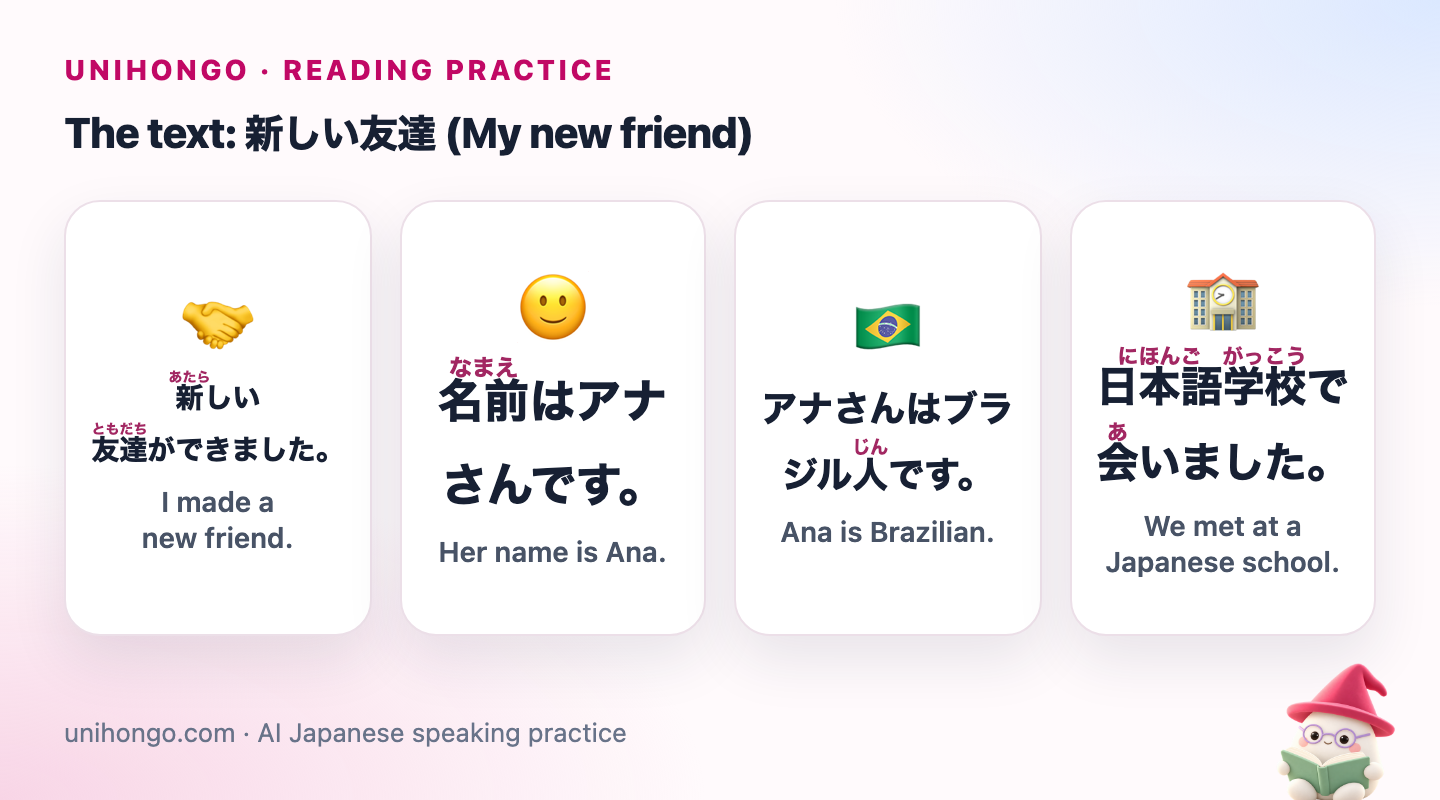
| Japanese | Romaji | Meaning |
|---|---|---|
| 新しい友達ができました。 | Atarashii tomodachi ga dekimashita. | I made a new friend. |
| 名前はアナさんです。 | Namae wa Ana san desu. | Her name is Ana. |
| アナさんはブラジル人です。 | Ana san wa Burajirujin desu. | Ana is Brazilian. |
| 日本語学校で会いました。 | Nihongo gakkō de aimashita. | We met at a Japanese school. |
| アナさんは料理が好きです。 | Ana san wa ryōri ga suki desu. | Ana likes cooking. |
| 私の趣味は写真です。 | Watashi no shumi wa shashin desu. | My hobby is photography. |
| 先週の日曜日、二人で公園へ行きました。 | Senshū no nichiyōbi, futari de kōen e ikimashita. | Last Sunday, the two of us went to the park. |
| アナさんはブラジルの歌を歌いました。 | Ana san wa Burajiru no uta o utaimashita. | Ana sang a Brazilian song. |
| 私はアナさんの写真を撮りました。 | Watashi wa Ana san no shashin o torimashita. | I took photos of Ana. |
| アナさんはポルトガル語と英語ができます。 | Ana san wa Porutogarugo to eigo ga dekimasu. | Ana can speak Portuguese and English. |
| でも、漢字はまだ苦手です。 | Demo, kanji wa mada nigate desu. | But she still finds kanji hard. |
| 私はポルトガル語がぜんぜんわかりません。 | Watashi wa Porutogarugo ga zenzen wakarimasen. | I don't understand Portuguese at all. |
| だから、私たちはいつも日本語で話します。 | Dakara, watashitachi wa itsumo nihongo de hanashimasu. | So we always talk in Japanese. |
| 来週、一緒に料理を作ります。 | Raishū, issho ni ryōri o tsukurimasu. | Next week we're going to cook together. |
The writer calls the friend アナさん throughout, even in writing. Adding さん to a friend's name is normal in Japanese until you agree to drop it, and you never add さん to your own name.
Vocabulary notes
Nationality and language words follow a pattern, so learning a few unlocks many more. The table shows the pattern; the phrase rows cover the other words in the text.
| Japanese | Romaji | Meaning |
|---|---|---|
| 日本語学校 | nihongo gakkō | Japanese language school |
| 趣味 | shumi | hobby (N4) |
| 歌 | uta | song |
| 歌いました | utaimashita | sang |
| 苦手 | nigate | weak at, not good with (N4) |
| ぜんぜん | zenzen | not at all (with a negative) |
| だから | dakara | so, that's why |
| 一緒に | issho ni | together |
| Country | Nationality (+人) | Language (+語) |
|---|---|---|
| ブラジル (Brazil) | ブラジル人 | ポルトガル語 |
| 日本 (Japan) | 日本人 | 日本語 |
| アメリカ (USA) | アメリカ人 | 英語 |
| 中国 (China) | 中国人 | 中国語 |
| フランス (France) | フランス人 | フランス語 |
| ベトナム (Vietnam) | ベトナム人 | ベトナム語 |
English does not follow the pattern: the language of the USA and the UK is 英語, not アメリカ語 or イギリス語. The same is true for countries whose main language has a different name, as with Brazil and Portuguese.
苦手 is softer than できません. 漢字が苦手です means kanji is not my strong point or I find kanji hard, which is a polite, modest thing to say about yourself.
Grammar notes: four patterns in the text
Each pattern comes with its sentence from the text and one new example.
| Japanese | Romaji | Meaning |
|---|---|---|
| アナさんはブラジル人です。 | Ana san wa Burajirujin desu. | Person は country + 人 です. (text) |
| リーさんは中国人です。 | Rī san wa Chūgokujin desu. | Mr Lee is Chinese. (new example) |
| ポルトガル語と英語ができます。 | Porutogarugo to eigo ga dekimasu. | N が できます: can do, can speak. (text) |
| 兄はテニスができます。 | Ani wa tenisu ga dekimasu. | My older brother can play tennis. (new example) |
| いつも日本語で話します。 | Itsumo nihongo de hanashimasu. | Language + で: in a language. (text) |
| 英語で書いてもいいですか。 | Eigo de kaite mo ii desu ka. | May I write it in English? (new example) |
| だから、日本語で話します。 | Dakara, nihongo de hanashimasu. | だから: so, that's why. (text) |
| 雨です。だから、家にいます。 | Ame desu. Dakara, ie ni imasu. | It's raining, so I'm staying in. (new example) |
The new example 英語で書いてもいいですか uses てもいいですか, may I, which is N4 grammar, but it is so useful in class that it is worth learning as a set phrase now.
Notice ぜんぜん must be followed by a negative in standard use: ぜんぜんわかりません. In casual speech you will hear young people say ぜんぜん大丈夫, totally fine, with a positive, but in a test or polite speech keep it with negatives.
Comprehension questions
Answer each question in Japanese.
- Where is Ana from?
- Where did the writer and Ana meet?
- Which language do they speak together, and why?
| Japanese | Romaji | Meaning |
|---|---|---|
| ブラジルです。ブラジル人です。 | Burajiru desu. Burajirujin desu. | Answer 1: Brazil. She's Brazilian. |
| 日本語学校で会いました。 | Nihongo gakkō de aimashita. | Answer 2: At a Japanese language school. |
| 日本語です。私はポルトガル語がわかりませんから。 | Nihongo desu. Watashi wa Porutogarugo ga wakarimasen kara. | Answer 3: Japanese, because the writer doesn't understand Portuguese. |
Answer 3 turns the text's だから sentence around into a から reason. Being able to switch between the two is a good sign that you have understood the logic, not just the words.
How the first meeting might have sounded
The text tells us the two met at a Japanese language school. Here is a short dialogue imagining that first conversation, in polite Japanese. お国はどちらですか is a polite way to ask where someone is from; どこから来ましたか is more casual and also common.
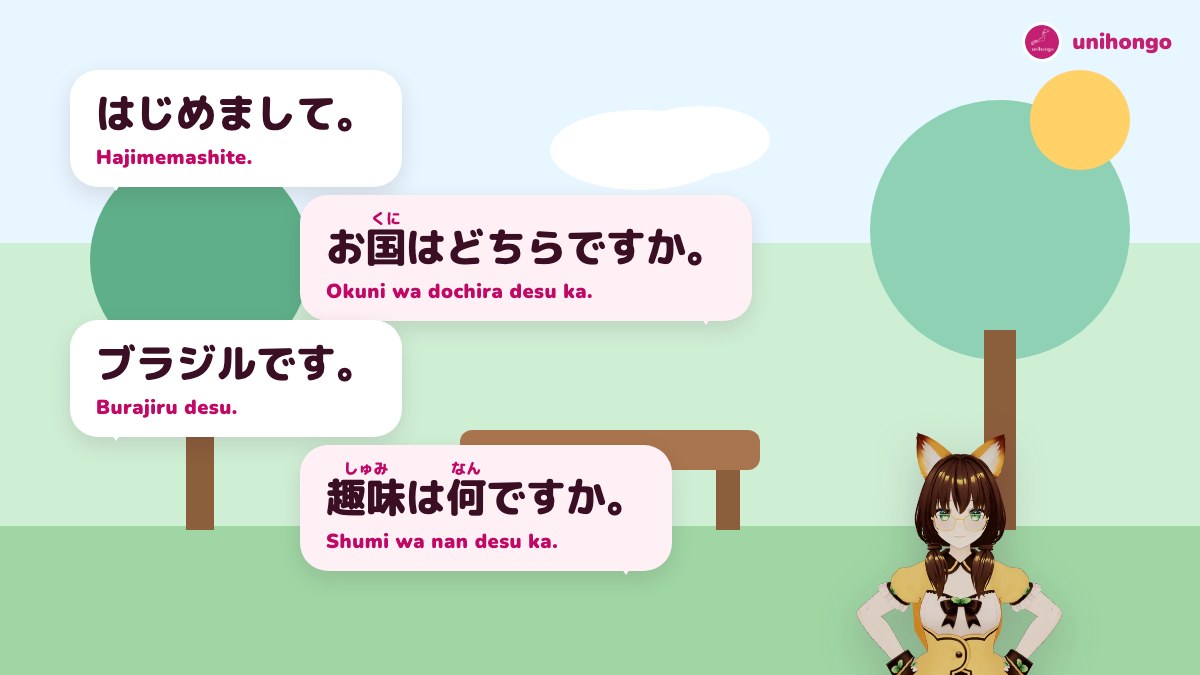
| Japanese | Romaji | Meaning |
|---|---|---|
| はじめまして。アナです。 | Hajimemashite. Ana desu. | Ana: Nice to meet you. I'm Ana. |
| はじめまして。お国はどちらですか。 | Hajimemashite. Okuni wa dochira desu ka. | You: Nice to meet you. Where are you from? |
| ブラジルです。 | Burajiru desu. | Ana: Brazil. |
| そうですか。趣味は何ですか。 | Sō desu ka. Shumi wa nan desu ka. | You: I see. What are your hobbies? |
| 料理です。あなたは? | Ryōri desu. Anata wa? | Ana: Cooking. And you? |
| 写真です。よろしくお願いします。 | Shashin desu. Yoroshiku onegai shimasu. | You: Photography. I look forward to knowing you. |
Common mistakes with nationalities and languages
- Saying アメリカ語 or イギリス語. The language is 英語, whatever the country.
- Adding さん to your own name: アナさんです when Ana introduces herself. Say just your name: アナです.
- Using を with できます: ポルトガル語をできます. できます takes が: ポルトガル語ができます.
- Using ぜんぜん with a positive in polite speech: ぜんぜんわかります. Keep it with a negative: ぜんぜんわかりません.
- Using に for the language you speak in: 日本語に話します. Use で: 日本語で話します.
A read-aloud routine for this text
- Say the country, nationality and language words in sets: Burajiru, Burajirujin, Porutogarugo.
- Read the text slowly, giving katakana words their full Japanese rhythm: Po-ru-to-ga-ru-go has six beats.
- Read at natural speed. The past sentences (met, went, sang, took) and present sentences (likes, can, speaks) should sound equally smooth.
- Replace Ana with a real or imagined friend and read it again with new details.
- Introduce yourself aloud as Ana does in the dialogue: name, country, hobby, よろしくお願いします.
Katakana names of countries can feel strange to say with Japanese rhythm, but it helps people understand you. Saying Brazil the English way inside a Japanese sentence is often harder to catch than Burajiru.
Rehearse your next first meeting
- Paste the sentence that confused you most into Mocchi, Unihongo's study assistant, with /explain; 友達ができました is a good one to start with. Mocchi remembers what you asked, so later reviews can check you still know it.
- Ask Mocchi for /read and a new N5 text about meeting someone from another country, to see 〜人 and 〜語 in a fresh setting.
- Then open AI Sensei, choose Ibuki-sensei and ask Ibuki-sensei to play a new classmate at a language school. Introduce yourself, ask where she is from and about her hobbies, and retell Ana's story to her at the end.