

The story: 引っ越しの日
Read the text once from start to finish. The narrator has just moved to a new flat and writes about the day in polite style.
The text moves through one day, so pay attention to the time words at the start of the sentences: 朝, 午後, 夕方 and 夜. If you can say what happened in each part of the day after the first reading, your comprehension is already good, even if some words are still unclear.
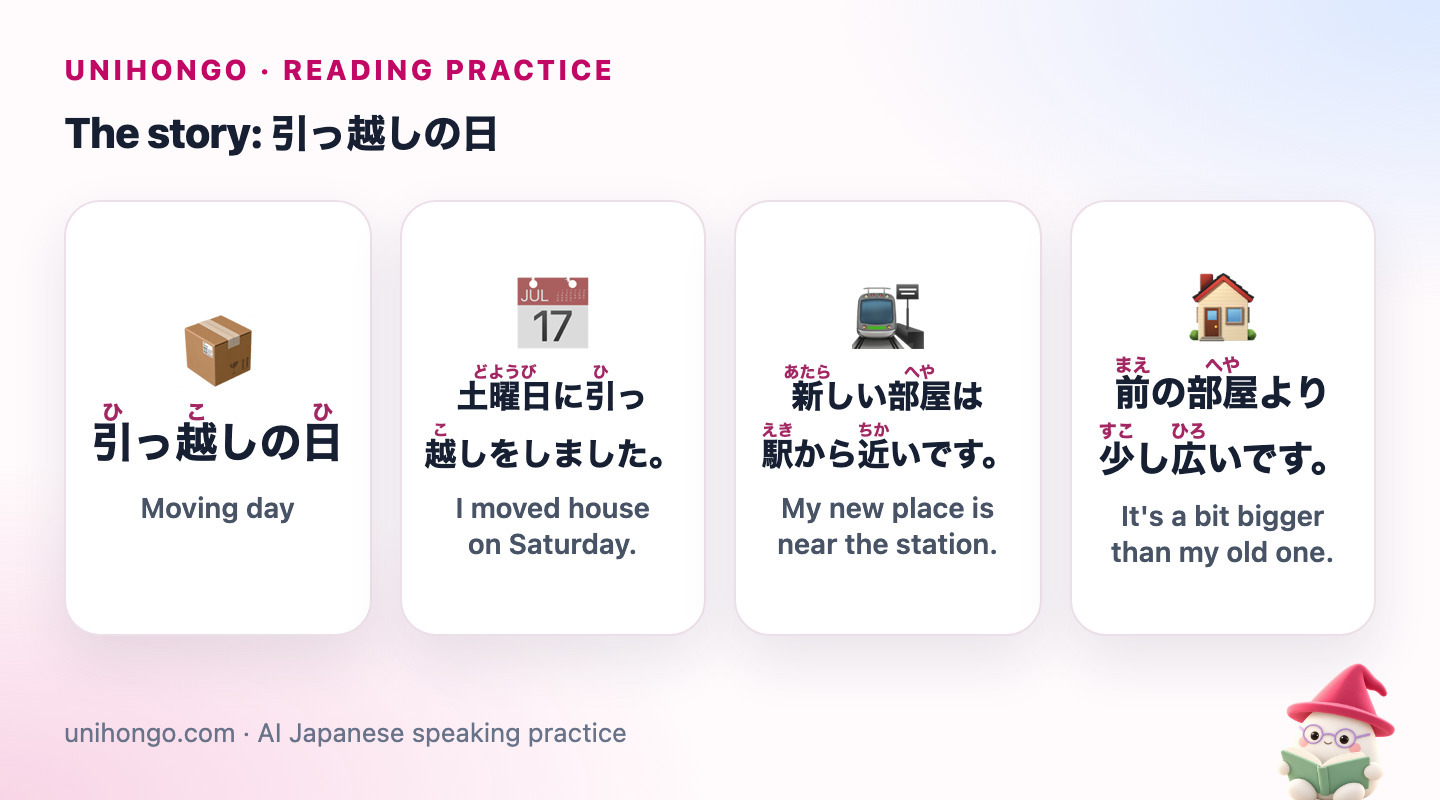
| Japanese | Romaji | Meaning |
|---|---|---|
| 引っ越しの日 | Hikkoshi no hi | Moving day |
| 土曜日に引っ越しをしました。 | Doyōbi ni hikkoshi o shimashita. | I moved house on Saturday. |
| 新しい部屋は駅から近いです。 | Atarashii heya wa eki kara chikai desu. | My new place is near the station. |
| 前の部屋より少し広いです。 | Mae no heya yori sukoshi hiroi desu. | It's a bit bigger than my old one. |
| 朝九時に引っ越し屋さんが来て、荷物を運んでくれました。 | Asa kuji ni hikkoshiya-san ga kite, nimotsu o hakonde kuremashita. | The movers came at nine and carried my things. |
| 箱がたくさんあったので、二時間ぐらいかかりました。 | Hako ga takusan atta node, nijikan gurai kakarimashita. | There were a lot of boxes, so it took about two hours. |
| 一人で引っ越しをするのは初めてでした。 | Hitori de hikkoshi o suru no wa hajimete deshita. | It was my first time moving on my own. |
| 午後は箱を開けて、服や本を片付けました。 | Gogo wa hako o akete, fuku ya hon o katazukemashita. | In the afternoon I opened boxes and put away clothes and books. |
| でも、カーテンを買うのを忘れていました。 | Demo, kāten o kau no o wasurete imashita. | But I had forgotten to buy curtains. |
| 近くのホームセンターに行って、カーテンと電気を買いました。 | Chikaku no hōmu sentā ni itte, kāten to denki o kaimashita. | I went to a DIY store nearby and bought curtains and a light. |
| 夕方、大家さんにあいさつに行きました。 | Yūgata, ōya-san ni aisatsu ni ikimashita. | In the early evening, I went to say hello to the landlord. |
| 大家さんはごみの出し方の紙をくれました。 | Ōya-san wa gomi no dashikata no kami o kuremashita. | The landlord gave me a sheet on how to put out rubbish. |
| 燃えるごみは月曜日と木曜日に出すそうです。 | Moeru gomi wa getsuyōbi to mokuyōbi ni dasu sō desu. | Burnable rubbish goes out on Mondays and Thursdays, it says. |
| 夜はとても疲れていたので、コンビニのお弁当を食べました。 | Yoru wa totemo tsukarete ita node, konbini no obentō o tabemashita. | I was exhausted by evening, so I ate a konbini bento. |
| まだ箱が五つ残っていますが、明日片付けようと思います。 | Mada hako ga itsutsu nokotte imasu ga, ashita katazukeyō to omoimasu. | Five boxes are still left, but I'll sort them out tomorrow. |
| この部屋で新しい生活が始まります。 | Kono heya de atarashii seikatsu ga hajimarimasu. | A new life begins in this room. |
Vocabulary notes
Most of these words appear on real moving-day paperwork and in conversations with landlords and neighbours.
| Japanese | Romaji | Meaning |
|---|---|---|
| 引っ越し | hikkoshi | moving house |
| 引っ越し屋さん | hikkoshiya-san | movers, a removal company |
| 荷物 | nimotsu | luggage, belongings |
| 運ぶ | hakobu | to carry, to transport |
| 片付ける | katazukeru | to tidy up, to put away |
| ホームセンター | hōmu sentā | DIY and household goods store |
| 大家さん | ōya-san | landlord or landlady |
| 出し方 | dashikata | how to put out (rubbish) |
| 燃えるごみ | moeru gomi | burnable rubbish |
| 残る | nokoru | to remain, to be left |
電気 usually means electricity, but in everyday speech it also means the lights: 電気をつけて, turn on the light. In this story the narrator buys a ceiling light fitting, which the Japanese simply call 電気 at home. And 屋さん after a noun turns it into a shop or a trade: 引っ越し屋さん, movers; パン屋さん, bakery.
Grammar notes: chains, reasons, first times and plans
The story is a chain of actions, so the て form does a lot of work. The other three patterns give reasons, firsts and plans.
| Japanese | Romaji | Meaning |
|---|---|---|
| 箱を開けて、服や本を片付けました。 | Hako o akete, fuku ya hon o katazukemashita. | From the text: I opened boxes and put away clothes and books. |
| シャワーを浴びて、すぐ寝ました。 | Shawā o abite, sugu nemashita. | I took a shower and went straight to bed. |
| 箱がたくさんあったので、二時間ぐらいかかりました。 | Hako ga takusan atta node, nijikan gurai kakarimashita. | From the text: There were many boxes, so it took two hours. |
| 道が混んでいたので、遅れました。 | Michi ga konde ita node, okuremashita. | The roads were busy, so I was late. |
| 一人で引っ越しをするのは初めてでした。 | Hitori de hikkoshi o suru no wa hajimete deshita. | From the text: Moving alone was a first for me. |
| 日本で運転するのは初めてです。 | Nihon de unten suru no wa hajimete desu. | It's my first time driving in Japan. |
| 明日片付けようと思います。 | Ashita katazukeyō to omoimasu. | From the text: I'll sort them out tomorrow. |
| 週末に家具を買おうと思います。 | Shūmatsu ni kagu o kaō to omoimasu. | I'm thinking of buying furniture at the weekend. |
One more pattern hides in sentence 8: カーテンを買うのを忘れていました. Here の turns 買う into a noun phrase, the buying of curtains, which becomes the object of 忘れる. The ていました form tells you the forgetting had already happened before the narrator noticed.
Real moving-day tasks in Japanese
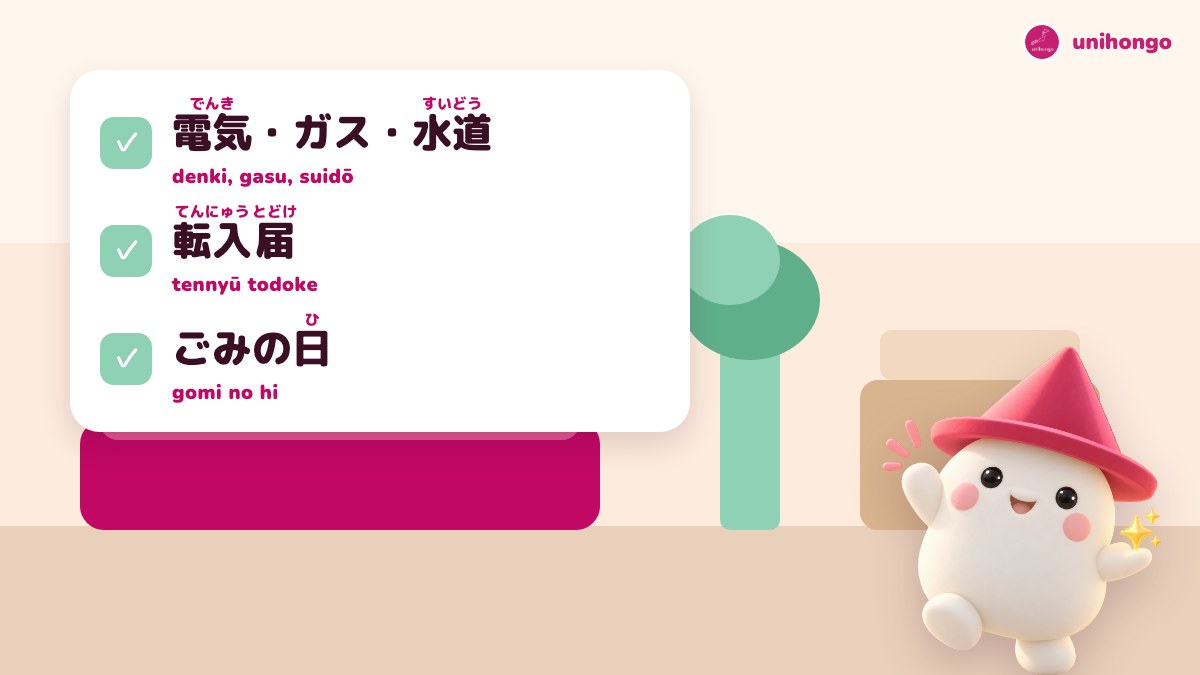
The story skips the paperwork, but real moves in Japan come with a small checklist. Utilities need to be started: electricity and water can often be arranged online or by phone, while gas usually needs a technician to visit and open the supply with you at home. If you move to a different city or ward, you normally file a moving-in notice, 転入届, at the new city office within 14 days. Rules and services differ by area, so check your city's website.
Then there is rubbish. Most areas give out a calendar or leaflet showing which day each type is collected. Ask early: putting rubbish out on the wrong day is a common first-week mistake and the quickest way to get a polite note on the door.
| Japanese | Romaji | Meaning |
|---|---|---|
| ガスの開栓をお願いしたいんですが。 | Gasu no kaisen o onegai shitai n desu ga. | I'd like to have the gas turned on. |
| 転入届を出したいです。 | Tennyū todoke o dashitai desu. | I'd like to file a moving-in notice. |
| 燃えるごみは何曜日ですか。 | Moeru gomi wa nan'yōbi desu ka. | Which day is burnable rubbish collected? |
| この箱は台所にお願いします。 | Kono hako wa daidokoro ni onegai shimasu. | This box goes in the kitchen, please. |
| ベッドは奥の部屋に置いてください。 | Beddo wa oku no heya ni oite kudasai. | Please put the bed in the back room. |
Reading traps in this text
- 引っ越し屋さんが来て、荷物を運んでくれました has one subject for both verbs. The て form keeps the same subject until a new が appears.
- 一人で引っ越しをするのは初めてでした has no person as its subject. The whole の clause is the topic: moving on my own was a first.
- カーテンを買うのを忘れていました contains two を. The first belongs to 買う, the second to 忘れる. Read from the inside out.
- ごみの出し方の紙 chains two の: a sheet about how to put out rubbish. の can link nouns in many loose ways, so let the context decide.
- 出すそうです here reports what the leaflet says, not what a person said. 〜そうです works for written information too.
Check your understanding
Three questions about the story. The answers follow.
- Why did moving the boxes take about two hours?
- What had the narrator forgotten to buy?
- What does the narrator plan to do tomorrow?
Answers
| Japanese | Romaji | Meaning |
|---|---|---|
| 箱がたくさんあったからです。 | Hako ga takusan atta kara desu. | 1. Because there were a lot of boxes. |
| カーテンです。 | Kāten desu. | 2. Curtains. |
| 残っている箱を片付けようと思っています。 | Nokotte iru hako o katazukeyō to omotte imasu. | 3. They plan to unpack the remaining boxes. |
In answer 3, 残っている箱 is another plain-form verb describing a noun: the boxes that remain. Building answers like this is good practice for the N4 reading section, where the correct choice often paraphrases the text rather than copying it.
Read it aloud in four scenes
- Scene 1, morning (sentences 1 to 6): read slowly and keep 引っ越し with a clear small っ: hik-koshi.
- Scene 2, afternoon (7 to 9): practise the long vowels in kāten and hōmu sentā.
- Scene 3, evening (10 to 12): read ōya-san with a long o and keep 曜日 as yōbi.
- Scene 4, night (13 to 15): finish with a calm, slightly lower voice, as if you were writing in a diary.
- Now read all four scenes without stopping, then retell the day in four sentences.
Make the moving words stick
The fastest way to keep this vocabulary is to use it in sentences about your own home. Tell Mocchi on Unihongo: /read give me a short N4 text about cleaning a new room, then quiz me on 片付ける, 運ぶ and 残る. Mocchi writes a fresh text at your level, asks a few questions, and keeps track of the words you got wrong so they come back in later reviews.
For quick repetition, add the ten words in this post to your own flashcards and play them in Kotoba Stack on the games page. Seeing 大家さん and 燃えるごみ fall in a game a few times a week is a light way to make them automatic.