

The text: カレーの作り方 (How to make curry)
Read the text once without the English and count the steps. How many separate actions are there between cutting the vegetables and eating?
| Japanese | Romaji | Meaning |
|---|---|---|
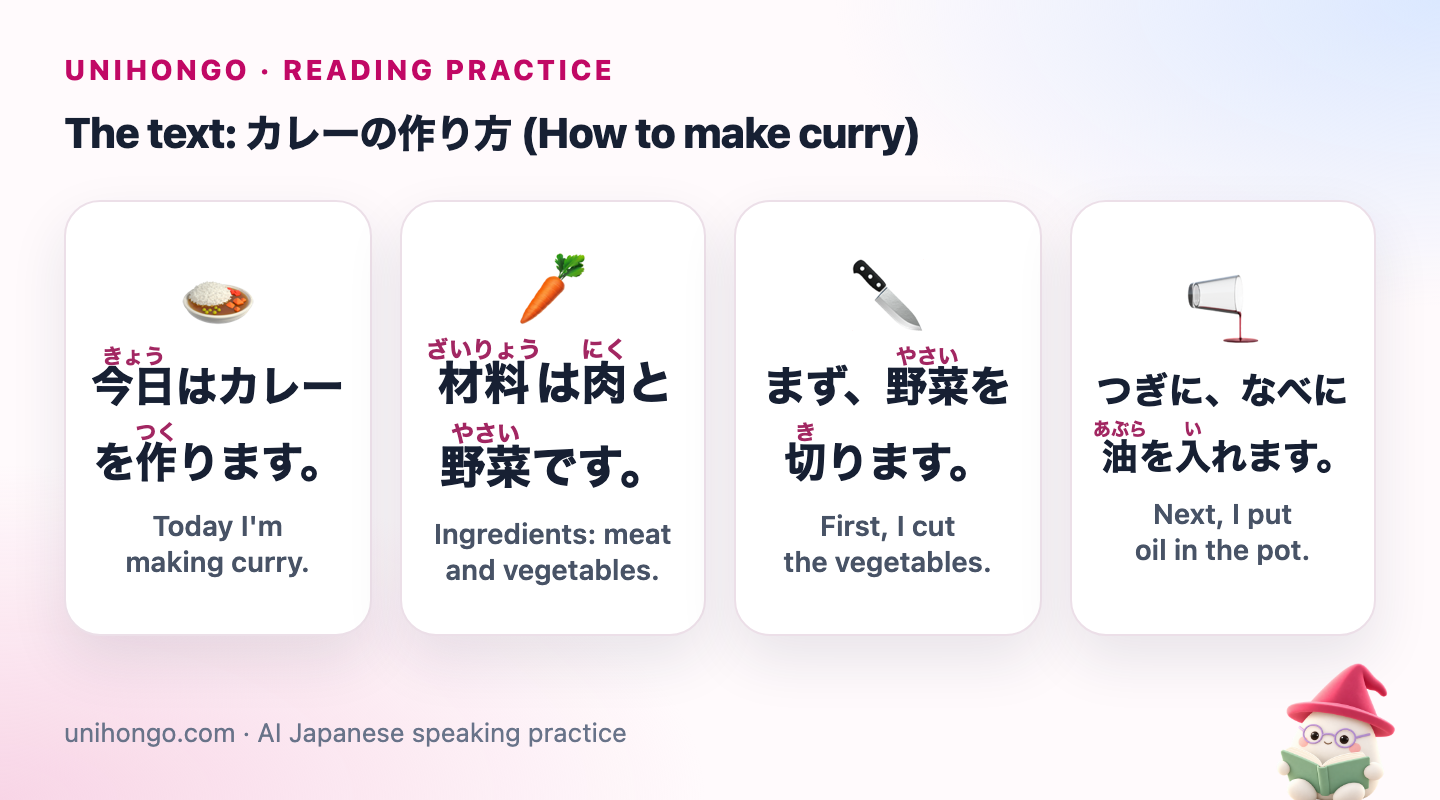
| 今日はカレーを作ります。 | Kyō wa karē o tsukurimasu. | Today I'm making curry. |
| 材料は肉と野菜です。 | Zairyō wa niku to yasai desu. | Ingredients: meat and vegetables. |
| まず、野菜を切ります。 | Mazu, yasai o kirimasu. | First, I cut the vegetables. |
| つぎに、なべに油を入れます。 | Tsugi ni, nabe ni abura o iremasu. | Next, I put oil in the pot. |
| 野菜はじゃがいもとにんじんと玉ねぎです。 | Yasai wa jagaimo to ninjin to tamanegi desu. | The vegetables are potatoes, carrots and onions. |
| 肉と野菜をなべに入れます。 | Niku to yasai o nabe ni iremasu. | I put the meat and vegetables in the pot. |
| 五分ぐらい炒めます。 | Gofun gurai itamemasu. | I stir-fry them for about five minutes. |
| それから、水を入れます。 | Sore kara, mizu o iremasu. | Then I add water. |
| 二十分ぐらい待ちます。 | Nijuppun gurai machimasu. | I wait about twenty minutes. |
| つぎに、カレーのルーを入れます。 | Tsugi ni, karē no rū o iremasu. | Next, I add the curry roux. |
| ゆっくりまぜます。 | Yukkuri mazemasu. | I stir it slowly. |
| 最後に、ごはんの上にかけます。 | Saigo ni, gohan no ue ni kakemasu. | Finally, I pour it over rice. |
| 家族は「おいしい!」と言います。 | Kazoku wa 'Oishii!' to iimasu. | My family says, 'Delicious!' |
| カレーは簡単で、おいしいです。 | Karē wa kantan de, oishii desu. | Curry is easy and tasty. |
The text is written as the writer's own cooking, so the verbs are plain ます forms: I cut, I add. A printed recipe would often use the same forms or the even shorter dictionary form (切る, 入れる), and you can read both the same way.
Vocabulary notes: kitchen words
These are the words you will see on the back of a box of curry roux and in most simple recipes.
| Japanese | Romaji | Meaning |
|---|---|---|
| 材料 | zairyō | ingredients (N4) |
| 肉 | niku | meat |
| じゃがいも | jagaimo | potato |
| にんじん | ninjin | carrot |
| 玉ねぎ | tamanegi | onion |
| なべ | nabe | pot, saucepan |
| 油 | abura | oil (for cooking) |
| 切ります | kirimasu | to cut |
| 炒めます | itamemasu | to stir-fry (above N5, but in every recipe) |
| まぜます | mazemasu | to stir, to mix |
| かけます | kakemasu | to pour over |
| 簡単 | kantan | easy, simple (a な-adjective) |
Japanese home curry often uses pork, beef or chicken depending on the region and family, so 肉 on its own is a fair description. If you want to be specific: 豚肉 (butaniku, pork), 牛肉 (gyūniku, beef), 鶏肉 (toriniku, chicken).
Grammar notes: four patterns in the text
Each pattern is shown with its line from the text and one new example from a different kitchen task.
| Japanese | Romaji | Meaning |
|---|---|---|
| まず、野菜を切ります。 | Mazu, yasai o kirimasu. | まず / つぎに / 最後に: sequence. (text) |
| まず、お湯をわかします。 | Mazu, oyu o wakashimasu. | First, boil some water. (new example) |
| 肉と野菜をなべに入れます。 | Niku to yasai o nabe ni iremasu. | A を B に 入れます: put A into B. (text) |
| さとうをコーヒーに入れます。 | Satō o kōhī ni iremasu. | I put sugar in my coffee. (new example) |
| 二十分ぐらい待ちます。 | Nijuppun gurai machimasu. | Amount + ぐらい: about. (text) |
| 三分ぐらい待ちます。 | Sanpun gurai machimasu. | Wait about three minutes. (new example) |
| 簡単で、おいしいです。 | Kantan de, oishii desu. | な-adjective + で: and. (text) |
| この店は安くて、おいしいです。 | Kono mise wa yasukute, oishii desu. | This shop is cheap and good. (new example) |
The last pattern changes with the adjective type. な-adjectives and nouns join with で (簡単で, きれいで), while い-adjectives change い to くて (安い becomes 安くて). Saying 安いで is a very common learner mistake.
Notice 三分 is sanpun and 二十分 is nijuppun: the counter 分 changes its sound after some numbers. One, three, four, six, eight and ten are the ones to watch: ippun, sanpun, yonpun, roppun, happun, juppun.
Comprehension questions
Answer in Japanese with a short sentence.
- Which vegetables does the writer use?
- How long does the writer wait after adding water?
- What does the writer add after waiting?
| Japanese | Romaji | Meaning |
|---|---|---|
| じゃがいもとにんじんと玉ねぎです。 | Jagaimo to ninjin to tamanegi desu. | Answer 1: Potatoes, carrots and onions. |
| 二十分ぐらい待ちます。 | Nijuppun gurai machimasu. | Answer 2: About twenty minutes. |
| カレーのルーを入れます。 | Karē no rū o iremasu. | Answer 3: The curry roux. |
Question 3 tests the order of steps, which is exactly what sequence words are for. Look for つぎに right after the waiting step: that is your answer.
The recipe as a checklist
If you want to cook along, here are the steps as a checklist. Read each one aloud before you do it; narrating while you work is one of the most effective ways to make verbs automatic.
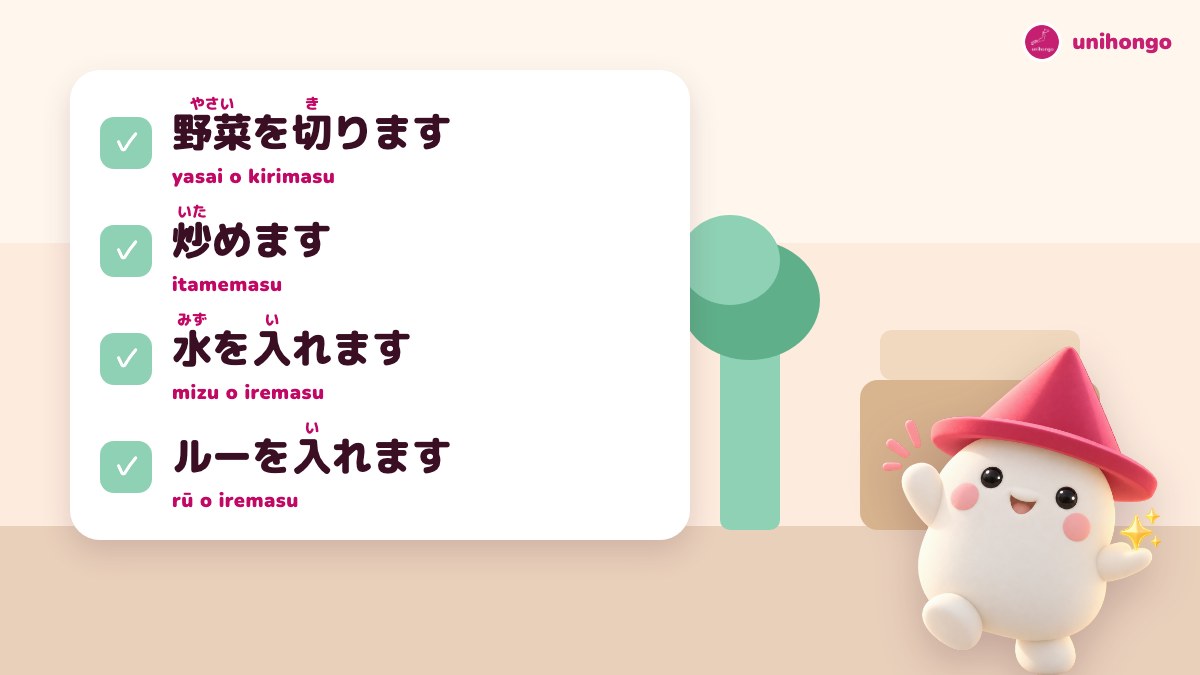
- まず: cut the potatoes, carrots and onions (野菜を切ります).
- つぎに: put oil in the pot, then stir-fry the meat and vegetables for about five minutes (炒めます).
- それから: add water and wait about twenty minutes (水を入れます, 待ちます).
- つぎに: add the roux and stir slowly (ルーを入れます, まぜます).
- 最後に: pour it over rice (ごはんの上にかけます).
Common mistakes in recipe Japanese
- Swapping the particles with 入れます: なべを油に入れます means put the pot into the oil. The thing goes with を and the container with に.
- Joining い-adjectives with で: 安いで、おいしい. い-adjectives use くて: 安くて、おいしい.
- Reading 二十分 as nijūfun. The counter 分 changes after some numbers: nijuppun.
- Using ごろ for lengths of time: 二十分ごろ待ちます. Use ぐらい for amounts and durations, and ごろ for points in time.
- Saying さいごで for finally. The set phrase is 最後に, saigo ni.
A read-aloud routine for this text
- Read the sequence words alone, in order: mazu, tsugi ni, sore kara, tsugi ni, saigo ni.
- Read the text slowly while miming each action: cutting, pouring, stirring.
- Read at natural speed, pausing briefly after each sequence word and comma.
- Change the dish: read the text again as if making soup or stew, swapping the ingredients.
- Explain how to make a dish you know in six steps, aloud and without notes.
Karē and rū both have long vowels, written in katakana with the long mark ー. Keeping them long makes these loanwords sound Japanese rather than English.
Cook along with Mocchi
When a step is unclear, ask Mocchi, Unihongo's study assistant, to /explain it; /explain 最後に、ごはんの上にかけます, for example, gets you each word, the particles and the verb かけます in other uses, such as putting soy sauce on food. Then ask for /read with a new N5 recipe, maybe onigiri or miso soup, and see how many of the same verbs come back. Mocchi keeps a note of the verbs you forget so that a later quiz can return to them.
To practise the steps aloud, AI Sensei works well: ask Yamada-sensei to play a friend who has never made curry and explain the recipe to Yamada-sensei step by step, using まず, つぎに and 最後に.